Thank you for visiting SNEWPapers!
Sign up free
Editorial
June 8, 1871
The Anderson Intelligencer
Anderson, Anderson County, South Carolina
What is this article about?
Editorial advocating for Anderson County, South Carolina, to subscribe $250,000-$300,000 in bonds to the Atlanta and Richmond Air Line Railway stock. It details the project's history from pre-war origins, post-war revival with Northern capital, route changes, and competing subscriptions by other counties. Emphasizes economic benefits, property value increase, and future dividends to offset costs, urging attendance at a June 13 meeting.
Clipping
OCR Quality
95%
Excellent
Full Text
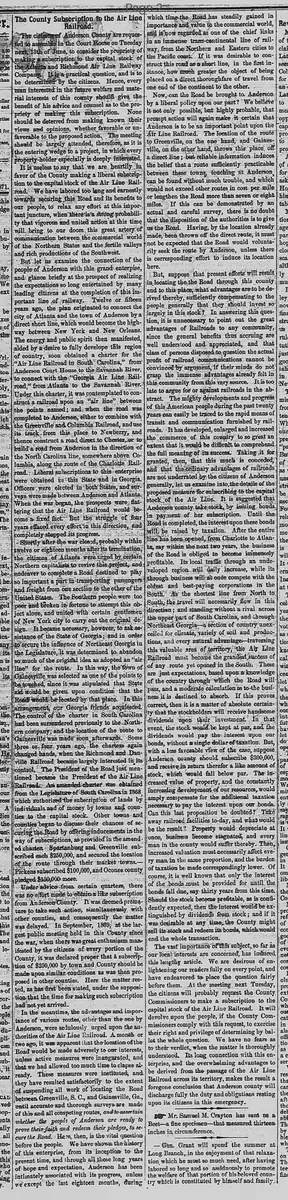
The County Subscription to the Air Line Railroad.
The citizens of Anderson County are requested to assemble in the Court House on Tuesday next, 13th of June, to consider the propriety of making subscription to the capital stock of the Atlanta and Richmond Air Line Railway Company. It is a practical question, and is to be determined by the citizens. Hence, every man interested in the future welfare and material interests of this county should give the benefit of his advice and counsel as to the propriety of making this subscription. None should be deterred from making known their views and opinions, whether favorable or unfavorable to the proposed action. The meeting should be largely attended, therefore, as it is the entering wedge to a project, in which every property-holder especially is deeply interested.
It is useless to say that we are heartily in favor of the County making a liberal subscription to the capital stock of the Air Line Railroad. We have labored too long and earnestly towards securing this Road and its benefits to our people, to relax any effort at this important juncture, when there is a strong probability that vigorous and united action at this time will bring to our doors this great artery of communication between the commercial world of the Northern States and the fertile valleys and rich productions of the Southwest.
But let us examine the connection of the people of Anderson with this grand enterprise, and glance briefly at the prospect of realizing the expectations so long entertained by many leading citizens at the completion of this important line of railway. Twelve or fifteen years ago, the plan originated to connect the city of Atlanta and the town of Anderson by a direct short line, which would become the highway between New York and New Orleans. The energy and public spirit then manifested, aided by a desire to fully develop this region of country, soon obtained a charter for the 'Air Line Railroad in South Carolina,' from Anderson Court House to the Savannah River, to connect with the 'Georgia Air Line Railroad,' from Atlanta to the Savannah River.
Under this charter, it was contemplated to construct a railroad upon an 'air line' between the points named; and when the road was completed to Anderson, either to combine with the Greenville and Columbia Railroad, and use its track from this place to Newberry, and thence construct a road direct to Chester, or to build a road from Anderson in the direction of the North Carolina line, somewhere above Columbia, along the route of the Charlotte Railroad. Liberal subscriptions to this enterprise were obtained in this State and in Georgia. Officers were elected in both States, and surveys were made between Anderson and Atlanta.
When the war began, the prospects were flattering that the Air Line Railroad would become a fixed fact. But the struggle of four years effaced every effort in this direction, and completely stopped its progress.
Shortly after the war closed, probably within twelve or eighteen months after its termination, the citizens of Atlanta were urged by certain Northern capitalists to revive this project; and endeavor to complete a Road destined to play so important a part in transporting passengers and freight from one section to the other of the United States. The Southern people were too poor and broken in fortune to attempt this object alone, and united with certain gentlemen of New York city to carry out the original design. It became necessary, however, to ask assistance of the State of Georgia; and in order to secure the influence of Northeast Georgia in the Legislature, it was determined to abandon so much of the original idea as adopted an 'air line' for the route. In this way, the town of Gainesville was selected as one of the points to be touched, since it was stipulated that State aid would be given upon condition that the Road would be located by that place. In this arrangement, our Georgia friends acquiesced.
The control of the charter in South Carolina had been surrendered previously to the Northern company, and the location of the route to Gainesville was made soon afterwards. Some three or four years ago, the charters again changed hands, when the Richmond and Danville Railroad became largely interested in its control. The President of the Road just mentioned became the President of the Air Line Railroad. An amended charter was obtained from the Legislature of South Carolina in 1868, which authorized the subscription of lands by individuals and of money by towns and counties to the capital stock. Other towns and counties began to discuss their chances of securing the Road by offering inducements in the way of subscriptions, as provided in the amended charter. Spartanburg and Greenville subscribed each $250,000, and secured the location of the route through their market towns. Pickens subscribed $100,000, and Oconee county pledged $150,000 more.
Under advice from certain quarters, there was no effort made to obtain a like subscription from Anderson County. It was deemed premature to take such action, simultaneously with other counties, and consequently the matter was delayed. In September, 1869, at the largest public meeting held in this County since the war, when there was great enthusiasm manifested by the citizens of every portion of the County, it was declared proper that a subscription of $250,000 by town and County should be made upon similar conditions as was then proposed in other counties. Here the matter rested, as has first been stated, under the supposition that the time for making such subscription had not yet arrived.
In the meantime, the advantages and importance of various routes, other than the one by Anderson, were sedulously urged upon the authorities of the Air Line Railroad. A month or two ago, it was apparent that the location of the Road would be made adversely to our interests, unless active measures were inaugurated, and that we had allowed too much time to elapse already. These measures were instituted; and they have resulted satisfactorily to the extent of suspending all work of locating the Road between Greenville, S. C., and Gainesville, Ga., until accurate and thorough surveys are made of this and all competing routes, and to ascertain whether the people of Anderson are ready to prove their faith and redeem their pledges, to secure the Road. Here, then, is the vital question before the people. We have shown the history of this enterprise, from its inception to the present time, and through all these long years of hope and expectation, Anderson has been intimately associated with its progress, unless we except the last eighteen months, during which time the Road has steadily gained in importance and value to the commercial world, and is now regarded as one of the chief links in an immense trans-continental line of railway from the Northern and Eastern cities to the Pacific coast.
If it was desirable to construct this road as a short line, in the first instance, how much greater the object of being placed on a direct thoroughfare of travel from one end of the continent to the other.
Now, can the Road be brought to Anderson by a liberal policy upon our part? We believe it not only possible, but highly probable, that prompt action will again make it certain that Anderson is to be an important point upon the Air Line Railroad. The location of the route to Greenville, on the one hand, and Gainesville, on the other hand, throws this place off a direct line; but reliable information induces the belief that a route sufficiently practicable between these towns, touching at Anderson, can be found without much trouble, and which would not exceed other routes in cost per mile or lengthen the Road more than seven or eight miles. If this can be demonstrated by an actual and careful survey, there is no doubt that the disposition of the authorities is to give us the Road. Having, by the location already made, been thrown off the direct route, it must not be expected that the Road would voluntarily seek the route by Anderson, unless there is corresponding effort to induce its location here.
But, suppose that present efforts will result in locating the Road through this county and to this place; what advantages are to be derived thereby, sufficiently compensating to the people generally that they should invest so largely in this stock? In answering this question, it is unnecessary to point out the great advantages of Railroads to any community, since the general benefits thus accruing are well understood and appreciated, and that class of persons disposed to question the actual profit of railroad communications cannot be convinced by argument, if their minds do not grasp the immense advantages already felt in this community from this very source. It is too late to argue for or against railroads in the abstract. The mighty developments and progress of this American people during the past twenty years can easily be traced to the rapid means of transit and communication furnished by railroads. It has developed, enlarged and increased the commerce of this country to so great an extent that it would be difficult to comprehend the full meaning of its success. Taking it for granted, then, that this much is conceded, and that the ordinary advantages of railroads are not underrated by the citizens of Anderson generally, let us examine into the details of the proposed measure for subscribing to the capital stock of the Air Line. It is suggested that Anderson county take stock, by issuing bonds in payment of her subscription. Until the Road is completed, the interest upon these bonds will be raised by taxation. After the entire line has been opened, from Charlotte to Atlanta, say within the next two years, the business of the Road is obliged to become immensely profitable. Its local traffic through an undeveloped region will daily increase, while its through-business will at once compete with the oldest and best-paying corporations in the South. As the shortest line from North to South, the travel will necessarily flow in this direction: and standing without a rival across the upper part of South Carolina, and through Northeast Georgia—a section of country unequalled for climate, variety of soil and productions, and every natural advantage—traversing this valuable area of territory, the Air Line Railroad must become the grandest success of any route yet opened in the South. These are just expectations; based upon a knowledge of the country through which the Road will pass, and a moderate calculation as to the business it is destined to absorb. If this proves correct, then it is a matter of absolute certainty that the stockholders will receive handsome dividends upon their investment. In that event, the stock would be kept at par, and the dividends would pay the interest upon our bonds, without a single dollar of taxation. But, with a less favorable view of the case, suppose Anderson county should subscribe $300,000, and receive in return therefor a like amount of stock, which would fall below par. The increased value of property, and the constantly increasing development of our resources, would amply compensate for the additional taxation necessary to pay the interest upon our bonds.
Can this last proposition be doubted? Take away railroad facilities to-day, and what would be the result? Property would depreciate at once, business become stagnated, and every man in the county would suffer thereby. Then, increased valuation must necessarily affect every man in the same proportion, and the burden of taxation be made correspondingly lower. Of course, it is well known that only the interest of the bonds must be provided for until the bonds fall due, say thirty years from this time. Should the stock become profitable, as is confidently expected, then the interest would be extinguished by dividends from stock; and if it was desirable at any time, the County might sell its stock and redeem its bonds, which would end the whole transaction.
The vast importance of this subject, so far as our local interests are concerned, has induced this lengthy article. We are desirous of enlightening our readers fully on every point, and have endeavored to place the question fairly before them. At the meeting next Tuesday, the citizens will probably request the County Commissioners to make a subscription to the capital stock of the Air Line Railroad. It will devolve upon the people, if the County Commissioners comply with this request, to exercise their right and privilege of determining by ballot the whole question. We have no fears as to their verdict, when the matter is thoroughly understood. Its long connection with this enterprise, and the overwhelming advantages to be derived from the passage of the Air Line Railroad across its territory, makes the result a foregone conclusion that Anderson county will discharge fully the duty and obligations resting upon its citizens in this emergency.
The citizens of Anderson County are requested to assemble in the Court House on Tuesday next, 13th of June, to consider the propriety of making subscription to the capital stock of the Atlanta and Richmond Air Line Railway Company. It is a practical question, and is to be determined by the citizens. Hence, every man interested in the future welfare and material interests of this county should give the benefit of his advice and counsel as to the propriety of making this subscription. None should be deterred from making known their views and opinions, whether favorable or unfavorable to the proposed action. The meeting should be largely attended, therefore, as it is the entering wedge to a project, in which every property-holder especially is deeply interested.
It is useless to say that we are heartily in favor of the County making a liberal subscription to the capital stock of the Air Line Railroad. We have labored too long and earnestly towards securing this Road and its benefits to our people, to relax any effort at this important juncture, when there is a strong probability that vigorous and united action at this time will bring to our doors this great artery of communication between the commercial world of the Northern States and the fertile valleys and rich productions of the Southwest.
But let us examine the connection of the people of Anderson with this grand enterprise, and glance briefly at the prospect of realizing the expectations so long entertained by many leading citizens at the completion of this important line of railway. Twelve or fifteen years ago, the plan originated to connect the city of Atlanta and the town of Anderson by a direct short line, which would become the highway between New York and New Orleans. The energy and public spirit then manifested, aided by a desire to fully develop this region of country, soon obtained a charter for the 'Air Line Railroad in South Carolina,' from Anderson Court House to the Savannah River, to connect with the 'Georgia Air Line Railroad,' from Atlanta to the Savannah River.
Under this charter, it was contemplated to construct a railroad upon an 'air line' between the points named; and when the road was completed to Anderson, either to combine with the Greenville and Columbia Railroad, and use its track from this place to Newberry, and thence construct a road direct to Chester, or to build a road from Anderson in the direction of the North Carolina line, somewhere above Columbia, along the route of the Charlotte Railroad. Liberal subscriptions to this enterprise were obtained in this State and in Georgia. Officers were elected in both States, and surveys were made between Anderson and Atlanta.
When the war began, the prospects were flattering that the Air Line Railroad would become a fixed fact. But the struggle of four years effaced every effort in this direction, and completely stopped its progress.
Shortly after the war closed, probably within twelve or eighteen months after its termination, the citizens of Atlanta were urged by certain Northern capitalists to revive this project; and endeavor to complete a Road destined to play so important a part in transporting passengers and freight from one section to the other of the United States. The Southern people were too poor and broken in fortune to attempt this object alone, and united with certain gentlemen of New York city to carry out the original design. It became necessary, however, to ask assistance of the State of Georgia; and in order to secure the influence of Northeast Georgia in the Legislature, it was determined to abandon so much of the original idea as adopted an 'air line' for the route. In this way, the town of Gainesville was selected as one of the points to be touched, since it was stipulated that State aid would be given upon condition that the Road would be located by that place. In this arrangement, our Georgia friends acquiesced.
The control of the charter in South Carolina had been surrendered previously to the Northern company, and the location of the route to Gainesville was made soon afterwards. Some three or four years ago, the charters again changed hands, when the Richmond and Danville Railroad became largely interested in its control. The President of the Road just mentioned became the President of the Air Line Railroad. An amended charter was obtained from the Legislature of South Carolina in 1868, which authorized the subscription of lands by individuals and of money by towns and counties to the capital stock. Other towns and counties began to discuss their chances of securing the Road by offering inducements in the way of subscriptions, as provided in the amended charter. Spartanburg and Greenville subscribed each $250,000, and secured the location of the route through their market towns. Pickens subscribed $100,000, and Oconee county pledged $150,000 more.
Under advice from certain quarters, there was no effort made to obtain a like subscription from Anderson County. It was deemed premature to take such action, simultaneously with other counties, and consequently the matter was delayed. In September, 1869, at the largest public meeting held in this County since the war, when there was great enthusiasm manifested by the citizens of every portion of the County, it was declared proper that a subscription of $250,000 by town and County should be made upon similar conditions as was then proposed in other counties. Here the matter rested, as has first been stated, under the supposition that the time for making such subscription had not yet arrived.
In the meantime, the advantages and importance of various routes, other than the one by Anderson, were sedulously urged upon the authorities of the Air Line Railroad. A month or two ago, it was apparent that the location of the Road would be made adversely to our interests, unless active measures were inaugurated, and that we had allowed too much time to elapse already. These measures were instituted; and they have resulted satisfactorily to the extent of suspending all work of locating the Road between Greenville, S. C., and Gainesville, Ga., until accurate and thorough surveys are made of this and all competing routes, and to ascertain whether the people of Anderson are ready to prove their faith and redeem their pledges, to secure the Road. Here, then, is the vital question before the people. We have shown the history of this enterprise, from its inception to the present time, and through all these long years of hope and expectation, Anderson has been intimately associated with its progress, unless we except the last eighteen months, during which time the Road has steadily gained in importance and value to the commercial world, and is now regarded as one of the chief links in an immense trans-continental line of railway from the Northern and Eastern cities to the Pacific coast.
If it was desirable to construct this road as a short line, in the first instance, how much greater the object of being placed on a direct thoroughfare of travel from one end of the continent to the other.
Now, can the Road be brought to Anderson by a liberal policy upon our part? We believe it not only possible, but highly probable, that prompt action will again make it certain that Anderson is to be an important point upon the Air Line Railroad. The location of the route to Greenville, on the one hand, and Gainesville, on the other hand, throws this place off a direct line; but reliable information induces the belief that a route sufficiently practicable between these towns, touching at Anderson, can be found without much trouble, and which would not exceed other routes in cost per mile or lengthen the Road more than seven or eight miles. If this can be demonstrated by an actual and careful survey, there is no doubt that the disposition of the authorities is to give us the Road. Having, by the location already made, been thrown off the direct route, it must not be expected that the Road would voluntarily seek the route by Anderson, unless there is corresponding effort to induce its location here.
But, suppose that present efforts will result in locating the Road through this county and to this place; what advantages are to be derived thereby, sufficiently compensating to the people generally that they should invest so largely in this stock? In answering this question, it is unnecessary to point out the great advantages of Railroads to any community, since the general benefits thus accruing are well understood and appreciated, and that class of persons disposed to question the actual profit of railroad communications cannot be convinced by argument, if their minds do not grasp the immense advantages already felt in this community from this very source. It is too late to argue for or against railroads in the abstract. The mighty developments and progress of this American people during the past twenty years can easily be traced to the rapid means of transit and communication furnished by railroads. It has developed, enlarged and increased the commerce of this country to so great an extent that it would be difficult to comprehend the full meaning of its success. Taking it for granted, then, that this much is conceded, and that the ordinary advantages of railroads are not underrated by the citizens of Anderson generally, let us examine into the details of the proposed measure for subscribing to the capital stock of the Air Line. It is suggested that Anderson county take stock, by issuing bonds in payment of her subscription. Until the Road is completed, the interest upon these bonds will be raised by taxation. After the entire line has been opened, from Charlotte to Atlanta, say within the next two years, the business of the Road is obliged to become immensely profitable. Its local traffic through an undeveloped region will daily increase, while its through-business will at once compete with the oldest and best-paying corporations in the South. As the shortest line from North to South, the travel will necessarily flow in this direction: and standing without a rival across the upper part of South Carolina, and through Northeast Georgia—a section of country unequalled for climate, variety of soil and productions, and every natural advantage—traversing this valuable area of territory, the Air Line Railroad must become the grandest success of any route yet opened in the South. These are just expectations; based upon a knowledge of the country through which the Road will pass, and a moderate calculation as to the business it is destined to absorb. If this proves correct, then it is a matter of absolute certainty that the stockholders will receive handsome dividends upon their investment. In that event, the stock would be kept at par, and the dividends would pay the interest upon our bonds, without a single dollar of taxation. But, with a less favorable view of the case, suppose Anderson county should subscribe $300,000, and receive in return therefor a like amount of stock, which would fall below par. The increased value of property, and the constantly increasing development of our resources, would amply compensate for the additional taxation necessary to pay the interest upon our bonds.
Can this last proposition be doubted? Take away railroad facilities to-day, and what would be the result? Property would depreciate at once, business become stagnated, and every man in the county would suffer thereby. Then, increased valuation must necessarily affect every man in the same proportion, and the burden of taxation be made correspondingly lower. Of course, it is well known that only the interest of the bonds must be provided for until the bonds fall due, say thirty years from this time. Should the stock become profitable, as is confidently expected, then the interest would be extinguished by dividends from stock; and if it was desirable at any time, the County might sell its stock and redeem its bonds, which would end the whole transaction.
The vast importance of this subject, so far as our local interests are concerned, has induced this lengthy article. We are desirous of enlightening our readers fully on every point, and have endeavored to place the question fairly before them. At the meeting next Tuesday, the citizens will probably request the County Commissioners to make a subscription to the capital stock of the Air Line Railroad. It will devolve upon the people, if the County Commissioners comply with this request, to exercise their right and privilege of determining by ballot the whole question. We have no fears as to their verdict, when the matter is thoroughly understood. Its long connection with this enterprise, and the overwhelming advantages to be derived from the passage of the Air Line Railroad across its territory, makes the result a foregone conclusion that Anderson county will discharge fully the duty and obligations resting upon its citizens in this emergency.
What sub-type of article is it?
Infrastructure
Economic Policy
What keywords are associated?
Air Line Railroad
Anderson County Subscription
Railway Charter
County Bonds
Economic Development
Post War Reconstruction
Route Location
Dividends And Taxation
What entities or persons were involved?
Anderson County
Atlanta And Richmond Air Line Railway Company
Richmond And Danville Railroad
Greenville And Columbia Railroad
Spartanburg
Greenville
Pickens
Oconee County
Gainesville
Northern Capitalists
New York Gentlemen
Editorial Details
Primary Topic
Anderson County Subscription To Atlanta And Richmond Air Line Railway
Stance / Tone
Strongly Supportive Of Subscription And Railroad Development
Key Figures
Anderson County
Atlanta And Richmond Air Line Railway Company
Richmond And Danville Railroad
Greenville And Columbia Railroad
Spartanburg
Greenville
Pickens
Oconee County
Gainesville
Northern Capitalists
New York Gentlemen
Key Arguments
Historical Origins Of Air Line Railroad Project Pre War, Interrupted By Civil War
Post War Revival With Northern Capital And Route Adjustments To Gainesville
Amended 1868 Charter Allowing County Subscriptions
Competing Subscriptions By Spartanburg ($250,000), Greenville ($250,000), Pickens ($100,000), Oconee ($150,000)
Anderson's 1869 Pledge For $250,000 Subscription
Recent Suspension Of Route Location Pending Surveys And Anderson's Commitment
Expected Profitability From Through Traffic And Local Development
Subscription Via Bonds; Dividends To Cover Interest, Or Property Value Increase To Offset Taxes
Railroads Essential For Economic Progress And Property Values