Thank you for visiting SNEWPapers!
Sign up free
Gazette Of The United States And Daily Evening Advertiser
Philadelphia, Philadelphia County, Pennsylvania
What is this article about?
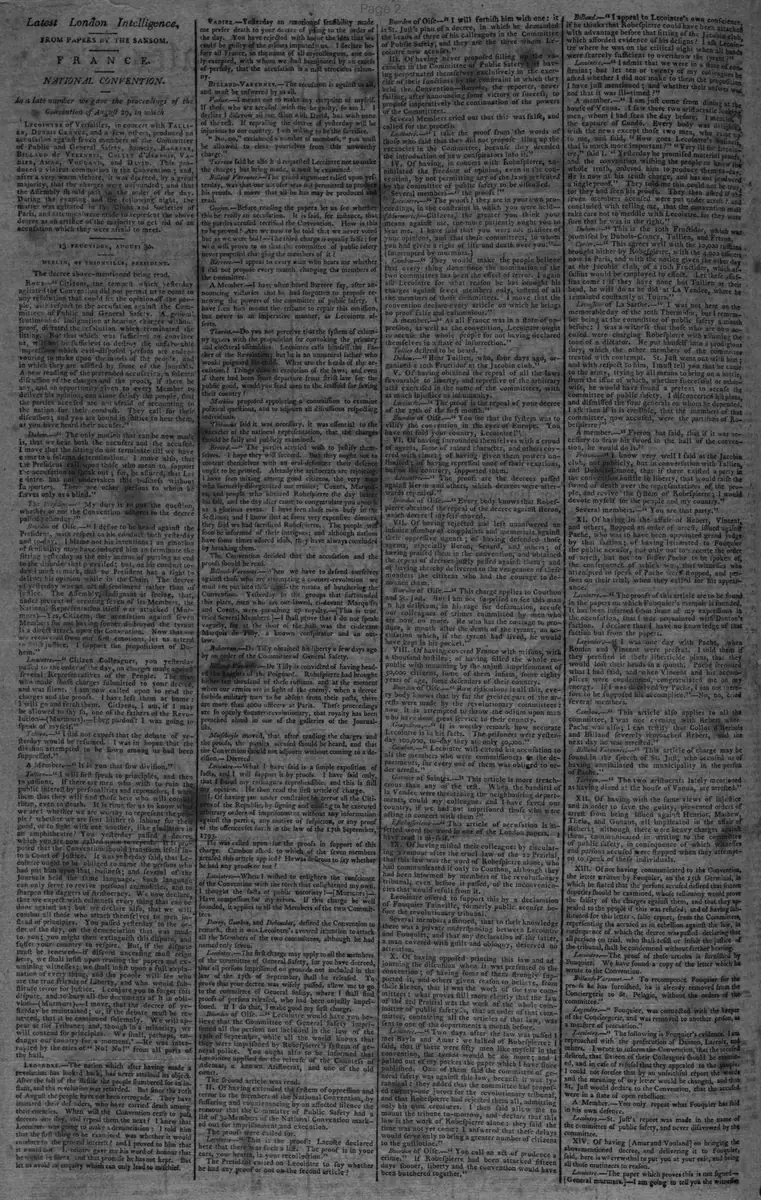
In the French National Convention on August 30, 1794, a heated debate ensues over Lecointre's accusation against seven members of the Committee of Public Safety (Barrère, Billaud-Varennes, Collot d'Herbois, Vadier, Amar, Voulland, David) for alleged abuses during the Terror. After extensive discussion and failed proofs, the Convention declares the charges calumnious and confirms the prior decree dismissing them.
Merged-components note: Merged continuation of the same long foreign news article on the French National Convention across pages 2, 3, and 4, as indicated by textual flow and 'see last page' reference.
Clippings
1 of 3
OCR Quality
Full Text
FROM PAPERS BY THE SANSOM.
FRANCE
NATIONAL CONVENTION
In a late number we gave the proceedings of the
Convention of August 29, in which
Lecointre of Versailles, in concert with Tallien,
and, Dubois Crancé, and a few others, produced an
accusation against even members of the Committee
of Public and General Safety, namely, Barrère,
Billaud-Varennes, Collot d'Herbois, Vadier,
Amar, Voulland, and David. This pro-
duced a violent commotion in the Convention; and,
after a very warm debate, it was decreed, by a great
majority, that the charges were unfounded; and that
the Assembly should pass to the order of the day.
During the evening and the following night, the
matter was agitated in the Clubs and Societies of
Paris, and attempts were made to represent the above
decree as an artifice of the majority to get rid of an
accusation which they were afraid to meet.
13 FRUCTIDOR, AUGUST 30
MERLIN, OF THIONVILLE, PRESIDENT.
The decree above-mentioned being read.
Roux—Citizens, the tempest which yesterday
agitated the Convention did not permit us to come to
any resolution that could fix the opinion of the peo-
ple, with respect to the accusation against the Com-
mittee of Public and General Safety. A general
sentiment of indignation at hearing charges without
proof, dictated the resolution which terminated the
sitting. But that which was sufficient to convince
us, will not be sufficient to destroy the unfavorable
impressions which evil-disposed persons are endea-
voring to make upon the minds of the people, and
in which they are assisted by some of the journals.
A new reading of the pretended accusation, a solemn
discussion of the charges and the proofs, if there be
any, and an opportunity given to every Member to
deliver his opinion, can alone satisfy the people, that
the parties accused are not afraid of accounting to
the nation for their conduct. They call for their
discussion; and you are bound in justice to hear them,
as you have heard their accuser.
Duhem—The only motion that can be now made
is, that we hear both the accusers and the accused.
I move that the sitting do not terminate till we have
come to a solemn determination. I move also, that
the President call upon those who mean to support
the accusation to speak out; for, be assured, that Lecointre
has not undertaken this business without
supporters. There are other persons to whom he
serves only as a blind.
The President—My duty is to put the question.
whether or not the Convention adheres to the decree
passed yesterday?
Bourdon of Oise—I desire to be heard against the
President, with respect to his conduct both yesterday
and to-day. I blame not his intentions: an emotion
of sensibility may have induced him to terminate the
sitting yesterday as the only means of putting an end
to the disorder that prevailed; but, on his conduct to-
day I must remark, that no President has a right to
deliver his opinion while in the Chair. The decree
of yesterday was an act of sentiment rather than of
justice. The Assembly, indignant at seeing, that,
under pretext of accusing even of its Members, the
National Representation itself was attacked (Mur-
murs)—Yes, Citizens, the accusation against even
Members for not having sooner destroyed the tyrant
is a direct attack upon the Convention. Now that we
are recovered from our first emotions, let us attend
to strict justice. I support the propositions of Du-
hem.
Lecointre—Citizen Colleagues, you yesterday
passed to the order of the day, on charges made against
several Representatives of the People. The man
who made those charges submitted to your decree,
and was silent. I am now called upon to read the
charges and the proofs. I have left them at home:
I will go and fetch them. Citizens, I am, if I may
be allowed to say so, one of the fathers of the Revo-
lution (Murmurs)—I beg pardon: I was going to
speak of myself.
Tallien—I did not expect that the debate of yes-
terday would be resumed. I was in hopes that the
division attempted to be sown among us had been
suppressed.
A Member—It is you that sow division.
Tallien—I will first speak to principles, and then
to passions. If there are men who wish to ruin the
public interest by personalities and reproaches, I warn
them that they will find those here who will combat
them, even to death. It is time for us to know what
we are: whether we are worthy to represent the peo-
ple? whether we are sent hither to labour for their
good, or to fight with one another, like gladiators in
an amphitheatre? You yesterday passed a decree
which you are now called upon to repeal. It is pro-
posed that the Convention should transform itself in-
to a Court of Justice. It was yesterday said, that Le-
cointre ought to be obliged to name the persons who
had put him upon that business; and several of the
Journals held the same language. Such language
can only serve to revive personal animosities, and to
sharpen the daggers of Aristocracy. We now declare,
that we expect with calmness every thing that can be
done against us; but we declare also, that we will
combat all those who attach themselves to men in-
stead of principles. You passed yesterday to the or-
der of the day, on the denunciation that was made
to you; you might then extinguish this dispute, and
suffer your country to respire. But, if the dispute
must be renewed—if discord unceasing must reign
here, we shall insist upon reading the papers and ex-
amining witnesses; we shall insist upon a full expla-
nation of every thing, and the people will see who
are the true friends of Liberty, and who would sub-
stitute terror for justice. I conjure you to forget this
dispute, and to bury all the documents of it in obli-
vion—(Murmurs)—I move, that the decree of yes-
terday be maintained; or, if the debate must be re-
newed, that it be continued solemnly. We will ap-
pear at the Tribune; and, though in a minority, we
will contend for principles. We shall, perhaps, en-
danger our country for a moment.”—He was inter-
rupted by the cries of “No! No!” from all parts of
the hall.
Legendre—The nation which after having made a
revolution has looked back, has never attained its object.
After the fall of the Bastille the people slumbered for an in-
stant, and the revolution was retarded. But since the 10th
of August the people have not been retrograde. They have
imitated their defenders, who have carried death among
their enemies. When will the Convention cease to pass
decrees one day, and repeal them the next? I knew that
Lecointre was going to make a denunciation: I told him
that the first thing to be examined was whether it would
conduce to the general interest? and I proved to him that
it would not. Lecointre gave me his word of honour that
he would be silent, and that promise he has not kept. But
let us avoid an enquiry which can only lead to mischief.
Vadier—Yesterday an emotion of sensibility made
me prefer death to your decree of passing to the order of
the day. You have rejected with horror the idea that we
could be guilty of the crimes imputed to us. I declare be-
fore all France, in the name of all my colleagues, one on-
ly excepted, with whom we had been joined by an excess
of perfidy, that the accusation is a most atrocious calum-
ny.
Billaud-Varennes. The accusation is against us all,
and must be answered by us all.
Vadier—I meant not to make any exception of myself.
If those who are accused with me be guilty, so am I. I
declare I disavow all connection with David, but with none
of the rest. If repealing the decree of yesterday will be
injurious to our country, I am willing to be the sacrifice.
“No, no,” exclaimed a number of members, “you mu-
be allowed to clear yourselves from this unworthy
charge.”
Turreau said he also had requested Lecointre not to make
the charge: but being made, it must be examined.
Billaud Varennes. The grand argument relied upon ye.
terday, was that our accuser was not permitted to produce
his proofs. I move that all he has may be produced and
read.
Goujon. —Before reading the papers let us see whether
this be really an accusation. It is said, for instance, that
the parties accused terrified the Convention. How is this
to be proved? Are we now to be told that we never voted
but as we were bid?—The third charge is equally false; for
who will prove to us that the committee of public safety
never proposed changing the members of it?
Barrère—I appeal to every man who hears me whether
I did not propose every month changing the members of
the committee.
A Member—I have often heard Barrère say, after an-
announcing victories that he had forgotten to propose re-
newing the powers of the committee of public safety.
I have seen him mount the tribune to repair this omission.
but never in an imperative manner, as Lecointre as-
serts.
Thuriot. —Do you not perceive that the system of calum-
ny agrees with the proposition for convoking the primary
and electoral assemblies. Lecointre calls himself the Fa-
ther of the Revolution; but he is an unnatural father who
would poignard his child. What are the heads of the ac-
cusation? Things done in execution of the laws; and even
if there had been some departure from strict law or the
public good, would you send men to the scaffold for saving
their country?
Mathieu proposed appointing a commission to examine
political questions, and to adjourn all discussions respecting
individuals.
Thibaudot said it was necessary, it was essential to the
character of the national representation, that the charges
should be fully and publicly examined.
Breard—“The parties accused wish to justify them-
selves. I hope they will succeed. But they ought not to
content themselves with an oral defence: their defence
ought to be printed. Already the aristocrats are rejoicing.
I have seen mixing among good citizens, the very men
who formerly disorganized our armies; Counts, Marqui-
es, and people who idolized Robespierre the day before
his fall, and the day after came to congratulate you upon it
as a glorious event. I have seen these men buy in the
Sections; and I know that at some very expensive dinners
they said we had sacrificed Robespierre. The people will
soon be informed of their intrigues; and although nations
have some times adored idols, they have always concluded
by breaking them.
The Convention decided that the accusation and the
proofs should be read.
Billaud-Varennes. —When we have to defend ourselves
against those who are attempting a counter-revolution we
must not put into their hands the means of butchering the
Convention. Yesterday in the groups that surrounded
this place, men who are out-lawed, ci-devant Marquises
and Counts, were preaching up royalty.—This is true,
cried Several Members.]—I shall prove that I do not speak
vaguely, or at random: at the door of the hall was the ci-devant
Marquis de Tilly, a known conspirator and an out-
law.
Dubarran,—De Tilly obtained his liberty a few days ago
by an order of the Committee of General Safety.
Billaud-Varennts.—De Tilly is convicted of having head-
ed the knights of the Poignard. Robespierre had brought
hither ten thousand of these ruffians, and at the moment
when our armies are in sight of the enemy, when a decree
forbids military men to be absent from their posts, there
are more than 4000 officers at Paris. These proceedings
are so openly counter-revolutionary, that royalty has been
preached aloud in one of the galleries of the Journal-
ists.
Moiebayle moved, that after reading the charges and
the proofs, the parties accused should be heard, and that
the Convention should not adjourn without coming to a de-
cision.—Decreed.
Lecointre.—What I have said is a simple exposition of
acts, and I will support it by proofs. I have said only.
that I found my colleagues reprehensible, and this is still
my opinion. He then read the first article of charge.
I. Of having put under constraint by terror all the Citi-
zens of the Republic, by signing and causing to be executed
arbitrary orders of imprisonment without any information
against the parties, any motive of suspicion, or any proof
of the offences set forth in the law of the 17th September,
1793.
He was called upon for the proofs in support of this
charge. Cambon asked, to which of the seven members
accused this article applied? He was desirous to know whether
he had any proofs or not?
Lecointre.—When I wished to enlighten the conscience
of the Convention with the torch that enlightened my own,
I thought the acts of public notoriety!—Murmurs]—
Have compassion for my errors. If this charge be well
founded, it applies to all the Members of the two Commit-
tes.
Duroy, Cambon, and Dubonchet, desired the Convention to
remark, that it was Lecointre's avowed intention to attack
all the Members of the two committees, although he had
named only seven.
Lecointre.—The first charge may apply to all the members
of the committee of General Safety, for you have decreed.
that all persons imprisoned on grounds not included in the
law of the 17th of September, shall be released. To
prove that your decree was wisely passed, allow me to go
to the committee of General Safety, where I shall find
proofs of persons released, who had been unjustly impri-
soned. If I do that, I make good my first charge.
Bourdon of Oise. “Lecointre would have you be-
lieve that the Committee of General Safety impri-
soned all the persons not included in the law of the
17th of September, while all the world knows that
they were imprisoned by Robespierre's system of ge-
neral police. You ought also to be informed that
Lecointre applied for the release of the Countess of
Ademar, a known Aristocrat, and one of the old
court.
The second article was read.
II. Of having extended the system of oppression and
terror to the members of the National Convention, by
suffering and countenancing by an affected silence the
rumour that the Committee of Public Safety had a
list of 30 Members of the National Convention mark-
ed out for imprisonment and execution.
The proofs were called for.
Lecointre—“This is the proof: Lacoste declared
here that there was such a list. The proof is in your
ears, your hearts, in your recollection.”
The President called on Lecointre to say whether
he had any proof or not on the second article?
Bourdon of Oise—“I will furnish him with one: it
is St. Just's plan of a decree, in which he demanded
the heads of three of his colleagues in the Committee
of Public Safety, and they are the three whom Le-
cointre now accuses.”
III. Of having never proposed filling up the va-
cancies in the Committee of Public Safety; of hav-
ing perpetuated themselves exclusively in the exer-
cise of their functions by the constraint in which they
held the Convention—Barrère, the reporter, never
failing, after announcing some victory or success, to
propose imperatively the continuation of the powers
of the Committees.
Several Members cried out that this was false, and
called for the process.
Lecointre. I take the proof from the words of
those who said that they did not propose filling up the
vacancies in the Committee, because they dreaded
the introduction of new conspirators into it.”
IV. Of having, in concert with Robespierre, an-
nihilated the freedom of opinion, even in the con-
vention, by not permitting any of the laws presented
by the committee of public safety to be discussed.
Several members—the proofs!”
Lecointre.—“The proofs? they are in your own pro-
ceedings, in the constraint in which you were held—
(Murmurs)—Citizens, the greater you think your
means against me, the more patiently ought you to
hear me. I have said that you were not masters of
your opinions, and that these committees, to whom
you had given a right of life and death over you.”—
(Interrupted by murmurs.)
Cambon—“They would make the people believe
that every- thing done since the nomination of the
two committees has been the effect of terror. I again
ask Lecointre for what reason he has brought his
charges against seven members only, instead of all
the members of those committees. I move that the
convention declare every article on which he brings
no proof false and calumnious.”
A member.“As all France was in a state of op-
pression, as well as the convention, Lecointre ought
to accuse the whole people for not having declared
themselves in a state of insurrection.”
Tallien desired to be heard.
Duhem.—“Hear Tallien, who, four days ago, or-
ganized a 10th Fructidor at the Jacobin club.”
V. Of having obtained the repeal of all the laws
favourable to liberty, and repressive of the arbitrary
acts exercised in the name of the committees, with
as much injustice as inhumanity.
Lecointre. The proof is the repeal of your decree
of the 27th of the first month.
Bourdon of Oise.“You see that the system was to
vilify the convention in the eyes of Europe. You
have not sold your country, Lecointre!”
VI. Of having surrounded themselves with a crowd
of agents, some of ruined character, and others cov-
ered with crimes; of having given them powers un-
limited; of having repressed none of their vexations,
but on the contrary, supported them.
Lecointre. The proofs are the decrees passed
against Héron and others, which decrees were after-
wards repealed.”
Bourdon of Oise. “Every body knows that Robe-
spierre obtained the repeal of the decree against Héron,
which decree I myself moved.
VII. Of having rejected and left unanswered an
infinite number of complaints and memorials against
their oppressive agents; of having defended those
agents, especially Héron, Senard, and others; of
having praised them in the convention, and obtained
the repeal of decrees justly passed against them; and
of having thereby delivered to the vengeance of these
monsters the citizens who had the courage to de-
nounce them.
Bourdon of Oise. —“This charge applies to Couthon
and St. Just. But I am not surprised to see this man
in his delirium, in his rage for defamation, accuse
our colleagues of crimes committed by men who
are now no more. He who has the courage to pro-
duce, a month after the death of the tyrant, an ac-
cusation which, if the tyrant had lived, he would
have kept in his pocket.
VIII. Of having covered France with prisons, with
a thousand Bastilles; of having filled the whole re-
public with mourning by the unjust imprisonment of
50,000 citizens, some of them infirm, some eighty
years of age, some defenders of their country.
Bourdon of Oise. “How ridiculous is all this, eve-
ry body knows that by far the greater part of the ar-
rests were made by the revolutionary committees:
now it is attempted to throw the odium upon men
who have done great service to their country.
Gaupilleau,—“It is worthy remark how accurate
Lecointre is in his facts. The prisoners were yester-
day 100,000, to-day they are only 50,000.”
Cambon.—“Lecointre will extend his accusation to
all the members who were commissioners in the de-
partments, for every one of them was obliged to or-
der arrests.”
Garnier of Saintes.—This article is more treach-
erous than any of the rest. When the banditti of
la Vendée were threatening the neighbouring depart-
ments, could my colleagues and I have saved our
country, if we had not imprisoned those who were
acting in concert with them?”
Eschassérioux —“This article of accusation is in-
serted word for word in one of the London papers. I
have read it myself.”
IX. Of having misled their colleagues by circulat-
ing a rumour after the cruel law of the 22 Prairial.
that this law was the work of Robespierre alone, who
had communicated it only to Couthon, although they
had been informed by members of the revolutionary
tribunal, even before it passed, of the inconvenien-
cies that would result from it.
Lecointre offered to support this by a declaration
of Fouquier Tinville, formerly public accuser be-
fore the revolutionary tribunal.
Several members affirmed, that to their knowledge
there was a private understanding between Lecointre
and Fouquier, and that any declaration of the latter,
a man covered with guilt and obloquy, deserved no
attention.
X. Of having opposed printing this law and ad-
journing the discussion when it was presented to the
convention; of having some of them strongly sup-
ported it, and others given reason to believe, from
their silence, that it was the work of the two com-
mittees: what proves still more clearly that the law
of the 22d Prairial was the work of the whole com-
mittee of public safety, that an order of that com-
mittee, containing all the articles of that law, was
sent to one of the departments a month before.
Lecointre. “Two days after the law was passed I
met Vadier and Amar: we talked of Robespierre: I
said, that if there were fifty men like myself in the
convention, the tyrant would be no more; and I
pulled out of my pocket the paper which I have since
published. One of them said the committee of ge-
neral safety was against this law, because it was ty-
rannical: they added that the committee had propos-
ed twenty-one jurors for the revolutionary tribunal.
and that Robespierre had rejected them all, admitting
only his own creatures. I then said allow me to
mount the tribune to-morrow, and declare that this
law is the work of Robespierre alone: they said the
time was not yet come: I answered that these delays
would serve only to bring a greater number of citizens
to the guillotine.”
Bourdon of Oise.“You call an act of prudence a
crime. If Robespierre had been attacked fifteen
days sooner, liberty and the convention would have
been butchered together.”
Billaud.—“I appeal to Lecointre's own conscience.
if he thinks that Robespierre could have been attacked
with advantage before that sitting of the Jacobin club,
which afforded evidence of his designs? I ask Lecoin-
tre where he was on the critical night when all hands
were scarcely sufficient to overthrow the tyrant?”
Lecointre. “I admit that we were in a state of con-
straint; but let ten or twenty of my colleagues be
asked whether I did not make to them the proposition
I have just mentioned; and whether their answer was
not that it was ill-timed?”
A member. —“I am just come from dining at the
house of Vadier. I saw there two aristocratic looking
men, whom I had seen the day before. I mention
the capture of Condé. Every body was delighted
with the news except those two men, who came up
to me, and said, 'How goes Lecointre's business.
that is much more important?' 'Very ill for Lecoin-
tre, ' said I. 'Yesterday he promised material proofs,
and the convention wishing the people to know the
whole truth, ordered him to produce them to-day.
He is now at his tenth charge, and has not produced
a single proof.' They told me this could not be true.
for they had seen his proofs. They then asked if the
seven members accused were put under arrest? and
concluded with telling me, that the convention must
take care not to meddle with Lecointre. for they were
sure that he was in the right.”
Duhem.—“This is the 10th Fructidor, which was
promised by Dubois-Crancé, Tallien, and Fréron,
Carriler, This agrees well with the 10,000 ruffians
brought hither by Robespierre, with the 4000 officers
now in Paris, and with the notice given the other day
at the Jacobin club, of a 10th Fructidor, which as-
sassins would be employed to effect. Let these as-
sassins come: if they have none but Tallien at their
head, he will do as he did at La Vendée, where he
remained constantly at Tours.”
Levasseur of La Sarthe.—“I was not here on the
memorable day of the 9th Thermidor, but I remem-
ber being at the committee of public safety a month
before: I was a witness that those who are now ac-
cused were charging Robespierre with assuming the
tone of a dictator. He put himself into a prodigious
fury, which the other members of the committee
treated with contempt. St. Just went out with him;
and with respect to him, I must tell you that he came
to the army, trying by all means to bring on a battle,
from the issue of which, whether successful or other-
wise, he would have found a pretext to accuse the
committee of public safety. I disconcerted his plans.
and dismissed the four generals on whom he depended.
I ask then if it is credible, that the members of that
committee, now accused, were the partisans of Ro-
bespierre?”
A member.“Fréron has said, that if it was ne-
cessary to draw his sword in the hall of the conven-
tion, he would do it. ”
Fréron.—“I know very well I said at the Jacobin
club, not publicly, but in conversation with Tallien,
and Dubois-Crancé, that if there existed a party in
the convention hostile to liberty, that would raise the
sword of death over the representatives of the peo-
ple, and revive the system of Robespierre; I would
devote myself for the people and my country.”
Several members.—“You are that party.”
XI. Of having in the affair of Hébert, Vincent.
and others, stopped an order of arrest, issued against
Pache, who was to have been appointed grand judge
by that faction; of having intimated to Fouquier
the public accuser, not only not to execute the order
of arrest, but not to suffer Pache to be spoken of,
the consequence of which was, that witnesses who
attempted to speak of Pache were stopped, and per-
sons on their trial, when they called for his appear-
ance.
Lecointre.—“The proofs of this article are to be found
in the papers on which Fouquier's memoir is founded.
It has been inferred from some of my expressions in
the accusation, that I was acquainted with Danton's
faction. I declare that I have no knowledge of that
faction but from the papers.
Legendre.“I was one day with Pache, when
Ronsin and Vincent were present. I told them if
they persisted in their liberticide plans, that they
would lose their heads in a month. Pache seconded
what I had said, and when Vincent and his accom-
plices were condemned, congratulated me on my
energy. If I was deceived by Pache, I am not there-
fore to be supposed his accomplice.”—No, no, cried
several members.
Cambon. This article also applies to all the
committee, I was one evening with Hébert where.
Pache was also; I can testify that Collot d'Herbois
and Billaud severely reproached Hébert, and the
next day he was arrested.”
Billaud Varennes.“This article of charge may be
found in the speech of St. Just, who accused us of
having annihilated the municipality in the person
of Pache.”
Turreau.—“The two aristocrats lately mentioned
as having dined at the house of Vadier, are arrested.”
XII. Of having with the same views of injustice
and in order to save the guilty, prevented orders of
arrest from being issued against Henriot, Mathieu,
Their, and Gonant, all implicated in the affair of
Hébert; although there were heavy charges against
them, communicated in writing to the committee
of public safety, in consequence of which witnesses
and persons accused were stopped when they attempt-
ed to speak of these individuals.
XIII. Of not having communicated to the Convention,
the letter written by Fouquier, on the 15th Germinal, in
which he stated that the persons accused desired that sixteen
deputies should be examined, whose testimony would prove
the falsity of the charges against them, and that they ap-
pealed to the people if this was refused; and of having sub-
stituted for this letter a false report, from the Committees,
representing the accused as in rebellion against the law, in
consequence of which the decree was passed declaring that
all persons on trial, who shall resist or insult the justice o
the tribunal, shall be condemned without further hearing
Lecointre. —The proof of these articles is furnished by
Fouquier. We have found a copy of the letter which he
wrote to the Convention.
Billaud-Varennes. To recompense Fouquier for the
proofs he has furnished, he is already removed from the
Conciergerie to St. Pelagie, without the orders of the
committee.”
Legendre.—“Fouquier, was connected with the keeper
of the Conciergerie, and was removed to another prison, as
a measure of precaution.”
Lecointre. “The following is Fouquier's evidence. I am
reproached with the prosecution of Danton, Lacroix, and
others. I wrote to inform the Convention, that the accused
desired, that sixteen of their Colleagues should be examin-
ed, and in case of refusal that they appealed to the people.
I could not foresee that by an unfaithful report the words
and the meaning of my letter would be changed, and that
St. Just would declare to the Convention, that the accused.
were in a state of open rebellion.
A Member,—You only repeat what Fouquier has said
in his own defence.
Lecointre. St. Just's report was made in the name of
the committee of public safety, and never disavowed by the
committee.
XIV. Of having [Amar and Vouland] on bringing the
abovementioned decree, and delivering it to Fouquier,
said, here is wherewithal to put you at your ease, and bring
all those mutineers to reason.
Lecointre. —The paper which proves this is not signed—
[General murmurs.] I am going to tell you the witness
This is a great friend of Danton.
Carrier. - Protected by Tallien.
Bourdon of l'Oise observed that the proofs offered, are either
he assertion of Fouquier, or anonymous letters.
XV. Of having, when important matters were on our
hand, permitted, and even ordered, jurors to be chosen
out of the Sections that were in turn, in order to find ju-
gors that would be tractable.
Lecointre. The proof of this is a paper from Fabricius :
The facts may be proved by witnesses and jurors of the Re-
volutionary Tribunal.
Several Members. -- This again is an anonymous pa-
per.
XVI. Of having (Amar, Vouland, David and Vadier)
when the jurors were in the Chamber of Deliberation,
and it was rumoured in the Tribunal, that the majority
was for acquitting the accused, gone into a chamber adjoin-
ing to that of the jury, and employed Hermann to make
them vote for death, which he did by going into the coun-
cil chamber, speaking against the accused, and threatening
the jurors with the resentment of the committees if they
did not convict them.
Lecointre. Witnesses will prove this charge.
Vadier. - I appeal to the testimony of those who were
with me on that day, to say whether I spoke to the President.
to the Judges, or to the Jury?
Thyrion. -- The day on which the Convention pro-
nounced, that persons on trial resisting or insulting
the justice of the Tribunal should have no further
hearing, I was at the tribunal with Vadier and eve-
ral other Deputies; Vadier could neither see nor
hear what was doing, any more than I could. I got
upon a chair. Danton saw me and called to me, to
obtain an order from the Convention for hearing
witnesses. Vadier continued near me till the con-
clusion, and could not possibly influence the decision
of the jury."
Amar. -- I declare to the convention and to all
France, that the imputations against me and Vouland
are so many atrocious calumnies. We were at the
tribunal in a very narrow place behind the judges and
the jury, at the time the decree in question was bro't:
we could not therefore bring it. It is equally false
that we influenced the judges or the jury. Neither
of us spoke to them or saw Fabricius."
Duhem. "Fabricius was Danton's fetch and carry
dog.
Vouland. -- I declare also that I did not carry the
decree in question : in the night that preceded the day
on which it passed, there was brought to the commit-
tee of general safety, a declaration of a person named
La Flotte, which appeared interesting, and likely to
throw light upon the proceeding. The committee
charged me to carry it to the tribunal : I went thi-
ther with Amar, and delivered it to Hermann, who
told me that the jury was assembled, and that I could
not enter their chamber: I gave him the paper; and I
have not seen him since."
Amar. -- Tallien says, that I have committed an
error. I was at the committee of the proces verbal,
when they came there to expedite the decree: it is
true that I carried it to the tribunal, but it is false
that I menaced the judges."
Garner of Saintes. It is the height of wicked-
ness to produce anonymous letters against represent-
atives of the people, who have deserved well of their
country, who have already saved it, and who will
save it again; for the convention fears neither dan-
gers nor death. -- Warm applauses.
Duroy. -- They no longer fear the poignards of in-
trigueres."
Garnier. I move that we pass to the next article.
because there does not exist a document in support of
this."
XVII. Of having often ordered the ending to trial
go or ho persons at one time for different offences,
Many voices. -- The proofs!
Lecointre. Public notoriety, and the declaration
of Fouquier Tainville."
A member. -- It is always the same. What is be-
come of the heap of papers carried yesterday to the
tribunal?
Maret. -- France must know that the abomina-
fions committed at the revolutionary tribunals, and
the judgments which involved at the same time the
man of the north, and the man of the south, with-
out either of them being seen, were neither avowed
by the convention nor the committees ; it was Robe-
spierre who combined these atrocities with Fouquier
Tainville."
Many voices. Another article!
XVIII. Of having ordered the public accuser to
bring to trial within twenty-four hours, the persons
suspected of the conspiracy of the prisons, so that 155
persons named in the act of accusation, were to be
tried and to perish in the same day; but the dread of
public opinion having produced some reflection, it
was decided that they should be tried at three differ-
ent times.
Lecointre. -- The proof of this article is the origi-
nal of the act of accusation against the prisoners, in
execution of an order of the committee of public
safety of the 4th Messidor.
Billaud Varennes. -- The convention knows that
Robespierre, in order to bring about a counter-re-
volution by terror, had organized a general police,
.of which he himself and St. Just took the charge
exclusively. I told you yesterday, that the com-
mittee of public safety, understanding that on the
next day, 150 persons were to be tried on the ac-
ccusation of having endeavoured to produce a coun-
ter-revolution in the prisons; and that at this epoch
the faction of Hebert counted on the conspiracy of the
persons, as he was in hopes of letting loose upon
society 4000 counter-revolutionists: the commit-
tee, I say, understanding these facts, demanded of
Fouquier if it was true that he meant, the next
day, " to try these 150 persons; and if it was true
that the scaffold was already prepared ? Fou-
quier was convicted of the fact; indignation seized
all the members, and they said that he had con-
verted justice into butchery. The committee un-
derstanding also, that the scaffold which had been
For the Remainder, See the Last Page.
erected in the hall of the tribunal, still remained there, in spite of the orders that had been given to remove it, again ordered the public accuser to pull it down, and he announced to us that it was so. I request that the convention will direct a report to be made of the orders of the committee. I defy any person to find in them the name of the members now accused, as Lecointre has dared to assert. I recall to the convention that Fouquier was brought to the bar, and that he came every day to the committee of public safety; he never spoke but to Robespierre. I again demand that you order the registers of the committee to be brought that you may know the nature of the decrees, and who were the authors.
Goupilleau de Fontenay—It is for him who accuses to prove."
Dumont of Calvados.—"In the first paper Fouquier said, that having learnt the plan of reducing the number of the Jury, he went to the Committee of Public Safety, where he found Billaud-Varennes, Collot d'Herbois, and others, who told him that it was Robespierre's business: it was owned by Fouquier himself that it was Robespierre who conducted the Tribunal; Fouquier did not add, that he afterwards addressed himself to the Committee, from which it is clear, that it was he who arranged every thing with Robespierre."
Vadier.—"Fouquier gave no account of this to the Tribunal, but having seen in the journals, an immense list of workmen and artizans, who had been guillotined, I was shocked at the fact, and I demanded of him if he intended to bring about a counter-revolution, by murdering the people, the patriots; while he suffered Marshals of France, emigrants, and ci-devant nobles, who had conspired against their country, to live."
The next article was called for.
XIX. Of having suffered the same witnesses, entertained, nourished in the prisons, and known under the name of Sheer, to depose against the accused for money: among these witnesses we distinguish Ferrieres-auvre-Boeuf, ex-noble, and Leymerie, the private Secretary of Amar.
Many Voices—"The Proofs!"
Lecointre—"This fact is attested by witnesses."
XX. Of having formally falsified the denunciation made to the Convention against Joseph-le-Bon; made an unfaithful report on his conduct, and disguised his cruelties under the denomination of bitter forms.
Barrere—"Citizen, a denunciation was made against Joseph-le-Bon, and it was not till five or six days afterwards that the Committee of Public Safety took up the affair. Robespierre the younger, spoke against the Representatives of the People. Robespierre the elder, and St. Just, spoke in his favour: in the mean time, several citizens from Arras, were sent to accuse Le-Bon anew, and were supported by Guffroy: we were anxious to prevent strife among the Representatives of the People. I was charged to make a report upon the subject, and as I did not know his conduct, I would not make a judicial but a political report, in order to prevent the consequence of the discord that manifested itself: but at the same time that we made this report, which did not pronounce him the facts with which he was charged, we said to this Representative of the People, 'you are stript of your functions; you shall be permitted to go to Cambray only, to search the papers that are necessary to your justification.' This is what I have to say as to Joseph-le-Bon."
Bourdon of Oise.—"The truth is, that the two Committees were not willing to suffer any Representative of the People to be attacked, because we did not wish to deliver any one man over to Robespierre: (Murmurs)—besides, if any one member, our friend, had committed the crimes imputed to Joseph-le-Bon, without doubt, you would not have thought him cleared by such a report as was made upon this Citizen."
XXI. Of not having made known to the Convention, the absence of Robespierre from the Committee, for four decades, (40 days); of having suffered him, notwithstanding his absence, to sign acts; concealed the manoeuvres that this conspirator had employed, with a view to disorganize every thing, to make himself partisans, and to ruin the public cause.
Lecointre. It was not until the moment that Robespierre was beaten, that we knew that he had been for four decades absent from the Committee: and in the sitting of the 9th, 26th July, Billaud Varennes told you that if he had any reproach to make himself, it was, that he had kept silence on the crimes of Robespierre, and that he had not unmasked him sooner."
Cambon—"Citizens, here we see a combination of wickedness more refined than that of Robespierre himself, it is made a crime to our colleagues both that they have spoken, and that they have been silent. I demand that the committee shall fix a term within which a member of a committee shall be bound to denounce his colleague on account of absence."
Billaud Varennes.—"The absence of Robespierre from the committee was useful to the country, for it gave us time to combine the means of his destruction. You know that if he had been constantly there he would have very much interrupted us. St. Just and Couthon, who were always present, were very inconvenient spies upon our conduct.—I ask if it was ever made a reproach to Brutus, that for six years he counterfeited idiotism, in order to strike down the tyranny of Tarquin? And why did not Lecointre himself, who had an act of accusation against Robespierre in his pocket, speak out sooner."
Lecointre-Puyraveaux.—"I was by the absence of Robespierre from the committee that he was demolished. It is admirable to observe how well, during his absence, the men whom he was desirous to ruin laboured for the success of the republic! It was during his absence that our armies gained the greatest victories. Thus, Robespierre felt that, in order to attack the members of the committee, he must turn these successes against them; and this he actually did, by alleging that our armies were in the same state as in the time of the traitor Dumourier, wishing thereby to make us believe that our generals were aristocrats. Robespierre attacked Billaud, Collot d'Herbois, and Barrere, because they interrupted his projects.—Who are attacked to-day: Billaud, Collot d'Herbois, Barrere! Have I not a right to think that it is the same motive which has directed the accusation against the same representatives?"
XXII. Of having permitted general Lavalette, Dufraie, and so many other traitors, or conspirators long denounced the committees, or struck by decrees of the convention, to remain at Paris, where they obtained employments, and were put into a situation to commit new crimes.
Lecointre.—"The proofs are the condemnation of Lavalette, and your registers?"
A member—I call on Duhem to declare, whether, last year, being named commissioner to the army of the north, and being in a situation to judge of the conduct of Lavalette, I did not go to the convention to denounce him, and whether Robespierre did not take up his defence?"
Duhem.—"The object of this accusation, be assured, citizens, is to re-establish the memory of Danton. Danton had no dispute with Robespierre, but as to his tyranny. I surprise him on his knees before the tyrant, soliciting a report to the advantage of Lavalette."
Forster.—"I attest the fact; Danton said to Robespierre, in my report I prefer that Lavalette is innocent: you shall support me." I said to them, "what! you both—intend then to support a ci-devant noble, justly suspected in the eyes of our colleagues? I do not understand you: I begin to doubt your patriotism."
Bourdon, of Oise.—"In the sitting of the 9th, one of the crimes which I imputed to Robespierre, was having placed Lavalette in the national guard of Paris. He could not deny the fact. It is atrocious, at this day, after a condemned party has avowed a fact, to accuse other citizens, who have led him on account of it to the scaffold. The denunciation Lecointre is a mere rhapsody: he is the dupe of the intriguers who have put him forward. If he had the smallest particle of good sense, he would have followed the advice which many of his colleagues have given him."
Lecointre-Puyraveaux.—"Lavalette was the creature of Robespierre, and the assistant of Henriot. Who were these that Robespierre wished to ruin? Billaud, Collot, &c. How can they accuse these men of protecting the man who sought to assassinate them?"
Duhem.—"One proof that Lavalette was the creature of Robespierre, is, that when we went to the committee of public safety, to search for the papers that were necessary to try the accomplices of Lavalette, we were told that Robespierre had carried them away."
XXIII. Of not having taken, in the night of the 8th, and in the day of the 9th Thermidor, any measures to preserve the public tranquillity, and secure the safety of the convention, evidently endangered by the speech of the tyrant, pronounced by him on the 8th, at the tribune of the convention, and in the evening at that of the Jacobins, who had promised him succour, force, and protection.
Cambon.—"The conduct of the committees of public and general safety on the 8th, 9th, and 10th Thermidor, will be judged of by posterity. For myself I declare that these two committees saved their country."
Monestier.—"I owe it to truth to say that in the night of the 9th, the members of these committees were on the march from place to place, to give us the watchword, and to make us adopt the necessary measures."
Many voices.—"I was the national convention entire."
Monestier.—"I am far from wishing to take from the national convention the glory they acquired on that day, but it is the precise truth, that Billaud, Varennes, Collot d'Herbois, Barrere, Elie Lacoste, Vadery and others, came to give us a particular account of what was passing in Paris, and of the measures they had taken to secure the triumph of liberty."
Goupilleau.—"The member who proposed to outlaw the criminal is Voulland, organ of the committees of public and general safety."
XXIV. Of not having arrested in the night between the 8th and 9th, general Henriot, the mayor, and the national agent of Paris, Lavalette, and so many other principal accomplices of Robespierre, who had been all denounced by so many of their accomplices.
Many voices.—"The proofs!"
Lecointre In the printed paper that has been distributed to you, I have said, that in the night between the 8th and 9th, I went to find Lavicomterie at the Committee of General Safety, where I pressed him to cause Henriot, the mayor, and the National Agent, to be arrested; at one o'clock in the morning, I repeated the same request to the Committee. I told them that my brother, a notary, and captain in the National Guards, had received an order at eleven o'clock, to hold himself in readiness with his company: I demanded that my brother should be sent for to give an account of the fact: the committee sent for him accordingly, and demanded if he had received the order from Henriot: he said, he had received it from the general of the quarter. Several can attest this fact."
Freron—I presented myself to the Committee of Public Safety at half past one o'clock to demand the arrest of Henriot, but I could not get admission. Meeting Cambon I communicated to him my alarms: he promised to deliver my wishes to the committee."
Cambon confirmed this fact, but said he was not able to acquit himself of his commission; the committee being in deliberation:—"I was witness to a warm dispute between St. Just and Collot d'Herbois."
Billaud-Varrennes.—"There was no doubt, after the sitting of the Jacobins, that a counter-revolution was the order of the day. You must learn a fact, which you will find in the speech of St. Just, that the committee deliberated if they should arrest Henriot, the mayor, the national agent, and other conspirators: the discussion was very warm between Collot d'Herbois and St. Just: it was easy to see that the commune, the commander of the national guard, and even the Jacobins themselves, were for the conspirators: their plan was to hinder the Convention from meeting the next day: it was necessary, therefore, to take measures to prevent this liberticide plot: we thought it wise to call before the committee of public safety, the mayor and the national agent, as by holding them with us, we thought we should prevent their correspondence with the other conspirators: if there was any guilt in this, I confess that we are criminal. [Applaudits.] The committee felt, that the National Convention alone could stop the movement that was preparing: they came into the hall, and proposed the arrest of the mayor, Dumas, and of several other conspirators: Couthon, who knew that we were going to make this proposal, tried to stop us by a torrent of discussion, but we left him to the committee."
Barrere.—"We are accused of having taken no measures in the night between the 9th and 10th, and yet all France is acquainted with those which we proposed to you: it is right to give an account here of all that passed in the committee. St. Just, who had promised to denounce us, held us constantly in observation. He told us that he was to make a report to the convention, in which he would criminate us: he came to the committee on the 8th, at the moment in which Robespierre triumphed in the Jacobin club: we were employed in objects of administration: he sat down, but took no part in the deliberation: at eleven o'clock we said to him, As you do nothing, read to us your report: he answered, that he had sent the first sheets to one of his friends? "In that case, read to us your conclusion:" he would not. During this conversation Collot d'Herbois arrived: on entering he darted a look at St. Just. St. Just asked him, What had passed at the Jacobins? "What! you ask us," replied Collot d'Herbois to him, "you ask us what has passed at the Jacobins! are you not the accomplices of Robespierre? have you not combined your projects? I see it: you have organized an infamous triumvirate; your project is to assassinate us, and with us the Republic: but I tell you, that even when you have succeeded in destroying us, you will not long enjoy the fruit of your crimes; and the people, who will soon be enlightened, will cut you in pieces." St. Just grew pale and was disconcerted. "You have in your pocket," continued Collot d'Herbois, "notes against us? show us them!" St. Just emptied his pockets, and assured us he had none. At five o'clock in the morning St. Just left us, and promised to return at eleven, to show us the report he intended to read to the convention; and we retired to digest the measure we had agreed upon. At noon we received a letter conceived in these terms:
"You have stigmatized my heart: I go to lay it open to the National Convention.
(Signed) St. Just."
Couthon got possession of this letter: we then said, that we were betrayed: we instantly took our departure for the convention: you know what passed in that memorable sitting and the measures that we proposed against the traitors:—After the suspension of the sitting at five o'clock, they brought to us at the committee of public safety, an order, signed Henriot, enjoining the sections to repair in arms to the commune. Instantly we printed an order, which we sent to the sections, forbidding them, under the most rigorous penalties, to obey the traitor Henriot. A crown to him who should bring the head of Henriot. We then came to the convention to propose a civic reward and to outlaw Robespierre and his accomplices. This is what we have done: it is for you to judge of it." [Warm applauses.]
XXV. Of not taking on the 9th, any measure of rigour for the execution of the decree for the arrest of Robespierre and his accomplices; of having exposed, by this criminal negligence, the national representatives to be murdered, as the satellites of the conspirators were able, on the same day, to rescue, even under the eyes of the convention and its committees, and without the least resistance, the traitor Henriot, who had been detained in the committee of general safety.
Voulland—It is said that the committee of general safety took no measure for putting into execution the decree of arrest against Robespierre, Dumas, and others. I beg leave to inform the convention, that there is a proces-verbal at St. Pelagie, stating, that Dumas was conducted to that prison at four o'clock in the afternoon; afterwards he was rescued: the weakness of the house alone, is the cause that he got out. As soon as we knew this fact, we arrested the keeper of St. Pelagie."
Amar stated a variety of measures taken by the committee to enforce the decree of arrest against the traitors.
XXVI. Of having employed men known to the counter-revolutionists, of ruined characters, debauched in their manners, corrupt, and even under accusation, such as Beaumarchais, d'Espagnac, Haller, and others, and of having confided to them immense treasure belonging to the Republic, with which they emigrated.
Many members—"To the mad-house."
Cambon—It is important that the National Convention should know the documents upon which Lecointre founds his accusation, after which I shall reply to them by facts."
Lecointre said he had no proofs.
Cambon—As he has no proofs we are not bound to answer: at the same time I ought to state to the assembly, that of the two facts which Lecointre charges on our colleagues, if the first is a crime, we ought to be honest enough, Robert, Lindet, Guyton-Morveau, Delmas, and myself, to declare that it applies only to us. The republic wanted muskets, we thought it our duty, in order to procure them, to make use of a man, whom we knew well, but who made it impossible for himself to deceive us, by putting all his fortune into the hands of the nation as a security. I speak of Beaumarchais. As to d'Espagnac, it was the ancient minister who employed him, and not the member, whom Lecointre would criminate. I ought to say on the third head, relative to Haller, that as often as the committee of finances denounced him, the committee of public safety interfered it was the representative with the army in Italy who supported him, and you all know that this was Robespierre the younger."
Merlin of Douai stated a fact within his own knowledge, that two months ago, Voulland showed him the guilt of Haller, but said he was protected by a man whom he could not name, but who evidently was Robespierre.
Garat of Marseilles said that six months ago they had accused Haller before the committee, and that Robespierre alone defended him.
Barrere—"If this last head of accusation had been drawn up in London, I should have easily known the authors, for the English are interested to know the operations of the committees with Beaumarchais. Already several Englishmen and other strangers, have come to sound the committee on this subject: for some months ago the committee of public safety rushed to take a vigorous measure against Haller, who transported the oils of the republic to Genoa.—Robespierre said to us, 'I see your intention, you wish to ruin the army of Italy, because I have my brother there: Haller is an aristocrat, but he serves the republic well.' Robespierre the younger returned and spoke strongly in favour of Haller: notwithstanding which, we signed the arrest sent us by Robert Lindet against the traitor, and also stopped his projects. As to Beaumarchais, I forbear to speak of his operations, because they are relative to transactions with foreigners: it would serve Pitt if we were longer to talk on this subject."
Bouffroy.—"I am astonished that we should prolong the discussion of this article: we are demanding a more detailed account from the representatives of the people charged with the administration, than was ever called for from ancient ministers."
Elie Lacoste—It is right that the convention should know a fact: it is, that Beaumarchais was denounced in November, 1792, and in January, 1793, the decree of accusation was repealed on the motion of Lecointre himself.'"
Lecointre—It is true: I first moved the accusation against Beaumarchais: he was at that time absent: on his return he printed seven or eight numbers in answer to my charges. I then demanded that the decree of accusation should be turned into a simple order of putting him under arrest at his own house, and this was adopted."
Goupilleau de Fontenay.—"Citizens, I never desired leave to speak in this place, either to accuse or defend any of my colleagues. At the time that the people called on me to fill the august function of a legislator, I said to myself—no man is exempted from passion. I do not come here, then, to support the passions of this; or of that individual: I come to consolidate the republican government. Penetrated with this truth, I have constantly endeavoured to stifle that which could serve the passions by that which is useful to the public weal. I am convinced, after what passed in the sitting of yesterday, that the object of the denunciation which has been presented to you, was in some sort to bring a process against the majority of the nation: in the same manner, in the constituent assembly, there was an attempt to begin a trial on the 10th of October, just as they are now striving to do on the 20th Thermidor. You ought to see whether this denunciation can be useful to the public cause. Putting individuals aside, I entreat my colleagues to go back with me to the epoch, when the committee of public safety assumed the reins of government. Four principal places in the north were in the hands of our enemies. Toulon was delivered to the English: La Vendee, the prey of ruffians and rebels, caused us the greatest alarms: we had neither powder nor ammunition, and famine was at our gates. Who is it that has delivered us from all these horrors? Your two committees of public and general safety; and surely when it is a question to judge of the political life of individuals, you ought to put into the balance the services they have rendered, with the faults they may have committed."
Many voices—"They have not committed faults."
Goupilleau—"I repeat it; you should put into the same balance the services and faults of an individual: none of us are exempt: I carry my eye to the past: I see that faults and acts of injustice have been committed: I seek to discover their origin: I find it in the events inseparable from a great revolution. In the twenty-six heads of accusation which have been presented to you against several of our colleagues, I think I perceive the personal faults of Robespierre, as a shield in reproaching these members for having taken such and such a measure, as for the measures which they did take. What was the duty of the committee of public safety? Its duty was to attack the tyrant in the manner most useful to the public weal. It was not so much Robespierre that they had to overthrow, as the tyranny which he had imposed upon the French people, and which might have continued after his death. It was said with emphasis in this tribune, that nine individuals had formed the daring project to assassinate the tyrant. Citizens, three weeks after the death of Caesar, ten thousand Romans might have said that they had formed the project which Brutus executed. It was said with reason that Robespierre intended the dissolution of the national convention; that he demanded thirty heads of the representatives of the people; Couthon demanded six: to-day they demand seven: I infer from this that the heads that were demanded then, are the same heads that are demanded to-day.—(Warm applause.) Some days ago they spoke from this tribune with indignation of the system of terror that had been spread over you and the French people; and yet to-day they strive to establish it anew; they wish to excite divisions among you, by suspecting the conduct of the men who have organized the victories of your armies, and conducted the public cause. Citizens, after having examined each head of accusation separately, you ought to be convinced that it was not the trial of the seven members, but that of the revolution they rushed to make. You ought to be convinced that this accusation was intended also to sow division among the members of the convention. I move then, for the interest of the people, and in the name of that union which ought to reign among the representatives, that the national convention maintain the decree passed yesterday."
Elie Lacoste.—"The intention of Lecointre in making this ridiculous accusation; was without doubt to break the white flag fly over the pavilion of unity there- fore, a decree of arrest against Lecointre?" (Murmurs.)
Many members.—"The order of the day."
Legendre.—"The convention has proved to the French people, that it respects the liberty of opinion. An accusation against some of their members has been gravely and freely discussed, and their innocence has been demonstrated by the total want of proof. You have heard Lecointre. I knew his speech even before he made it; but I declare, at the same time, that I do not regard him as a counter-revolutionary, but as a member who has suspicions of some of his colleagues from some particular enmity; or, perhaps as a man who has lost his reason. Citizens, I shall prove what I say. Some days ago I went to Lecointre to prevent him, if possible, from making this speech, and from throwing this apple of discord into the convention. He asked me if the committee of public safety were met? I answered him, yes: in that case (said he) go with me, and I will read to them my work, with the documents upon which it is founded, and invite them to prepare their defence.' In fact we went thither, but the members were separated. I then engaged him strongly not to pronounce his discourse: he gave me his word of honour that he would not, read it. I am ignorant of the motives that has induced him to change his resolution. Citizens, they demand a decree of arrest against Lecointre (No! no! was exclaimed from all sides). As it is not insisted upon, I confine myself to say that we ought to forget this sitting, which has so essentially served the republic. I move that the decree of yesterday be confirmed."
Many Members.—"Question! question!"
Collot d'Herbois.—"Citizens, every person is convinced of the necessity of the discussion that has taken place. It was said that the decree of yesterday was the effect of sentiment: on this ground the discussion was necessary, for it has been proved that your sentiments are conformable to justice, with whatever promptitude they may burst forth (Warm Applause). It was necessary that the citizens should be enlightened: perfidious journals of which there are too many, carried agitation into the Departments, by simply announcing that you had passed to the Order of the Day upon 27 heads of charge against seven Members of the Convention. This manner of giving an account of facts might have given rise to unpleasant reflections. but you have established a beacon; you have planted conviction in every conscience; not a single friend of his country but will thank you for having given so much publicity and so much clarity to this discussion; the enemies of the Revolution only will despair; and when they despair, the country will rejoice (The Hall rung with Applauses). After this discussion I believe every individual defence unnecessary; I believe there is not a single fact that is not perfectly cleared up but this sitting will produce one great advantage, it will bid denunciations from being renewed; it is the denunciators that we must put in a state of arrest (Applauses). This you have done to-day; henceforth every bad determination, fabricated in secret for the purpose of favouring projects destructive of liberty, will stop at this Tribune: he who presents it, whether imprudent or deceived, will wait there a long time before he makes himself the echo of the enemies of the Republic. These, Citizens, are the happy effects which will result from this day's business. I am also persuaded, that if the accusation you have heard had succeeded, it must have comprehended a great many more individuals than were mentioned; and therefore so many of our generous colleagues claimed their share in these pretended offences; therefore did the Convention take so much interest in its discussion: for observe, what would have been the transition with which the Aristocracy flattered itself, if it had succeeded in its first march: it would quickly have poured upon the whole Convention those reproaches which in the beginning it hazarded against some of the Members. This stratagem was proper to mislead those who do not bestow a serious attention upon objects, nor penetrate far enough into consequences. We should soon have been all accused: I ask what Member of the Convention could have remained in tranquillity, if such a scrutiny of his operations might be demanded of him? Who could effect any good if it were permitted to make an industrious search into past faults? Citizens, you have learned to weigh in your wisdom the consequences which such an accusation might have produced; you have illustrated and analyzed it; you have beheld it in the microscope of human prudence: there is not one citizen who is not equally convinced with yourselves: it is right to proclaim this conviction Heretofore, Aristocracy prepared itself a triumph: it believed it would make a breach in the body of the Convention through which to attack the Republic; but the Republic shall remain entire, great and sublime, in the midst of the commotions supported by Aristocracy." All the attempts of the satellites of Robespierre, which tend to destroy the confidence of the citizens in the Convention, shall be without effect; and when the citizens repose themselves on you, the safety of the Republic is certain. (Loud plaudits) The politicians of the day say that the Revolution has run its circle. Let me for a moment borrow their image! The point from which it set out is Royalty. If it has run through the circle, it has arrived at the opposite extremity, and between the two extremes, we must raise a brazen wall to separate them. (Loud Applause). This wall it is your business to construct. I shall not prolong the discussion. Let us give no more place to resentment? Let our minds be open to sentiments of concord and union! Let us prove to our colleague that he has deceived himself, by doing good, every day more and more, and thereby increasing in his mind regret for having denounced us. (The warmest applauses crowned this Speech).
A Member.—"It was easy to see that this discussion would turn to the advantage of the Revolution. It resembles that of the Sections on the 10th of August. But Lecointre is no counter-revolutionary. A traitor would not have been stupid enough to undertake such a denunciation. All the world knows that there are men who conceal themselves behind the curtain, and who put forward persons of deranged heads as their avant-couriers. I demand the close of the discussion, and that the Decree of yesterday be confirmed."
Cambon—"None of the sittings of the Convention ought to be useless to Liberty. Yesterday you rejected with indignation, and without hearing our colleague, the denunciation made against them; and Aristocracy, which still concealed itself, sought to stir up the People against your Decree. To-day, when every thing is cleared up; when no document worthy of credit has been presented to you: when you are convinced of the falsity of the accusation brought against several of your Members, you ought to declare it calumnious by a solemn Decree."
This proposition being put to the vote was unanimously decreed, amidst the most warm acclamation. The sitting was closed at nine o'clock at night.
We have given the whole of this business without interruption, although various articles of importance intervened.
At the commencement of the sitting Carnot reported, that the 20th regiment of cavalry, composed chiefly of foreigners, had given proofs of incivism and want of discipline.
The Convention decreed, that the regiment should be disbanded; that the representative of the people, Mallarme, should re-embody such of the men as had behaved well; that the foreigners, deserters, and others, composing this regiment, should be detained, if necessary, and subjected to the measures of general safety decreed by the Convention.
What sub-type of article is it?
What keywords are associated?
What entities or persons were involved?
Where did it happen?
Foreign News Details
Primary Location
Paris, France
Event Date
13 Fructidor, August 30, 1794
Key Persons
Outcome
the convention unanimously declares the accusation calumnious, confirms the decree of august 29 to pass to the order of the day, and dismisses the charges after debate reveals lack of proofs. separately, the 20th regiment of cavalry is disbanded for incivism.
Event Details
Lecointre accuses seven members of the Committees of Public and General Safety of abuses including arbitrary imprisonments, terror, failure to renew committee membership, suppressing debate, repealing liberty laws, protecting agents, falsifying reports, and inaction against Robespierre's accomplices. Over 26 articles are debated; accused defend by attributing actions to Robespierre and providing context. No substantial proofs are produced, leading to rejection of charges.