Thank you for visiting SNEWPapers!
Sign up free
Middlebury Register
Middlebury, Addison County, Vermont
What is this article about?
The US Senate passes the Filled Cheese Bill after debate, and the President signs it into law. It defines, taxes, and requires labeling of imitation cheese made with non-dairy fats to prevent deception, aid identification, and boost pure cheese exports amid declining trade.
Clipping
OCR Quality
Full Text
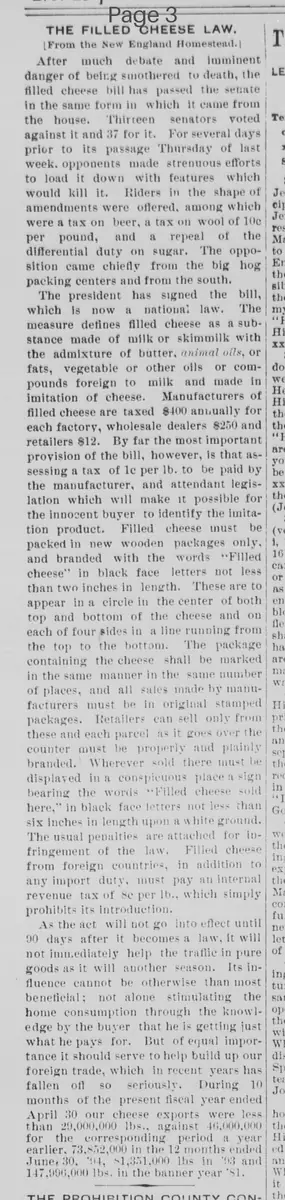
[From the New England Homestead.]
After much debate and imminent danger of being smothered to death, the filled cheese bill has passed the senate in the same form in which it came from the house. Thirteen senators voted against it and 37 for it. For several days prior to its passage Thursday of last week, opponents made strenuous efforts to load it down with features which would kill it. Riders in the shape of amendments were offered, among which were a tax on beer, a tax on wool of 10c per pound, and a repeal of the differential duty on sugar. The opposition came chiefly from the big hog packing centers and from the south.
The president has signed the bill, which is now a national law. The measure defines filled cheese as a substance made of milk or skimmilk with the admixture of butter, animal oils, or fats, vegetable or other oils or compounds foreign to milk and made in imitation of cheese. Manufacturers of filled cheese are taxed $400 annually for each factory, wholesale dealers $250 and retailers $12. By far the most important provision of the bill, however, is that assessing a tax of 1c per lb. to be paid by the manufacturer, and attendant legislation which will make it possible for the innocent buyer to identify the imitation product. Filled cheese must be packed in new wooden packages only, and branded with the words "Filled cheese" in black face letters not less than two inches in length. These are to appear in a circle in the center of both top and bottom of the cheese and on each of four sides in a line running from the top to the bottom. The package containing the cheese shall be marked in the same manner in the same number of places, and all sales made by manufacturers must be in original stamped packages. Retailers can sell only from these and each parcel as it goes over the counter must be properly and plainly branded. Wherever sold there must be displayed in a conspicuous place a sign bearing the words "Filled cheese sold here," in black face letters not less than six inches in length upon a white ground.
The usual penalties are attached for infringement of the law. Filled cheese from foreign countries, in addition to any import duty, must pay an internal revenue tax of 5c per lb., which simply prohibits its introduction.
As the act will not go into effect until 90 days after it becomes a law, it will not immediately help the traffic in pure goods as it will another season. Its influence cannot be otherwise than most beneficial; not alone stimulating the home consumption through the knowledge by the buyer that he is getting just what he pays for. But of equal importance it should serve to help build up our foreign trade, which in recent years has fallen off so seriously. During 10 months of the present fiscal year ended April 30 our cheese exports were less than 29,000,000 lbs., against 46,000,000 for the corresponding period a year earlier, 73,852,000 in the 12 months ended June 30, '94, 81,351,000 lbs in '93 and 147,996,000 lbs. in the banner year '91.
What sub-type of article is it?
What themes does it cover?
What keywords are associated?
Where did it happen?
Story Details
Location
United States
Event Date
Thursday Of Last Week (Senate Passage); Signed By President
Story Details
After debate, the filled cheese bill passes the Senate 37-13 and is signed into law by the President. It defines filled cheese as imitation made with non-milk fats, imposes taxes on manufacturers, dealers, and retailers, requires prominent labeling on packages and signs to identify it, prohibits imports, and aims to boost pure cheese trade amid declining exports.