Thank you for visiting SNEWPapers!
Sign up free
Daily National Intelligencer
Washington, District Of Columbia
What is this article about?
Article from Niles's Weekly Register details U.S. population from 1790-1810 censuses and projects growth to 1820 (nearly 10 million) and beyond to 1850 (over 21 million), highlighting faster expansion in western states and implications for national prosperity.
Clipping
OCR Quality
Full Text
FROM THE COMPILER.
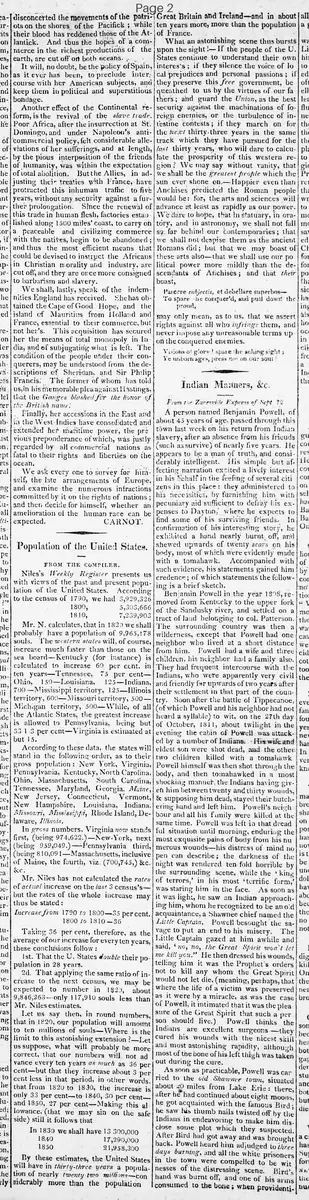
Niles's Weekly Register presents us with views of the past and present population of the United States. According to the census of 1790, we had 3,929,326
1800, 5,303,666
1810, 7,239,903
Mr. N. calculates, that in 1820 we shall probably have a population of 9,965,178 souls. The western states will, of course, increase much faster than those on the sea board—Kentucky (for instance) is calculated to increase 60 per cent. in ten years—Tennessee, 75 per cent—Ohio, 150—Louisiana, 125—Indiana, 700—Mississippi territory, 125—Illinois territory, 600—Missouri territory, 500—Michigan territory, 500—While, of all the Atlantic States, the greatest increase is allowed to Pennsylvania, being but 33 1/3 per cent—Virginia is estimated at but 15.
According to these data, the states will stand in the following order, as to their gross population: New York, Virginia, Pennsylvania, Kentucky, North Carolina, Ohio, Massachusetts, South Carolina, Tennessee, Maryland, Georgia, Maine, New Jersey, Connecticut, Vermont, New Hampshire, Louisiana, Indiana, Missouri, Mississippi, Rhode Island, Delaware, Illinois.
In gross numbers, Virginia now stands first, (being 974,622.)—New-York, next (being 959,049.)—Pennsylvania third, (being 810,091—Massachusetts, inclusive of Maine, the fourth, viz. (700,745,) &c. &c.
Mr. Niles has not calculated the rates of actual increase on the last 3 census's—but the rates of the whole increase may thus be stated:
Increase from 1790 to 1800—35 per cent
1800 to 1810—36
Taking 36 per cent, therefore, as the average of our increase for every ten years, these conclusions follow:
1st. That the U. States double their population in 28 years.
2d. That applying the same ratio of increase to the next census, we may be expected to number in 1820, about 9,846,268—only 117,910 souls less than Mr. Niles estimates.
Let us say then, in round numbers, that in 1820, our population will amount to ten millions of souls—Where is the limit to this astonishing extension?—Let us suppose, what will probably be more correct, that our numbers will not advance every ten years as much as 36 per cent—but that they increase about 3 per cent less in that period, in other words that from 1820 to 1830, the increase is only 33 per cent—to 1840, 30 per cent—and 1850, 27 per cent—Making this allowance, (that we may sin on the safe side) still it follows that
In 1830 we shall have 13,300,000
1840 17,290,000
1850 21,958,300
By these estimates, the United States will have in thirty-three years a population of nearly twenty-two millions—considerably more than the population of Great Britain and Ireland—and in about ten years more, more than the population of France.
What an astonishing scene thus bursts upon the sight!—If the people of the U. States continue to understand their own interests; if they silence the voice of local prejudices and personal passions; if they preserve this free government, bequeathed to us by the virtues of our fathers; and guard the Union, as the best security against the machinations of foreign enemies, or the turbulence of intestine contests; if they march on for the next thirty-three years in the same track which they have pursued for the last thirty years, who will dare to calculate the prosperity of this western region? We may say without vanity, that we shall be the greatest people which the sun ever shone on.—Happier even than Anchises predicted the Roman people would be: for, the arts and sciences will advance at least as rapidly as our power. We dare to hope, that in statuary, in oratory, and in astronomy, we shall not fall so far behind our contemporaries; that we shall not despise them as the ancient Romans did; but that we may boast of these arts also—that we shall use our political power more mildly than the descendants of Anchises; and that their boast,
Parcere subiectis, et debellare superbos—
To spare the conquer'd, and pull down the proud,
may only mean, as to us, that we assert rights against all who infringe them, and never impose any unreasonable terms upon the conquered enemies.
Visions of glory! spare the aching sight:
Ye unborn ages, press not on our soul
What sub-type of article is it?
What keywords are associated?
What entities or persons were involved?
Where did it happen?
Domestic News Details
Primary Location
United States
Key Persons
Event Details
Niles's Weekly Register provides population figures from censuses: 1790: 3,929,326; 1800: 5,303,666; 1810: 7,239,903. Projections for 1820: approximately 9,965,178 or 9,846,268 souls. Western states expected to grow faster, e.g., Indiana 700%, Missouri 500%. Atlantic states slower, e.g., Pennsylvania 33 1/3%, Virginia 15%. Future projections: 1830: 13,300,000; 1840: 17,290,000; 1850: 21,958,300. Discussion on implications for prosperity and global standing.