Thank you for visiting SNEWPapers!
Sign up free
Story
February 9, 1916
The Laramie Republican
Laramie, Albany County, Wyoming
What is this article about?
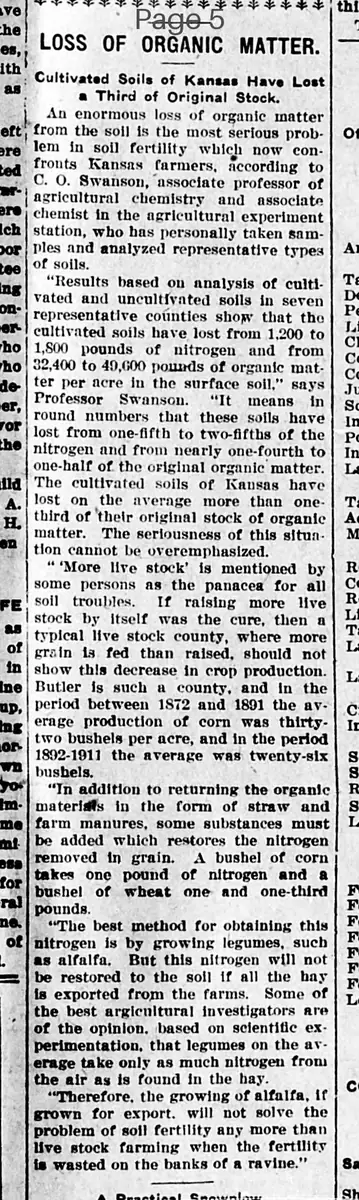
Kansas cultivated soils have lost one-third of original organic matter and significant nitrogen per acre, per Prof. C. O. Swanson's analysis, causing crop yield drops; livestock and legume farming proposed but ineffective if materials are exported.
Clipping
OCR Quality
95%
Excellent
Full Text
LOSS OF ORGANIC MATTER.
Cultivated Soils of Kansas Have Lost
Third of Original Stock.
An enormous loss of organic matter
from the soil is the most serious prob-
lem in soil fertility which now con-
fronts Kansas farmers, according to
C. O. Swanson, associate professor of
agricultural chemistry and associate
chemist in the agricultural experiment
station, who has personally taken sam-
ples and analyzed representative types
of soils.
"Results based on analysis of culti-
vated and uncultivated soils in seven
representative counties show that the
cultivated soils have lost from 1,200 to
1,500 pounds of nitrogen and from
32,400 to 49,600 pounds of organic mat-
ter per acre in the surface soil," says
Professor Swanson.
"It means
in
round numbers that these soils have
lost from one-fifth to two-fifths of the
nitrogen and from nearly one-fourth to
one-half of the original organic matter.
The cultivated soils of Kansas have
lost on the average more than one-
third of their original stock of organic
matter. The seriousness of this situa-
tion cannot be overemphasized.
" 'More live stock' is mentioned by
some persons as the panacea for all
soil troubles. If raising more live
stock by itself was the cure, then a
typical live stock county, where more
grain is fed than raised, should not
show this decrease in crop production.
Butler is such a county, and in the
period between 1872 and 1891 the av-
erage production of corn was thirty-
two bushels per acre, and in the period
1892-1911 the average was twenty-six
bushels.
"In addition to returning the organic
materials in the form of straw and
farm manures, some substances must
be added which restores the nitrogen
removed in grain. A bushel of corn
takes one pound of nitrogen and a
bushel of wheat one and one-third
pounds.
"The best method for obtaining this
nitrogen is by growing legumes, such
as alfalfa. But this nitrogen will not
be restored to the soil if all the hay
is exported from the farms. Some of
the best agricultural investigators are
of the opinion, based on scientific ex-
perimentation, that legumes on the av-
erage take only as much nitrogen from
the air as is found in the hay.
"Therefore, the growing of alfalfa, if
grown for export, will not solve the
problem of soil fertility any more than
live stock farming when the fertility
is wasted on the banks of a ravine."
Cultivated Soils of Kansas Have Lost
Third of Original Stock.
An enormous loss of organic matter
from the soil is the most serious prob-
lem in soil fertility which now con-
fronts Kansas farmers, according to
C. O. Swanson, associate professor of
agricultural chemistry and associate
chemist in the agricultural experiment
station, who has personally taken sam-
ples and analyzed representative types
of soils.
"Results based on analysis of culti-
vated and uncultivated soils in seven
representative counties show that the
cultivated soils have lost from 1,200 to
1,500 pounds of nitrogen and from
32,400 to 49,600 pounds of organic mat-
ter per acre in the surface soil," says
Professor Swanson.
"It means
in
round numbers that these soils have
lost from one-fifth to two-fifths of the
nitrogen and from nearly one-fourth to
one-half of the original organic matter.
The cultivated soils of Kansas have
lost on the average more than one-
third of their original stock of organic
matter. The seriousness of this situa-
tion cannot be overemphasized.
" 'More live stock' is mentioned by
some persons as the panacea for all
soil troubles. If raising more live
stock by itself was the cure, then a
typical live stock county, where more
grain is fed than raised, should not
show this decrease in crop production.
Butler is such a county, and in the
period between 1872 and 1891 the av-
erage production of corn was thirty-
two bushels per acre, and in the period
1892-1911 the average was twenty-six
bushels.
"In addition to returning the organic
materials in the form of straw and
farm manures, some substances must
be added which restores the nitrogen
removed in grain. A bushel of corn
takes one pound of nitrogen and a
bushel of wheat one and one-third
pounds.
"The best method for obtaining this
nitrogen is by growing legumes, such
as alfalfa. But this nitrogen will not
be restored to the soil if all the hay
is exported from the farms. Some of
the best agricultural investigators are
of the opinion, based on scientific ex-
perimentation, that legumes on the av-
erage take only as much nitrogen from
the air as is found in the hay.
"Therefore, the growing of alfalfa, if
grown for export, will not solve the
problem of soil fertility any more than
live stock farming when the fertility
is wasted on the banks of a ravine."
What sub-type of article is it?
Curiosity
What themes does it cover?
Misfortune
Nature
What keywords are associated?
Soil Fertility
Organic Matter Loss
Nitrogen Depletion
Kansas Agriculture
Crop Production Decline
What entities or persons were involved?
C. O. Swanson
Where did it happen?
Kansas
Story Details
Key Persons
C. O. Swanson
Location
Kansas
Story Details
Analysis shows cultivated Kansas soils have lost significant organic matter and nitrogen, averaging over one-third of original stock, leading to decreased crop production; solutions like livestock and legumes discussed but limited if fertility is exported.