Thank you for visiting SNEWPapers!
Sign up free
Story
May 26, 1829
Lancaster Gazette
Lancaster, Worcester County, Massachusetts
What is this article about?
Description of unusual animal associations where predators and prey coexist peacefully due to training, including a cat nursing rats and John Austin's London menagerie exhibiting cats, rats, mice, hawks, rabbits, and birds living harmoniously.
Clipping
OCR Quality
98%
Excellent
Full Text
MISCELLANEOUS.
Singular Association of Animals.
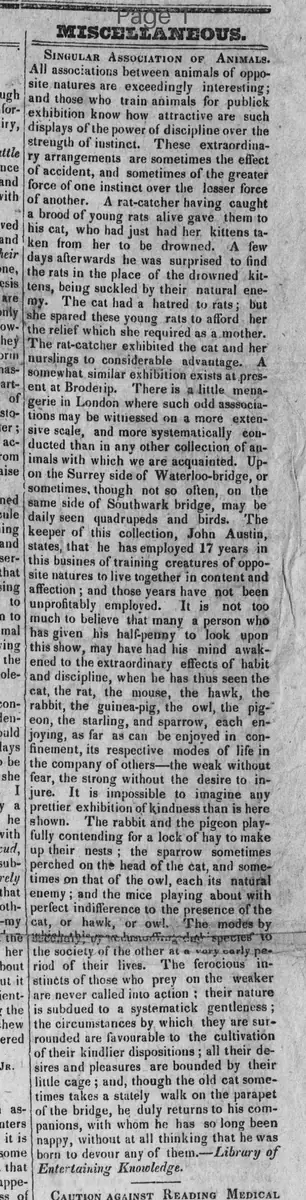
All associations between animals of opposite natures are exceedingly interesting; and those who train animals for publick exhibition know how attractive are such displays of the power of discipline over the strength of instinct. These extraordinary arrangements are sometimes the effect of accident, and sometimes of the greater force of one instinct over the lesser force of another. A rat-catcher having caught a brood of young rats alive gave them to his cat, who had just had her kittens taken from her to be drowned. A few days afterwards he was surprised to find the rats in the place of the drowned kittens, being suckled by their natural enemy. The cat had a hatred to rats; but she spared these young rats to afford her the relief which she required as a mother. The rat-catcher exhibited the cat and her nurslings to considerable advantage. A somewhat similar exhibition exists at present at Broderip. There is a little menagerie in London where such odd associations may be witnessed on a more extensive scale, and more systematically conducted than in any other collection of animals with which we are acquainted. Upon the Surrey side of Waterloo-bridge, or sometimes, though not so often, on the same side of Southwark bridge, may be daily seen quadrupeds and birds. The keeper of this collection, John Austin, states, that he has employed 17 years in this business of training creatures of opposite natures to live together in content and affection; and those years have not been unprofitably employed. It is not too much to believe that many a person who has given his half-penny to look upon this show, may have had his mind awakened to the extraordinary effects of habit and discipline, when he has thus seen the cat, the rat, the mouse, the hawk, the rabbit, the guinea-pig, the owl, the pigeon, the starling, and sparrow, each enjoying, as far as can be enjoyed in confinement, its respective modes of life in the company of others—the weak without fear, the strong without the desire to injure. It is impossible to imagine any prettier exhibition of kindness than is here shown. The rabbit and the pigeon playfully contending for a lock of hay to make up their nests; the sparrow sometimes perched on the head of the cat, and sometimes on that of the owl, each its natural enemy; and the mice playing about with perfect indifference to the presence of the cat, or hawk, or owl. The modes by which he has accustomed the species to the society of the other at a very early period of their lives. The ferocious instincts of those who prey on the weaker are never called into action; their nature is subdued to a systematic gentleness; the circumstances by which they are surrounded are favourable to the cultivation of their kindlier dispositions; all their desires and pleasures are bounded by their little cage; and, though the old cat sometimes takes a stately walk on the parapet of the bridge, he duly returns to his companions, with whom he has so long been happy, without at all thinking that he was born to devour any of them.—Library of Entertaining Knowledge.
Singular Association of Animals.
All associations between animals of opposite natures are exceedingly interesting; and those who train animals for publick exhibition know how attractive are such displays of the power of discipline over the strength of instinct. These extraordinary arrangements are sometimes the effect of accident, and sometimes of the greater force of one instinct over the lesser force of another. A rat-catcher having caught a brood of young rats alive gave them to his cat, who had just had her kittens taken from her to be drowned. A few days afterwards he was surprised to find the rats in the place of the drowned kittens, being suckled by their natural enemy. The cat had a hatred to rats; but she spared these young rats to afford her the relief which she required as a mother. The rat-catcher exhibited the cat and her nurslings to considerable advantage. A somewhat similar exhibition exists at present at Broderip. There is a little menagerie in London where such odd associations may be witnessed on a more extensive scale, and more systematically conducted than in any other collection of animals with which we are acquainted. Upon the Surrey side of Waterloo-bridge, or sometimes, though not so often, on the same side of Southwark bridge, may be daily seen quadrupeds and birds. The keeper of this collection, John Austin, states, that he has employed 17 years in this business of training creatures of opposite natures to live together in content and affection; and those years have not been unprofitably employed. It is not too much to believe that many a person who has given his half-penny to look upon this show, may have had his mind awakened to the extraordinary effects of habit and discipline, when he has thus seen the cat, the rat, the mouse, the hawk, the rabbit, the guinea-pig, the owl, the pigeon, the starling, and sparrow, each enjoying, as far as can be enjoyed in confinement, its respective modes of life in the company of others—the weak without fear, the strong without the desire to injure. It is impossible to imagine any prettier exhibition of kindness than is here shown. The rabbit and the pigeon playfully contending for a lock of hay to make up their nests; the sparrow sometimes perched on the head of the cat, and sometimes on that of the owl, each its natural enemy; and the mice playing about with perfect indifference to the presence of the cat, or hawk, or owl. The modes by which he has accustomed the species to the society of the other at a very early period of their lives. The ferocious instincts of those who prey on the weaker are never called into action; their nature is subdued to a systematic gentleness; the circumstances by which they are surrounded are favourable to the cultivation of their kindlier dispositions; all their desires and pleasures are bounded by their little cage; and, though the old cat sometimes takes a stately walk on the parapet of the bridge, he duly returns to his companions, with whom he has so long been happy, without at all thinking that he was born to devour any of them.—Library of Entertaining Knowledge.
What sub-type of article is it?
Animal Story
Curiosity
What themes does it cover?
Nature
Moral Virtue
What keywords are associated?
Animal Association
Cat Nursing Rats
Menagerie
John Austin
Training Animals
Peaceful Coexistence
Predator Prey Harmony
What entities or persons were involved?
John Austin
Rat Catcher
Where did it happen?
Surrey Side Of Waterloo Bridge, London; Southwark Bridge
Story Details
Key Persons
John Austin
Rat Catcher
Location
Surrey Side Of Waterloo Bridge, London; Southwark Bridge
Story Details
A rat-catcher gives young rats to a cat whose kittens were drowned; she nurses them. John Austin's 17-year menagerie in London trains cats, rats, mice, hawks, rabbits, guinea-pigs, owls, pigeons, starlings, and sparrows to live peacefully together from young age, subduing predatory instincts through habit and discipline.