Thank you for visiting SNEWPapers!
Sign up free
Daily Richmond Whig
Richmond, Virginia
What is this article about?
Editorial critiques the decline of the U.S. States Telegraph and rise of The Globe as the Jackson administration's organ, quoting The Globe's defense of President Jackson's potential re-election despite his constitutional amendment suggestion limiting terms to one.
Merged-components note: These two components form a single continuous editorial piece discussing the Globe, Telegraph, and political figures; the second directly continues and comments on the content of the first.
Clipping
OCR Quality
Full Text
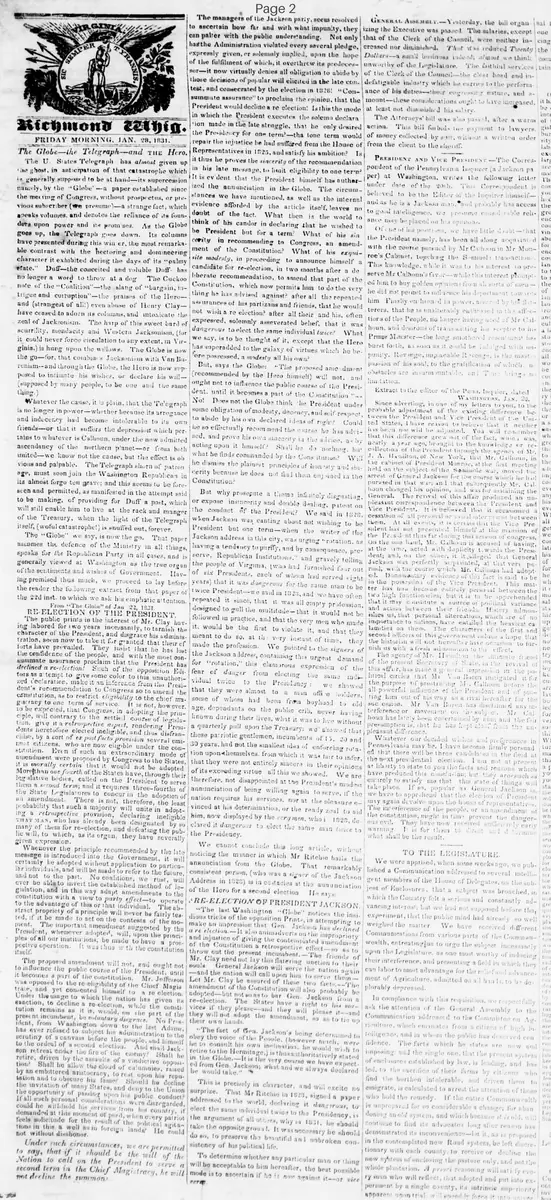
The U. States Telegraph has almost given up the ghost, in anticipation of that catastrophe which is generally supposed to be at hand—its supersession namely, by the "Globe"—a paper established since the meeting of Congress, without prospectus, or previous subscriber (we presume)—a strange fact, which speaks volumes, and denotes the reliance of its founders upon power and its promises. As the Globe goes up, the Telegraph goes down. Its columns have presented during this winter, the most remarkable contrast with the hectoring and domineering character it exhibited during the days of its "palmy state." Duff—the conceited and voluble Duff—has no longer a word to throw at a dog. The cuckoo note of the "Coalition"—the slang of "bargain, intrigue and corruption"—the praises of the Hero—and (strangest of all!) even abuse of Henry Clay—have ceased to adorn its columns, and intoxicate the zeal of Jacksonism. The harp of this sweet bard of scurrility, mendacity and Western Jacksonism, (for it could never force circulation to any extent, in Virginia,) is hung upon the willows. The Globe is now the go-for, that combines Jacksonism with Van Burenism—and through the Globe, the Hero is now supposed to intimate his wishes, or declare his will—(supposed by many people, to be one and the same thing.)
Whatever the cause, it is plain, that the Telegraph is no longer in power—whether because its arrogance and indecency had become intolerable to its own friends—or that it suffers the depression which pertains to whatever is Calhoun, under the now admitted ascendancy of the northern planet—or from both united—we know not the cause, but the effect is obvious and palpable. The Telegraph shorn of patronage, must soon join the Washington Republican in its almost forgotten grave; and this seems to be foreseen and permitted, as manifested in the attempt said to be making, of providing for Duff a post, which will still enable him to live at the rack and manger of the Treasury, when the light of the Telegraph itself, (woful catastrophe!) is snuffed out, forever.
The "Globe" we say, is now the go. That paper assumes the defence of the Ministry in all things, speaks for the Republican Party in all cases, and is generally viewed at Washington as the true organ of the sentiments and wishes of Government. Having premised thus much, we proceed to lay before the reader the following extract from that paper of the 22d inst. to which we ask his emphatic attention.
From "The Globe" of Jan 22, 1831
RE-ELECTION OF THE PRESIDENT.
The public prints in the interest of Mr. Clay having labored for two years incessantly, to tarnish the character of the President, and disgrace his administration, seem now to take it for granted that their efforts have prevailed. They insist that he has lost the confidence of the people, and with the most consummate assurance proclaim that the President has declined a re-election! Such of the opposition Editors as attempt to give some color to this unauthorized declaration, make it an inference from the President's recommendation to Congress so to amend the constitution, as to restrict eligibility to the chief magistracy to one term of service. It is not, however, to be expected, that Congress, in adopting the principle, will contrary to the settled course of legislation, give it a retrospective aspect, rendering Presidents heretofore elected ineligible, and thus disfranchise, by a sort of ex post facto provision several eminent citizens, who are now eligible under the constitution. Even if such an extraordinary mode of amendment were proposed by Congress to the States, it is morally certain that it would not be adopted. More than one fourth of the States have, through their legislative bodies, called on the President to serve them a second term; and it requires three-fourths of the State Legislatures to concur in the adoption of an amendment. There is not, therefore, the least probability that such a majority will unite in adopting a retrospective provision, declaring ineligible That Man, who has already been designated by so many of them for re-election, and defeating the public will, to which, as its organ, they have severally given expression.
Whenever the principle recommended by the late message is introduced into the Government, it will certainly be adopted without application to particular individuals, and will be made to refer to the future, and not to the past. No coalitions, we trust, will ever be able to invert the established method of legislation, and in this way adapt amendments to the constitution with a view to party effect—to operate to the advantage of this or that individual. The abstract propriety of a principle will never be fairly tested, if it be made to act on the contests of the moment. The important amendment suggested by the President, whenever adopted, will, upon the principles of all our institutions, be made to have a prospective operation. It was thus with the constitution itself.
The proposed amendment will not, and ought not to influence the public course of the President, until it becomes a part of the constitution. Mr. Jefferson was opposed to the re-eligibility of the Chief Magistrate, and yet consented himself to a re-election. Under the usage to which the nation has given its sanction, to decline a re-election, while the constitution remains as it is, would, on the part of the present incumbent, be voluntary disgrace. No President, from Washington down to the last Adams, has ever refused to subject his administration to the scrutiny of a canvass before the people, and himself to the ordeal of a second election. And shall Jackson retreat under the fire of the enemy? Shall he retire, driven by the assaults of a vindictive opposition? Shall he allow the cloud of calumnies, raised by an embittered aristocracy, to rest upon his reputation and to obscure his fame? Should he decline the invitation of many States, and deny to the Union the opportunity of passing upon his public conduct? If all such personal considerations were disregarded, could he withhold his services from his country, if demanded at this moment of peril, when every patriot feels solicitude for the result of the political agitations in this as well as in foreign lands? He could not without dishonor.
Under such circumstances, we are permitted to say, that if it should be the will of the Nation to call on the President to serve a second term in the Chief Magistracy, he will not decline the summons.
This is precisely in character, and will excite no surprise. That Mr. Ritchie in 1828, signed a paper addressed to the world, declaring it dangerous, to elect the same individual twice to the Presidency, is the argument of all others, why in 1831, he should take the opposite ground. It was necessary he should do so, to preserve the beautiful and unbroken consistency of his political life.
To determine whether any particular man or thing will be acceptable to him hereafter, the best possible mode is to ascertain if he is now against it—or vice versa.
What sub-type of article is it?
What keywords are associated?
What entities or persons were involved?
Editorial Details
Primary Topic
Decline Of The Telegraph And Rise Of The Globe As Jackson's Organ; Defense Of Jackson's Re Election
Stance / Tone
Critical Of Administration Media Shift And Sarcastic About Political Consistency
Key Figures
Key Arguments