Thank you for visiting SNEWPapers!
Sign up free
Letter to Editor
August 11, 1768
The Virginia Gazette
Richmond, Williamsburg, Richmond County, Virginia
What is this article about?
A letter to the printer requests insertion of Voltaire's essay on smallpox inoculation, which explains its origins among Circassians for preserving beauty and trade, adoption by Turks and English nobility via Lady Wortley Montague and the Princess of Wales, and its life-saving benefits over natural infection.
Clipping
OCR Quality
95%
Excellent
Full Text
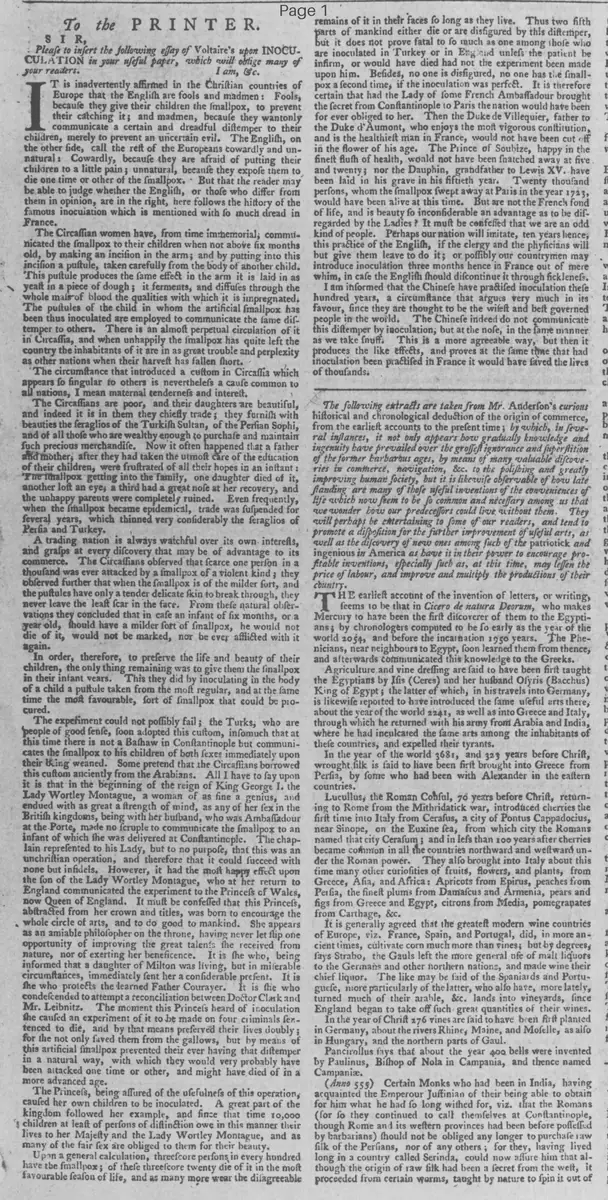
To the PRINTER.
Sir,
Please to insert the following essay of Voltaire's upon INOCULATION in your useful paper, which will oblige many of your readers.
I am, Sir,
It is inadvertently affirmed in the Christian countries of Europe that the English are fools and madmen: Fools, because they give their children the smallpox, to prevent their catching it; and madmen, because they wantonly communicate a certain and dreadful distemper to their children, merely to prevent an uncertain evil. The English, on the other side, call the rest of the Europeans cowardly and unnatural: Cowardly, because they are afraid of putting their children to a little pain; unnatural, because they expose them to die one time or other of the smallpox. But that the reader may be able to judge whether the English, or those who differ from them in opinion, are in the right, here follows the history of the famous inoculation which is mentioned with so much dread in France.
The Circassian women have, from time immemorial, communicated the smallpox to their children when not above six months old, by making an incision in the arm; and by putting into this incision a pustule, taken carefully from the body of another child. This pustule produces the same effect in the arm it is laid in as yeast in a piece of dough; it ferments, and diffuses through the whole mass of blood the qualities with which it is impregnated: The pustules of the child in whom the artificial smallpox has been thus inoculated are employed to communicate the same distemper to others. There is an almost perpetual circulation of it in Circassia, and when unhappily the smallpox has quite left the country the inhabitants of it are in as great trouble and perplexity as other nations when their harvest has fallen short.
The circumstance that introduced a custom in Circassia which appears so singular to others is nevertheless a cause common to all nations, I mean maternal tenderness and interest. The Circassians are poor, and their daughters are beautiful, and indeed it is in them they chiefly trade; they furnish with beauties the seraglios of the Turkish Sultan, of the Persian Sophi, and of all those who are wealthy enough to purchase and maintain such precious merchandise. Now it often happened that a father and mother after they had taken the utmost care of the education of their children, were frustrated of all their hopes in an instant: The smallpox getting into the family, one daughter died of it, another lost an eye, a third had a great nose at her recovery, and the unhappy parents were completely ruined. Even frequently, when the smallpox became epidemical, trade was suspended for several years, which thinned very considerably the seraglios of Persia and Turkey.
A trading nation is always watchful over its own interest, and grasps at every discovery that may be of advantage to its commerce. The Circassians observed that scarce one person in a thousand was ever attacked by a smallpox of a violent kind; they observed further that when the smallpox is of the milder sort, and the pustules have only a tender delicate skin to break through, they never leave the least scar in the face. From these natural observations they concluded that in case an infant of six months, or a year old, should have a milder sort of smallpox, he would not die of it, would not be marked, nor be ever afflicted with it again.
In order, therefore, to preserve the life and beauty of their children, the only thing remaining was to give them the smallpox in their infant years. This they did by inoculating in the body of a child a pustule taken from the most regular, and at the same time the most favourable, sort of smallpox that could be procured.
The experiment could not possibly fail; the Turks, who are people of good sense, soon adopted this custom, insomuch that at this time there is not a Bashaw in Constantinople but communicates the smallpox to his children of both sexes immediately upon their being weaned. Some pretend that the Circassians borrowed this custom anciently from the Arabians. All I have to say upon it is that in the beginning of the reign of King George I. the Lady Wortley Montague, a woman of as fine a genius, and endued with as great a strength of mind, as any of her sex in the British kingdoms, being with her husband, who was Ambassador at the Porte, made no scruple to communicate the smallpox to an infant of which she was delivered at Constantinople. The chaplain represented to his Lady, but to no purpose, that this was an unchristian operation, and therefore that it could succeed with none but infidels. However, it had the most happy effect upon the son of the Lady Wortley Montague, who at her return to England communicated the experiment to the Princess of Wales, now Queen of England. It must be confessed that this Princess, abstracted from her crown and titles, was born to encourage the whole circle of arts, and to do good to mankind. She appears as an amiable philosopher on the throne, having never let slip one opportunity of improving the great talents she received from nature, nor of exerting her beneficence. It is she who, being informed that a daughter of Milton was living, but in miserable circumstances, immediately sent her a considerable present. It is she who protects the learned Father Courayer. It is she who condescended to attempt a reconciliation between Doctor Clarke and Mr. Leibnitz. The moment this Princess heard of inoculation she caused an experiment of it to be made on four criminals sentenced to die, and by that means preserved their lives doubly; for she not only saved them from the gallows, but by means of this artificial smallpox prevented their ever having that distemper in a natural way, with which they would very probably have been attacked one time or other, and might have died of in a more advanced age.
The Princess, being assured of the usefulness of this operation, caused her own children to be inoculated. A great part of the kingdom followed her example, and since that time 10,000 children at least of persons of distinction owe in this manner their lives to her Majesty and the Lady Wortley Montague, and as many of the fair sex are obliged to them for their beauty.
Upon a general calculation, threescore persons in every hundred have the smallpox; of these threescore twenty die of it in the most favourable season of life, and as many more wear the disagreeable remains of it in their faces as long as they live. Thus two fifths parts of mankind either die or are disfigured by this distemper, but it does not prove fatal to so much as one among those who are inoculated in Turkey or in England unless the patient be infirm, or would have died had not the experiment been made upon him. Besides, no one is disfigured, no one has the smallpox a second time, if the inoculation was perfect. It is therefore certain that had the Lady of some French Ambassador brought the secret from Constantinople to Paris the nation would have been for ever obliged to her. Then the Duke de Villeroi, father to the Duke d'Aumont, who enjoys the most vigorous constitution, and is the healthiest man in France, would not have been cut off in the flower of his age. The Prince of Soubise, happy in the finest flush of health, would not have been snatched away at five and twenty; nor the Dauphin, grandfather to Lewis XV. have been laid in his grave in his fiftieth year. Twenty thousand persons, whom the smallpox swept away at Paris in the year 1723, would have been alive at this time. But are not the French fond of life, and is beauty so inconsiderable an advantage as to be disregarded by the Ladies? It must be confessed that we are an odd kind of people. Perhaps our nation will imitate, ten years hence, this practice of the English, if the clergy and the physicians will but give them leave to do it; or possibly our countrymen may introduce inoculation three months hence in France out of mere whim, in case the English should discontinue it through fickleness.
I am informed that the Chinese have practised inoculation these three hundred years, a circumstance that argues very much in its favour, since they are thought to be the wisest and best governed people in the world. The Chinese indeed do not communicate this distemper by inoculation; but at the nose, in the same manner as we take snuff. This is a more agreeable way, but then it produces the like effects, and proves at the same time that had inoculation been practised in France it would have saved the lives of thousands.
Sir,
Please to insert the following essay of Voltaire's upon INOCULATION in your useful paper, which will oblige many of your readers.
I am, Sir,
It is inadvertently affirmed in the Christian countries of Europe that the English are fools and madmen: Fools, because they give their children the smallpox, to prevent their catching it; and madmen, because they wantonly communicate a certain and dreadful distemper to their children, merely to prevent an uncertain evil. The English, on the other side, call the rest of the Europeans cowardly and unnatural: Cowardly, because they are afraid of putting their children to a little pain; unnatural, because they expose them to die one time or other of the smallpox. But that the reader may be able to judge whether the English, or those who differ from them in opinion, are in the right, here follows the history of the famous inoculation which is mentioned with so much dread in France.
The Circassian women have, from time immemorial, communicated the smallpox to their children when not above six months old, by making an incision in the arm; and by putting into this incision a pustule, taken carefully from the body of another child. This pustule produces the same effect in the arm it is laid in as yeast in a piece of dough; it ferments, and diffuses through the whole mass of blood the qualities with which it is impregnated: The pustules of the child in whom the artificial smallpox has been thus inoculated are employed to communicate the same distemper to others. There is an almost perpetual circulation of it in Circassia, and when unhappily the smallpox has quite left the country the inhabitants of it are in as great trouble and perplexity as other nations when their harvest has fallen short.
The circumstance that introduced a custom in Circassia which appears so singular to others is nevertheless a cause common to all nations, I mean maternal tenderness and interest. The Circassians are poor, and their daughters are beautiful, and indeed it is in them they chiefly trade; they furnish with beauties the seraglios of the Turkish Sultan, of the Persian Sophi, and of all those who are wealthy enough to purchase and maintain such precious merchandise. Now it often happened that a father and mother after they had taken the utmost care of the education of their children, were frustrated of all their hopes in an instant: The smallpox getting into the family, one daughter died of it, another lost an eye, a third had a great nose at her recovery, and the unhappy parents were completely ruined. Even frequently, when the smallpox became epidemical, trade was suspended for several years, which thinned very considerably the seraglios of Persia and Turkey.
A trading nation is always watchful over its own interest, and grasps at every discovery that may be of advantage to its commerce. The Circassians observed that scarce one person in a thousand was ever attacked by a smallpox of a violent kind; they observed further that when the smallpox is of the milder sort, and the pustules have only a tender delicate skin to break through, they never leave the least scar in the face. From these natural observations they concluded that in case an infant of six months, or a year old, should have a milder sort of smallpox, he would not die of it, would not be marked, nor be ever afflicted with it again.
In order, therefore, to preserve the life and beauty of their children, the only thing remaining was to give them the smallpox in their infant years. This they did by inoculating in the body of a child a pustule taken from the most regular, and at the same time the most favourable, sort of smallpox that could be procured.
The experiment could not possibly fail; the Turks, who are people of good sense, soon adopted this custom, insomuch that at this time there is not a Bashaw in Constantinople but communicates the smallpox to his children of both sexes immediately upon their being weaned. Some pretend that the Circassians borrowed this custom anciently from the Arabians. All I have to say upon it is that in the beginning of the reign of King George I. the Lady Wortley Montague, a woman of as fine a genius, and endued with as great a strength of mind, as any of her sex in the British kingdoms, being with her husband, who was Ambassador at the Porte, made no scruple to communicate the smallpox to an infant of which she was delivered at Constantinople. The chaplain represented to his Lady, but to no purpose, that this was an unchristian operation, and therefore that it could succeed with none but infidels. However, it had the most happy effect upon the son of the Lady Wortley Montague, who at her return to England communicated the experiment to the Princess of Wales, now Queen of England. It must be confessed that this Princess, abstracted from her crown and titles, was born to encourage the whole circle of arts, and to do good to mankind. She appears as an amiable philosopher on the throne, having never let slip one opportunity of improving the great talents she received from nature, nor of exerting her beneficence. It is she who, being informed that a daughter of Milton was living, but in miserable circumstances, immediately sent her a considerable present. It is she who protects the learned Father Courayer. It is she who condescended to attempt a reconciliation between Doctor Clarke and Mr. Leibnitz. The moment this Princess heard of inoculation she caused an experiment of it to be made on four criminals sentenced to die, and by that means preserved their lives doubly; for she not only saved them from the gallows, but by means of this artificial smallpox prevented their ever having that distemper in a natural way, with which they would very probably have been attacked one time or other, and might have died of in a more advanced age.
The Princess, being assured of the usefulness of this operation, caused her own children to be inoculated. A great part of the kingdom followed her example, and since that time 10,000 children at least of persons of distinction owe in this manner their lives to her Majesty and the Lady Wortley Montague, and as many of the fair sex are obliged to them for their beauty.
Upon a general calculation, threescore persons in every hundred have the smallpox; of these threescore twenty die of it in the most favourable season of life, and as many more wear the disagreeable remains of it in their faces as long as they live. Thus two fifths parts of mankind either die or are disfigured by this distemper, but it does not prove fatal to so much as one among those who are inoculated in Turkey or in England unless the patient be infirm, or would have died had not the experiment been made upon him. Besides, no one is disfigured, no one has the smallpox a second time, if the inoculation was perfect. It is therefore certain that had the Lady of some French Ambassador brought the secret from Constantinople to Paris the nation would have been for ever obliged to her. Then the Duke de Villeroi, father to the Duke d'Aumont, who enjoys the most vigorous constitution, and is the healthiest man in France, would not have been cut off in the flower of his age. The Prince of Soubise, happy in the finest flush of health, would not have been snatched away at five and twenty; nor the Dauphin, grandfather to Lewis XV. have been laid in his grave in his fiftieth year. Twenty thousand persons, whom the smallpox swept away at Paris in the year 1723, would have been alive at this time. But are not the French fond of life, and is beauty so inconsiderable an advantage as to be disregarded by the Ladies? It must be confessed that we are an odd kind of people. Perhaps our nation will imitate, ten years hence, this practice of the English, if the clergy and the physicians will but give them leave to do it; or possibly our countrymen may introduce inoculation three months hence in France out of mere whim, in case the English should discontinue it through fickleness.
I am informed that the Chinese have practised inoculation these three hundred years, a circumstance that argues very much in its favour, since they are thought to be the wisest and best governed people in the world. The Chinese indeed do not communicate this distemper by inoculation; but at the nose, in the same manner as we take snuff. This is a more agreeable way, but then it produces the like effects, and proves at the same time that had inoculation been practised in France it would have saved the lives of thousands.
What sub-type of article is it?
Informative
Historical
Persuasive
What themes does it cover?
Health Medicine
What keywords are associated?
Smallpox Inoculation
Voltaire Essay
Circassians
Lady Wortley Montague
Princess Of Wales
Health Benefits
French Adoption
What entities or persons were involved?
Voltaire
The Printer
Letter to Editor Details
Author
Voltaire
Recipient
The Printer
Main Argument
inoculation against smallpox, originating from circassia and adopted in england, prevents death and disfigurement from the disease more safely than natural infection, and should be embraced in france to save lives and preserve beauty.
Notable Details
- circassian practice for trading daughters
- lady wortley montague's adoption in constantinople
- princess of wales's experiments on criminals and her children
- chinese nasal inoculation for 300 years
- critique of french reluctance due to clergy and physicians