Thank you for visiting SNEWPapers!
Sign up free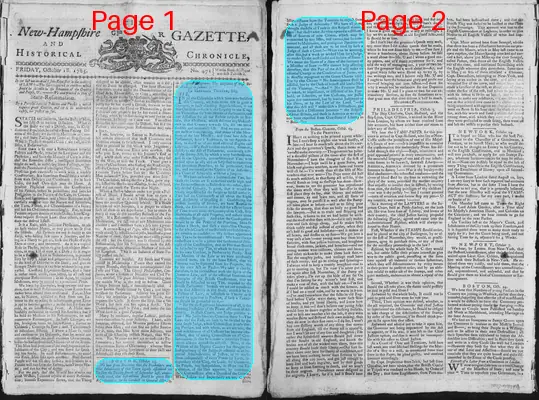
The New Hampshire Gazette And Historical Chronicle
Portsmouth, Greenland, Rockingham County, New Hampshire
What is this article about?
On September 24, Braintree inhabitants unanimously instructed representative Ebenezer Thayer to oppose the Stamp Act in the General Assembly, decrying its burdensome taxes, unconstitutional nature, and extension of Admiralty court powers without juries.
Merged-components note: This is a continuation of the Braintree instructions regarding the Stamp Act, split across pages; the second part was mislabeled as editorial but belongs to domestic_news.
Clippings
1 of 2
OCR Quality
Full Text
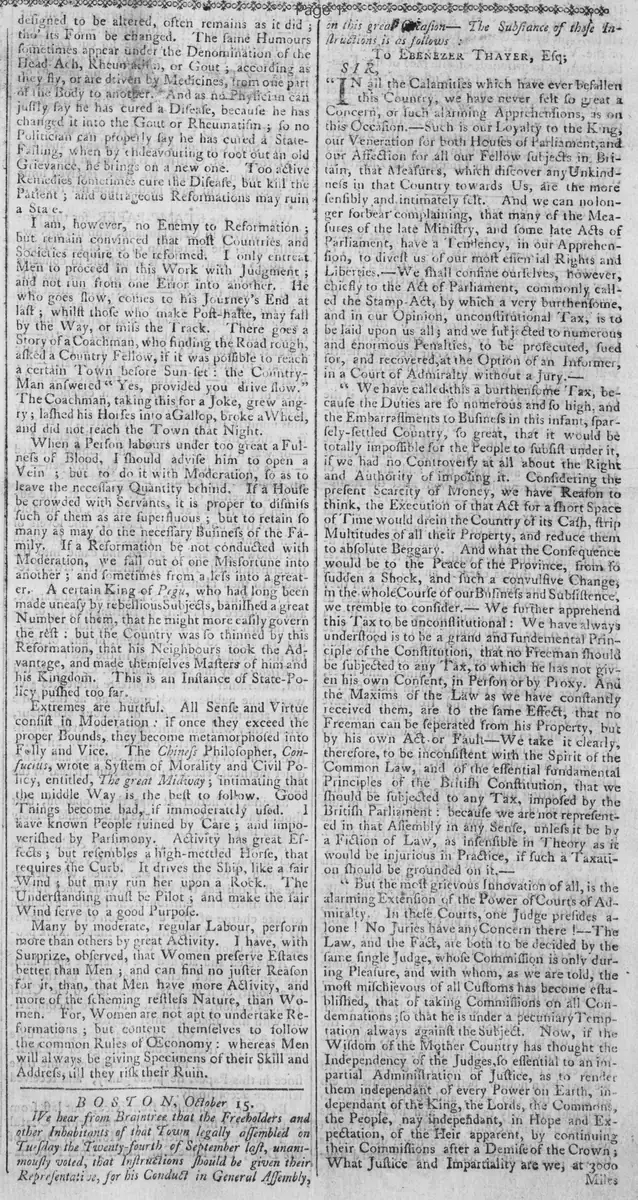
We hear from Braintree that the Freeholders and other Inhabitants of that Town legally assembled on Tuesday the Twenty-fourth of September last, unanimously voted, that Instructions should be given their Representative, for his Conduct in General Assembly,
on this great Occasion—The Substance of those Instructions is as follows:
To EBENEZER THAYER, Esq;
SIR,
"In all the Calamities which have ever befallen this Country, we have never felt so great a Concern, or such alarming Apprehensions, as on this Occasion.—Such is our Loyalty to the King, our Veneration for both Houses of Parliament, and our Affection for all our Fellow Subjects in Britain, that Measures, which discover any Unkindness in that Country towards Us, are the more sensibly and intimately felt. And we can no longer forbear complaining, that many of the Measures of the late Ministry, and some late Acts of Parliament, have a Tendency, in our Apprehension, to divest us of our most essential Rights and Liberties.—We shall confine ourselves, however, chiefly to the Act of Parliament, commonly call'd the Stamp-Act, by which a very burthensome, and in our Opinion, unconstitutional Tax, is to be laid upon us all; and we subjected to numerous and enormous Penalties, to be prosecuted, sued for, and recovered, at the Option of an Informer, in a Court of Admiralty without a Jury.—
"We have call'd this a burthensome Tax, because the Duties are so numerous and so high, and the Embarrassments to Business in this infant, partly-settled Country, so great, that it would be totally impossible for the People to subsist under it, if we had no Controversy at all about the Right and Authority of imposing it. Considering the present Scarcity of Money, we have Reason to think, the Execution of that Act for a short Space of Time would drain the Country of its Cash, strip Multitudes of all their Property, and reduce them to absolute Beggary. And what the Consequence would be to the Peace of the Province, from so sudden a Shock, and such a convulsive Change, in the whole Course of our Business and Subsistence, we tremble to consider.—We further apprehend this Tax to be unconstitutional: We have always understood it to be a grand and fundamental Principle of the Constitution, that no Freeman should be subjected to any Tax, to which he has not given his own Consent, in Person or by Proxy. And the Maxims of the Law as we have constantly received them, are to the same Effect, that no Freeman can be separated from his Property, but by his own Act or Fault—We take it clearly, therefore, to be inconsistent with the Spirit of the Common Law, and of the essential fundamental Principles of the British Constitution, that we should be subjected to any Tax, imposed by the British Parliament: because we are not represented in that Assembly in any Sense, unless it be by a Fiction of Law, as insensible in Theory as it would be injurious in Practice, if such a Taxation should be grounded on it.—
"But the most grievous Innovation of all, is the alarming Extension of the Power of Courts of Admiralty. In these Courts, one Judge presides alone! No Juries have any Concern there!—The Law, and the Fact, are both to be decided by the same single Judge, whose Commission is only during Pleasure, and with whom, as we are told, the most mischievous of all Customs has become established, that of taking Commissions on all Condemnations; so that he is under a pecuniary Temptation always against the Subject. Now, if the Wisdom of the Mother Country has thought the Independency of the Judges, so essential to an impartial Administration of Justice, as to render them independent of every Power on Earth, independent of the King, the Lords, the Commons, the People, nay independent, in Hope and Expectation, of the Heir apparent, by continuing their Commissions after a Demise of the Crown; What Justice and Impartiality are we, at such a time, to expect from this single Admiralty Judge, who is absolutely dependent on every Stroke of a Minister's Pen?"
Three thousand Miles distance from the Fountain to expect from Such a Judge of Admiralty? We have all along thought the Acts of Trade in this Respect a Grievance: but the Stamp-Act has opened a vast Number of Sources of new Crimes, which may be committed by any Man, and cannot, but be committed by Multitudes; and prodigious Penalties are annexed. and all these are to be tried by such a Judge of such a Court!--What can be wanting, after this, but a weak or wicked Man for a Judge, to render Us the most sordid and forlorn of Slaves? We mean the Slaves of a Slave of the Servants of a Minister of State:--We cannot help asserting therefore, that this Part of the Act will make an essential Change in the Constitution of Juries, and is directly repugnant to the Great Charter itself. For by that Charter "No Amerciament Shall be assessed, but by the Oath of honest and lawful Men of the Vicinage."-And "No Freeman Shall be taken, or imprisoned, or disseized of his Freehold, or Liberties, or free Customs, nor passed upon nor condemned, but by lawful Judgment of his Peers, or by the Law of the Land." So that this Act will "make such a Distinction, and create such a Difference between "the Subjects in Great-Britain, and those in America as we could not have expected from Guardians of Liberty in Both.
What sub-type of article is it?
What keywords are associated?
What entities or persons were involved?
Where did it happen?
Domestic News Details
Primary Location
Braintree
Event Date
Tuesday The Twenty Fourth Of September Last
Key Persons
Outcome
unanimous vote to issue instructions to the representative protesting the stamp act
Event Details
Freeholders and inhabitants of Braintree assembled and voted to instruct their representative on opposing the Stamp Act, detailing its burdensome taxes, unconstitutionality without representation, and extension of Admiralty courts without juries, which they saw as violating British constitutional principles and the Great Charter.