Thank you for visiting SNEWPapers!
Sign up free
The Evening Argus
Rock Island, Rock Island County County, Illinois
What is this article about?
Critical overview of General Benjamin F. Butler's Civil War military career, praising early successes like seizing Baltimore's Federal Hill and coining 'contraband' for escaped slaves, but highlighting failures at Big Bethel, Fort Fisher, and Drury's Bluff. Focuses on his alleged brutal treatment of chaplain Mr. Hudson, imprisoned in a gunpowder-filled tent after a critical letter.
Clipping
OCR Quality
Full Text
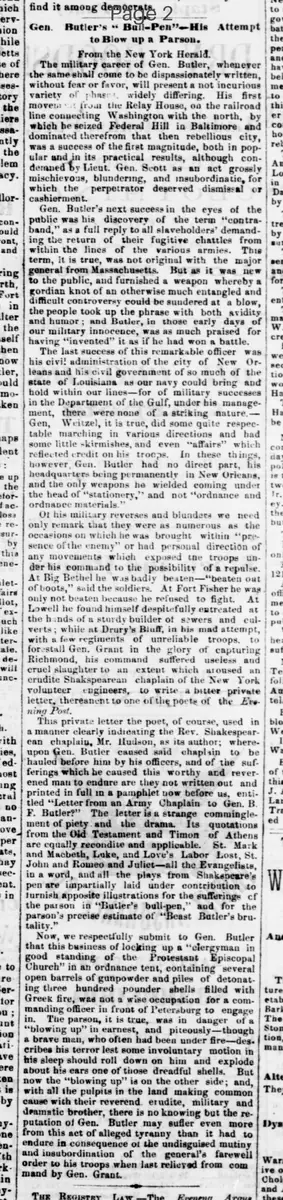
From the New York Herald.
The military career of Gen. Butler, whenever the same shall come to be dispassionately written, without fear or favor, will present a not incurious variety of phases, widely differing. His first movement from the Relay House, on the railroad line connecting Washington with the north, by which he seized Federal Hill in Baltimore and dominated therefrom that then rebellious city, was a success of the first magnitude, both in popular and in its practical results, although condemned by Lieut. Gen. Scott as an act grossly mischievous, blundering, and insubordinate, for which the perpetrator deserved dismissal or cashierment. Gen. Butler's next success in the eyes of the public was his discovery of the term "contraband," as a full reply to all slaveholders' demanding the return of their fugitive chattels from within the lines of the various armies. This term, it is true, was not original with the major general from Massachusetts. But as it was new to the public, and furnished a weapon whereby a Gordian knot of an otherwise much entangled and difficult controversy could be sundered at a blow, the people took up the phrase with both avidity and humor; and Butler, in those early days of our military innocence, was as much praised for having "invented" it as if he had won a battle. The last success of this remarkable officer was his civil administration of the city of New Orleans and his civil government of so much of the state of Louisiana as our navy could bring and hold within our lines—for of military successes in the Department of the Gulf, under his management, there were none of a striking nature. Gen. Weitzel, it is true, did some quite respectable marching in various directions and had some little skirmishes, and even "affairs" which reflected credit on his troops. In these things, however, Gen. Butler had no direct part, his headquarters being permanently in New Orleans, and the only weapons he wielded coming under the head of "stationery," and not "ordnance and ordnance materials." Of his military reverses and blunders we need only remark that they were as numerous as the occasions on which he was brought within "presence of the enemy" or had personal direction of any movements which exposed the troops under his command to the possibility of a repulse. At Big Bethel he was badly beaten—"beaten out of boots," said the soldiers. At Fort Fisher he was only not beaten because he refused to fight. At Lowell he found himself despitefully entreated at the hands of a sturdy builder of sewers and culverts; while at Drury's Bluff, in his mad attempt, with a few regiments of unreliable troops, to forestall Gen. Grant in the glory of capturing Richmond, his command suffered useless and cruel slaughter to an extent which aroused an erudite Shakspearean chaplain of the New York volunteer engineers, to write a bitter private letter, thereanent to one of the poets of the Evening Post. This private letter the poet, of course, used in a manner clearly indicating the Rev. Shakspearean chaplain, Mr. Hudson, as its author; whereupon Gen. Butler caused said chaplain to be hauled before him by his officers, and of the sufferings which he caused this worthy and reverend man to endure are they not written out and printed in full in a pamphlet now before us, entitled "Letter from an Army Chaplain to Gen. B. F. Butler?" The letter is a strange comminglement of piety and the drama. Its quotations from the Old Testament and Timon of Athens are equally recondite and applicable. St. Mark and Macbeth, Luke, and Love's Labor Lost, St. John and Romeo and Juliet—all the Evangelists, in a word, and all the plays from Shakspeare's pen are impartially laid under contribution to furnish apposite illustrations for the sufferings of the parson in "Butler's bull-pen," and for the parson's precise estimate of "Beast Butler's brutality." Now, we respectfully submit to Gen. Butler that this business of locking up a "clergyman in good standing of the Protestant Episcopal Church" in an ordnance tent, containing several open barrels of gunpowder and piles of detonating three hundred pounder shells filled with Greek fire, was not a wise occupation for a commanding officer in front of Petersburg to engage in. The parson, it is true, was in danger of a "blowing up" in earnest, and piteously—though a brave man, who often had been under fire—describes his terror lest some involuntary motion in his sleep should roll down on him and explode about his ears one of those dreadful shells. But now the "blowing up" is on the other side; and, with all the pulpits in the land making common cause with their reverend, erudite, military and dramatic brother, there is no knowing but the reputation of Gen. Butler may suffer even more from this act of alleged tyranny than it had to endure in consequence of the undisguised mutiny and insubordination of the general's farewell order to his troops when last relieved from command by Gen. Grant.
What sub-type of article is it?
What themes does it cover?
What keywords are associated?
What entities or persons were involved?
Where did it happen?
Story Details
Key Persons
Location
Baltimore, New Orleans, Louisiana, Big Bethel, Fort Fisher, Drury's Bluff, Petersburg
Story Details
Overview of Gen. Butler's Civil War career successes and failures, focusing on his imprisonment of chaplain Mr. Hudson in a dangerous tent after a critical letter, as detailed in the chaplain's pamphlet.