Thank you for visiting SNEWPapers!
Sign up free
Story
December 23, 1909
The Mena Weekly Star
Mena, Polk County, Arkansas
What is this article about?
Article on how naturalists collect crustacea: from fish stomachs, foreign ships (e.g., Chilian crab via Dr. Clark and Vallentin), and crabs bearing other species, highlighting Maia squinado in Cornwall.
Clipping
OCR Quality
98%
Excellent
Full Text
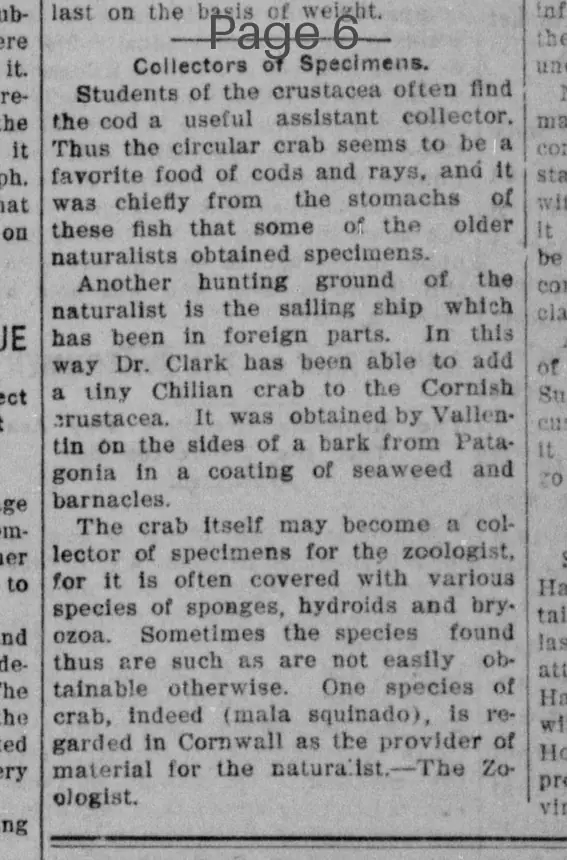
Collectors of Specimens.
Students of the crustacea often find the cod a useful assistant collector. Thus the circular crab seems to be a favorite food of cods and rays, and it was chiefly from the stomachs of these fish that some of the older naturalists obtained specimens.
Another hunting ground of the naturalist is the sailing ship which has been in foreign parts. In this way Dr. Clark has been able to add a tiny Chilian crab to the Cornish crustacea. It was obtained by Vallentin on the sides of a bark from Patagonia in a coating of seaweed and barnacles.
The crab itself may become a collector of specimens for the zoologist, for it is often covered with various species of sponges, hydroids and bryozoa. Sometimes the species found thus are such as are not easily obtainable otherwise. One species of crab, indeed (Maia squinado), is regarded in Cornwall as the provider of material for the naturalist.—The Zoologist.
Students of the crustacea often find the cod a useful assistant collector. Thus the circular crab seems to be a favorite food of cods and rays, and it was chiefly from the stomachs of these fish that some of the older naturalists obtained specimens.
Another hunting ground of the naturalist is the sailing ship which has been in foreign parts. In this way Dr. Clark has been able to add a tiny Chilian crab to the Cornish crustacea. It was obtained by Vallentin on the sides of a bark from Patagonia in a coating of seaweed and barnacles.
The crab itself may become a collector of specimens for the zoologist, for it is often covered with various species of sponges, hydroids and bryozoa. Sometimes the species found thus are such as are not easily obtainable otherwise. One species of crab, indeed (Maia squinado), is regarded in Cornwall as the provider of material for the naturalist.—The Zoologist.
What sub-type of article is it?
Curiosity
What themes does it cover?
Nature
Exploration
What keywords are associated?
Crustacea Specimens
Cod Collectors
Sailing Ship Finds
Crab Zoology
Cornish Naturalists
What entities or persons were involved?
Dr. Clark
Vallentin
Where did it happen?
Cornwall, Patagonia
Story Details
Key Persons
Dr. Clark
Vallentin
Location
Cornwall, Patagonia
Story Details
Naturalists collect crustacea specimens from cod and ray stomachs, sailing ships from foreign parts like a Chilian crab from a Patagonian bark, and crabs covered in sponges, hydroids, and bryozoa, with Maia squinado noted in Cornwall as a provider.