Thank you for visiting SNEWPapers!
Sign up free
Daily National Intelligencer
Washington, District Of Columbia
What is this article about?
Part VII of an editorial advocating a strict system of retaliation against British impressment of native American citizens during peace, proposing a congressional law to seize and confine British subjects within the US until impressed Americans are freed, ensuring honorable peace post-War of 1812. Praises Washington's past retaliatory firmness.
Merged-components note: Continuation of the multi-part editorial essay 'CONSIDERATIONS ON AN HONORABLE PEACE BETWEEN THE UNITED STATES OF AMERICA AND THE UNITED KINGDOM OF G. BRITAIN AND IRELAND' (No. VII) across pages 2 and 3, maintaining coherent topic and flow.
Clippings
1 of 2
OCR Quality
Full Text
CONSIDERATIONS
ON AN HONORABLE PEACE BETWEEN
THE UNITED STATES OF AMERICA
AND THE UNITED KINGDOM OF G.
BRITAIN AND IRELAND
Ha tibi erunt artes; pacisque imponere morem,
Parcere subjectis, et debellare superbos.
Eneid Lib. VI.
Our great forefathers held this prudent course.
Thus rul'd their ardor, thus preserved their force;
By laws, like these, immortal conquests made,
And earth's proud tyrants low in ashes laid.
Iliad Lib. IV.
NO VII
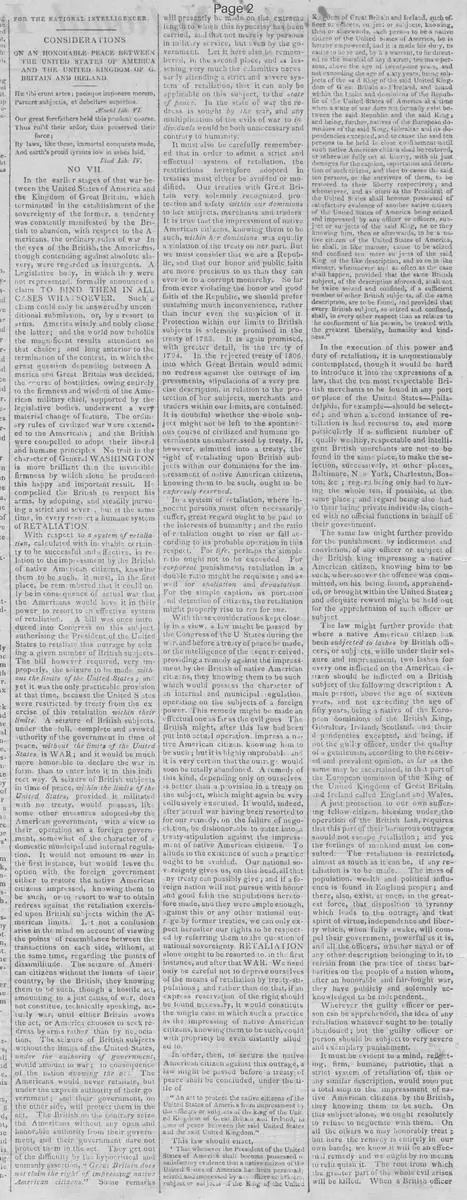
In the earlier stages of that war between the United States of America and the Kingdom of Great Britain, which terminated in the establishment of the sovereignty of the former, a tendency was constantly manifested by the British to abandon, with respect to the Americans, the ordinary rules of war. In the eyes of the British, the Americans, though contending against absolute slavery, were regarded as insurgents. A Legislative body, in which they were not represented, formally announced a claim TO BIND THEM IN ALL CASES WHATSOEVER. Such a claim could only be answered by unconditional submission, or, by a resort to arms. America wisely and nobly chose the latter: and the world now beholds the magnificent results attendant on that choice: and long anterior to the termination of the contest, in which the great question depending between America and Great Britain was decided, the course of hostilities, owing entirely to the firmness and wisdom of the American military chief, supported by the legislative bodies, underwent a very material change of feature. The ordinary rules of civilized war were extended to the Americans: and the British were compelled to adopt their liberal and humane principles. No trait in the character of General WASHINGTON is more brilliant than the invincible firmness by which alone he produced this happy and important result. He compelled the British to respect his arms, by adopting, and steadily pursuing a strict and severe, but at the same time, in every respect a humane system of RETALIATION.
With respect to a system of retaliation, calculated with inevitable certainty to be successful and effective, in relation to the impressment by the British of native American citizens, knowing them to be such, it must, in the first place, be remembered that it could only be in consequence of actual war that the Americans would have it in their power to resort to an effective system of retaliation. A bill was once introduced into Congress on this subject, authorising the President of the United States to retaliate this outrage by seizing a given number of British subjects. The bill however required, very improperly, the seizure to be made without the limits of the United States; and yet it was the only practicable provision at that time, because the United States were restricted by treaty from the exercise of this retaliation within their limits. A seizure of British subjects, under the full, complete and avowed authority of the government in time of peace, without the limits of the United States, is WAR; and it would be much more honorable to declare the war in form, than to enter into it in this indirect way. A seizure of British subjects in time of peace, within the limits of the United States, provided it militated with no treaty, would possess, like some other measures adopted by the American government, with a view to their operation on a foreign government, somewhat of the character of a domestic municipal and internal regulation. It would not amount to war in the first instance, but would leave the option with the foreign government either to restore the native American citizens impressed, knowing them to be such, or to resort to war to obtain redress against the retaliation exercised upon British subjects within the American limits. Let not a confusion arise in the mind on account of viewing the points of resemblance between the transactions on each side, without, at the same time, regarding the points of dissimilitude. The seizure of American citizens without the limits of their country, by the British, they knowing them to be such, though a hostile act, amounting to a just cause of war, does not constitute, technically speaking, actual war, until either Britain avows the act, or America chooses to seek redress by arms rather than by negotiation. The seizure of British subjects without the limits of the United States, under the authority of government, would amount to war; in consequence of the nation avowing the act. The Americans would never retaliate, but under the express authority of their government; and their government, on the other side, will protect them in the act. The British on the contrary seize the Americans without any open and honorable authority from their government, and their government dare not protect them in the act. They get out of the difficulty by the hypocritical and unmanly assertion, "Great Britain does not claim the right of impressing native American citizens."
Some remarks will presently be made on the extreme length to which this hypocrisy has been carried, and that not merely by persons in military service, but even by the government. Let it here also be remembered, in the second place, and as lessening very much the calamities necessarily attending a strict and severe system of retaliation, that it can only be applicable on this subject, to the state of peace. In the state of war the redress is sought by the war, and any multiplication of the evils of war to individuals would be both unnecessary and contrary to humanity.
It must also be carefully remembered that in order to admit a strict and effectual system of retaliation, the restrictions heretofore adopted in treaties must either be avoided or modified. Our treaties with Great Britain very solemnly recognized protection and safety within our dominions to her subjects, merchants and traders. It is true that the impressment of native American citizens, knowing them to be such, within her dominions was equally a violation of the treaty on her part. But we must consider that we are a Republic, and that our honor and public faith are more precious to us than they can ever be to a corrupt monarchy. So far from ever violating the honor and good faith of the Republic, we should prefer sustaining much inconvenience, rather than incur even the suspicion of it. Protection within our limits to British subjects is solemnly promised in the treaty of 1783. It is again promised, with greater detail, in the treaty of 1794. In the rejected treaty of 1806 into which Great Britain would admit no redress against the outrage of impressments, stipulations of a very precise description, in relation to the protection of her subjects, merchants and traders within our limits, are contained.
It is doubtful whether the whole subject might not be left to the spontaneous course of civilized and humane governments unembarrassed by treaty. If, however, admitted into a treaty, the right of retaliating upon British subjects within our dominions for the impressment of native American citizens, knowing them to be such, ought to be expressly reserved.
In a system of retaliation, where innocent persons must often necessarily suffer, great regard ought to be paid to the interests of humanity; and the ratio of retaliation ought to rise or fall according to its probable operation in this respect. For life, perhaps the simple ratio ought not to be exceeded. For corporeal punishment, retaliation in a double ratio might be requisite; and as well for spoliation and devastation. For the simple caption, as portation and detention of citizens, the retaliation might properly rise to ten for one.
With these considerations kept closely in a view, a law might be passed by the Congress of the U States during the war, and before a treaty of peace be made, or the intelligence of the event received, providing a remedy against the impressment by the British of native American citizens, they knowing them to be such, which would possess the character of an internal and municipal regulation, operating on the subjects of a foreign power. This remedy might be made an effectual one as far as the evil goes. The British might, after this law had been put into actual operation, impress a native American citizen, knowing him to be such; but it is highly improbable and it is very certain that the outrage would soon be totally abandoned. A remedy of this kind, depending only on ourselves is better than a provision in a treaty on the subject, which might again be very collusively executed. It would, indeed, after actual war having been resorted to for our remedy, on the failure of negotiation, be dishonorable to enter into a treaty-stipulation against the impressment of native American citizens. To allude to the existence of such a practice ought to be avoided. Our national sovereignty gives us, on this head, all that any treaty can possibly give; and if a foreign nation will not pursue with honor and good faith the stipulations heretofore made, and they were ample enough, against this or any other national outrage by former treaties, we can only expect hereafter our rights to be respected by referring them to the question of national sovereignty. RETALIATION alone ought to be resorted to, in the first instance, and after that WAR. We need only be careful not to deprive ourselves of the means of retaliation by treaty-stipulations; and rather than do that, if an express reservation of the right should be found necessary, it would constitute the single case in which such a practice as the impressing of native American citizens, knowing them to be such, could with propriety be even distantly alluded to.
In order, then, to secure the native American citizen against this outrage, a law might be passed before a treaty of peace shall be concluded, under the title of
"An act to protect the native citizens of the United States of America from impressment by the officers or subjects of the king of the United Kingdom of Great Britain and Ireland, in time of peace between the said United States and the said United Kingdom."
This law should enact,
That whenever the President of the United States of America shall become possessed of satisfactory evidence that a native citizen of the United States of America has been personally seized and impressed by any officer or officers, subject or subjects of the King of the United Kingdom of Great Britain and Ireland, such officer or officers, subject or subjects, knowing, then or afterwards, such person to be a native citizen of the United States of America, he is hereby empowered, and it is made his duty, to cause to be seized, by his warrant, to be directed to the marshal of any district, ten male persons, above the age of twenty-one years, and not exceeding the age of sixty years, being subjects of the said King of the said United Kingdom of Great Britain and Ireland, and found within the limits and dominions of the Republic of the United States of America at a time when a state of war does not formally exist between the said Republic and the said King; and being, further, natives of the European dominions of the said King. Gibraltar and its dependencies excepted, and to cause the said ten persons to be held in close confinement until such native American citizen shall be restored, or otherwise fully set at liberty, with all just damages for the caption, asportation and detention of such citizen, and then to cause the said ten persons, or the survivors of them, to be restored to their liberty respectively; and whensoever, and as often as the President of the United States shall become possessed of satisfactory evidence of another native citizen of the United States of America being seized and impressed by any officer or officers, subject or subjects of the said King, he or they knowing him, then or afterwards, to be a native citizen of the United States of America, he shall, in like manner, cause to be seized and confined ten more subjects of the said King of the like description, and so on in like manner, whensoever and as often as the case shall happen, provided that the same British subject, of the description aforesaid, shall not be twice seized and confined, if a sufficient number of other British subjects, of the same description, are to be found, and provided that every British subject, so seized and confined, shall, in every other respect than as relates to the confinement of his person, be treated with the greatest liberality, humanity and kindness."
In the execution of this power and duty of retaliation, it is unquestionably contemplated, though it would be hard to introduce it into the expressions of a law, that the ten most respectable British merchants to be found in any port or place of the United States--Philadelphia, for example--should be selected: and when a second instance of retaliation is had recourse to, and more particularly if a sufficient number of equally wealthy, respectable and intelligent British merchants are not to be found in the same place, to make the selection, successively, at other places, Baltimore, New York, Charleston, Boston, &c.; regard being only had to having the whole ten, if possible, at the same place; and regard being also had to their being private individuals, clothed with no official functions in behalf of their government.
The same law might further provide for the punishment, by indictment and conviction, of any officer or subject of the British king impressing a native American citizen, knowing him to be such, wheresoever the offence was committed, on his being found, apprehended, or brought within the United States; and adequate reward might be held out for the apprehension of such officer or subject.
The law might further provide that where a native American citizen has been subjected to lashes by British officers, or subjects, while under their seizure and impressment, two lashes for every one inflicted on the American citizen should be inflicted on a British subject of the following description: A male person, above the age of sixteen years, and not exceeding the age of fifty years, being a native of the European dominions of the British King, Gibraltar, Ireland, Scotland, and their dependencies excepted, and being, if not the guilty officer, under the quality of a gentleman, according to the received and prevalent opinion, as far as the same may be ascertained, in that part of the European dominion of the King of the United Kingdom of Great Britain and Ireland called England and Wales.
A just protection to our own suffering fellow-citizen, bleeding under the operation of the British lash, requires that this part of their barbarous outrages should not escape retaliation; and yet the feelings of mankind must be consulted. The retaliation is restricted, almost as much as it can be, if any retaliation is to be made. The mass of population, wealth and political influence is found in England proper; and there, also, exist, at once, in the greatest force, that disposition to tyranny which leads to the outrage, and that spirit of virtue, independence and liberty which, when fully awake, will compel their government, powerful as it is, and all the officers, whether naval or of any other description belonging to it, to refrain from the practice of these barbarities on the people of a nation whom, after an honorable and fair-fought war, they have publicly and solemnly acknowledged to be independent.
Wherever the guilty officer or person can be apprehended, the idea of any retaliation whatever ought to be totally abandoned; but the guilty officer or person should be subject to very severe and exemplary punishment.
It must be evident to a mind, reflecting, firm, humane, patriotic, that a strict system of retaliation of this or any similar description, would soon put a total stop to the impressment of native American citizens by the British, they knowing them to be such. On this subject alone, we ought resolutely to refuse to negotiate with them. On all the others we may honorably treat; but here the remedy is entirely in our own hands; we know it will be an effectual remedy and we ought by no means to relinquish it. The root from which the greater part of the whole evil arises will be killed. When a British officer or subject does not dare to impress a native American citizen, knowing him to be such we shall stand on much better ground, and have a much fairer prospect of success when we seek redress in the case of the native American impressed not knowing him to be such and in the case of the naturalized citizen. On one great and principal part of the subject we shall stand clear. Our victory will be perfect and complete. If we are true to ourselves we need little fear the oppression of others. If we are true to ourselves, those who wish to be naturalized will have a pledge of our fidelity and firmness, and will perceive that as we have the power, so we have the will, to give them effectual and with no great variation of mode, the protection we stipulate when they enter into the arms and bosom of our country.
In actual and declared war the provisions of antecedent treaties, founded on and applicable only to the state of peace, become null; and we are, therefore, free by a legislative provision of our own, where the ground is perfectly clear and undisputed, where no extraneous considerations can possibly have an embarrassing influence, to establish THE PERPETUAL IMMUNITY OF THE NATIVE AMERICAN CITIZEN FROM BRITISH IMPRESSMENT.
CINCINNATUS.
Georgetown, October 28th, 1813.
What sub-type of article is it?
What keywords are associated?
What entities or persons were involved?
Editorial Details
Primary Topic
Retaliation Against British Impressment For Honorable Peace
Stance / Tone
Advocating Strict And Humane Retaliation To End Impressment
Key Figures
Key Arguments