Thank you for visiting SNEWPapers!
Sign up free
Story
September 7, 1900
The Laramie Republican
Laramie, Albany County, Wyoming
What is this article about?
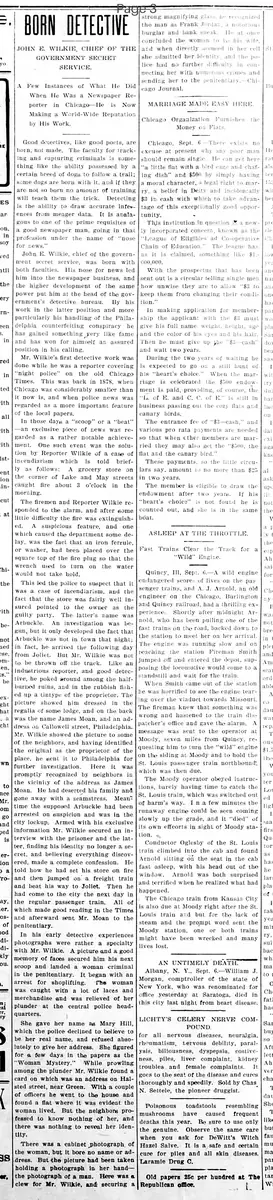
John E. Wilkie, chief of the U.S. Secret Service, began his career as a Chicago newspaper reporter in 1878, using keen detective skills to solve cases like an arson at a grocery store by identifying the owner via a tintype photo and a shoplifting incident by recognizing a burglar's wife in a photo.
Clipping
OCR Quality
98%
Excellent
Full Text
BORN DETECTIVE
JOHN E. WILKIE, CHIEF OF THE GOVERNMENT SECRET SERVICE.
A Few Instances of What He Did When He Was a Newspaper Reporter in Chicago—He is Now Making a World-Wide Reputation by His Work.
Good detectives, like good poets, are born, not made. The faculty for tracking and capturing criminals is something like the ability possessed by a certain breed of dogs to follow a trail; some dogs are born with it, and if they are not so born no amount of training will teach them the trick. Detecting is the ability to draw accurate inferences from meager data. It is analogous to one of the prime requisites of a good newspaper man, going in that profession under the name of "nose for news."
John E. Wilkie, chief of the government secret service, was born with both faculties. His nose for news led him into the newspaper business, and the higher development of the same power put him at the head of the government's detective bureau. By his work in the latter position and more particularly his handling of the Philadelphia counterfeiting conspiracy he has gained something very like fame and has won for himself an assured position in his calling.
Mr. Wilkie's first detective work was done while he was a reporter covering "night police" on the old Chicago Times. This was back in 1878, when Chicago was considerably smaller than it now is, and when police news was regarded as a more important feature of the local papers.
In those days a "scoop" or a "beat"—an exclusive piece of news—was regarded as a rather notable achievement. One such event was the solution by Reporter Wilkie of a case of incendiarism which is told briefly as follows: A grocery store on the corner of Lake and May streets caught fire about 3 o'clock in the morning.
The firemen and Reporter Wilkie responded to the alarm, and after some little difficulty the fire was extinguished. A suspicious feature, and one which caused the department some delay, was the fact that an iron ferrule, or washer, had been placed over the square top of the fire plug so that the wrench used to turn on the water would not take hold.
This led the police to suspect that it was a case of incendiarism, and the fact that the store was fairly well insured pointed to the owner as the guilty party. The latter's name was Arbuckle. An investigation was begun, but it only developed the fact that Arbuckle was not in town that night; in fact, he arrived the following day from Joliet. But Mr. Wilkie was not to be thrown off the track. Like an industrious reporter and good detective, he poked around among the half-burned ruins, and in the rubbish fished up a tintype of the proprietor. The picture showed him dressed in the regalia of some lodge, and on the back was the name James Moan, and an address on Callowell street, Philadelphia.
Mr. Wilkie showed the picture to some of the neighbors, and having identified the original as the proprietor of the place, he sent it to Philadelphia for further investigation. Here it was promptly recognized by neighbors in the vicinity of the address as James Moan. He had deserted his family and gone away with a seamstress. Meantime the supposed Arbuckle had been arrested on suspicion and was in the city lockup. Armed with his exclusive information Mr. Wilkie secured an interview with the prisoner and the latter, finding his identity no longer a secret, and believing everything discovered, made a complete confession. He told how he had set his store on fire and then jumped on a freight train and beat his way to Joliet. Then he had come to the city the next day in the regular passenger train. All of which made good reading in the Times and afterward sent Mr. Moan to the penitentiary.
In his early detective experiences photographs were rather a specialty with Mr. Wilkie. A picture and a good memory of faces secured him his next scoop and landed a woman criminal in the penitentiary. It began with an arrest for shoplifting. The woman was caught with a lot of laces and merchandise and was relieved of her plunder at the central police headquarters.
She gave her name as Mary Hill, which the police declined to believe to be her real name, and refused absolutely to give her address. She figured for a few days in the papers as the "Woman Mystery." While prowling among the plunder Mr. Wilkie found a card on which was an address on Halsted street, near Green. With a couple of officers he went to the house and found a flat where it was evident the woman lived. But the neighbors professed to know nothing of her, and there was nothing to reveal her identity.
There was a cabinet photograph of the woman, but it bore no name or address. But the picture had been taken holding a photograph in her hand—the photograph of a man. Here was a clew for Mr. Wilkie, and securing a strong magnifying glass, he recognized the man as Frank Jorlat, a notorious burglar and bank sneak. He at once concluded the woman to be his wife, and when directly accused in her cell she admitted her identity, and the police had no further difficulty in connecting her with numerous crimes and sending her to the penitentiary.—Chicago Journal.
JOHN E. WILKIE, CHIEF OF THE GOVERNMENT SECRET SERVICE.
A Few Instances of What He Did When He Was a Newspaper Reporter in Chicago—He is Now Making a World-Wide Reputation by His Work.
Good detectives, like good poets, are born, not made. The faculty for tracking and capturing criminals is something like the ability possessed by a certain breed of dogs to follow a trail; some dogs are born with it, and if they are not so born no amount of training will teach them the trick. Detecting is the ability to draw accurate inferences from meager data. It is analogous to one of the prime requisites of a good newspaper man, going in that profession under the name of "nose for news."
John E. Wilkie, chief of the government secret service, was born with both faculties. His nose for news led him into the newspaper business, and the higher development of the same power put him at the head of the government's detective bureau. By his work in the latter position and more particularly his handling of the Philadelphia counterfeiting conspiracy he has gained something very like fame and has won for himself an assured position in his calling.
Mr. Wilkie's first detective work was done while he was a reporter covering "night police" on the old Chicago Times. This was back in 1878, when Chicago was considerably smaller than it now is, and when police news was regarded as a more important feature of the local papers.
In those days a "scoop" or a "beat"—an exclusive piece of news—was regarded as a rather notable achievement. One such event was the solution by Reporter Wilkie of a case of incendiarism which is told briefly as follows: A grocery store on the corner of Lake and May streets caught fire about 3 o'clock in the morning.
The firemen and Reporter Wilkie responded to the alarm, and after some little difficulty the fire was extinguished. A suspicious feature, and one which caused the department some delay, was the fact that an iron ferrule, or washer, had been placed over the square top of the fire plug so that the wrench used to turn on the water would not take hold.
This led the police to suspect that it was a case of incendiarism, and the fact that the store was fairly well insured pointed to the owner as the guilty party. The latter's name was Arbuckle. An investigation was begun, but it only developed the fact that Arbuckle was not in town that night; in fact, he arrived the following day from Joliet. But Mr. Wilkie was not to be thrown off the track. Like an industrious reporter and good detective, he poked around among the half-burned ruins, and in the rubbish fished up a tintype of the proprietor. The picture showed him dressed in the regalia of some lodge, and on the back was the name James Moan, and an address on Callowell street, Philadelphia.
Mr. Wilkie showed the picture to some of the neighbors, and having identified the original as the proprietor of the place, he sent it to Philadelphia for further investigation. Here it was promptly recognized by neighbors in the vicinity of the address as James Moan. He had deserted his family and gone away with a seamstress. Meantime the supposed Arbuckle had been arrested on suspicion and was in the city lockup. Armed with his exclusive information Mr. Wilkie secured an interview with the prisoner and the latter, finding his identity no longer a secret, and believing everything discovered, made a complete confession. He told how he had set his store on fire and then jumped on a freight train and beat his way to Joliet. Then he had come to the city the next day in the regular passenger train. All of which made good reading in the Times and afterward sent Mr. Moan to the penitentiary.
In his early detective experiences photographs were rather a specialty with Mr. Wilkie. A picture and a good memory of faces secured him his next scoop and landed a woman criminal in the penitentiary. It began with an arrest for shoplifting. The woman was caught with a lot of laces and merchandise and was relieved of her plunder at the central police headquarters.
She gave her name as Mary Hill, which the police declined to believe to be her real name, and refused absolutely to give her address. She figured for a few days in the papers as the "Woman Mystery." While prowling among the plunder Mr. Wilkie found a card on which was an address on Halsted street, near Green. With a couple of officers he went to the house and found a flat where it was evident the woman lived. But the neighbors professed to know nothing of her, and there was nothing to reveal her identity.
There was a cabinet photograph of the woman, but it bore no name or address. But the picture had been taken holding a photograph in her hand—the photograph of a man. Here was a clew for Mr. Wilkie, and securing a strong magnifying glass, he recognized the man as Frank Jorlat, a notorious burglar and bank sneak. He at once concluded the woman to be his wife, and when directly accused in her cell she admitted her identity, and the police had no further difficulty in connecting her with numerous crimes and sending her to the penitentiary.—Chicago Journal.
What sub-type of article is it?
Biography
Crime Story
Personal Triumph
What themes does it cover?
Triumph
Justice
Crime Punishment
What keywords are associated?
Detective Reporter
Incendiarism Case
Shoplifting Arrest
Photograph Clue
Chicago Crimes
What entities or persons were involved?
John E. Wilkie
James Moan
Arbuckle
Mary Hill
Frank Jorlat
Where did it happen?
Chicago
Story Details
Key Persons
John E. Wilkie
James Moan
Arbuckle
Mary Hill
Frank Jorlat
Location
Chicago
Event Date
1878
Story Details
John E. Wilkie, as a Chicago Times reporter in 1878, solved an arson case by identifying the store owner James Moan via a tintype photo linking him to Philadelphia, leading to his confession. He also identified a shoplifter as the wife of burglar Frank Jorlat using a photo clue, resulting in her conviction.