Thank you for visiting SNEWPapers!
Sign up free
Southern Argus
Columbus, Lowndes County, Mississippi
What is this article about?
U.S. Senate debates and passes bill repealing 1836 Deposit Act, criticized as granting excessive executive control over public moneys to President Van Buren. Webster, Calhoun, and others oppose; vote 27-22 in favor. James Trotter votes yea.
Merged-components note: Continuation of congressional debate on the Sub-Treasury and deposite act; sequential reading order and adjacent spatial position with continuous text.
Clipping
OCR Quality
Full Text
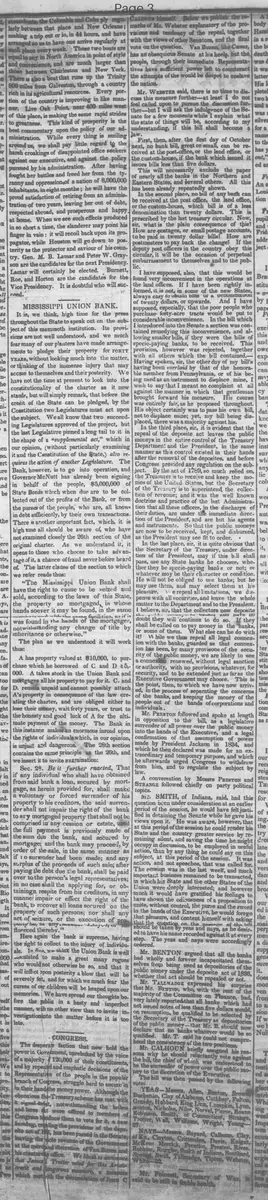
The desperate faction that now hold the power in Government, unrebuked by the voice of a majority 120,000 of their constituents, and by repeated and emphatic decisions of the Representatives of the people in the popular branch of Congress, struggle hard to secure in their hands the money power. Although the obnoxious Sub-Treasury scheme has met with a signal defeat, notwithstanding the bribes and lures that were offered to members of Congress to induce them to vote for it, a new humbug, reviving the provisions of the deposite act of '36, has been passed in the Senate, leaving the whole revenue of the Government at the mercy and discretion of Van Buren and his creatures in office. We blush to announce that James Trotter voted for this Aristocratic and dangerous measure, a measure which met with the denunciation of John C. Calhoun himself. Below we publish the remarks of Mr. Webster explanatory of the provisions and tendency of the repeal, together with the views of other Senators, and the final vote on the question. Van Buren, like Caesar, has an obsequious Senate at his heels, but the people, through their immediate Representatives have sufficient power left to counteract the attempts of the would be despot to enslave the nation.
Mr. WEBSTER said, there is no time to discuss this measure further—at least I do not feel called upon to pursue the discussion further but I will ask the indulgence of the Senate for a few moments while I explain what the state of things will be, according to my understanding, if this bill shall become a law.
First, then, after the first day of October next, no bank bill, great or small, can be received at the post-office, or the land office, or the custom-house, if the bank which issued it issues bills less than five dollars. This will necessarily exclude the paper of nearly all the banks in the Northern and Eastern States, and several others. All this has been already repeatedly shown.
In the second place, no bill of any bank can be received at the post office, the land office, or the custom-house, which bill is of a less denomination than twenty dollars. This is prescribed by the last treasury circular. Now, sir, what is the plain consequence of this? How are postages, or small postage accounts, to be paid in twenty dollar bills! How are postmasters to pay back the change? If the deputy post officers in the country obey this circular, it will be the occasion of perpetual embarrassment to themselves and to the public.
I have supposed, also, that this would be found very inconvenient in the operations at the land offices. If I have been rightly informed, it is not, in some of the new States, always easy to obtain bills of a denomination of twenty dollars, or upwards. And I have supposed, especially, that the poor people who purchase forty-acre tracts would be put to considerable inconvenience. In the bill which I introduced into the Senate a section was contained remedying this inconvenience, and allowing smaller bills, if they were the bills of specie-paying banks, to be received. This provision, however was rejected, together with all others which the bill contained.—
Having spoken, sir, the other day of my bill's having been overlaid by that of the honorable member from Pennsylvania, or of his being used as an instrument to displace mine, I wish to say that I meant no complaint at all against the manner in which that gentleman brought forward his measure. His course was entirely fair, as he proposed throughout. His object certainly was to pass his own bill, not to displace mine; yet, my bill being displaced, there was a majority against his.
In the third place, sir, it is evident that the repeal of the deposite act leaves the public moneys in the entire control of the Treasury Department and the President, in the same manner as this control existed in their hands after the removal of the deposites, and before Congress provided any regulation on the subject. By the act of 1789, so much relied on, the Treasurer is to receive and keep the moneys of the United States, but the Secretary of the Treasury is to superintend the collection of revenue; and it was the well known doctrine and practice of the last Administration that all these officers, in the discharge of their duties, are under the immediate direction of the President, and are but his agents and instruments. So that the public moneys are now to be received, kept, and disbursed as the President may see fit to order.
In the last place, sir. it is quite obvious that the Secretary of the Treasury, under direction of the President, may if this bill shall pass, use any State banks he chooses, whether they be specie-paying banks or not; or whatever may be their character or condition. He will not be obliged to use banks; but he may use them, and may select them at his pleasure. We repeal all limitations, we dispense with all securities, and leave the whole matter to the Department and to the President.
I believe, sir, that the collectors now deposite and have no doubt they will continue to do so. If they shall be called on to pay money in the banks, or some of them. What else can he do with it! While we thus repeal all legal connexion with the banks, guarded as that connexion has been, by many provisions of the security of the public money, we are likely to see a connexion renewed, without legal sanction or authority, with no provisions, whatever, for security, and to be extended just as far as the Executive Government may choose. This is the point, then, to which we have now arrived, in the process of separating the concerns of the banks, and keeping the money of the people out of the hands of corporations and individuals.
Mr. Preston followed and spoke at length in opposition to the bill, as a legislative surrender of all power over the public money into the hands of the Executive, and a legal confirmation of that assumption of power made by President Jackson in 1834. and which he then declared was made for an extraordinary and temporary purpose, and which he afterwards urged Congress to withdraw from him, and to regulate the subject by law.
A conversation by Messrs Preston and Strange followed chiefly on party political topics.
Mr. SMITH, of Indiana, said, had this question been under consideration at an earlier period of the session, he would have felt justified in detaining the Senate while he gave his views upon it. He was aware, however, that at this period of the session he could render his State and the country greater service by remaining silent, and saving the time he might occupy in discussion, to be employed in useful action, than by any thing he could say on this subject, at this period of the session. It was action, and not speeches, that was called for. The session was in the last week, and much important business remained to be transacted, in which his State and the other States of the Union were deeply interested; and however much it would have gratified his feelings to have shown the odiousness of a proposition to unite, without control, the purse and the sword in the hands of the Executive, he would forego that pleasure, and content himself with asking that the question on the passage of the bill should be taken by yeas and nays, as he desired to have his name recorded against it at every step. The yeas and nays were accordingly ordered.
Mr. BENTON argued that all the banks had wholly and forever incapacitated themselves from being used as depositories of the public money under the deposite act of 1836, whether that act should be repealed or not.
Mr. TALLMADGE expressed his surprise that Mr. Benton, who, with the rest of the majority of the Committee on Finance, had, very lately reported that all banks which had not issued notes of less than five dollars would, on resumption, be qualified to be selected by the Secretary of the Treasury as depositories of the public money—that Mr. B. should now declare that no banks whatever would be so qualified. Mr. T. said he could not comprehend the consistency of the two positions.
Mr. CALHOUN briefly assigned his reasons why he should reluctantly vote against the bill, the chief of which was understood to be the surrender of power over the public money to the discretion of the Executive.
The bill was then passed by the following vote:
YEAS—Messrs. Allen, Benton, Brown, Buchanan, Clay of Alabama, Cuthbert, Fulton, Grundy, Hubbard, King, Linn, Lumpkin, Lyon, Mouton, Nicholas, Niles, Norvell, Pierce, Roane, Robinson, Smith, of Connecticut, Strange, Trotter, Wall, Williams, Wright, Young—27.
NAYS—Messrs. Bayard, Calhoun, Clay, of Ky. Clayton, Crittenden, Davis, Knight, McLean, Merrick, Prentiss, Preston, Rives, Robbins, Ruggles, Smith of Indiana, Southard, Spence, Swift, Tallmadge, Tipton, Webster, White—22.
Mr. Poinsett, Secretary of War, said to be still in feeble health,
What sub-type of article is it?
What keywords are associated?
What entities or persons were involved?
Where did it happen?
Domestic News Details
Primary Location
United States Senate
Key Persons
Outcome
bill passed by senate 27-22 (yeas: allen, benton, brown, buchanan, clay of alabama, cuthbert, fulton, grundy, hubbard, king, linn, lumpkin, lyon, mouton, nicholas, niles, norvell, pierce, roane, robinson, smith of connecticut, strange, trotter, wall, williams, wright, young; nays: bayard, calhoun, clay of ky., clayton, crittenden, davis, knight, mclean, merrick, prentiss, preston, rives, robbins, ruggles, smith of indiana, southard, spence, swift, tallmadge, tipton, webster, white).
Event Details
Senate debate on bill repealing 1836 Deposit Act, reviving Sub-Treasury provisions and placing public revenues under executive control. Webster explains implications on bank bills and inconveniences; Preston opposes as surrender to executive; Smith calls for vote; Benton argues banks disqualified; Tallmadge questions Benton; Calhoun votes against due to executive discretion.