Thank you for visiting SNEWPapers!
Sign up free
Herald Of The United States
Warren, Bristol County, Rhode Island
What is this article about?
British Parliament debates the American Intercourse bill, opposed by MPs Rose, Percival, and Canning for violating navigation laws and favoring American trade over British interests; the bill passes second reading 112-54 on grounds of colonial supply needs.
Clipping
OCR Quality
Full Text
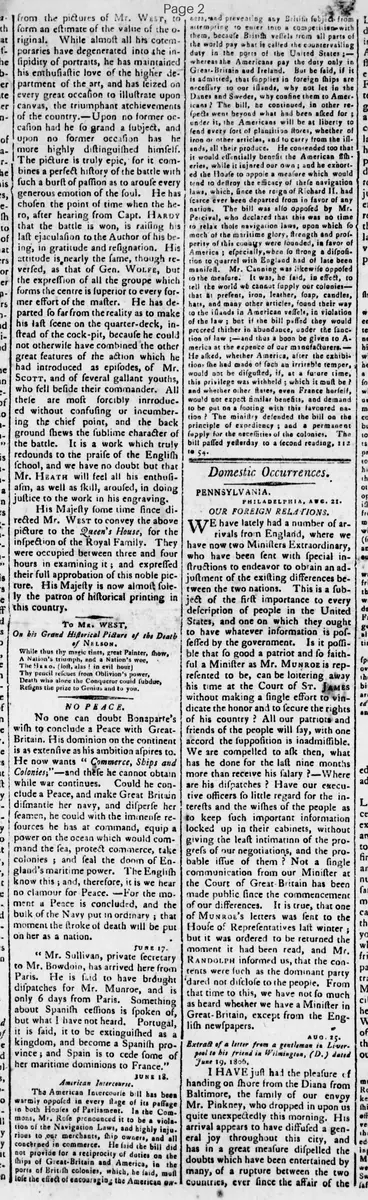
American Intercourse.
The American Intercourse bill has been warmly opposed in every stage of its passage in both Houses of Parliament. In the Commons, Mr. Rose pronounced it to be a violation of the Navigation Laws, and highly injurious to our merchants, ship owners, and all concerned in commerce. He said the bill did not provide for a reciprocity of duties on the ships of Great-Britain and America, in the ports of British colonies, which, he said, must lose the effect of encouraging the American owners, and preventing any British subject from attempting to enter into a competition with them, because British vessels from all parts of the world pay what is called the countervailing duty in the ports of the United States :- whereas the Americans pay the duty only in Great-Britain and Ireland. But he said, if it is admitted, that supplies in foreign ships are necessary to our islands, why not let in the Danes and Swedes, why confine them to Americans? The bill, he continued, in other respects went beyond what had been asked for; under it, the Americans will be at liberty to send every sort of plantation stores, whether of iron or other articles, and to carry from the islands, all their produce. He contended too that it would essentially benefit the American fisheries, while it injured our own; and he exhorted the House to oppose a measure which would tend to destroy the efficacy of these navigation laws, which, since the reign of Richard II. had scarce ever been departed from in favor of any nation. The bill was also opposed by Mr. Percival, who declared that this was no time to relax those navigation laws, upon which so much of the maritime glory, strength and prosperity of this country were founded, in favor of America; especially, when so strong a disposition to quarrel with England had of late been manifest. Mr. Canning was likewise opposed to the measure. It was, he said, in effect, to tell the world we cannot supply our colonies- that at present, iron, leather, soap, candles, hats, and many other articles, found their way to the islands in American vessels, in violation of the law; but if the bill passed they would proceed thither in abundance, under the sanction of law; -and thus a boon be given to America at the expense of our manufacturers. He asked, whether America, after the exhibitions she had made of such an irritable temper, would not be disgusted, if, at a future time, this privilege was withheld; which it must be and whether other states, even France herself, would not expect similar benefits, and demand to be put on a footing with this favoured nation? The ministry defended the bill on the principle of expediency; and a permanent supply for the necessaries of the colonies. The bill passed yesterday to a second reading, 112 to 54.
What sub-type of article is it?
What keywords are associated?
What entities or persons were involved?
Where did it happen?
Foreign News Details
Primary Location
America
Event Date
June 18
Key Persons
Outcome
the bill passed yesterday to a second reading, 112 to 54.
Event Details
The American Intercourse bill faced strong opposition in both Houses of Parliament, particularly in the Commons from Mr. Rose, who argued it violated Navigation Laws and harmed British commerce by lacking reciprocity in duties and allowing Americans to supply British colonies with goods like iron and carry away produce, benefiting American fisheries at Britain's expense. Mr. Percival opposed relaxing the laws amid American tensions, and Mr. Canning warned it would signal British inability to supply colonies and invite demands from other nations. The ministry supported it for expediency and colonial needs.