Thank you for visiting SNEWPapers!
Sign up free
Editorial
January 21, 1792
Gazette Of The United States
New York, New York County, New York
What is this article about?
An editorial defends the congressional duties and excises as protective bounties for agriculture, manufacturing, and trade, countering claims of heavy taxation and economic stagnation. It highlights increased prosperity in exports, imports, shipping, and property values from 1789 to 1791.
Clipping
OCR Quality
98%
Excellent
Full Text
ORIGINAL COMMUNICATIONS.
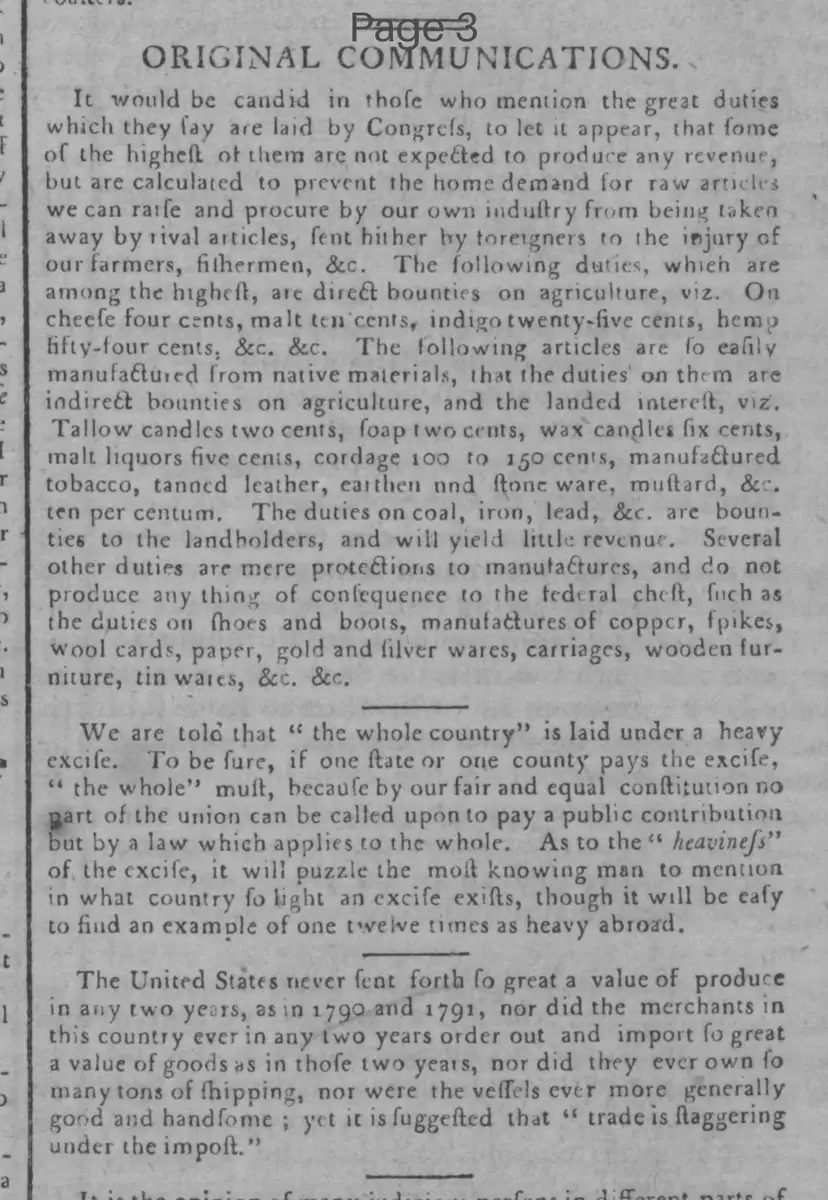
It would be candid in those who mention the great duties which they say are laid by Congress, to let it appear, that some of the highest of them are not expected to produce any revenue, but are calculated to protect the home demand for raw articles we can raise and procure by our own industry from being taken away by rival articles, sent hither by foreigners to the injury of our farmers, fishermen, &c. The following duties, which are among the highest, are direct bounties on agriculture, viz. On cheese four cents, malt ten cents, indigo twenty-five cents, hemp fifty-four cents, &c. &c. The following articles are so easily manufactured from native materials, that the duties on them are indirect bounties on agriculture, and the landed interest, viz. Tallow candles two cents, soap two cents, wax candles six cents, malt liquors five cents, cordage 10 to 15 cents, manufactured tobacco, tanned leather, earthen and stone ware, mustard, &c. ten per centum. The duties on coal, iron, lead, &c. are bounties to the landholders, and will yield little revenue. Several other duties are mere protections to manufactures, and do not produce any thing of consequence to the federal chest, such as the duties on shoes and boots, manufactures of copper, spikes, wool cards, paper, gold and silver wares, carriages, wooden furniture, tin wares, &c. &c.
We are told that "the whole country" is laid under a heavy excise. To be sure, if one state or one county pays the excise, "the whole" must, because by our fair and equal constitution no part of the union can be called upon to pay a public contribution but by a law which applies to the whole. As to the "heaviness" of the excise, it will puzzle the most knowing man to mention in what country so light an excise exists, though it will be easy to find an example of one twelve times as heavy abroad.
The United States never sent forth so great a value of produce in any two years, as in 1790 and 1791, nor did the merchants in this country ever in any two years order out and import so great a value of goods as in those two years, nor did they ever own so many tons of shipping, nor were the vessels ever more generally good and handsome; yet it is suggested that "trade is staggering under the impost."
It is the opinion of many judicious persons in different parts of this country, that lands improved and unimproved have advanced in price from 20 to 30 per cent. since the year 1789. City property is every where more advanced. Old branches of business are extended, none have fallen off, new branches are daily appearing in different quarters. These things will yield to men of sober thought satisfactory proof that the general system of Congress is beneficial to the general interests.
It would be candid in those who mention the great duties which they say are laid by Congress, to let it appear, that some of the highest of them are not expected to produce any revenue, but are calculated to protect the home demand for raw articles we can raise and procure by our own industry from being taken away by rival articles, sent hither by foreigners to the injury of our farmers, fishermen, &c. The following duties, which are among the highest, are direct bounties on agriculture, viz. On cheese four cents, malt ten cents, indigo twenty-five cents, hemp fifty-four cents, &c. &c. The following articles are so easily manufactured from native materials, that the duties on them are indirect bounties on agriculture, and the landed interest, viz. Tallow candles two cents, soap two cents, wax candles six cents, malt liquors five cents, cordage 10 to 15 cents, manufactured tobacco, tanned leather, earthen and stone ware, mustard, &c. ten per centum. The duties on coal, iron, lead, &c. are bounties to the landholders, and will yield little revenue. Several other duties are mere protections to manufactures, and do not produce any thing of consequence to the federal chest, such as the duties on shoes and boots, manufactures of copper, spikes, wool cards, paper, gold and silver wares, carriages, wooden furniture, tin wares, &c. &c.
We are told that "the whole country" is laid under a heavy excise. To be sure, if one state or one county pays the excise, "the whole" must, because by our fair and equal constitution no part of the union can be called upon to pay a public contribution but by a law which applies to the whole. As to the "heaviness" of the excise, it will puzzle the most knowing man to mention in what country so light an excise exists, though it will be easy to find an example of one twelve times as heavy abroad.
The United States never sent forth so great a value of produce in any two years, as in 1790 and 1791, nor did the merchants in this country ever in any two years order out and import so great a value of goods as in those two years, nor did they ever own so many tons of shipping, nor were the vessels ever more generally good and handsome; yet it is suggested that "trade is staggering under the impost."
It is the opinion of many judicious persons in different parts of this country, that lands improved and unimproved have advanced in price from 20 to 30 per cent. since the year 1789. City property is every where more advanced. Old branches of business are extended, none have fallen off, new branches are daily appearing in different quarters. These things will yield to men of sober thought satisfactory proof that the general system of Congress is beneficial to the general interests.
What sub-type of article is it?
Economic Policy
Agriculture
Trade Or Commerce
What keywords are associated?
Congressional Duties
Excise Tax
Agricultural Bounties
Trade Prosperity
Impost Protection
Economic Growth
What entities or persons were involved?
Congress
United States
Editorial Details
Primary Topic
Defense Of Congressional Duties And Excises As Beneficial To Agriculture And Trade
Stance / Tone
Supportive Of Federal Economic Policies
Key Figures
Congress
United States
Key Arguments
Highest Duties On Items Like Cheese, Malt, Indigo, And Hemp Are Direct Bounties On Agriculture To Protect Against Foreign Rivals.
Duties On Manufactured Goods From Native Materials Like Candles, Soap, And Cordage Are Indirect Bounties To Agriculture And Landholders.
Duties On Coal, Iron, Lead, And Various Manufactures Protect Domestic Production With Little Revenue Yield.
The Excise Is Light Compared To Foreign Examples And Applies Equally Across The Union Per The Constitution.
Us Exports, Imports, Shipping Tonnage, And Vessel Quality Reached Record Highs In 1790 1791 Despite The Impost.
Land And City Property Prices Have Risen 20 30% Since 1789, With Business Expansion Indicating Congressional System's Benefits.