Thank you for visiting SNEWPapers!
Sign up free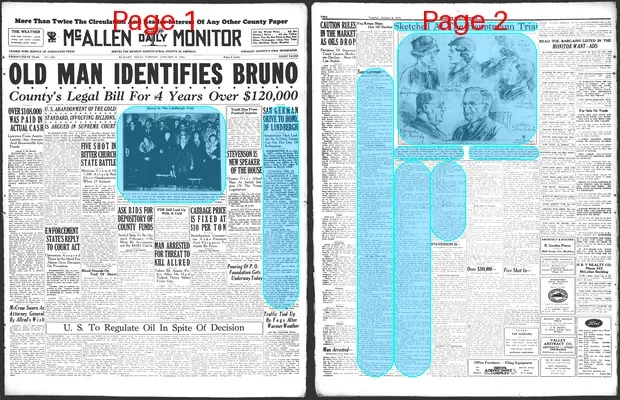
Mcallen Daily Monitor
Mcallen, Brownsville, Harlingen, Hidalgo County, Cameron County, Texas
What is this article about?
News coverage of the January 8, 1935, trial of Bruno Richard Hauptmann for the Lindbergh baby kidnapping and murder in Flemington, N.J. Includes juror profiles, elderly witness Amandus Hockmuth's identification of Hauptmann near the crime scene with a ladder, taxi driver John Perrone's testimony on a ransom note, failed ladder evidence admission, defense critique of police fingerprint work, and sketches of trial participants.
Merged-components note: Merged Lindbergh-Hauptmann trial story components across pages, including related image, captions, and courtroom sketches due to topical and spatial continuity
Clippings
1 of 2
OCR Quality
Full Text
Here are some of the jurors quickly chosen for the trial of Bruno Richard Hauptmann, charged in Flemington, N. J., with the murder of the Lindbergh baby. Among them, shown by the numbers, are: 1-Sheriff John H. Curtiss of Hunterdon County; 2-Mrs. Verna Snyder, 36, Centreville housewife; 3-Charles F. Snyder, Clinton, whose likeness to Hauptmann made spectators gasp, and 4-Charles Walton, Sr., foreman.
SAW GERMAN DRIVE TO HOME OF LINDBERGH Hauptmann Had Ladder In A Dirty Green Car On The Day Of Kidnapping.
FLEMINGTON, N. J., Jan. 8. (AP)-John Perrone, the New York taxicab driver today identified Bruno Richard Hauptmann as the man who gave him one dollar to deliver a note to Dr. John F. Condon in March, 1932.
(Copyright, 1935, by The Associated Press)
FLEMINGTON, N. J., Jan. 8.-An aged former neighbor of Colonel Charles A. Lindbergh pointed a palsied finger at the accused Bruno Richard Hauptmann today and declared he saw him near the Lindbergh home on the day Charles Augustus Lindbergh, Jr., was stolen from his crib and slain.
The aged witness, Amandus Hockmuth, 87, positively identified Hauptmann as a man in a dirty green automobile who passed his home on March 1, 1932, turned into the Lindbergh road and "glared at me as if he saw a ghost!"
The melodramatic surprise-heightened by the extinguishing of the courtroom lights just as the old man first pointed accusingly at Hauptmann-was sandwiched between two other highlights of the morning session.
Ladder Ruled Out.
The state failed in its second attempt to get the ladder down which it contends the baby was carried to its death into evidence, and the defense pursued a vigorous attack upon the efficiency of the New Jersey police after two state troopers testified they could find no fingerprints in the Lindbergh nursery, on the ladder, or on the ransom note which Lindbergh found on the nursery window sill.
Hockmuth said he had seen a man in a car in Hopewell on March 1, 1932. The baby was kidnapped that night.
He said there was a ladder in the car.
Wilentz asked Hockmuth if he could point out "that man" in the car.
"There he is," he said, his shaking finger pointed to Hauptmann.
'Now will you step down and place your hand on his shoulder."
Reilly objected to this until the aged man said, "He's the man between the state trooper and the man in the white shirt."
He then got down from the chair and placed his hand gingerly on Hauptmann's shoulder and then withdrew it gingerly.
Hauptmann shook his head in short negative rolls.
"I saw the car coming, and the man in it looked out of the window
(Continued on Page Two)
Saw German-
(Continued From Page One)
at me as if he had seen a ghost," Hockmuth said.
"I object," Reilly sang out. "I object to ghost stories."
Old Man Trembles.
The old man, trembling violently and speaking in an almost inaudible tone, said the car swung into the Lindbergh lane and stopped briefly.
Q. Do you remember the color of the car?
A. Yes, a dirty green.
Reilly began cross examination.
Reilly asked the witness to tell if he had stood in the court room doorway with a state trooper during yesterday's session.
"Did that state trooper point out Bruno Richard Hauptmann to you as he sat in his seat," bellowed Reilly.
"No," shot back the shaky voice with spirit.
Wilentz bounded to his feet in strenuous objection.
"I object to the defense badgering this witness."
The bearded little man, who gave his age at 87, shook. His hand clasped and unclasped continually. His head shook nervously.
Overrules Objections.
Justice Trenchard overruled several objections of the attorney general.
"I see no badgering here," the justice remarked.
"This is a point of inquiry."
The 87-year-old surprise witness answered a number of questions about when he moved to Hopewell before Reilly snapped:
Q. What was the date you say you saw this man?
A. March 1, 1932.
Q. What day of the week?
A. Tuesday. I think it was Tuesday.
day.
Q. What time did you see that dirty green car?
A. About noon. It was a clear day.
Reilly then had the old man describe that he had seen Hauptmann from his vantage point on the kitchen porch, which fronted on the Lindbergh estate, entrance line which Hockmuth referred to as "Lindy's Road."
He said he heard the dirty green car coming he looked at the road thinking it might be Lindbergh.
Q. Was it a cold day?
A. It was March.
Q. How fast was the car going when you first saw the man?
A. About forty miles an hour.
"He speeded around the turn" the old man said.
"Then he slid into the ditch, stopped, and started again."
"How many cars did you say you saw go into the ditch before this one?"
"Seven."
Q. And prior to this one, on what date did one go into the ditch?
A. I can't remember.
"How was the man dressed."
Reilly asked, referring to the man in the dirty green car.
"I think he had a dark shirt on. All I saw of him was the red face and the glaring eyes," the feeble voice replied.
Old Man Visits Jail.
Reilly questioned the old man on his visit to the jail a month ago when he viewed Hauptmann.
He sought to bring out the old man's memory was faulty.
The defense had Hockmuth say several times he had "never" told anyone of seeing Hauptmann.
When Wilentz sought to bring out that the trembling old man had discussed the case with state officials, Reilly objected strenuously but Justice Trenchard overruled him and said the state had the right to clarify the point.
Reilly demanded to know whether Hockmuth had ever been in an institution.
"I was employed in the Hudson River State Hospital at Poughkeepsie, N. Y.," he said.
Under further questioning he said he had been back there for a visit but "never stayed there."
He said he first learned about Hauptmann in the newspapers.
"I read about him and saw his picture there," he said.
Reilly excused the old man and Wilentz waived redirect.
A five-minute recess was taken.
Captain John J. Lamb of the state police was the first witness sworn after the recess.
Arthur J. Koehler, wood expert of the U. S. Forestry department took the stand.
He said he was stationed at Madison, Wisconsin.
Koehler said he had examined the ladder and had turned it back to Capt. Lamb.
He was excused after a minute or so by the prosecution and the defense began cross-examination.
Wilentz indicated that his testimony at this time would concern only possession of the ladder and that his expert testimony would come later.
Defense Attorney Frederick A. Pope conducted the cross-examination.
Koehler said that he had taken the ladder apart, removing the nails and the rungs and later supervised its reassembly, using the same nails.
Pope brought out that the nails had passed from his possession.
and he corrected his testimony on this point.
When Koehler's cross-examination was over, Wilentz offered the ladder in evidence. Pope immediately objected.
Captain John J. Lamb and Lieutenant John Sweeney, both of the New Jersey state police, were other witnesses of the morning session. The defense attack upon the efficiency of the department they represented came with Frank A. Kelly, fingerprint expert, and Nuncio de Gaetano, a trooper, on the stand.
Reilly attacked especially the "expertness" of Kelly, and quarreled with him over proper methods used for preserving fingerprints.
Wilentz turned to the Lindbergh nursery and had Kelly tell of the table and chair in the middle of the room.
Q. You said you could find no fingerprints in the nursery.
A. That is right.
Q. No fingerprints of anyone.
A. Well...
Q. Answer the question. No fingerprints of anyone?
A. None.
Wilentz then invited cross-examination.
Reilly began:
Q. Mr. Kelly, did you ever study the Bertillon system?
A. No.
Q. Are you known as the expert in the fingerprint line?
Reilly then demanded why the trooper had not studied the Bertillon system, an identification system, which he began to describe.
"It's obsolete," Kelly interposed.
Reilly turned angrily to the court to request that his answer be stricken from the record.
Q. You want us to believe, Mr. Kelly, that although Mrs. Lindbergh had been in the nursery and although Betty Gow went in there to treat the child and rub its chest, you could find no finger prints?
A. That's true.
Reilly had the witness describe his arrival at the nursery.
Q. What was the first object you attempted to photograph or take fingerprints from.
A. The note.
Reilly then had the expert give a description of his method of taking prints.
Kelly told how he brushed black powder on the envelope and note and then brushed it off carefully.
"Don't you know," snapped Reilly, "that by brushing the powder off, you are liable to brush the fingerprint off. Don't you know the proper way is to blow it off."
The witness was slightly annoyed.
"I know that blowing the moisture of your breath can destroy a print."
He then told how he examined the kidnap window and sill and the entire nursery but found no fingerprints.
Reilly sought to have the witness express his opinion on how long a finger print would remain on a surface.
"I wouldn't say it would last five minutes," snapped Kelly, after Reilly pressed him to state how many days or hours a print would last.
Reilly then turned to the footprint.
Q. How would you preserve footprints?
A. I'd measure them and make a mold of them.
Q. What would prevent you from taking measurements?
A. If someone else did before I got there.
Q. Did someone else measure the footprint at the Lindbergh home?
A. I understand Detective De Gaetano did.
Q. How about the ladder, where did you examine it?
A. I looked it over and processed it right in the hall.
Q. What was the condition of the ladder—dry or wet?
A. It was dry.
Q. It was a cold night. Was there no frost?
A. No frost.
Q. What kind of ladder did Col. Lindbergh have in his garage?
A. An extension ladder.
Q. How high did it go?
A. I didn't try to raise it.
Q. Who directed you to the ladder.
A. I asked Ollie Whateley, and he showed it to me.
Q. The butler?
A. Yes, the butler.
Q. This footprinting, was it more or less frozen in the mud next day?
A. No sir.
Reilly then excused the witness subject to recall to make fingerprint tests in court.
State Police Detective Muncio de Gaetano was then sworn.
As the jury heard the account of what investigators found in the Lindbergh nursery and elsewhere the night of the crime.
De Gaetano told of finding three splotches of dirt in the nursery leading from the window to the crib. He said the path from the window to the crib was unobstructed.
Sketched At The Hauptmann Trial
Here, caught in quick sketches on the opening day of the Hauptmann trial, are six of the leading characters in the drama being played in the crowded courtroom at Flemington, N. J. Top, left to right, Henry Barrow Associated Press staff artist, depicts Mrs. Bruno Richard Hauptmann, wife of the man charged with murdering the Lindbergh baby, and three of the jurors who will decide his fate. Walton, 55, a machinist, is foreman of the jury. Mrs. Stockton, 32, an attorney's secretary, has a seven-year-old child. Mrs. Pill, a widow, has two grown sons and cares for two grandchildren, supporting herself by bead work.
The three jurors were sketched as they sat in the jury box after having been sworn in. Below are Edward J. Reilly, chief defense lawyer, and Justice Thomas W. Trenchard, presiding at the trial.
What sub-type of article is it?
What themes does it cover?
What keywords are associated?
What entities or persons were involved?
Where did it happen?
Story Details
Key Persons
Location
Flemington, N. J.; Hopewell, N. J.; Lindbergh Home
Event Date
Jan. 8, 1935; March 1, 1932
Story Details
During the trial of Bruno Richard Hauptmann for the murder of the Lindbergh baby, jurors were selected including Mrs. Verna Snyder, Charles F. Snyder, and Charles Walton, Sr. Witness Amandus Hockmuth, 87, identified Hauptmann as the man he saw in a dirty green car with a ladder near the Lindbergh home on March 1, 1932, the day of the kidnapping. John Perrone identified Hauptmann as the man who paid him to deliver a ransom note. The state failed to introduce the ladder into evidence. Defense attacked police efficiency regarding fingerprints in the nursery, on the ladder, and ransom note. Wood expert Arthur J. Koehler examined the ladder. Sketches depicted key figures in the trial.