Thank you for visiting SNEWPapers!
Sign up free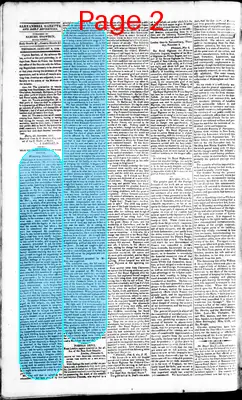
Alexandria Gazette & Daily Advertiser
Alexandria, Virginia
What is this article about?
On January 6, 1818, the U.S. House of Representatives, in committee of the whole, debated and amended a congressional compensation bill from $9 to $8 per day plus travel pay, amid discussions on public opinion, patriotism, and equity with other officials.
Clipping
OCR Quality
Full Text
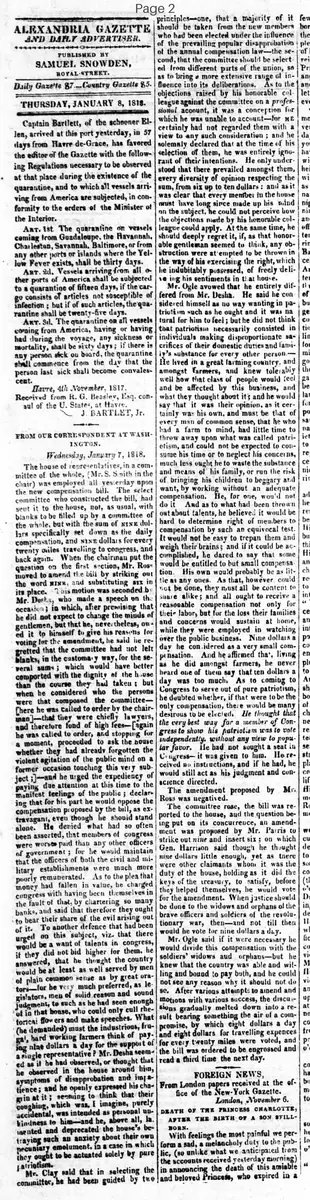
Wednesday, January 7, 1818.
The house of representatives, in a committee of the whole, (Mr. S. Smith in the chair) was employed all yesterday upon the new compensation bill. The select committee who constructed the bill, had sent it to the house, not, as usual, with blanks to be filled up by a committee of the whole, but with the sum of nine dollars specifically set down as the daily compensation, and nine dollars for every twenty miles travelling to congress, and back again. When the chairman put the question on the first section, Mr. Ross moved to amend the bill by striking out the word nine, and substituting six in its place. This motion was seconded by Mr. Desha, who made a speech on the occasion; in which, after premising that he did not expect to change the minds of gentlemen, but that he, nevertheless, owed it to himself to give his reasons for voting for the amendment, he said he regretted that the committee had not left blanks, in the customary way, for the several sums; which would have better comported with the dignity of the house than the course they had taken; but when he considered who the persons were that composed the committee— There he was called to order by the chairman—that they were chiefly lawyers, and therefore fond of high fees—again he was called to order, and stopping for a moment, proceeded to ask the house whether they had already forgotten the violent agitation of the public mind on a former occasion touching this very subject;—and he urged the expediency of paying due attention at this time to the manifest feelings of the public; declaring that on his part he would oppose the compensation proposed by the bill, as extravagant, even though he should stand alone. He denied what had so often been asserted, that members of congress were worse paid than any other officers of government; for he would maintain that the officers of both the civil and military establishments were much more poorly remunerated. As to the plea that money had fallen in value, he charged congress with having been themselves in the fault of that, by chartering so many banks, and said that therefore they ought to bear their share of the evil arising out of it. To another defence that had been urged on this subject, viz. that there would be a want of talents in congress, if they did not bid higher for them, he answered, that he thought the country would be at least as well served by men of plain common sense as by great orators—for he very much preferred, as legislators, men of solid reason and sound judgment, to such as he had seen enough of in that house, who could only cull rhetorical flowers and make speeches. What (he demanded) must the industrious, frugal, hard working farmers think of paying nine dollars a day for the support of a single representative? Mr. Desha seemed as if he had observed, or thought that he observed in the house around him, symptoms of disapprobation and impatience; and he openly expressed his chagrin at it; seeming to think that their coughing, which was, I imagine, purely accidental, was intended as personal;—betraying such an anxiety about their own pecuniary emolument, in a case in which they ought to be actuated solely by pure patriotism.
Mr. Clay said that in selecting the committee, he had been guided by two principles—one, that a majority of it should be taken from the new members who had been elected under the influence of the prevailing popular disapprobation of the annual compensation law; the second, that the committee should be selected from different parts of the union, so as to bring a more extensive range of influence into its deliberations. As to the objections raised by his honorable colleague against the committee on a professional account, it was a conception for which he was unable to account—for he certainly had not regarded them with a view to any such consideration; and he solemnly declared that at the time of his selection of them, he was entirely ignorant of their intentions. He only understood that there prevailed amongst them, every diversity of opinion respecting the sum, from six up to ten dollars: and as it was clear that every member in the house must have long since made up his mind on the subject, he could not perceive how the objections made by his honorable colleague could apply. At the same time, he should deeply regret it, if, as that honorable gentleman seemed to think, any obstruction were attempted to be thrown in the way of his exercising the right, which he indubitably possessed, of freely delivering his sentiments in that house.
Mr. Ogle avowed that he entirely differed from Mr. Desha. He said he considered himself as noway wanting in patriotism such as he ought and it was natural for him to feel; but he did not think that patriotism necessarily consisted in individuals making disproportionate sacrifices of their domestic duties and family's substance for every other person.— He lived in a great farming country, and amongst farmers, and knew tolerably well how that class of people would feel and be affected by this business, and what they thought about it and he would say that it was their opinion, as it certainly was his own, and must be that of every man of common sense, that he who had a farm to mind, had little time to throw away upon what was called patriotism, and could not be expected to consume his time or to neglect his concerns, much less ought he to waste the substance and means of his family, or run the risk of bringing his children to beggary and want, by working without an adequate compensation. He, for one, would not do it. And as to what had been thrown out about talents, he believed it would be hard to determine right of members to compensation by such an equivocal test. It would not be easy to trepan them and weigh their brains; and if it could be accomplished, he dared to say that some would be entitled to but small compensation. His own would probably be as little as any one's. As that, however, could not be done, they must all be content to share alike; and all ought to receive a reasonable compensation not only for their labor, but for the loss their families and concerns would sustain at home, while they were employed in watching over the public business. Nine dollars a day he considered as a very small compensation. And he affirmed that, living as he did amongst farmers, he never heard one of them say that ten dollars a day was too much: As to coming to Congress to serve out of pure patriotism, he doubted whether, if that were to be the only compensation, there would be many desirous to be elected. He thought that the very best way for a member of Congress to show his patriotism was to vote independently, without any view to popular favor. He had not sought a seat in Congress—it was given to him. He received no instructions, and if he had, he would still act as his judgment and conscience directed.
The amendment proposed by Mr. Ross was negatived.
The committee rose, the bill was reported to the house, and the question being put on its concurrence, an amendment was proposed by Mr. Parris to strike out nine and insert six; on which Gen. Harrison said though he thought nine dollars little enough, yet as there were other claimants whom it was the duty of the house, holding as it did the keys of the treasury, to satisfy, before they helped themselves, he would vote for the amendment. When justice should be done to the widows and orphans of the brave officers and soldiers of the revolutionary war, then—and not till then—would he vote for nine dollars a day.
Mr. Ogle said if it were necessary he would divide this compensation with the soldiers' widows and orphans—but he knew that the country was able and willing and bound to pay both, and he could not see any reason why it should not do so. After various attempts to amend and motions with various success, the discussions gradually melted down into a result bearing something the air of a compromise, by which eight dollars a day and eight dollars for travelling expenses for every twenty miles were voted, and the bill was ordered to be engrossed and read a third time the next day.
What sub-type of article is it?
What keywords are associated?
What entities or persons were involved?
Where did it happen?
Domestic News Details
Primary Location
Washington
Event Date
1818 01 06
Key Persons
Outcome
the bill was amended to provide eight dollars a day and eight dollars for every twenty miles of travel, then ordered engrossed and read a third time.
Event Details
In a committee of the whole, the House debated a compensation bill initially set at nine dollars per day and nine dollars per twenty miles travel. Amendments to reduce to six dollars were proposed and debated by members including Desha, Clay, Ogle, and others, citing public sentiment, patriotism, and fairness to other government officers. Ross's amendment failed, but later compromise resulted in eight dollars.