Thank you for visiting SNEWPapers!
Sign up free
The Kentucky Gazette
Lexington, Fayette County, Kentucky
What is this article about?
An address by Timoleon to Kentuckians warns against excessive enthusiasm from the French and American revolutions, advocates balanced government based on natural rights and majority rule, criticizes anarchic influences and party spirit undermining U.S. federal authority, and urges unity against French aggression.
Merged-components note: This is a continuation of the same editorial piece across pages 1 and 2, as indicated by the sequential reading order and direct text flow.
Clippings
1 of 2
OCR Quality
Full Text
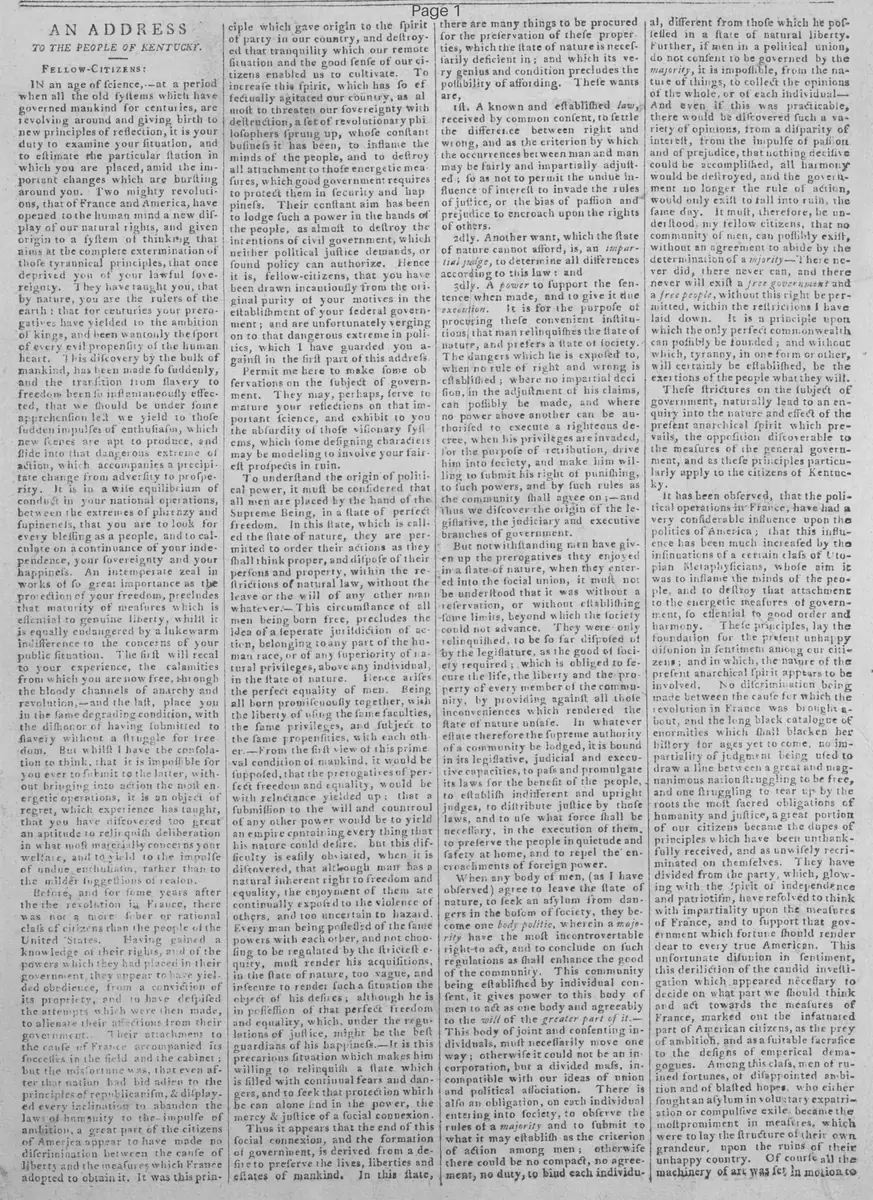
TO THE PEOPLE OF KENTUCKY.
FELLOW-CITIZENS:
IN an age of science,--at a period when all the old systems which have governed mankind for centuries, are revolving around and giving birth to new principles of reflection, it is your duty to examine your situation, and to estimate the particular station in which you are placed, amid the important changes which are bursting around you. Two mighty revolutions, that of France and America, have opened to the human mind a new display of our natural rights, and given origin to a system of thinking that aims at the complete extermination of those tyrannical principles, that once deprived you of your lawful sovereignty. They have taught you, that by nature, you are the rulers of the earth: that for centuries your prerogatives have yielded to the ambition of kings, and been wantonly the sport of every evil propensity of the human heart. This discovery by the bulk of mankind, has been made so suddenly, and the transition from slavery to freedom been so instantaneously effected, that we should be under some apprehension lest we yield to those sudden impulses of enthusiasm, which new scenes are apt to produce, and slide into that dangerous extreme of action, which accompanies a precipitate change from adversity to prosperity. It is in a wise equilibrium of conduct in your national operations, between the extremes of phrenzy and supineness, that you are to look for every blessing as a people, and to calculate on a continuance of your independence, your sovereignty and your happiness. An intemperate zeal in works of so great importance as the protection of your freedom, precludes that maturity of measures which is essential to genuine liberty, whilst it is equally endangered by a lukewarm indifference to the concerns of your public situation. The first will recall to your experience, the calamities from which you are now free, through the bloody channels of anarchy and revolution,--and the last, place you in the same degrading condition, with the dishonor of having submitted to slavery without a struggle for freedom. But whilst I have the consolation to think, that it is impossible for you ever to submit to the latter, without bringing into action the most energetic operations, it is an object of regret, which experience has taught, that you have discovered too great an aptitude to relinquish deliberation in what most materially concerns your welfare, and to yield to the impulse of undue enthusiasm, rather than to the milder suggestions of reason.
Before, and for some years after the revolution in France, there was not a more sober or rational class of citizens than the people of the United States. Having gained a knowledge of their rights, and of the powers which they had placed in their government, they appear to have yielded obedience, from a conviction of its propriety, and to have despised the attempts which were then made, to alienate their affections from their government. Their attachment to the cause of France accompanied its successes in the field and the cabinet; but the misfortune was, that even after that nation had bid adieu to the principles of republicanism, & displayed every inclination to abandon the laws of humanity to the impulse of ambition, a great part of the citizens of America appear to have made no discrimination between the cause of liberty and the measures which France adopted to obtain it. It was this principle which gave origin to the spirit of party in our country, and destroyed that tranquility which our remote situation and the good sense of our citizens enabled us to cultivate. To increase this spirit, which has so effectually agitated our country, as almost to threaten our sovereignty with destruction, a set of revolutionary philosophers sprung up, whose constant business it has been, to inflame the minds of the people, and to destroy all attachment to those energetic measures, which good government requires to protect them in security and happiness. Their constant aim has been to lodge such a power in the hands of the people, as almost to destroy the intentions of civil government, which neither political justice demands, or sound policy can authorize. Hence it is, fellow-citizens, that you have been drawn incautiously from the original purity of your motives in the establishment of your federal government; and are unfortunately verging on to that dangerous extreme in politics, which I have guarded you against in the first part of this address.
Permit me here to make some observations on the subject of government. They may, perhaps, serve to mature your reflections on that important science, and exhibit to you the absurdity of those visionary systems, which some designing characters may be modeling to involve your fairest prospects in ruin.
To understand the origin of political power, it must be considered that all men are placed by the hand of the Supreme Being, in a state of perfect freedom. In this state, which is called the state of nature, they are permitted to order their actions as they shall think proper, and dispose of their persons and property, within the restrictions of natural law, without the leave or the will of any other man whatever.-- This circumstance of all men being born free, precludes the idea of a separate jurisdiction of action, belonging to any part of the human race, or of any superiority of natural privileges, above any individual, in the state of nature. Hence arises the perfect equality of men. Being all born promiscuously together, with the liberty of using the same faculties, the same privileges, and subject to the same propensities, with each other.--From the first view of this primeval condition of mankind, it would be supposed, that the prerogatives of perfect freedom and equality, would be with reluctance yielded up; that a submission to the will and controul of any other power would be to yield an empire containing every thing that his nature could desire, but this difficulty is easily obviated, when it is discovered, that although man has a natural inherent right to freedom and equality, the enjoyment of them are continually exposed to the violence of others, and too uncertain to hazard. Every man being possessed of the same powers with each other, and not choosing to be regulated by the strictest equity, most render his acquisitions, in the state of nature, too vague, and insecure to render such a situation the object of his desires; although he is in possession of that perfect freedom and equality, which, under the regulations of justice, might be the best guardians of his happiness.--It is this precarious situation which makes him willing to relinquish a state which is filled with continual fears and dangers, and to seek that protection which he can alone find in the power, the mercy & justice of a social connexion. Thus it appears that the end of this social connexion, and the formation of government, is derived from a desire to preserve the lives, liberties and estates of mankind. In this state, there are many things to be procured for the preservation of these properties, which the state of nature is necessarily deficient in; and which its very genius and condition precludes the possibility of affording. These wants are,
1st. A known and established law, received by common consent, to settle the difference between right and wrong, and as the criterion by which the occurrences between man and man may be fairly and impartially adjusted; so as not to permit the undue influence of interest to invade the rules of justice, or the bias of passion and prejudice to encroach upon the rights of others.
2dly. Another want, which the state of nature cannot afford, is, an impartial judge, to determine all differences according to this law: and
3dly. A power to support the sentence when made, and to give it due execution. It is for the purpose of procuring these convenient institutions that man relinquishes the state of nature, and prefers a state of society. The dangers which he is exposed to, when no rule of right and wrong is established; where no impartial decision, in the adjustment of his claims, can possibly be made, and where no power above another can be authorised to execute a righteous decree, when his privileges are invaded, for the purpose of retribution, drive him into society, and make him willing to submit his right of punishing, to such powers, and by such rules as the community shall agree on;--and thus we discover the origin of the legislative, the judiciary and executive branches of government.
But notwithstanding men have given up the prerogatives they enjoyed in a state of nature, when they entered into the social union, it must not be understood that it was without a reservation, or without establishing some limits, beyond which the society could not advance. They were only relinquished, to be so far disposed of by the legislature, as the good of society required; which is obliged to secure the life, the liberty and the property of every member of the community, by providing against all those inconveniences which rendered the state of nature unsafe. In whatever estate therefore the supreme authority of a community be lodged, it is bound in its legislative, judicial and executive capacities, to pass and promulgate its laws for the benefit of the people, to establish indifferent and upright judges, to distribute justice by those laws, and to use what force shall be necessary, in the execution of them, to preserve the people in quietude and safety at home, and to repel the encroachments of foreign power.
When any body of men, (as I have observed) agree to leave the state of nature, to seek an asylum from dangers in the bosom of society, they become one body politic, wherein a majority have the most incontrovertable right to act, and to conclude on such regulations as shall enhance the good of the community. This community being established by individual consent, it gives power to this body of men to act as one body and agreeably to the will of the greater part of it.-- This body of joint and consenting individuals, must necessarily move one way; otherwise it could not be an incorporation, but a divided mass, incompatible with our ideas of union and political association. There is also an obligation, on each individual entering into society, to observe the rules of a majority and to submit to what it may establish as the criterion of action among men; otherwise there could be no compact, no agreement, no duty, to bind each individual, different from those which he possessed in a state of natural liberty.
Further, if men in a political union, do not consent to be governed by the majority, it is impossible, from the nature of things, to collect the opinions of the whole, or of each individual-- And even if this was practicable, there would be discovered such a variety of opinions, from a disparity of interest, from the impulse of passion and of prejudice, that nothing decisive could be accomplished, all harmony would be destroyed, and the government no longer the rule of action, would only exist to fall into ruin, the same day. It must, therefore, be understood, my fellow citizens, that no community of men, can possibly exist, without an agreement to abide by the determination of a majority--There never did, there never can, and there never will exist a free government and a free people, without this right be permitted, within the restrictions I have laid down. It is a principle upon which the only perfect commonwealth can possibly be founded; and without which, tyranny, in one form or other, will certainly be established, be the exertions of the people what they will.
These strictures on the subject of government, naturally lead to an enquiry into the nature and effect of the present anarchical spirit which prevails, the opposition discoverable to the measures of the general government, and as these principles particularly apply to the citizens of Kentucky.
It has been observed, that the political operations in France, have had a very considerable influence upon the politics of America; that this influence has been much increased by those insinuations of a certain class of Utopian metaphysicians, whose aim it was to inflame the minds of the people, and to destroy that attachment to the energetic measures of government, so essential to good order and harmony. These principles, lay the foundation for the present unhappy disunion in sentiment among our citizens; and in which, the nature of the present anarchical spirit appears to be involved. No discrimination being made between the cause for which the revolution in France was brought about, and the long black catalogue of enormities which shall blacken her history for ages yet to come, no impartiality of judgment being used to draw a line between a great and magnanimous nation struggling to be free, and one struggling to tear up by the roots the most sacred obligations of humanity and justice, a great portion of our citizens became the dupes of principles which have been unthankfully received, and as unwisely reciprocated on themselves. They have divided from the party, which, glowing with the spirit of independence and patriotism, have resolved to think with impartiality upon the measures of France, and to support that government which fortune should render dear to every true American. This unfortunate disunion in sentiment, this dereliction of the candid investigation which appeared necessary to decide on what part we should think and act towards the measures of France, marked out the infatuated part of American citizens, as the prey of ambition, and as a suitable sacrifice to the designs of empirical demagogues. Among this class, men of ruined fortunes, of disappointed ambition and of blasted hopes, who either sought an asylum in voluntary expatriation or compulsive exile became the most prominent in measures, which were to lay the structure of their own grandeur, upon the ruins of their unhappy country. Of course all the machinery of art was set in motion to
To revive the spirit of party when declining, and to blow it into flame as long as it existed.—The attachment which the people may have discovered to the government of their choice, was instantly marked out for destruction. France and French politics were always right, and the measures which were extorted from the American government by the injustice of that nation, were always the objects of reprobation. The duties and formalities which were used towards Great Britain by America, and which her own interest could not have demanded as sacrifices to her ancient prejudices, were deemed as the offspring of a desired connexion with that monarchy, and as an unjust partiality against the French nation. Even those principles of civil government, which the Americans had chosen as the basis of their liberty, were wantonly attacked, and worn to that flimsy texture, by the chymical power of metaphysical reasoning, which can never be embraced by practice, and are too inefficient to support a people who are necessarily governed by powerful interests and forcible prejudices. The sovereignty of the people was cried up in every pamphlet and every news-paper; they were told that they were the lords of the creation, that they should watch with solicitude over their freedom, that their government was verging towards aristocracy and oppression, and that they were then standing on the brink of slavery. It is no wonder that this language continually ringing in the ear, should almost induce the people to believe that government was unnecessary as it attacked a portion of their natural liberty, and that at any rate the measures which were adopted by the general government for their security and happiness, equalled the tyranny of Britain or the oppression of despotic countries. Fellow citizens, upon this particular subject you can never err, if you reflect that government is a necessary evil which cannot be dispensed with; that this necessity for its existence, arises from the dangerous consequences which would attend the influence of those passions, interests & prejudices which you all must feel; that government being therefore necessary, it is neither prudent to put so much power in your own hands, as to destroy its intentions, or so much in the hands of others as to endanger your liberties. A proper equilibrium of power is consistent with wisdom, and affords the best protection against every kind of encroachment which might invade your happiness as a people. If mankind were entirely virtuous, government would be unnecessary; and the best system that you can now conceive of, would not be superior to the most oppressive. As this period can never arrive from the nature of man, it is his duty, dictated by his interest, to submit to that system, which has the most proportionable powers over the evil propensities and dispositions of his heart. Thus the crime receives its due punishment, which in its effects, establishes the order, the harmony and happiness of society.
The effects, my Fellow-citizens, which the present anarchical spirit has produced, appear in that disunion of opinion on the subject of your national affairs, which places your liberty and your sovereignty in a state of danger. What advantages do you expect to reap from differing in sentiment from a majority of your sister states, when the united voice of America demands your unanimity as a necessary expedient for your salvation? If you be a divided people, you instantly lose that power which would make you adequate to the noblest achievements in defence of liberty.—Without this union, in vain shall you attempt to protect your sovereignty and independence, and seek redress from the ambitious designs of foreign power. Has not the malice of France winged itself against our commerce, insulted our character as a people, threatened our sovereignty and slighted all our overtures for redress of grievances, which were held out by our ministers of peace? Is it not time to alter those opinions as to the conduct of that nation, which you have without reflection adopted, and permitted to influence your decisions as to the measures of your own government? What hopes can you entertain in being blindly attached to the conduct of a people, who have sunk beneath your estimation? Will she assist you in the hour of danger? She has neither the power nor the principle to do it. Is she still sincere in her attachment to your interests? The laws of sincerity were never known by her, further than what her own interest dictated. Is she a pattern for your imitation, in the cultivation of justice and humanity, or in her systems of government? The first she has long since sacrificed to pride and ambition, and the last she has made the bloody instrument of human oppression.—All the principles of republicanism which she solemnly swore to observe in '92, have yielded to the ambition of a nation buoyed up by success, and made insolent by the splendour which has encircled her arms. Religion, morality, the faith which ought to exist between civilized nations, have fallen beneath the ravages of anarchy, and afford a melancholy picture of a nation lost to honor, and triumphant beneath the accumulated weight of its own infamy.
TIMOLEON.
(To be continued.)
What sub-type of article is it?
What keywords are associated?
What entities or persons were involved?
Editorial Details
Primary Topic
Defense Of Constitutional Government And Majority Rule Against French Revolutionary Influences
Stance / Tone
Cautionary Advocacy For Balanced Federal Authority And Unity Against Anarchy
Key Figures
Key Arguments