Thank you for visiting SNEWPapers!
Sign up free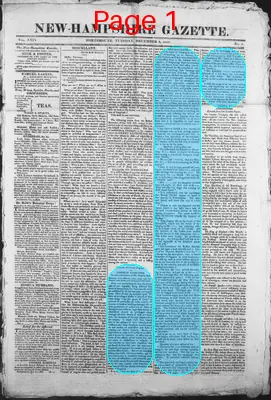
Editorial
December 8, 1818
The New Hampshire Gazette
Portsmouth, Rockingham County, New Hampshire
What is this article about?
Editorial from Richmond Enquirer critiques American newspapers for imitating British aristocratic flattery and titles, arguing it undermines republican equality and simplicity; warns against further encroachments and provides mocking examples.
Clipping
OCR Quality
95%
Excellent
Full Text
From the Richmond Enquirer.
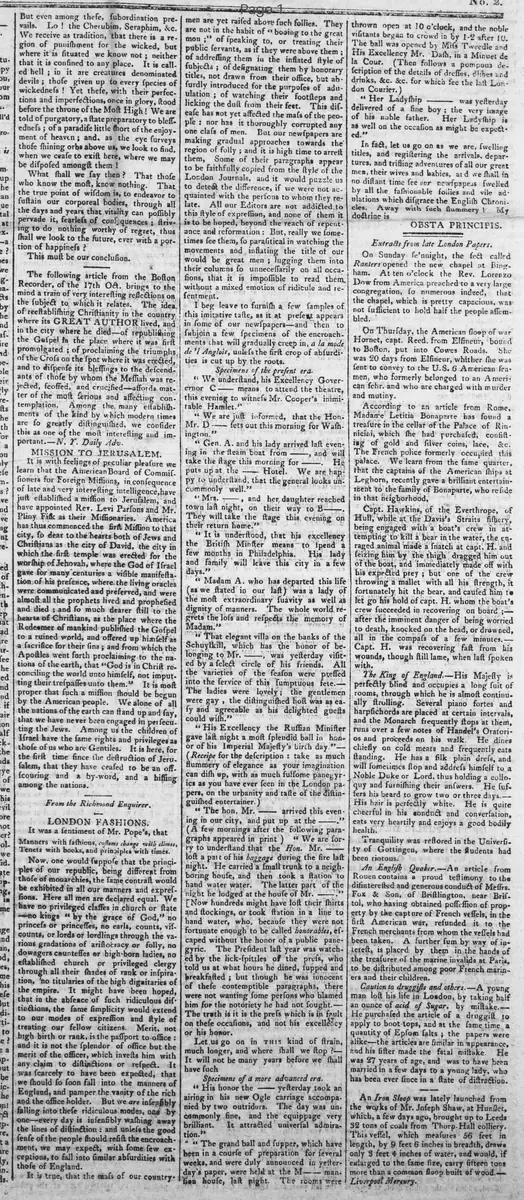
LONDON FASHIONS.
It was a sentiment of Mr. Pope's, that
Manners with fashions, customs change with climes,
Tenets with books, and principles with times.
Now, one would suppose that the principles of our republic, being different from
those of monarchies, the same contrast would
be exhibited in all our manners and expressions. Here all men are declared equal. We
have no privileged classes in church or state
no kings "by the grace of God," no
princes or princesses, no earls, counts, vi-
counts, or lords or lordlings through the va-
rious gradations of aristocracy or folly, no
dowagers countesses or high-born ladies, no
established church or privileged clergy
through all their shades of rank or inspira-
tion, 'no titularies of the high dignitaries of
the empire. It might have been hoped,
that in the absence of such ridiculous dis-
tinctions, the same simplicity would extend
to our modes of expression and style of
treating our fellow citizens. Merit, not
high birth or rank, is the passport to office:
and it is not the splendor of office but the
merit of the officer, which invests him with
any claim to distinctions or respect. It
was scarcely to have been expected, that
, we should so soon fall into the manners of
England, and pamper the vanity of the rich
and the office holder. But we are insensibly
falling into these ridiculous modes, one by
one—every day is insensibly washing away
the lines of distinction: and unless the good
sense of the people should resist the encroach-
ment, we may expect, with some few ex-
ceptions, to fall into similar absurdities with
those of England.
It is true, that the mass of our country-
men are yet raised above such follies. They
are not in the habit of "bowing to the great
man;" of speaking to, or treating their
public servants, as if they were above them:
of addressing them in the inflated style of
subjects; of designating them by honorary
titles, not drawn from their office, but ab-
surdly introduced for the purposes of adu-
latiion: of watching their footsteps and
licking the dust from their feet. This dis-
ease has not yet affected the mass of the peo-
ple: nor has it thoroughly corrupted any
one class of men. But our newspapers are
making gradual approaches towards the
region of folly; and it is high time to arrest
them. Some of their paragraphs appear
to be faithfully copied from the style of the
London Journals, and it would puzzle us
to detect the difference, if we were not ac-
quainted with the persons to whom they re-
late. All our Editors are not addicted to
this style of expression, and none of them it
is to be hoped, beyond the reach of repent-
ence and reformation: But, really we some-
times see them, so parasitical in watching the
movements and inflating the title of our
would be great men; lugging them into
their columns so unnecessarily on all occa-
sions, that it is impossible to read them
without a mixed emotion of ridicule and re-
sentment.
I beg leave to furnish a few samples of
this imitative taste, as it at present appears
in some of our newspapers—and then to
subjoin a few specimens of the encroach-
ments that will gradually creep in, a la mode
de l' Anglois, unless the first crop of absurdi-
ties is cut up by the roots.
Specimens of the present era.
"We understand, his Excellency Gover-
ner C— means to attend the theatre,
this evening to witness Mr. Cooper's inimi-
table Hamlet.
"We are just informed. that the Hon-
orable Mr. D— sets out this morning for Wash-
inton."
Gen. A— and his lady arrived last even-
ing in the steam boat from , and will
take the stage this morning for —. He
puts up at the — Hotel. We are hap-
py to understand, that the general looks un-
commonly well."
"Mrs. ——, and her daughter reached
town last night, on their way to B——
They will take the stage this, evening on
their return home."
"It is understood, that his excellency
the British Minister means to spend a
few months in Philadelphia. His lady
and family 'will leave this city in a few
days."
"Madam A— who has departed this life
(as we stated in our last) was a lady of
the most extraordinary suavity as well as
dignity of manners. The whole world re-
grets the loss and respects the memory of
Madam."
That elegant villa on the banks of the
Schuylkill, which has the honor of be-
longing to Mr. ' , was yesterday visit-
ed by a select circle of his friends. All
the varieties of the season were pressed
into the service of this sumptuous fete.
The ladies were lovely; the gentlemen
were gay, the distinguished host was as ea-
sy and agreeable as his delighted guests
could wish."
"His Excellency the Russian Minister
gave last night a most splendid ball in hon-
or of his Imperial Majesty's birth day.".
(Recipe for the description: take as much
flummery of elegance as your imagination
can dish up, with as much fulsome panegyr-
ics as you have ever seen in the London pa-
papers, on the urbanity and taste of the disti-
guished entertainer.)
"The hon. Mr. — arrived this even-
ing in our city, and put up at the —.".
(A few mornings after the following para-
graphs appeared in print" We are sor-
ry to understand that the Hon. Mr.
— lost a part of his baggage during the fire last
night. He carried a small trunk to a neigh-
boring house, and then took a station to
hand water. The latter part of the
night he lodged at the house of Mr. —.
Now hundreds might have lost their shirts
and stockings, or took station in a line to
hand water, who, because they were not
fortunate enough to be called honorables, es-
caped without the honor of a public pane-
gyric. The President last year was watch-
ed by the lick-spittles of the press, who
told us at what hours he dined, supped and
breakfasted: but though he was innocent
of these contemptible paragraphs, there
were not wanting some persons who blamed
him for the notoriety he had not sought.—
The truth is it is the press which is in fault
on these occasions, and not his excellency
or his honor.
Let us go on in this kind of train,
much longer, and where shall we stop?
It will not be many years before we shall
have such
Specimens of a more advanced era.
"His honor the — yesterday took an
airing in his new elegant carriage accompa-
nied by two outriders. The day was un-
commonly fine, and the equipage very
brilliant. It attracted universal admira-
tion."
"The grand ball and supper, which have
been in a course of preparation for several
weeks, and were duly announced in yester-
day's paper, were held at the M— man-
sion house, last night. The rooms were
thrown open at 10 o'clock, and the noble
visitors began to crowd in by 1-2 after 10.
The ball was opened by Miss Tweedle and
His Excellency Mr. Dash, in a Minuet de
la Cour. (Then follows a pompous de-
scription of the details of dress, dishes and
drinks, &c. &c. for which see the last Lon-
don Courier.)
"Her Ladyship
was yesterday
delivered of a fine boy; the very image
of his noble father. Her Ladyship is
as well on the occasion as might be expect-
ed."
In fact, let us go on as we are, swelling
titles, and registering the arrivals, depar-
tures, and trifling adventures of all our great
men, their wives and babies, ar d we shall in
no distant time see our newspapers swelled
by all the fashionable follies and vile ad-
ulations which disgrace the English Chro-
nicles. Away with such flummery! My
doctrine is
OBSTA PRINCIPIIS.
LONDON FASHIONS.
It was a sentiment of Mr. Pope's, that
Manners with fashions, customs change with climes,
Tenets with books, and principles with times.
Now, one would suppose that the principles of our republic, being different from
those of monarchies, the same contrast would
be exhibited in all our manners and expressions. Here all men are declared equal. We
have no privileged classes in church or state
no kings "by the grace of God," no
princes or princesses, no earls, counts, vi-
counts, or lords or lordlings through the va-
rious gradations of aristocracy or folly, no
dowagers countesses or high-born ladies, no
established church or privileged clergy
through all their shades of rank or inspira-
tion, 'no titularies of the high dignitaries of
the empire. It might have been hoped,
that in the absence of such ridiculous dis-
tinctions, the same simplicity would extend
to our modes of expression and style of
treating our fellow citizens. Merit, not
high birth or rank, is the passport to office:
and it is not the splendor of office but the
merit of the officer, which invests him with
any claim to distinctions or respect. It
was scarcely to have been expected, that
, we should so soon fall into the manners of
England, and pamper the vanity of the rich
and the office holder. But we are insensibly
falling into these ridiculous modes, one by
one—every day is insensibly washing away
the lines of distinction: and unless the good
sense of the people should resist the encroach-
ment, we may expect, with some few ex-
ceptions, to fall into similar absurdities with
those of England.
It is true, that the mass of our country-
men are yet raised above such follies. They
are not in the habit of "bowing to the great
man;" of speaking to, or treating their
public servants, as if they were above them:
of addressing them in the inflated style of
subjects; of designating them by honorary
titles, not drawn from their office, but ab-
surdly introduced for the purposes of adu-
latiion: of watching their footsteps and
licking the dust from their feet. This dis-
ease has not yet affected the mass of the peo-
ple: nor has it thoroughly corrupted any
one class of men. But our newspapers are
making gradual approaches towards the
region of folly; and it is high time to arrest
them. Some of their paragraphs appear
to be faithfully copied from the style of the
London Journals, and it would puzzle us
to detect the difference, if we were not ac-
quainted with the persons to whom they re-
late. All our Editors are not addicted to
this style of expression, and none of them it
is to be hoped, beyond the reach of repent-
ence and reformation: But, really we some-
times see them, so parasitical in watching the
movements and inflating the title of our
would be great men; lugging them into
their columns so unnecessarily on all occa-
sions, that it is impossible to read them
without a mixed emotion of ridicule and re-
sentment.
I beg leave to furnish a few samples of
this imitative taste, as it at present appears
in some of our newspapers—and then to
subjoin a few specimens of the encroach-
ments that will gradually creep in, a la mode
de l' Anglois, unless the first crop of absurdi-
ties is cut up by the roots.
Specimens of the present era.
"We understand, his Excellency Gover-
ner C— means to attend the theatre,
this evening to witness Mr. Cooper's inimi-
table Hamlet.
"We are just informed. that the Hon-
orable Mr. D— sets out this morning for Wash-
inton."
Gen. A— and his lady arrived last even-
ing in the steam boat from , and will
take the stage this morning for —. He
puts up at the — Hotel. We are hap-
py to understand, that the general looks un-
commonly well."
"Mrs. ——, and her daughter reached
town last night, on their way to B——
They will take the stage this, evening on
their return home."
"It is understood, that his excellency
the British Minister means to spend a
few months in Philadelphia. His lady
and family 'will leave this city in a few
days."
"Madam A— who has departed this life
(as we stated in our last) was a lady of
the most extraordinary suavity as well as
dignity of manners. The whole world re-
grets the loss and respects the memory of
Madam."
That elegant villa on the banks of the
Schuylkill, which has the honor of be-
longing to Mr. ' , was yesterday visit-
ed by a select circle of his friends. All
the varieties of the season were pressed
into the service of this sumptuous fete.
The ladies were lovely; the gentlemen
were gay, the distinguished host was as ea-
sy and agreeable as his delighted guests
could wish."
"His Excellency the Russian Minister
gave last night a most splendid ball in hon-
or of his Imperial Majesty's birth day.".
(Recipe for the description: take as much
flummery of elegance as your imagination
can dish up, with as much fulsome panegyr-
ics as you have ever seen in the London pa-
papers, on the urbanity and taste of the disti-
guished entertainer.)
"The hon. Mr. — arrived this even-
ing in our city, and put up at the —.".
(A few mornings after the following para-
graphs appeared in print" We are sor-
ry to understand that the Hon. Mr.
— lost a part of his baggage during the fire last
night. He carried a small trunk to a neigh-
boring house, and then took a station to
hand water. The latter part of the
night he lodged at the house of Mr. —.
Now hundreds might have lost their shirts
and stockings, or took station in a line to
hand water, who, because they were not
fortunate enough to be called honorables, es-
caped without the honor of a public pane-
gyric. The President last year was watch-
ed by the lick-spittles of the press, who
told us at what hours he dined, supped and
breakfasted: but though he was innocent
of these contemptible paragraphs, there
were not wanting some persons who blamed
him for the notoriety he had not sought.—
The truth is it is the press which is in fault
on these occasions, and not his excellency
or his honor.
Let us go on in this kind of train,
much longer, and where shall we stop?
It will not be many years before we shall
have such
Specimens of a more advanced era.
"His honor the — yesterday took an
airing in his new elegant carriage accompa-
nied by two outriders. The day was un-
commonly fine, and the equipage very
brilliant. It attracted universal admira-
tion."
"The grand ball and supper, which have
been in a course of preparation for several
weeks, and were duly announced in yester-
day's paper, were held at the M— man-
sion house, last night. The rooms were
thrown open at 10 o'clock, and the noble
visitors began to crowd in by 1-2 after 10.
The ball was opened by Miss Tweedle and
His Excellency Mr. Dash, in a Minuet de
la Cour. (Then follows a pompous de-
scription of the details of dress, dishes and
drinks, &c. &c. for which see the last Lon-
don Courier.)
"Her Ladyship
was yesterday
delivered of a fine boy; the very image
of his noble father. Her Ladyship is
as well on the occasion as might be expect-
ed."
In fact, let us go on as we are, swelling
titles, and registering the arrivals, depar-
tures, and trifling adventures of all our great
men, their wives and babies, ar d we shall in
no distant time see our newspapers swelled
by all the fashionable follies and vile ad-
ulations which disgrace the English Chro-
nicles. Away with such flummery! My
doctrine is
OBSTA PRINCIPIIS.
What sub-type of article is it?
Social Reform
Satire
What keywords are associated?
Aristocratic Manners
Republican Simplicity
Newspaper Flattery
British Imitation
Social Equality
Honorary Titles
Public Officials
What entities or persons were involved?
American Newspapers
Editors
Public Officials
British Influence
Editorial Details
Primary Topic
Critique Of Imitating British Aristocratic Manners In American Press And Society
Stance / Tone
Opposition To Flattery And Titles Undermining Republican Equality
Key Figures
American Newspapers
Editors
Public Officials
British Influence
Key Arguments
Republican Principles Demand Simplicity And Equality In Manners And Expressions
Newspapers Are Adopting Inflated, Flattering Styles From London Journals
Such Practices Pamper Vanity And Erode Distinctions Of Merit Over Rank
Mass Of People Resist But Press Leads The Folly; Reform Needed To Arrest It
Examples Show Unnecessary Adulation Of Governors, Generals, And Ministers
Continued Trend Will Lead To Full Adoption Of English Aristocratic Absurdities