Thank you for visiting SNEWPapers!
Sign up free
Gazette Of The United States
Philadelphia, Philadelphia County, Pennsylvania
What is this article about?
U.S. House of Representatives session on May 28: Passed bills for Baron Steuben's heirs and Miami River land; debated and postponed Vermont election dispute; resolved Senate disagreement on U.S. debt bill via conference; advanced Tennessee statehood bill with amendments and votes; received presidential messages on appropriations and acts signed.
Clipping
OCR Quality
Full Text
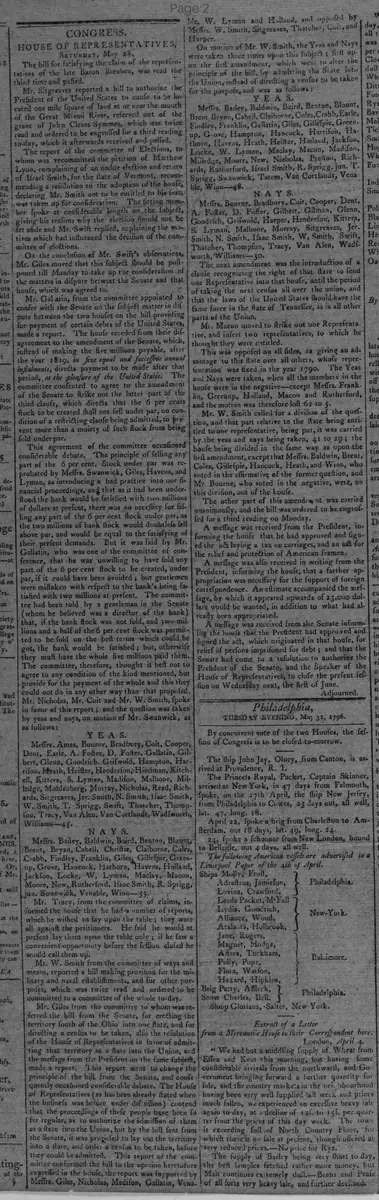
HOUSE OF REPRESENTATIVES,
SATURDAY, May 28,
The bill for satisfying the claim of the representatives of the late Baron Steuben, was read the third time and passed.
Mr. Sitgreaves reported a bill to authorize the President of the United States to cause to be located one mile square of land at or near the mouth of the Great Miami River, reserved out of the grant of John Cleves Symmes, which was twice read and ordered to be engrossed for a third reading to-day, which it afterwards received and passed.
The report of the committee of Elections, to whom was recommitted the petition of Matthew Lyon, complaining of an undue election and return of Israel Smith, for the state of Vermont, recommending a resolution to the adoption of the house, declaring Mr. Smith not to be entitled to his seat, was taken up for consideration. The sitting member spoke at considerable length on the subject, giving his reasons why the election should not be set aside and Mr. Swift replied, explaining the motives which had influenced the decision of the committee of elections.
On the conclusion of Mr. Swift's observations, Mr. Giles moved that this subject should be postponed till Monday to take up the consideration of the matters in dispute betwixt the Senate and that house, which was agreed to.
Mr. Gallatin, from the committee appointed to confer with the Senate on the subject matter in dispute between the two houses on the bill providing for payment of certain debts of the United States, made a report. The house receded from their disagreement to the amendment of the Senate, which, instead of making the five millions payable, after the year 1819, in five equal and successive annual installments, directs payment to be made after that period, at the pleasure of the United States. The committee consented to agree to the amendment of the Senate to strike out the latter part of the third clause, which directs that the 6 per cents stock to be created shall not sell under par, on condition of a restricting clause being admitted, to prevent more than a moiety of such stock from being sold under par.
This agreement of the committee occasioned considerable debate. The principle of selling any part of the 6 per cent. Stock under par was reprobated by Messrs. Swanwick, Giles, Havens, and Lyman, as introducing a bad practice into our financial proceedings, and that as it had been understood the bank would be satisfied with two millions of dollars at present, there was no necessity for selling any part of the 6 per cent stock under par, as the two millions of bank stock would doubtless sell above par, and would be equal to the satisfying of their present demands. But it was said by Mr. Gallatin, who was one of the committee of conference, that he was unwilling to have sold any part of the 6 per cent stock to be created, under par, if it could have been avoided ; but gentlemen were mistaken with respect to the bank's being satisfied with two millions at present. The committee had been told by a gentleman in the Senate (whom he believed was a director of the bank) that, if the bank stock was not sold, and two millions and a half of the 6 per cent stock was permitted to be sold on the best terms which could be got, the bank would be satisfied; but, otherwise they must have the whole five millions paid them. The committee, therefore, thought it best not to agree to any condition of the kind mentioned, but provide for the payment of the whole and this they could not do in any other way than-that proposed.
Mr. Nicholas, Mr. Coit and Mr. W. Smith, spoke in favor of this report ; and the question was taken by yeas and nays, on motion of Mr. Swanwick, as follows:
YEAS.
Messrs. Ames, Bourne, Bradbury, Coit, Cooper, Dent, Earle. A. Foster. D. Foster Gallatin. Gilbert, Glenn, Goodrich. Griswold, Hampton. Harrison, Heath, Heister, Henderson, Hindman, Kitterell, Kittera, S. Lyman, Madison, Malbone, Millledge, Muhlenberg, Murray, Nicholas, Read, Richards, Sitgreaves, Jer. Smith, N. Smith, Isaac Smith, W. Smith, T. Sprigg, Swift, Thatcher, Thompson, Tracy, Van Alen. Van Cortlandt, Wadsworth, Williams-45.
NAYS.
Messrs. Bailey, Baldwin, Baird, Benton, Blount. Brent, Bryan, Cabell, Christie, Claiborne, Coles, Crabb, Findley, Franklin, Giles, Gillespie, Greenup, Grove, Hancock, Hathorn, Havens, Holland, Jackson, Locke, W, Lyman, Maclay, Macon, Moore, New, Rutherford, Isaac Smith, R. Sprigg, jun. Swanwick, Venable, Winn-35.
Mr. Tracy, from the committee of claims, informed the house that he had a number of reports. which he wished to lay upon the table; they were all against the petitioners. He said he would at present lay them upon the table only; if he saw a convenient opportunity before the session closed he would call them up.
Mr. W. Smith from the committee of ways and means, reported a bill making provision for the military and naval establishments, and for other purposes, which was twice read and ordered to be committed to a committee of the whole to-day.
Mr. Giles from the committee to whom was referred the bill from the Senate, for erecting the territory south of the Ohio into one state, and for directing a census to be taken, also the resolution of the House of Representatives in favor of admitting that territory as a state into the Union, and the message from the President on the same subject, made a report. This report went to change the principle of the bill, from the Senate, and consequently occasioned considerable debate. The House of Representatives (as has been already stated when the business was before under discussion) contend that the proceedings of these people have been so far regular, as to authorize the admission of them as a state into the Union, but by the bill sent from the Senate, it was proposed to lay out the territory into a state, and order a census to be taken, before they could be admitted. This report of the committee conformed the bill to the opinion heretofore expressed in the house, the report was supported by Messrs. Giles, Nicholas, Madison, Gallatin, Venable, W. Lyman and Holland, and opposed by Messrs. W. Smith, Sitgreaves, Thatcher, Coit, and Harper.
On motion of Mr. W. Smith, the Yeas and Nays were taken three times upon this subject; first upon the first amendment, which went to alter the principle of the bill, by admitting the State into the Union, instead of directing a census to be taken for the purpose, and was as follows:
YEAS.
Messrs. Bailey, Baldwin, Baird, Benton, Blount, Brent Bryan, Cabell, Claiborne, Coles, Crabb, Earle, Findley, Franklin, Gallatin, Giles, Gillespie, Greenup, Grove, Hampton, Hancock, Harrison, Hathorn, Havens, Heath, Heister, Holland, Jackson, Locke, W. Lyman, Maclay, Macon, Madison, Millledge, Moore, New, Nicholas, Preston, Richards, Rutherford, Israel Smith, R. Sprigg, jun. T. Sprigg, Swanwick, Tatem, Van Cortlandt, Venable, Winn-48.
NAYS.
Messrs. Bourne, Bradbury. Coit, Cooper, Dent, A. Foster, D. Foster, Gilbert, Gilman, Glenn, Goodrich, Griswold, Harper, Henderson, Kittera, S. Lyman, Malbone, Murray, Sitgreaves, Jer. Smith, N. Smith. Isaac Smith, W, Smith, Swift, Thatcher, Thompson, Tracy, Van Alen, Wadsworth, Williams30.
The next amendment was the introduction of a clause recognizing the right of that state to send one Representative into that house, until the period of taking the next census all over the union, and that the laws of the United States should have the same force in the state of Tennessee, as in all other parts of the Union.
Mr. Mason moved to strike out one Representative, and insert two representatives, to which he thought they were entitled.
This was opposed on all sides, as giving an advantage to this state over all others, whose representation was fixed in the year 1790. The Yeas and Nays were taken, when all the members in the house were in the negative except Messrs. Franklin, Greenup, Holland, Macon and Rutherford, and the motion was therefore lost 62 to 5.
Mr. W. Smith called for a division of the question, and that part relative to the state being entitled to one representative, being put, it was carried by the yeas and nays being taken, 41 to 29; the house being divided in the same way as upon the first amendment, except that Messrs. Baldwin, Brent, Coles, Gillespie, Hancock, Heath, and Winn, who voted in the affirmative of the former question, and Mr. Bourne, who voted in the negative, were, on this division, out of the house.
The other part of this amendment was carried unanimously, and the bill was ordered to be engrossed for a third reading on Monday.
A message was received from the President, informing the house that he had approved and signed the act laying a tax on carriages, and an act for the relief and protection of American seamen.
A message was also received in writing from the President, informing the house, that a farther appropriation was necessary for the support of foreign correspondence. An estimate accompanied the message, by which it appeared upwards of 23,000 dollars would be wanted, in addition to what had already been appropriated.
A message was received from the Senate informing the house that the President had approved and signed the act, which originated in that house, for relief of persons imprisoned for debt ; and that the Senate had come to a resolution to authorize the President of the Senate. and the Speaker of the House of Representatives, to close the present session on Wednesday next, the first of June.
Adjourned.
What sub-type of article is it?
What keywords are associated?
What entities or persons were involved?
Domestic News Details
Event Date
Saturday, May 28
Key Persons
Outcome
bills passed for steuben claim and miami land; vermont election debate postponed; debt bill amendments agreed (45-35 vote); tennessee statehood bill amended and advanced (48-30, 41-29 votes); presidential messages on signed acts and appropriations; session to close june 1.
Event Details
House proceedings included passing bills, debating election disputes, resolving inter-chamber disagreements on debt payments involving 6% stock and bank demands, reporting on claims and military provisions, and amending Senate bill for Tennessee admission with debates and yeas/nays votes.