Thank you for visiting SNEWPapers!
Sign up free
The Providence Journal, And Town And Country Advertiser
Providence, Providence County, Rhode Island
What is this article about?
Biographical sketch of Napoleon Bonaparte, born in Corsica in 1767, detailing his family background, education, early military career, involvement in Corsican politics, and rise to prominence during the French Revolution, culminating in his command of the Army of Italy in 1796.
Clipping
OCR Quality
Full Text
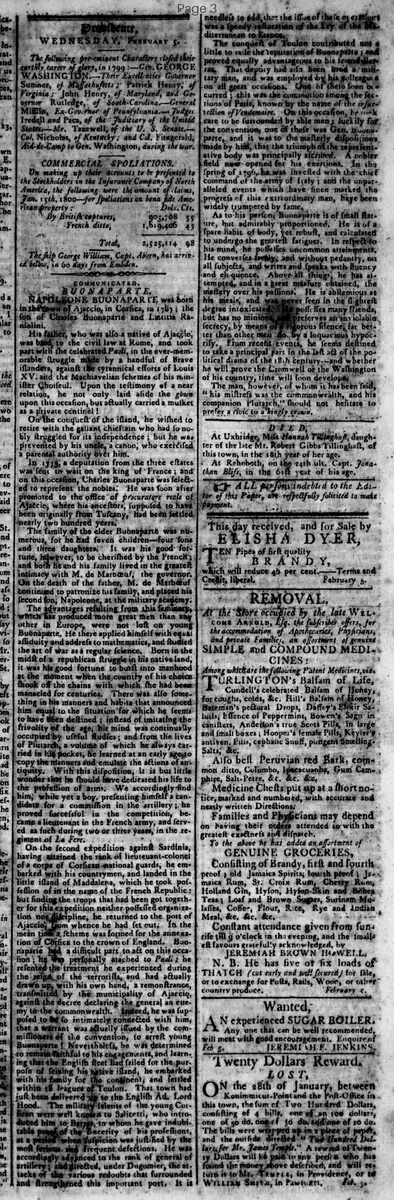
BUONAPARTE.
NAPOLEONE BUONAPARTE was born in the town of Ajaccio, in Corsica, in 1767; the son of Charles Buonaparte and Laetitia Ramolini.
His father, who was also a native of Ajaccio; was bred to the civil law at Rome, and took part with the celebrated Paoli, in the ever-memorable struggle made by a handful of brave islanders, against the tyrannical efforts of Louis XV. and the Machiavellian schemes of his minister Choiseul: Upon the testimony of a near relation, he not only laid aside the gown upon this occasion, but actually carried a musket as a private sentinel!
On the conquest of the island, he wished to retire with the gallant chieftain who had so nobly struggled for its independence; but he was prevented by his uncle, a canon, who exercised a parental authority over him.
In 1778, a deputation from the three estates was sent to wait on the king of France; and on this occasion, Charles-Buonaparte was selected to represent the nobles: He was soon after promoted to the office of procuratore reale of Ajaccio; where his ancestors, supposed to have been originally from Tuscany, had been settled nearly two hundred years.
The family of the elder Buonaparte was numerous, for he had seven children—four sons and three daughters! It was his good fortune, however, to be cherished by the French and both he and his family lived in the greatest intimacy with M. de Marbeuf, the governor.
On the death of the father M. de Marbeuf continued to patronize his family, and placed his second son, Napoleon, at the military academy: The advantages resulting from this seminary which has produced more great men than any other in Europe, were not lost on young Buonaparte. He there applied himself with equal assiduity and address to mathematics, and studied the art of war as a regular science. Born in the midst of a republican struggle in his native land; it was his good fortune to burst into manhood at the moment when the country of his choice shook off the chains with which she had been manacled for centuries. There was also something in his manners and habits that announced him equal to the situation for which he seems to have been destined: instead of imitating the frivolity of the age; his mind was continually occupied by useful studies: and from the lives of Plutarch, a volume of which he always carried in his pocket; he learned at an early age to copy the manners and emulate the actions of antiquity. With this disposition; it is but little wonder that he should have dedicated his life to the profession of arms; We accordingly find him; while yet a boy, presenting himself a candidate for a commission in the artillery; he proved successful in the competition, became a lieutenant in the French army, and served as such during two or three years, in the regiment of La Fere.
On the second expedition against Sardinia, having attained the rank of lieutenant-colonel of a corps of Corsican national guards; he embarked with his countrymen, and landed in the little island of Maddalena, which he took possession of in the name of the French Republic: but finding the troops that had been got together for this expedition neither possessed organization nor discipline; he returned to the port of Ajaccio from whence he had set out: in the mean time a scheme was formed for the annexation of Corsica to the crown of England. Buonaparte had a difficult part to act on this occasion; he was personally attached to Paoli: he resented the treatment he experienced during the reign of the terrorists, and had actually drawn up, with his own hand, a remonstrance, transmitted by the municipality of Ajaccio against the decree declaring the general an enemy to the commonwealth. Indeed; he was supposed to be so intimately connected with him, that a warrant was actually issued by the commissioner of the convention, to arrest young Buonaparte! Nevertheless, he was determined to remain faithful to his engagements, and learning that the English fleet had sailed for the purpose of raising his native island, he embarked with his family for the continent; and settled within 18 leagues of Toulon. That town had just been delivered up to the English Adm. Lord Hood. The military talents of the young Corsican were well known to Salicetti, who introduced him to Barras, to whom he gave indubitable proof of the sincerity of his professions, at a period when suspicion was justified by the most serious and frequent defections. He was accordingly advanced to the rank of general of artillery: and directed, under Dugommier, the attacks of the various redoubts that surrounded and strengthened this important port. It is needless to add that the issue of these operations was a speedy restoration of the key of the Mediterranean to France.
The conquest of Toulon contributed not a little to raise the reputation of Buonaparte; and proved equally advantageous to his friend Barras. That deputy had also been bred a military man, and was employed by his colleagues on all great occasions. One of these soon occurred: this was the commotion among the sections of Paris, known by the name of the insurrection of Vendemaire. On this occasion, he took care to be surrounded by able men; luckily for the convention, One of those was Gen. Buonaparte, and it was to the masterly dispositions made by him, that the triumph of the representative body was principally ascribed. A nobler field now opened for his exertions. In the spring of 1796, he was invested with the chief command of the army of Italy; and the unparalleled events which have since marked the progress of this extraordinary man, have been widely trumpeted by fame.
As to his person, Buonaparte is of small stature, but admirably proportioned. He is of a spare habit of body, yet robust, and calculated to undergo the greatest fatigues. In respect to his mind, he possesses uncommon attainments. He converses freely: and without pedantry, on all subjects, and writes and speaks with fluency and eloquence. Above all things he has attempted, and in a great measure obtained, the mastery over his passions. He is abstemious at his meals, and was never seen in the slightest degree intoxicated! He possesses many friends, but has no minions; preserves an inviolable secrecy by means of a rigorous silence better than other men do by a loquacious hypocrisy. From recent events, he seems destined to take a principal part in the last act of the political drama of the 18th century—and whether he will prove the Cromwell or the Washington of his country, time will soon develope:
The man, however, of whom it has been said "his mistress was the commonwealth, and his companion Plutarch," should not hesitate to prefer a civic to a kingly crown.
What sub-type of article is it?
What themes does it cover?
What keywords are associated?
What entities or persons were involved?
Where did it happen?
Story Details
Key Persons
Location
Ajaccio, Corsica; France; Toulon; Paris; Italy
Event Date
1767 To 1796
Story Details
Napoleon Bonaparte, born in Ajaccio, Corsica in 1767 to Charles Buonaparte and Laetitia Ramolini, whose father participated in the Corsican struggle against France. Educated at military academy, he became a lieutenant in the French army. Involved in Corsican politics, he fled to France, recaptured Toulon from the English, suppressed the Vendemiaire insurrection in Paris, and in 1796 took command of the Army of Italy.