Thank you for visiting SNEWPapers!
Sign up free
The Virginia Gazette
Richmond, Williamsburg, Richmond County, Virginia
What is this article about?
General Howe's letter details the British and Hessian forces' successful attack on Fort Washington on November 16, 1776, capturing 2300 American prisoners, followed by the evacuation of Fort Lee and advance into New Jersey, securing control of the North River.
Clipping
OCR Quality
Full Text
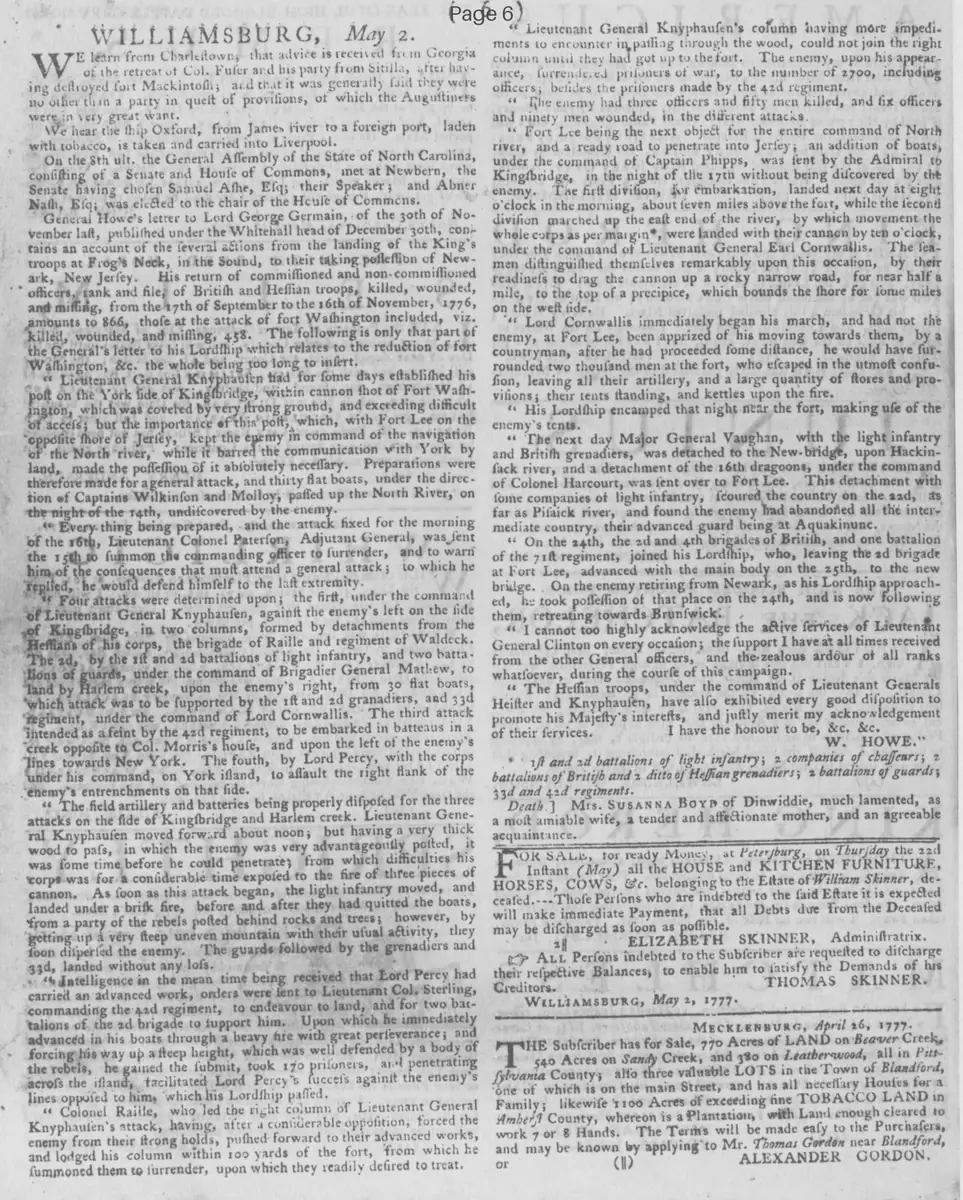
"Lieutenant General Knyphausen had for some days established his post on the York side of Kingsbridge, within cannon shot of Fort Washington, which was covered by very strong ground, and exceeding difficult of access; but the importance of this post, which, with Fort Lee on the opposite shore of Jersey, kept the enemy in command of the navigation of the North River, while it barred the communication with York by land, made the possession of it absolutely necessary. Preparations were therefore made for a general attack, and thirty flat boats, under the direction of Captains Wilkinson and Molloy, passed up the North River, on the night of the 14th, undiscovered by the enemy.
Every thing being prepared, and the attack fixed for the morning of the 16th, Lieutenant Colonel Paterson, Adjutant General, was sent on the 15th to summon the commanding officer to surrender, and to warn him of the consequences that must attend a general attack; to which he replied, he would defend himself to the last extremity.
Four attacks were determined upon; the first, under the command of Lieutenant General Knyphausen, against the enemy’s left on the side of Kingsbridge, in two columns, formed by detachments from the Hessians of his corps, the brigade of Rall and regiment of Waldeck. The 2d, by the 1st and 2d battalions of light infantry, and two battalions of guards, under the command of Brigadier General Mathew, to land by Harlem Creek, upon the enemy’s right, from 30 flat boats, which attack was to be supported by the 1st and 2d grenadiers, and 33d regiment, under the command of Lord Cornwallis. The third attack intended as a feint by the 42d regiment, to be embarked in batteaus in a creek opposite to Col. Morris’s house, and upon the left of the enemy’s lines towards New York. The fourth, by Lord Percy, with the corps under his command, on York Island, to assault the right flank of the enemy’s entrenchments on that side.
The field artillery and batteries being properly disposed for the three attacks on the side of Kingsbridge and Harlem Creek. Lieutenant General Knyphausen moved forward about noon; but having a very thick wood to pass, in which the enemy was very advantageously posted, his corps was for a considerable time exposed to the fire of three pieces of cannon. As soon as this attack began, the light infantry moved, and landed under a brisk fire, before and after they had quitted the boats, from a party of the rebels posted behind rocks and trees; however, by getting up a very steep uneven mountain with their usual activity, they soon dispersed the enemy. The guards followed by the grenadiers and 33d, landed without any loss.
Intelligence in the mean time being received that Lord Percy had carried an advanced work, orders were sent to Lieutenant Col. Sterling, commanding the 42d regiment, to endeavour to land, and for two battalions of the 2d brigade to support him, upon which he immediately advanced in his boats through a heavy fire with great perseverance; and forcing his way up a steep height, which was well defended by a body of the rebels, he gained the summit, took 170 prisoners, and penetrating across the island, facilitated Lord Percy’s success against the enemy’s lines opposed to him, which his Lordship passed.
Colonel Rall, who led the right column of Lieutenant General Knyphausen’s attack, having, after a considerable opposition, forced the enemy from their strong holds, pushed forward to their advanced works, and lodged his column within 100 yards of the fort, from which he summoned them to surrender, upon which they readily desired to treat.
Lieutenant General Knyphausen’s column having more impediments to encounter in passing through the wood, could not join the right column until they had got up to the fort. The enemy, upon his appearance, surrendered prisoners of war, to the number of 2300, including officers; besides the prisoners made by the 42d regiment.
The enemy had three officers and fifty men killed, and six officers and ninety men wounded, in the different attacks.
Fort Lee being the next object for the entire command of North River, and a ready road to penetrate into Jersey; an addition of boats, under the command of Captain Phipps, was sent by the Admiral to Kingsbridge, in the night of the 17th without being discovered by the enemy. The first division, for embarkation, landed next day at eight o’clock in the morning, about seven miles above the fort, while the second division marched up the east end of the river, by which movement the whole corps as per margin, were landed with their cannon by ten o’clock, under the command of Lieutenant General Earl Cornwallis. The seamen distinguished themselves remarkably upon this occasion, by their readiness to drag the cannon up a rocky narrow road, for near half a mile, to the top of a precipice, which bounds the shore for some miles on the west side.
Lord Cornwallis immediately began his march, and had not the enemy, at Fort Lee, been apprized of his moving towards them, by a countryman, after he had proceeded some distance, he would have surrounded two thousand men at the fort, who escaped in the utmost confusion, leaving all their artillery, and a large quantity of stores and provisions; their tents standing, and kettles upon the fire.
His Lordship encamped that night near the fort, making use of the enemy’s tents.
The next day Major General Vaughan, with the light infantry and British grenadiers, was detached to the New-bridge, upon Hackensack River, and a detachment of the 16th dragoons, under the command of Colonel Harcourt, was sent over to Fort Lee. This detachment with some companies of light infantry, scoured the country on the 22d, as far as Passaic River, and found the enemy had abandoned all the intermediate country, their advanced guard being at Acquackanonk.
On the 24th, the 2d and 4th brigades of British, and one battalion of the 71st regiment, joined his Lordship, who, leaving the 2d brigade at Fort Lee, advanced with the main body on the 25th, to the new bridge. On the enemy retiring from Newark, as his Lordship approached, he took possession of that place on the 28th, and is now following them, retreating towards Brunswick.
I cannot too highly acknowledge the active services of Lieutenant General Clinton on every occasion; the support I have at all times received from the other General officers, and the zealous ardour of all ranks whatsoever, during the course of this campaign.
The Hessian troops, under the command of Lieutenant Generals Heister and Knyphausen, have also exhibited every good disposition to promote his Majesty’s interests, and justly merit my acknowledgement of their services.
I have the honour to be, &c. &c.
W. HOWE."
The corps as per margin: 1st and 2d battalions of light infantry; 2 companies of chasseurs; 2 battalions of British and ditto of Hessian grenadiers; 2 battalions of guards; 33d and 42d regiments.
What sub-type of article is it?
What themes does it cover?
What keywords are associated?
What entities or persons were involved?
Where did it happen?
Story Details
Key Persons
Location
Fort Washington, York Island, Fort Lee, North River, New Jersey, Newark
Event Date
16th November 1776
Story Details
British and Hessian forces launched a coordinated attack on Fort Washington, overcoming defenses through multiple assaults, capturing 2300 prisoners. Subsequently, they forced the evacuation of Fort Lee, seizing supplies, and advanced into New Jersey, taking Newark while pursuing retreating Americans.