Thank you for visiting SNEWPapers!
Sign up free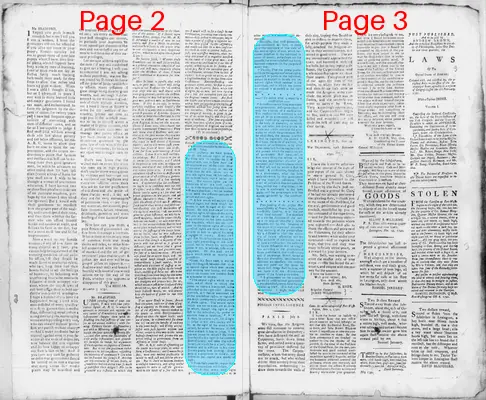
Literary
November 19, 1791
The Kentucky Gazette
Lexington, Fayette County, Kentucky
What is this article about?
Excerpt from Thomas Paine's 'Rights of Man' explaining natural rights as inherent to existence (e.g., intellectual rights, religion) and civil rights as societal protections derived from them. Discusses retained vs. surrendered rights, society's role, and constitutions as antecedent to government, binding its powers.
Merged-components note: This is a continuation of the literary extract from Thomas Paine's 'Rights of Man' across pages 2 and 3; the second part was mislabeled as editorial but is part of the same treatise excerpt.
Clippings
1 of 2
OCR Quality
98%
Excellent
Full Text
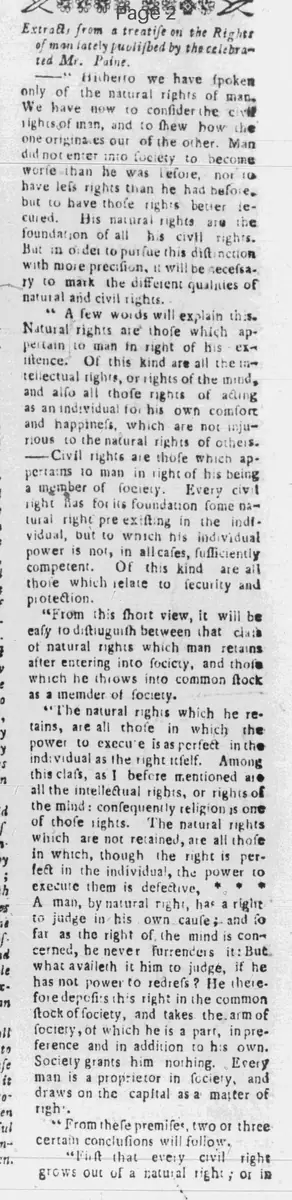
Extract, from a treatise on the Rights of man lately published by the celebrated Mr. Paine.
Hitherto we have spoken only of the natural rights of man. We have now to consider the civil rights of man, and to shew how the one originates out of the other. Man did not enter into society to become worse than he was before, nor to have less rights than he had before, but to have those rights better secured. His natural rights are the foundation of all his civil rights. But in order to pursue this distinction with more precision, it will be necessary to mark the different qualities of natural and civil rights.
A few words will explain this. Natural rights are those which appertain to man in right of his existence. Of this kind are all the intellectual rights, or rights of the mind, and also all those rights of acting as an individual for his own comfort and happiness, which are not injurious to the natural rights of others. Civil rights are those which appertain to man in right of his being a member of society. Every civil right has for its foundation some natural right pre-existing in the individual, but to which his individual power is not, in all cases, sufficiently competent. Of this kind are all those which relate to security and protection.
From this short view, it will be easy to distinguish between that class of natural rights which man retains after entering into society, and those which he throws into the common stock as a member of society.
The natural rights which he retains, are all those in which the power to execute is as perfect in the individual as the right itself. Among this class, as I before mentioned are all the intellectual rights, or rights of the mind: consequently religion is one of those rights. The natural rights which are not retained, are all those in which, though the right is perfect in the individual, the power to execute them is defective.
A man, by natural right, has a right to judge in his own cause; and so far as the right of the mind is concerned, he never surrenders it: But what availeth it him to judge, if he has not power to redress? He therefore deposits this right in the common stock of society, and takes the arm of society, of which he is a part, in preference and in addition to his own. Society grants him nothing. Every man is a proprietor in society and draws on the capital as a matter of right.
From these premises, two or three certain conclusions will follow.
First that every civil right grows out of a natural right; or in other words, is a natural right exchanged.
In other words, is a natural right exchanged.
Secondly, that civil power, properly considered as such, is made up of the aggregate of that class of the natural rights of man, which becomes defective in the individual in point of power, and answers not his purpose, but when collected to a focus, becomes competent to the purpose of every one.
Thirdly, That the power produced from the aggregate of natural rights, imperfect in power in the individual, cannot be applied to invade the natural rights which remain retained in the individual, and in which the power to execute is as perfect as the right itself.
To define what is meant by a constitution.
A constitution is a thing antecedent to a government, and a government is only the creature of a constitution. The constitution of a country is not the act of its government, but of the people constituting a government. It is the body of elements, to which you can refer, and quote article by article; and which contains the principles on which the government shall be established, the manner in which it shall be organized, the powers it shall have, the mode of elections, the duration of parliaments, or by what other name such bodies may be called; the powers which the executive part of government shall have; and, in fine, every thing that relates to the complete organization of a civil government, and the principles on which it shall act, and by which it shall be bound. A constitution, therefore, is to a government, what the laws made afterwards by that government are to a court of judicature. The court of judicature does not make the laws, neither can it alter them; it only acts in conformity to the laws made; and the government is in like manner governed by the constitution.
Then speaking of the present National assembly of France, he says, that strictly speaking, it is the personal social compact. The members of it are the delegates of the nation in its original character; future assemblies will be the delegates of the nation in its organized character. The authority of the present assembly is different to what the authority of future assemblies will be. The authority of the present one is to form a constitution: the authority of future Assemblies will be to legislate according to the principles and forms prescribed in that constitution; and if experience should hereafter show that alterations, amendments or additions are necessary, the constitution will point out the mode by which such things shall be done, and not leave it in the discretionary power of the future government.
A government on the principles on which constitutional governments are established, cannot have the right of altering itself. If it had, it would be arbitrary. It might make itself what it pleased.
Hitherto we have spoken only of the natural rights of man. We have now to consider the civil rights of man, and to shew how the one originates out of the other. Man did not enter into society to become worse than he was before, nor to have less rights than he had before, but to have those rights better secured. His natural rights are the foundation of all his civil rights. But in order to pursue this distinction with more precision, it will be necessary to mark the different qualities of natural and civil rights.
A few words will explain this. Natural rights are those which appertain to man in right of his existence. Of this kind are all the intellectual rights, or rights of the mind, and also all those rights of acting as an individual for his own comfort and happiness, which are not injurious to the natural rights of others. Civil rights are those which appertain to man in right of his being a member of society. Every civil right has for its foundation some natural right pre-existing in the individual, but to which his individual power is not, in all cases, sufficiently competent. Of this kind are all those which relate to security and protection.
From this short view, it will be easy to distinguish between that class of natural rights which man retains after entering into society, and those which he throws into the common stock as a member of society.
The natural rights which he retains, are all those in which the power to execute is as perfect in the individual as the right itself. Among this class, as I before mentioned are all the intellectual rights, or rights of the mind: consequently religion is one of those rights. The natural rights which are not retained, are all those in which, though the right is perfect in the individual, the power to execute them is defective.
A man, by natural right, has a right to judge in his own cause; and so far as the right of the mind is concerned, he never surrenders it: But what availeth it him to judge, if he has not power to redress? He therefore deposits this right in the common stock of society, and takes the arm of society, of which he is a part, in preference and in addition to his own. Society grants him nothing. Every man is a proprietor in society and draws on the capital as a matter of right.
From these premises, two or three certain conclusions will follow.
First that every civil right grows out of a natural right; or in other words, is a natural right exchanged.
In other words, is a natural right exchanged.
Secondly, that civil power, properly considered as such, is made up of the aggregate of that class of the natural rights of man, which becomes defective in the individual in point of power, and answers not his purpose, but when collected to a focus, becomes competent to the purpose of every one.
Thirdly, That the power produced from the aggregate of natural rights, imperfect in power in the individual, cannot be applied to invade the natural rights which remain retained in the individual, and in which the power to execute is as perfect as the right itself.
To define what is meant by a constitution.
A constitution is a thing antecedent to a government, and a government is only the creature of a constitution. The constitution of a country is not the act of its government, but of the people constituting a government. It is the body of elements, to which you can refer, and quote article by article; and which contains the principles on which the government shall be established, the manner in which it shall be organized, the powers it shall have, the mode of elections, the duration of parliaments, or by what other name such bodies may be called; the powers which the executive part of government shall have; and, in fine, every thing that relates to the complete organization of a civil government, and the principles on which it shall act, and by which it shall be bound. A constitution, therefore, is to a government, what the laws made afterwards by that government are to a court of judicature. The court of judicature does not make the laws, neither can it alter them; it only acts in conformity to the laws made; and the government is in like manner governed by the constitution.
Then speaking of the present National assembly of France, he says, that strictly speaking, it is the personal social compact. The members of it are the delegates of the nation in its original character; future assemblies will be the delegates of the nation in its organized character. The authority of the present assembly is different to what the authority of future assemblies will be. The authority of the present one is to form a constitution: the authority of future Assemblies will be to legislate according to the principles and forms prescribed in that constitution; and if experience should hereafter show that alterations, amendments or additions are necessary, the constitution will point out the mode by which such things shall be done, and not leave it in the discretionary power of the future government.
A government on the principles on which constitutional governments are established, cannot have the right of altering itself. If it had, it would be arbitrary. It might make itself what it pleased.
What sub-type of article is it?
Essay
What themes does it cover?
Liberty Freedom
Political
What keywords are associated?
Natural Rights
Civil Rights
Constitution
Government
Society
Thomas Paine
Rights Of Man
National Assembly
France
What entities or persons were involved?
Mr. Paine
Literary Details
Author
Mr. Paine
Subject
The Rights Of Man
Key Lines
Natural Rights Are Those Which Appertain To Man In Right Of His Existence.
His Natural Rights Are The Foundation Of All His Civil Rights.
A Constitution Is A Thing Antecedent To A Government, And A Government Is Only The Creature Of A Constitution.
The Constitution Of A Country Is Not The Act Of Its Government, But Of The People Constituting A Government.
A Government On The Principles On Which Constitutional Governments Are Established, Cannot Have The Right Of Altering Itself.