Thank you for visiting SNEWPapers!
Sign up free
Scandinavian American
Seattle, King County, Washington
What is this article about?
Scandinavian countries (Norway, Sweden, Denmark) discuss strategies to boost exports to the US following currency devaluation, including production increases, tariff benefits for Danish goods, market surveys, and proposals for a US distribution company for European products.
Clipping
OCR Quality
Full Text
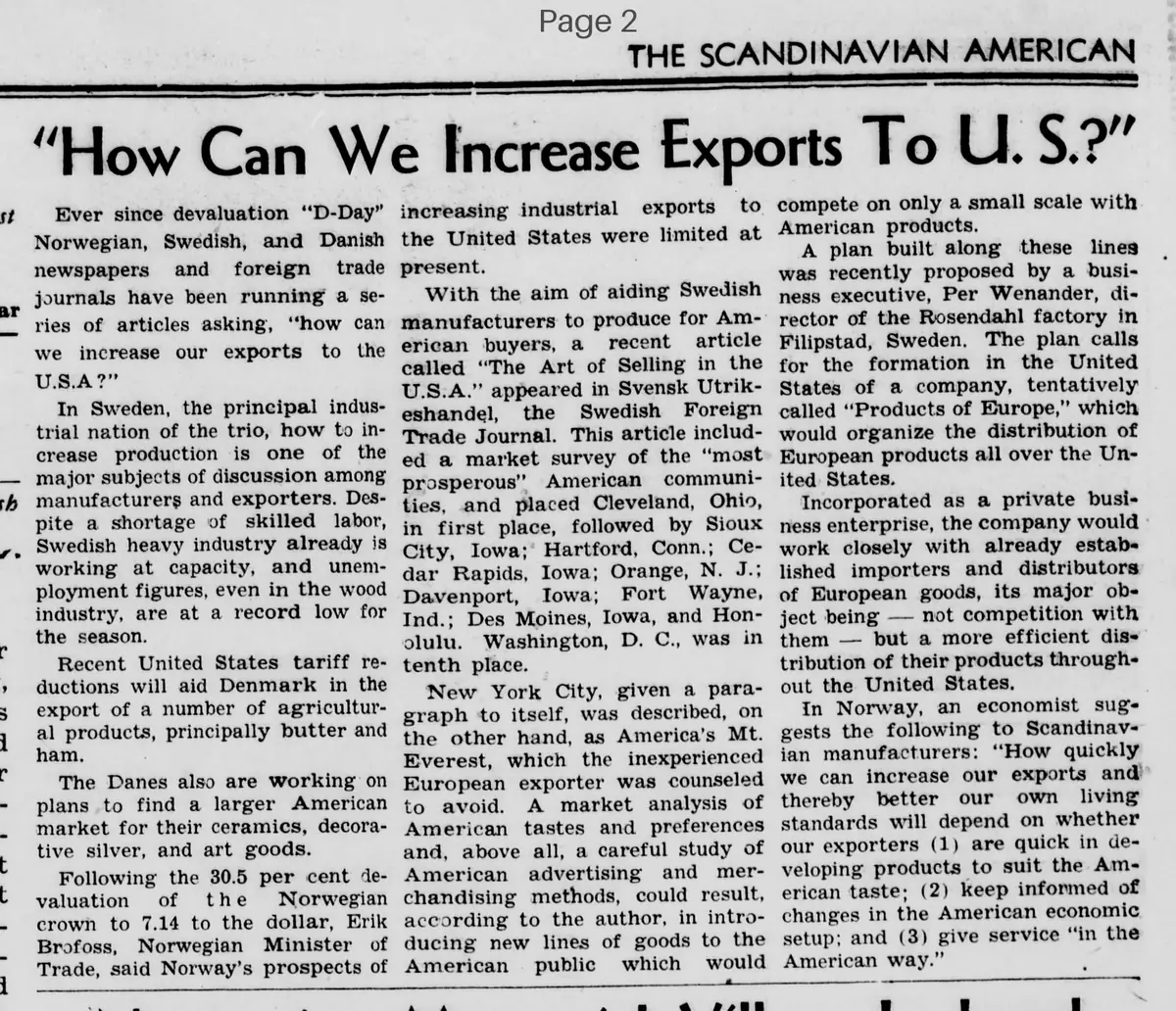
"How Can We Increase Exports To U. S.?"
Ever since devaluation "D-Day" Norwegian, Swedish, and Danish newspapers and foreign trade journals have been running a series of articles asking, "how can we increase our exports to the U.S.A?"
In Sweden, the principal industrial nation of the trio. how to increase production is one of the major subjects of discussion among manufacturers and exporters. Despite a shortage of skilled labor, Swedish heavy industry already is working at capacity, and unemployment figures, even in the wood industry, are at a record low for the season.
Recent United States tariff reductions will aid Denmark in the export of a number of agricultural products, principally butter and ham.
The Danes also are working on plans to find a larger American market for their ceramics. decorative silver, and art goods.
Following the 30.5 per cent devaluation of the Norwegian crown to 7.14 to the dollar, Erik Brofoss, Norwegian Minister of Trade, said Norway's prospects of increasing industrial exports to the United States were limited at present.
With the aim of aiding Swedish manufacturers to produce for American buyers, a recent article called "The Art of Selling in the U.S.A." appeared in Svensk Utrikeshandel, the Swedish Foreign Trade Journal. This article included a market survey of the "most prosperous" American communities, and placed Cleveland, Ohio, in first place. followed by Sioux City, Iowa; Hartford, Conn.; Cedar Rapids. Iowa; Orange, N. J.; Davenport, Iowa; Fort Wayne, Ind.: Des Moines. Iowa, and Honolulu. Washington, D. C., was in tenth place.
New York City, given a paragraph to itself, was described, on the other hand, as America's Mt. Everest, which the inexperienced European exporter was counseled to avoid.
A market analysis of American tastes and preferences and, above all, a careful study of American advertising and merchandising methods, could result, according to the author, in introducing new lines of goods to the American public which would compete on only a small scale with American products.
A plan built along these lines was recently proposed by a business executive, Per Wenander, director of the Rosendahl factory in Filipstad, Sweden. The plan calls for the formation in the United States of a company, tentatively called "Products of Europe," which would organize the distribution of European products all over the United States.
Incorporated as a private business enterprise, the company would work closely with already established importers and distributors of European goods, its major object being -- not competition with them but a more efficient distribution of their products throughout the United States.
In Norway, an economist suggests the following to Scandinavian manufacturers: "How quickly we can increase our exports and thereby better our own living standards will depend on whether our exporters (1) are quick in developing products to suit the American taste: (2) keep informed of changes in the American economic setup; and (3) give service 'in the American way.'"
What sub-type of article is it?
What keywords are associated?
What entities or persons were involved?
Where did it happen?
Foreign News Details
Primary Location
Norway, Sweden, Denmark
Key Persons
Outcome
prospects for increased exports discussed; us tariff reductions aid danish butter and ham; proposal for 'products of europe' distribution company in us
Event Details
Norwegian, Swedish, and Danish media discuss increasing exports to US after devaluation. Sweden focuses on production amid labor shortages and low unemployment. Denmark benefits from US tariff cuts on agricultural products and plans markets for ceramics, silver, art goods. Norway's Minister notes limited industrial export prospects post-30.5% crown devaluation. Swedish journal surveys prosperous US communities, advises avoiding New York, emphasizes market analysis and advertising study. Per Wenander proposes US company for efficient European goods distribution. Norwegian economist advises adapting products, staying informed on US economy, and providing American-style service.