Thank you for visiting SNEWPapers!
Sign up free
Letter to Editor
August 19, 1789
Gazette Of The United States
New York, New York County, New York
What is this article about?
Letter to Mr. Fenno urging publication of extracts from 'Diversions of Purley' to enlighten Americans on true English language principles, critiquing flawed works by Dr. Lowth, Samuel Johnson, and James Harris for lacking universal grammar foundations and promoting absurd philological ideas.
Clipping
OCR Quality
98%
Excellent
Full Text
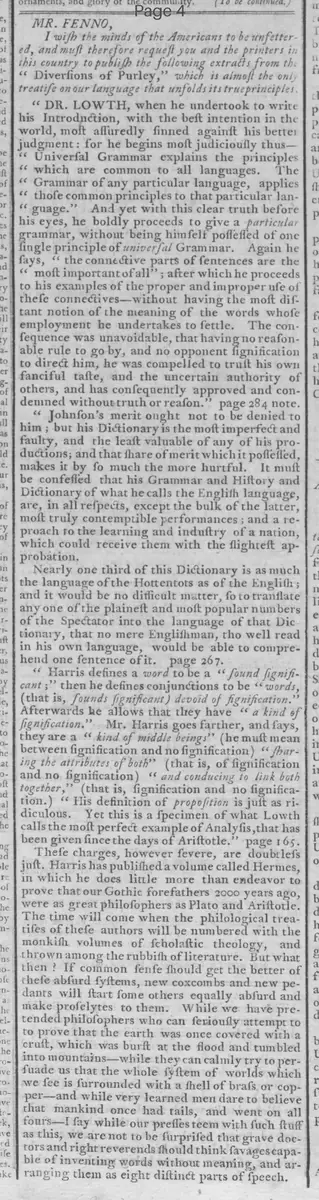
MR. FENNO,
I wish the minds of the Americans to be unfettered, and must therefore request you and the printers in this country to publish the following extracts from the "Diversions of Purley," which is almost the only treatise on our language that unfolds its true principles.
"DR. LOWTH, when he undertook to write his Introduction, with the best intention in the world, most assuredly sinned against his better judgment: for he begins most judiciously thus— "Universal Grammar explains the principles which are common to all languages. The Grammar of any particular language, applies those common principles to that particular language." And yet with this clear truth before his eyes, he boldly proceeds to give a particular grammar, without being himself possessed of one single principle of universal Grammar. Again he says, "the connective parts of sentences are the most important of all"; after which he proceeds to his examples of the proper and improper use of these connectives—without having the most distant notion of the meaning of the words whose employment he undertakes to settle. The consequence was unavoidable, that having no reasonable rule to go by, and no opponent signification to direct him, he was compelled to trust his own fanciful taste, and the uncertain authority of others, and has consequently approved and condemned without truth or reason." page 284 note.
"Johnson's merit ought not to be denied to him; but his Dictionary is the most imperfect and faulty, and the least valuable of any of his productions; and that share of merit which it possessed, makes it by so much the more hurtful. It must be confessed that his Grammar and History and Dictionary of what he calls the English language, are, in all respects, except the bulk of the latter, most truly contemptible performances; and a reproach to the learning and industry of a nation, which could receive them with the slightest approbation. Nearly one third of this Dictionary is as much the language of the Hottentots as of the English; and it would be no difficult matter, so to translate any one of the plainest and most popular numbers of the Spectator into the language of that Dictionary, that no mere Englishman, tho well read in his own language, would be able to comprehend one sentence of it. page 267.
"Harris defines a word to be a "Sound significant;" then he defines conjunctions to be "words. (that is, sounds significant) devoid of signification." Afterwards he allows that they have "a kind of signification." Mr. Harris goes farther, and says, they are a "kind of middle beings" (he must mean between signification and no signification) "having the attributes of both" (that is, of signification and no signification) "and conducing to link both together," (that is, signification and no signification.) "His definition of proposition is just as ridiculous. Yet this is a specimen of what Lowth calls the most perfect example of Analysis, that has been given since the days of Aristotle." page 165.
These charges, however severe, are doubtless just. Harris has published a volume called Hermes, in which he does little more than endeavor to prove that our Gothic forefathers 2000 years ago, were as great philosophers as Plato and Aristotle. The time will come when the philological treatises of these authors will be numbered with the monkish volumes of scholastic theology, and thrown among the rubbish of literature. But what then? If common sense should get the better of these absurd systems, new coxcombs and new pedants will start some others equally absurd and make proselytes to them. While we have pretended philosophers who can seriously attempt to prove that the earth was once covered with a crust, which was burst at the flood and tumbled into mountains—while they can calmly try to persuade us that the whole system of worlds which we see is surrounded with a shell of brass or copper—and while very learned men dare to believe that mankind once had tails, and went on all fours—I say while our presses teem with such stuff as this, we are not to be surprised that grave doctors and right reverends should think savages capable of inventing words without meaning, and arranging them as eight distinct parts of speech.
I wish the minds of the Americans to be unfettered, and must therefore request you and the printers in this country to publish the following extracts from the "Diversions of Purley," which is almost the only treatise on our language that unfolds its true principles.
"DR. LOWTH, when he undertook to write his Introduction, with the best intention in the world, most assuredly sinned against his better judgment: for he begins most judiciously thus— "Universal Grammar explains the principles which are common to all languages. The Grammar of any particular language, applies those common principles to that particular language." And yet with this clear truth before his eyes, he boldly proceeds to give a particular grammar, without being himself possessed of one single principle of universal Grammar. Again he says, "the connective parts of sentences are the most important of all"; after which he proceeds to his examples of the proper and improper use of these connectives—without having the most distant notion of the meaning of the words whose employment he undertakes to settle. The consequence was unavoidable, that having no reasonable rule to go by, and no opponent signification to direct him, he was compelled to trust his own fanciful taste, and the uncertain authority of others, and has consequently approved and condemned without truth or reason." page 284 note.
"Johnson's merit ought not to be denied to him; but his Dictionary is the most imperfect and faulty, and the least valuable of any of his productions; and that share of merit which it possessed, makes it by so much the more hurtful. It must be confessed that his Grammar and History and Dictionary of what he calls the English language, are, in all respects, except the bulk of the latter, most truly contemptible performances; and a reproach to the learning and industry of a nation, which could receive them with the slightest approbation. Nearly one third of this Dictionary is as much the language of the Hottentots as of the English; and it would be no difficult matter, so to translate any one of the plainest and most popular numbers of the Spectator into the language of that Dictionary, that no mere Englishman, tho well read in his own language, would be able to comprehend one sentence of it. page 267.
"Harris defines a word to be a "Sound significant;" then he defines conjunctions to be "words. (that is, sounds significant) devoid of signification." Afterwards he allows that they have "a kind of signification." Mr. Harris goes farther, and says, they are a "kind of middle beings" (he must mean between signification and no signification) "having the attributes of both" (that is, of signification and no signification) "and conducing to link both together," (that is, signification and no signification.) "His definition of proposition is just as ridiculous. Yet this is a specimen of what Lowth calls the most perfect example of Analysis, that has been given since the days of Aristotle." page 165.
These charges, however severe, are doubtless just. Harris has published a volume called Hermes, in which he does little more than endeavor to prove that our Gothic forefathers 2000 years ago, were as great philosophers as Plato and Aristotle. The time will come when the philological treatises of these authors will be numbered with the monkish volumes of scholastic theology, and thrown among the rubbish of literature. But what then? If common sense should get the better of these absurd systems, new coxcombs and new pedants will start some others equally absurd and make proselytes to them. While we have pretended philosophers who can seriously attempt to prove that the earth was once covered with a crust, which was burst at the flood and tumbled into mountains—while they can calmly try to persuade us that the whole system of worlds which we see is surrounded with a shell of brass or copper—and while very learned men dare to believe that mankind once had tails, and went on all fours—I say while our presses teem with such stuff as this, we are not to be surprised that grave doctors and right reverends should think savages capable of inventing words without meaning, and arranging them as eight distinct parts of speech.
What sub-type of article is it?
Philosophical
Informative
Persuasive
What themes does it cover?
Education
What keywords are associated?
English Language
Grammar Critique
Universal Grammar
Johnson Dictionary
Lowth Introduction
Harris Hermes
Philology
Diversions Of Purley
What entities or persons were involved?
Mr. Fenno
Letter to Editor Details
Recipient
Mr. Fenno
Main Argument
requests publication of extracts from 'diversions of purley' to reveal true principles of the english language and critiques the flawed, principle-lacking works of lowth, johnson, and harris on grammar and philology.
Notable Details
Critiques Dr. Lowth's 'Introduction' For Ignoring Universal Grammar Principles
Denounces Johnson's Dictionary As Contemptible And Obscure
Mocks Harris's Definitions In 'Hermes' As Ridiculous And Contradictory
References Page Numbers: 284, 267, 165
Compares Philological Treatises To Scholastic Theology Rubbish
Alludes To Absurd Philosophical Ideas Like Earth Crust Bursting At Flood