Thank you for visiting SNEWPapers!
Sign up free
Foreign News
March 18, 1828
Lancaster Gazette
Lancaster, Worcester County, Massachusetts
What is this article about?
Miss Bathurst, a young English lady in Rome, drowned in the swollen Tiber River during a ride near Ponte Molle. Despite calls for help, she could not be saved; her body was later recovered and buried in the English cemetery.
Clipping
OCR Quality
96%
Excellent
Full Text
MISS BATHURST.
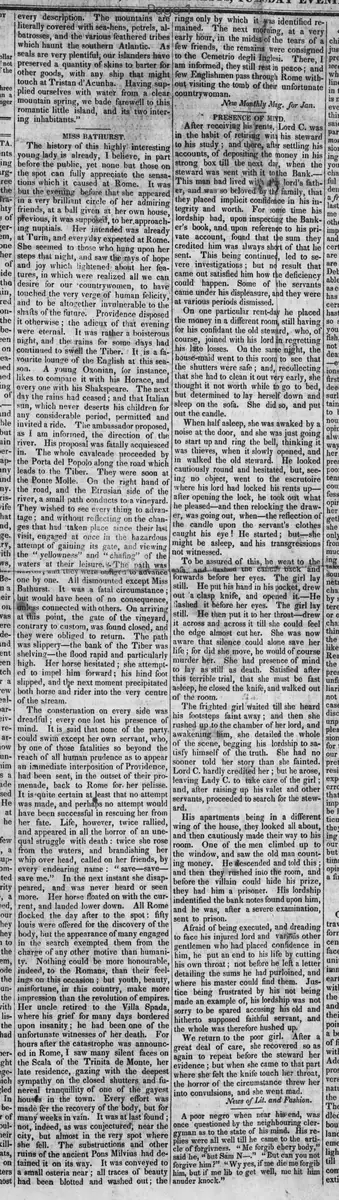
The history of this highly interesting young lady is already, I believe, in part before the public, yet none but those on the spot can fully appreciate the sensations which it caused at Rome. It was but the evening before that she appeared in a very brilliant circle of her admiring friends, at a ball given at her own house, previous, it was supposed, to her approaching nuptials. Her intended was already at Turin, and every day expected at Rome. She seemed to those who hung upon her steps that night, and saw the rays of hope and joy which lightened about her features, in which were realized all we can desire for our countrywomen, to have touched the very verge of human felicity, and to be altogether invulnerable to the shafts of the future. Providence disposed it otherwise; the adieux of that evening were eternal. It was rather a boisterous night, and the rains for some days had continued to swell the Tiber. It is a favourite lounge of the English at this season. A young Oxonian, for instance, likes to compare it with his Horace, and every one with his Shakspeare. The next day the rains had ceased; and that Italian sun, which never deserts his children for any considerable period, permitted and invited a ride. The ambassador proposed, as I am informed, the direction of the river. His proposal was fatally acquiesced in. The whole cavalcade proceeded by the Porta del Popolo along the road which leads to the Tiber. They were soon at the Ponte Molle. On the right hand of the road, and the Etruscan side of the river, a small path conducts to a vineyard. They wished to see every thing to advantage; and without reflecting on the changes that had taken place since their last visit, engaged at once in the hazardous attempt of gaining its gate, and viewing the "yellowness" and "chafing" of the waters at their leisure. The path was narrow, and they were obliged to advance one by one. All dismounted except Miss Bathurst. It was a fatal circumstance; but would have been of no consequence, unless connected with others. On arriving at this point, the gate of the vineyard contrary to custom, was found closed, and they were obliged to return. The path was slippery—the bank of the Tiber was shelving—the flood rapid and particularly high. Her horse hesitated; she attempted to impel him forward; his hind foot slipped, and the next moment precipitated both horse and rider into the very centre of the stream.
The consternation on every side was dreadful; every one lost his presence of mind. It is said that none of the party could swim except her own servant, who, by one of those fatalities so beyond the reach of all human prudence as to appear an immediate interposition of Providence, had been sent, in the outset of their promenade, back to Rome for her pelisse. It is quite certain at least that no attempt was made, and perhaps no attempt would have been successful in rescuing her from her fate. Life, however, twice rallied, and appeared in all the horror of an unequal struggle with death: twice she rose from the waters, and brandishing her whip over head, called on her friends, by every endearing name: "save—save—save me." In the next instant she disappeared, and was never heard or seen more. Her horse floated on with the current, and landed lower down. All Rome flocked the day after to the spot: fifty louis were offered for the discovery of the body, but the appearance of many engaged in the search exempted them from the charge of any other motive than humanity. Nothing could be more honourable, indeed, to the Romans, than their feelings on this occasion; but youth, beauty, misfortune, in this country, make more impression than the revolution of empires. Her uncle retired to the Villa Spada, where his grief for many days bordered upon insanity; he had been one of the unfortunate witnesses of her death. For hours after the catastrophe was announced in Rome, I saw many silent faces on the Scala of the Trinita de Monte, her late residence, gazing with the deepest sympathy on the closed shutters and funereal tranquillity of one of the gayest houses in the town. Every effort was made for the recovery of the body, but for many weeks in vain. It was at last found: not, indeed, as was conjectured, near the city, but almost in the very spot where she fell. The substructions and other ruins of the ancient Pons Milvius had detained it on its way. It was conveyed to a small osteria near: all traces of beauty had been blotted and washed out; the rings only by which it was identified remained. The next morning, at a very early hour, in the midst of the tears of a few friends, the remains were consigned to the Cimetrio degli Inglesi. There, I am informed, they still rest in peace; and few Englishmen pass through Rome without visiting the tomb of their unfortunate countrywoman.
New Monthly Mag. for Jan.
The history of this highly interesting young lady is already, I believe, in part before the public, yet none but those on the spot can fully appreciate the sensations which it caused at Rome. It was but the evening before that she appeared in a very brilliant circle of her admiring friends, at a ball given at her own house, previous, it was supposed, to her approaching nuptials. Her intended was already at Turin, and every day expected at Rome. She seemed to those who hung upon her steps that night, and saw the rays of hope and joy which lightened about her features, in which were realized all we can desire for our countrywomen, to have touched the very verge of human felicity, and to be altogether invulnerable to the shafts of the future. Providence disposed it otherwise; the adieux of that evening were eternal. It was rather a boisterous night, and the rains for some days had continued to swell the Tiber. It is a favourite lounge of the English at this season. A young Oxonian, for instance, likes to compare it with his Horace, and every one with his Shakspeare. The next day the rains had ceased; and that Italian sun, which never deserts his children for any considerable period, permitted and invited a ride. The ambassador proposed, as I am informed, the direction of the river. His proposal was fatally acquiesced in. The whole cavalcade proceeded by the Porta del Popolo along the road which leads to the Tiber. They were soon at the Ponte Molle. On the right hand of the road, and the Etruscan side of the river, a small path conducts to a vineyard. They wished to see every thing to advantage; and without reflecting on the changes that had taken place since their last visit, engaged at once in the hazardous attempt of gaining its gate, and viewing the "yellowness" and "chafing" of the waters at their leisure. The path was narrow, and they were obliged to advance one by one. All dismounted except Miss Bathurst. It was a fatal circumstance; but would have been of no consequence, unless connected with others. On arriving at this point, the gate of the vineyard contrary to custom, was found closed, and they were obliged to return. The path was slippery—the bank of the Tiber was shelving—the flood rapid and particularly high. Her horse hesitated; she attempted to impel him forward; his hind foot slipped, and the next moment precipitated both horse and rider into the very centre of the stream.
The consternation on every side was dreadful; every one lost his presence of mind. It is said that none of the party could swim except her own servant, who, by one of those fatalities so beyond the reach of all human prudence as to appear an immediate interposition of Providence, had been sent, in the outset of their promenade, back to Rome for her pelisse. It is quite certain at least that no attempt was made, and perhaps no attempt would have been successful in rescuing her from her fate. Life, however, twice rallied, and appeared in all the horror of an unequal struggle with death: twice she rose from the waters, and brandishing her whip over head, called on her friends, by every endearing name: "save—save—save me." In the next instant she disappeared, and was never heard or seen more. Her horse floated on with the current, and landed lower down. All Rome flocked the day after to the spot: fifty louis were offered for the discovery of the body, but the appearance of many engaged in the search exempted them from the charge of any other motive than humanity. Nothing could be more honourable, indeed, to the Romans, than their feelings on this occasion; but youth, beauty, misfortune, in this country, make more impression than the revolution of empires. Her uncle retired to the Villa Spada, where his grief for many days bordered upon insanity; he had been one of the unfortunate witnesses of her death. For hours after the catastrophe was announced in Rome, I saw many silent faces on the Scala of the Trinita de Monte, her late residence, gazing with the deepest sympathy on the closed shutters and funereal tranquillity of one of the gayest houses in the town. Every effort was made for the recovery of the body, but for many weeks in vain. It was at last found: not, indeed, as was conjectured, near the city, but almost in the very spot where she fell. The substructions and other ruins of the ancient Pons Milvius had detained it on its way. It was conveyed to a small osteria near: all traces of beauty had been blotted and washed out; the rings only by which it was identified remained. The next morning, at a very early hour, in the midst of the tears of a few friends, the remains were consigned to the Cimetrio degli Inglesi. There, I am informed, they still rest in peace; and few Englishmen pass through Rome without visiting the tomb of their unfortunate countrywoman.
New Monthly Mag. for Jan.
What sub-type of article is it?
Disaster
What keywords are associated?
Miss Bathurst
Tiber Drowning
Rome Accident
English Lady
Ponte Molle
What entities or persons were involved?
Miss Bathurst
Where did it happen?
Rome
Foreign News Details
Primary Location
Rome
Key Persons
Miss Bathurst
Outcome
miss bathurst drowned; body recovered after weeks and buried in cimetrio degli inglesi
Event Details
During a ride along the Tiber near Ponte Molle, Miss Bathurst's horse slipped on a slippery path, precipitating her into the swollen river. Despite rising twice and calling for help, she drowned. No rescue attempt succeeded; her servant was absent.