Thank you for visiting SNEWPapers!
Sign up free
The National Intelligencer And Washington Advertiser
Washington, District Of Columbia
What is this article about?
London commentary on the Treaty of Lunéville between France and Austria, criticizing Pitt's policies and praising the moderate terms that secure French boundaries, limit Austrian power in Italy and Germany, and declare independence for Cisalpine and Ligurian Republics.
Clipping
OCR Quality
Full Text
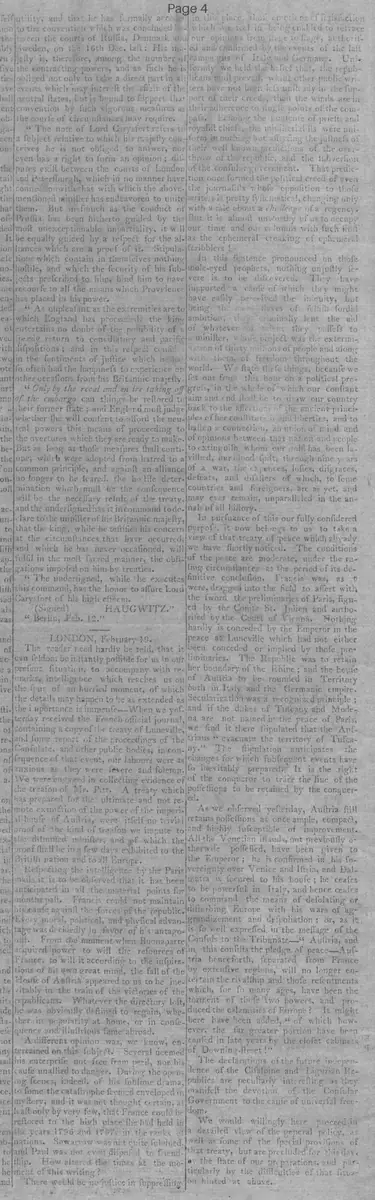
The reader need hardly be told, that it can seldom be instantly possible or useful in our present situation, to accompany with remarks, intelligence which reaches us on the spur of an hurried moment, of which the details may happen to be as extended as the importance is immense—When we yesterday received the French official journal, containing a copy of the treaty of Luneville, and some report of the proceedings of the Consulate, and other public bodies, in consequence of that event, our labours were as anxious as they were severe and solemn. We were engaged in collecting evidence of the treason of Mr. Pitt. A treaty which has prepared for the ultimate and not remote extinction of the power of the imperial house of Austria, were itself no trivial proof of the kind of treason we impute to the dismissed minister, and of which the proof shall be in a few days exhibited to the British nation and to all Europe.
Respecting the intelligence by the Paris mails it is to be observed that it has been anticipated in all the material points for months past. Francis could not maintain his cause against the forces of the republic. Every moral, political, and physical advantage was decidedly in favor of his antagonist. From the moment when Buonaparte acquired power to wield the resources of France, to wield it according to the inspirations of his own great mind, the fall of the House of Austria appeared to us to be inevitably in the train of the victories of the republicans. Whatever the directory lost, he was obviously destined to regain, whether in popularity at home, or in consequence and illustrious fame abroad.
A different opinion was, we know, entertained on this subject. Several deemed his enterprize not free from peril, nor his cause unallied to danger. During the opening scenes, indeed, of his sublime drama, to some the catastrophe seemed enveloped in mystery, and it was not thought certain, at least only by very few, that France could be restored to the high place she had held in the years 1796 and 1797, in the ranks of nations. Suwarrow was not quite subdued, and Paul was not even disposed to friendship. How altered the times at the moment of this writing?
There would be no justice in suppressing in this place the certainty of those effects which we had in London to see as confirmed by the events of the last campaigns of Italy and Germany. Uniformly we held the belief that, the republicans must prevail, whilst other public writers have not been less unsteady in the support of their creeds, than the winds are in their adherence to any one point of the compass. Echoing the nonsense of priests and royalist chiefs, the ministerialists were uniform in nothing but affording the justness of their well known predictions of the overthrow of the republic, and the subversion of the consular government. That prediction once formed the political creed of even the journalists whose opposition to those writers is pretty systematic, changing only with a tale about a challenge of a regency.
But it is almost unworthy of us to occupy our time and our columns with such trull as the ephemeral croaking of ephemeral scribblers!
In this sentence pronounced on those mole-eyed prophets, nothing unjustly severe is to be discovered. They have supported a cause of which they might have easily perceived the iniquity, but being the mere slaves of selfish sordid ambition, they wholly lent the aid of whatever talent they possess to a minister, whose project was the extermination of thirty millions of people and along with them, of freedom throughout the world. We state these things, because we set out from this hour on a political progress, in the whole of which our constant aim and end shall be to draw our country back to the assertions of the ancient principles of her constitution and liberties, and to hasten a connection, an union of mind and of opinions between that nation and people to extinguish whom our gold has been lavished, our blood spilt, through nine years of a war, the expenses, losses, disgraces, defeats, and disasters of which, to some countries and foreigners, are as yet, and may ever remain, unparalleled in the annals of all history.
In pursuance of this our fully considered purpose, it now belongs to us to take a view of that treaty of peace which we have lately noticed. The conditions of the peace are moderate, under the ruling circumstances at the period of its definitive conclusion. Francis was, as it were, dragged into the field to assert with the sword the preliminaries of Paris, signed by the Comte St. Julien and authorized by the Court of Vienna. Nothing hardly is conceded by the Emperor in the peace at Luneville which had not either been conceded or implied by those preliminaries. The Republic was to retain her boundary of the Rhine: and the house of Austria to be rounded in territory both in Italy and the Germanic empire. Secularization was a recognized principle; and if the dukes of Tuscany and Modena are not named in the peace of Paris, we find it there stipulated that the Austrians "evacuate the territory of Tuscany." The stipulation anticipates the changes for which subsequent events have so inevitably prepared. It is the right of the conqueror to trace the line of the possessions to be retained by the conquered.
As we observed yesterday, Austria still retains possessions at once ample, compact, and highly susceptible of improvement. All the Venetian islands, not previously otherwise possessed, have been given to the Emperor; he is confirmed in his sovereignty over Venice and Istria, and Dalmatia is secured to his house; he ceases to be powerful in Italy, and hence ceases to command the means of desolating or disturbing Europe with his wars of aggrandizement and despoilation; or, as it is so well expressed in the message of the Consuls to the Tribunate "Austria, and in this consists the pledge of peace—Austria henceforth, separated from France by extensive regions, will no longer entertain the rivalry and those resentments which, for so many ages, have been the torment of these two powers, and produced the calamities of Europe? It might here have been added, "of which however, the far greater portion have been caused in late years by the close cabinets of Downing-street!"
The declarations of the future independence of the Cisalpine and Ligurian Republics are peculiarly interesting, as they manifest the devotion of the Consular Government to the cause of universal freedom.
We would willingly here proceed in a detailed view of the general policy, as well as some of the special provisions of that treaty, but are precluded for this day by the state of our preparations, and particularly by the difficulties of that situation hinted at above.
What sub-type of article is it?
What keywords are associated?
What entities or persons were involved?
Where did it happen?
Foreign News Details
Primary Location
Luneville
Event Date
As Reported February 19
Key Persons
Outcome
france retains rhine boundary; austria cedes territories in italy and germany, evacuates tuscany, retains venice, istria, dalmatia; secularization recognized; independence declared for cisalpine and ligurian republics; limits austrian power in europe.
Event Details
The Treaty of Luneville concludes peace between France and Austria after campaigns in Italy and Germany. Terms are moderate, building on Paris preliminaries; France secures natural boundaries, Austria's influence in Italy reduced, ensuring separation from France for lasting peace. Commentary criticizes British minister Pitt's policies leading to war and praises French consular government's commitment to freedom.