Thank you for visiting SNEWPapers!
Sign up free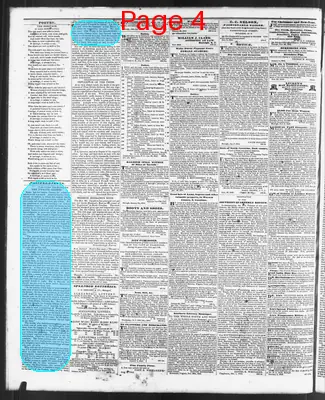
Editorial
January 31, 1844
The North Carolina Standard
Raleigh, Wake County, North Carolina
What is this article about?
Editorial from New York Evening Post criticizes protective tariffs on linseed oil, arguing they enrich a few 'twelve seiz ers' (oil crushers) at consumers' expense, neglecting farmers, and suggests bounties from treasury instead for transparency in protectionism.
Clipping
OCR Quality
95%
Excellent
Full Text
MISCELLANEOUS.
From the New York Evening Post.
THE TWELVE SEIZERS.
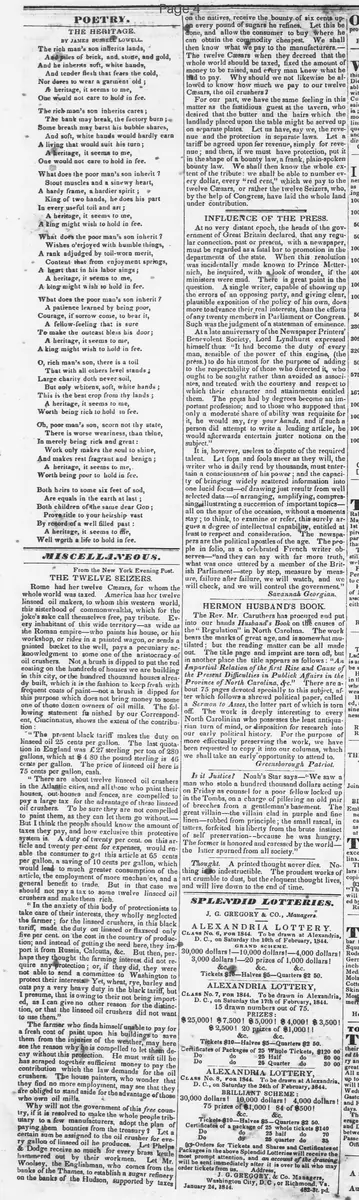
Rome had her twelve Caesars, for whom the whole world was taxed. America has her twelve linseed oil makers, to whom this western world, this sisterhood of commonwealths, which for the joke's sake call themselves free, pay tribute. Every inhabitant of this wide territory—as wide as the Roman empire—who paints his house, or his workshop, or rides in a painted wagon, or sends a painted bucket to the well, pays a pecuniary acknowledgment to some one of the aristocracy of oil crushers. Not a brush is dipped to put the red coating on the hundreds of houses we are building in this city, or the hundred thousand houses already built, which it is the fashion to keep fresh with frequent coats of paint—not a brush is dipped for this purpose which does not bring money to some one of those dozen owners of oil mills. The following statement furnished by our Correspondent, Cincinnatus, shows the extent of the contribution:
"The present black tariff makes the duty on linseed oil 25 cents per gallon. The last quotation in England was £27 sterling per ton of 280 gallons, which at $4 80 the pound sterling is 46 cents per gallon. The price of linseed oil here is 75 cents per gallon, cash.
"There are about twelve linseed oil crushers in the Atlantic cities, and all those who paint their houses, out-houses and fences, are compelled to pay a large tax for the advantage of these linseed oil crushers. To be sure they are not compelled to paint them, as they can let them go without.—But I think the people should know the amount of taxes they pay, and how exclusive this protective system is. A duty of twenty per cent. on this article and twenty per cent for expenses, would enable the consumer to get this article at 65 cents per gallon, a saving of 10 cents per gallon, which would lead to much greater consumption of the article, the employment of more mechanics, and a general benefit to trade. But in that case we should not pay a tax to some twelve linseed oil crushers and make them rich.
"In the anxiety of this body of protectionists to take care of their interests, they wholly neglected the farmer; for the linseed crushers, in this black tariff, made the duty on linseed or flaxseed only five per cent. on the cost in the country of production; and instead of getting the seed here, they import it from Russia, Calcutta, &c. But then, perhaps they thought the farming interest did not require any protection; or, if they did, they were not able to send a committee to Washington to protect their interests. Yet, wheat, rye, barley and oats pay a very heavy duty in the black tariff, but I presume, that is owing to their not being imported, as I can give no other reason for the distinction, or that the linseed oil crushers did not want to use them.
"The farmer who finds himself unable to pay for a fresh coat of paint upon his buildings to save them from the injuries of the weather, may here see the reason why he is compelled to let them decay without this protection. He must wait till he has scraped together sufficient money to pay the contribution which the law demands for the oil crushers. The house painters, who wonder that they find no more employment, may see that they are obliged to stand aside for the advantage of those who own oil mills.
Why will not the government of this free country, if it is resolved to make the whole people tributary to a few manufacturers, adopt the plan of paying them bounties from the treasury? Let a certain sum be assigned to the oil crusher for every gallon of linseed oil he produces. Let Phelps & Dodge receive so much for every brass kettle hammered out by their workmen. Let Mr. Woolsey, the Englishman, who comes from the banks of the Thames, to establish a sugar refinery on the banks of the Hudson, supported by taxes on the natives, receive the bounty of six cents upon every pound of sugars he refines. Let this be done, and allow the consumer to buy where he can obtain the commodity cheapest. We shall then know what we pay to the manufacturers.
The twelve Caesars when they decreed that the whole world should be taxed, fixed the amount of money to be raised, and every man knew what he had to pay. Why should we not likewise be allowed to know how much we pay to our twelve Caesars, the oil crushers?
For our part, we have the same feeling in this matter as the fastidious guest at the tavern, who desired that the butter and the hairs which the landlady placed upon the table might be served up on separate plates. Let us have, say we, the revenue and the protection in separate laws. Let a tariff be agreed upon for revenue, simply for revenue; and then, if we must have protection, put it in the shape of a bounty law, a frank, plain-spoken bounty law. We shall then know the whole extent of the tribute: we shall be able to number every dollar, every "red cent," which we pay to the twelve Caesars, or rather the twelve Seizers, who, by the help of Congress, have laid the whole land under contribution."
From the New York Evening Post.
THE TWELVE SEIZERS.
Rome had her twelve Caesars, for whom the whole world was taxed. America has her twelve linseed oil makers, to whom this western world, this sisterhood of commonwealths, which for the joke's sake call themselves free, pay tribute. Every inhabitant of this wide territory—as wide as the Roman empire—who paints his house, or his workshop, or rides in a painted wagon, or sends a painted bucket to the well, pays a pecuniary acknowledgment to some one of the aristocracy of oil crushers. Not a brush is dipped to put the red coating on the hundreds of houses we are building in this city, or the hundred thousand houses already built, which it is the fashion to keep fresh with frequent coats of paint—not a brush is dipped for this purpose which does not bring money to some one of those dozen owners of oil mills. The following statement furnished by our Correspondent, Cincinnatus, shows the extent of the contribution:
"The present black tariff makes the duty on linseed oil 25 cents per gallon. The last quotation in England was £27 sterling per ton of 280 gallons, which at $4 80 the pound sterling is 46 cents per gallon. The price of linseed oil here is 75 cents per gallon, cash.
"There are about twelve linseed oil crushers in the Atlantic cities, and all those who paint their houses, out-houses and fences, are compelled to pay a large tax for the advantage of these linseed oil crushers. To be sure they are not compelled to paint them, as they can let them go without.—But I think the people should know the amount of taxes they pay, and how exclusive this protective system is. A duty of twenty per cent. on this article and twenty per cent for expenses, would enable the consumer to get this article at 65 cents per gallon, a saving of 10 cents per gallon, which would lead to much greater consumption of the article, the employment of more mechanics, and a general benefit to trade. But in that case we should not pay a tax to some twelve linseed oil crushers and make them rich.
"In the anxiety of this body of protectionists to take care of their interests, they wholly neglected the farmer; for the linseed crushers, in this black tariff, made the duty on linseed or flaxseed only five per cent. on the cost in the country of production; and instead of getting the seed here, they import it from Russia, Calcutta, &c. But then, perhaps they thought the farming interest did not require any protection; or, if they did, they were not able to send a committee to Washington to protect their interests. Yet, wheat, rye, barley and oats pay a very heavy duty in the black tariff, but I presume, that is owing to their not being imported, as I can give no other reason for the distinction, or that the linseed oil crushers did not want to use them.
"The farmer who finds himself unable to pay for a fresh coat of paint upon his buildings to save them from the injuries of the weather, may here see the reason why he is compelled to let them decay without this protection. He must wait till he has scraped together sufficient money to pay the contribution which the law demands for the oil crushers. The house painters, who wonder that they find no more employment, may see that they are obliged to stand aside for the advantage of those who own oil mills.
Why will not the government of this free country, if it is resolved to make the whole people tributary to a few manufacturers, adopt the plan of paying them bounties from the treasury? Let a certain sum be assigned to the oil crusher for every gallon of linseed oil he produces. Let Phelps & Dodge receive so much for every brass kettle hammered out by their workmen. Let Mr. Woolsey, the Englishman, who comes from the banks of the Thames, to establish a sugar refinery on the banks of the Hudson, supported by taxes on the natives, receive the bounty of six cents upon every pound of sugars he refines. Let this be done, and allow the consumer to buy where he can obtain the commodity cheapest. We shall then know what we pay to the manufacturers.
The twelve Caesars when they decreed that the whole world should be taxed, fixed the amount of money to be raised, and every man knew what he had to pay. Why should we not likewise be allowed to know how much we pay to our twelve Caesars, the oil crushers?
For our part, we have the same feeling in this matter as the fastidious guest at the tavern, who desired that the butter and the hairs which the landlady placed upon the table might be served up on separate plates. Let us have, say we, the revenue and the protection in separate laws. Let a tariff be agreed upon for revenue, simply for revenue; and then, if we must have protection, put it in the shape of a bounty law, a frank, plain-spoken bounty law. We shall then know the whole extent of the tribute: we shall be able to number every dollar, every "red cent," which we pay to the twelve Caesars, or rather the twelve Seizers, who, by the help of Congress, have laid the whole land under contribution."
What sub-type of article is it?
Economic Policy
Taxation
What keywords are associated?
Linseed Oil
Protective Tariff
Oil Crushers
Bounties
Protectionism
Flaxseed Duty
Black Tariff
What entities or persons were involved?
Twelve Linseed Oil Crushers
Phelps & Dodge
Mr. Woolsey
Congress
Protectionists
Cincinnatus
Editorial Details
Primary Topic
Critique Of Protective Tariffs On Linseed Oil Benefiting Manufacturers At Consumers' Expense
Stance / Tone
Strongly Critical Of Protectionism, Advocating For Transparent Bounties Over Hidden Tariffs
Key Figures
Twelve Linseed Oil Crushers
Phelps & Dodge
Mr. Woolsey
Congress
Protectionists
Cincinnatus
Key Arguments
High Tariffs On Linseed Oil (25 Cents/Gallon) Raise Price To 75 Cents/Gallon, Benefiting 12 Atlantic Oil Crushers
Low Duty On Flaxseed (5%) Leads To Imports From Russia And Calcutta, Neglecting American Farmers
Protective System Excludes Broader Benefits Like Increased Consumption And Mechanic Employment
Suggests Bounties From Treasury Instead Of Tariffs For Transparency In Supporting Manufacturers
Tariffs Combine Revenue And Protection Opaquely; Separate Revenue Tariff And Bounty Law Preferred
Farmers And House Painters Suffer From High Costs, Unable To Afford Paint