Thank you for visiting SNEWPapers!
Sign up free
Literary
July 27, 1805
Alexandria Daily Advertiser
Alexandria, Virginia
What is this article about?
An ironical oration satirically praising duelling as an honorable practice essential for gentlemen, critiquing societal norms, the law of honor, and legal prohibitions. Delivered by Thomas Allibone Jr. at the University of Pennsylvania commencement on June 5, 1806.
Clipping
OCR Quality
95%
Excellent
Full Text
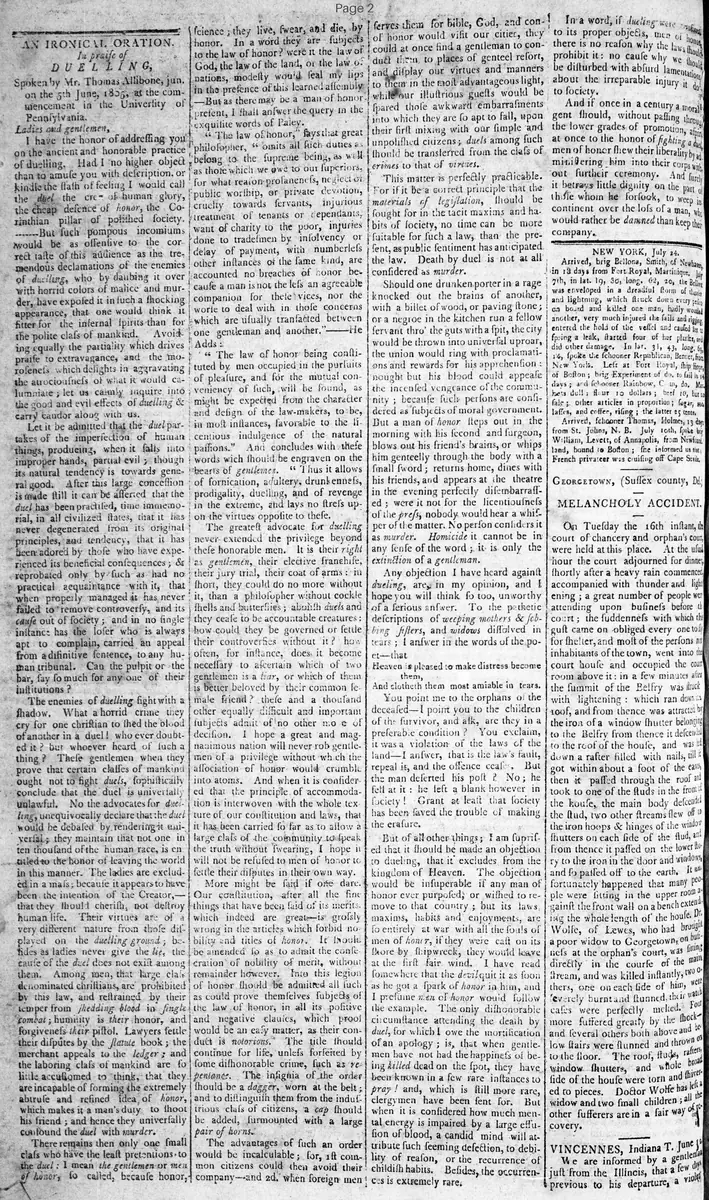
AN IRONICAL ORATION.
In praise of
DUELLING;
Spoken by Mr. Thomas Allibone, jun.
on the 5th June, 1806, at the com-
mencement in the University of
Pennsylvania.
Ladies and gentlemen,
I have the honor of addressing you
on the ancient and honorable practice
of duelling. Had I no higher object
than to amuse you with description, or
kindle the flash of feeling I would call
the duel the crest of human glory,
the cheap defence of honor, the Co-
rinthian pillar of polished society.
--But such pompous encomiums
would be as offensive to the cor-
rect taste of this audience as the tre-
mendous declamations of the enemies
of duelling, who by daubing it over
with horrid colors of malice and mur-
der, have exposed it in such a shocking
appearance, that one would think it
fitter for the infernal spirits than for
the polite class of mankind. Avoid-
ing equally the partiality which drives
praise to extravagance, and the mo-
roseness which delights in aggravating
the atrociousness of what it would ca-
lumniate; let us calmly inquire into
the good and evil effects of duelling &
carry candor along with us.
Let it be admitted that the duel par-
takes of the imperfection of human
things, producing, when it falls into
improper hands, partial evil; though
its natural tendency is towards gene-
ral good. After this large concession
is made still it cannot be asserted that the
duel has been practised, time immemo-
rial, in all civilized states, that it has
never degenerated from its original
principles, and tendency, that it has
been adored by those who have expe-
rienced its beneficial consequences; &
reprobated only by such as had no
practical acquaintance with it, that
when properly managed it has never
failed to remove controversy, and its
cause out of society; and in no single
instance has the loser who is always
apt to complain, carried an appeal
from definitive sentence, to any hu-
man tribunal. Can the pulpit or the
bar, say so much for any one of their
institutions?
The enemies of duelling fight with a
shadow. What a horrid crime they
cry for one christian to shed the blood
of another in a duel! who ever doubt-
ed it? but whoever heard of such a
thing? These gentlemen when they
prove that certain classes of mankind
ought not to fight duels, sophisticaly
conclude that the duel is universally
unlawful. No the advocates for duel-
ling, unequivocally declare that the duel
would be debased by rendering it uni-
versal; they maintain that not one in
ten thousand of the human race, is en-
titled to the honor of leaving the world
in this manner. The ladies are exclud-
ed in a mass; because it appears to have
been the intention of the Creator,--
that they should cherish, not destroy
human life. Their virtues are of a
very different nature from those dis-
played on the duelling ground; be-
sides as ladies never give the lie, the
cause of the duel does not exist among
them. Among men, that large class
denominated christians, are prohibited
by this law, and restrained by their
temper from shedding blood in single
combat; humility is their honor, and.
forgiveness their pistol. Lawyers settle
their disputes by the statute book; the
merchant appeals to the ledger: and
the laboring class of mankind are so
little accustomed to think, that they
are incapable of forming the extremely
abstruse and refined idea of honor.
which makes it a man's duty. to shoot
his friend; and hence they universally
confound the duel with murder.
There remains then only one small
class who have the least pretensions to
the duel: I mean the gentlemen or men
of honor, so called, because honor,
science; they live, swear, and die, by
honor. In a word they are subjects
to the law of honor? were it the law of
God, the law of the land, or the law of
ations,- modesty would seal my lips
in the presence of this learned assembly
-But as there may be a man of honor
present, I shall answer the query in the
exquisite words of Paley.
"The law of honor," says that great
philosopher, "omits all such duties as
belong to the supreme being, as well
as those which we owe to our superiors,
for what reason profaneness, neglect of
public worship, or private devotion,
cruelty towards servants, injurious
treatment of tenants or dependants,
want of charity to the poor, injuries
done to tradesmen by insolvency or
delay of payment, with numberless
other instances of the same kind, are
accounted no breaches of honor be-
cause a man is not the less an agreeable
companion for these vices, nor the
worse to deal with in those concerns
which are usually transacted between
one gentleman and another."-He
Adds:
"The law of honor being consti-
tuted by men occupied in the pursuits
of pleasure, and for the mutual con-
veniency of such .will be found, as
might be expected from the character
and design. of the law-makers, to be,
in most instances, favorable to the li-
centious indulgence of the natural
passions." And concludes with these
words which should be engraven on the
hearts of gentlemen. "Thus it allows
of fornication, adultery, drunkenness,
prodigality, duelling, and of revenge
in the extreme, and lays no stress up-
on the virtues opposite to these.
The greatest advocate for duelling
never- extended the privilege beyond
these honorable men. It is their right
as gentlemen, their elective franchise.
their jury trial, their coat of arms: in
short, they could do no more without
it, than a philosopher without cockle
shells and butterflies: abolish duels and
they cease to be accountable creatures:
how could they be governed or settle
their controversies without it? how
often, for instance. does. it become
necessary to ascertain which of two
gentlemen is a liar, or which of them
is better beloved by their common fe-
male friend? these and a thousand
other equally difficult and important
subjects admit of no other mode of
decision. I hope a great and mag-
nanimous nation will never rob gentle-
men of a privilege without which the
association of honor would crumble
into atoms. And when it is consider-
ed that the principle of accommoda-
tion is interwoven with the whole tex-
ture of our constitution and laws, that
it has been carried so far as to allow a
large class of the community to speak
the truth without swearing, I hope it
will not be refused to men of honor to
settle their disputes in their own way.
More might be said if one dare.
Our constitution, after all the fine
things that have been said of its merits.
which indeed are great--is grossly
wrong in the articles which forbid no-
bility and titles of honor. It should
be amended so as to admit the conse-
creation of nobility of merit, without
remainder however. Into this legion
of honor should be admitted all such
as could prove themselves subjects of
the law of honor, in all its positive
and negative clauses, which proof
would be an easy matter, as their con-
duct is notorious.* The title should
continue for life, unless forfeited by
some dishonorable crime, such as re-
pentance. . The insignia of the order
should be a dagger, -worn at the belt;
and to distinguish them from the indus-
trious class of citizens, a cap should
be added, surmounted with a large
pair of horns.
The advantages of such an order
would be incalculable; for, 1st com-
mon citizens could then avoid their
company~-and 2d. when foreign men
of honor would visit our cities, they
could at once find a gentleman to con-
duct them, to places of genteel resort,
and display our virtues and manners
to them in the most advantageous light,
while our illustrious guests would be
spared those awkward embarrassments
into which they are so apt to fall, upon
their first mixing with our simple and
unpolished citizens; duels among such
should be transferred from the class of
crimes to that of virtues.
This matter is perfectly practicable.
For if it be a correct principle that the
materials of legislation, should be
sought for in the tacit maxims and ha-
bits of society, no time can be more
suitable for such a law, than the pre-
sent, as public sentiment has anticipated
the law. Death by duel is not at all
considered as murder.
Should one drunken porter in a rage
knocked out the brains of another,
with a billet of wood, or paving stone;
or a negro in the kitchen run a fellow
servant thro' the guts with a spit, the city
would be thrown into universal uproar,
the union would ring with proclama-
tions and rewards for his apprehension:
nought but his blood could appease
the incensed vengeance of the commu-
nity; because such persons are confi-
dered as subjects of moral government.
But a man of honor steps out in the
morning with his second and surgeon,
blows out his friend's brains, or whips
him genteelly through the body with a
small sword; returns home, dines with
his friends, and appears at the theatre
in the evening perfectly disembarrass-
ed; were it not for the licentiousness
of the press, nobody would hear a whis-
per of the matter. No person considers it
as murder. Homicide it cannot be in
any sense of the word; it is only the
extinction of a gentleman.
Any objection I have heard against
dueling, are, in my opinion, and I
hope you will think so too, unworthy
of a serious answer. To the pathetic
descriptions of weeping mothers & sob-
bing sisters, and widows dissolved in
tears; I answer in the words of the po-
et-that
Heaven is pleased to make distress become
them,
And clotheth them most amiable in tears.
You point me to the orphans of the
deceased--I point you to the children
of the survivor, and ask, are they in a
preferable condition? You exclaim,
it was a violation of the laws of the
land--I answer, that is the law's fault,
repeal it, and the offence ceases. But
the man deserted his post: No: he
fell at it: he left a blank however in
society! Grant at least that society
has been saved the trouble of making
the erasure.
But of all other things; I am surpri-
sed that it should be made an objection
to dueling, that it excludes from the
kingdom of Heaven. The objection
would be insuperable if any man of
honor ever purposed; or wished to re-
move to that country; but its laws.
maxims, habits and enjoyments, are
so entirely at war with all the souls of
men of honor, if they were cast on its
shore by shipwreck, they would leave
at the first fair wind. I have read
somewhere that the devil quit it as soon
as he got a spark of honor in him, and
I presume men of honor would follow
the example. The only dishonorable
circumstance attending the death by
duel, for which I owe the mortification
of an apology; is, that when gentle-
men have not had the happiness of be-
ing killed dead on the spot, they have
been known in a few rare instances to
pray! and, which is still more rare,
clergymen have been sent for. But
when it is considered how much men-
tal energy is impaired by a large effu-
sion of blood, a candid mind will at-
tribute such seeming defection, to debi-
lity of reason, or the recurrence of
childish habits. Besides, the occurre-
ces is extremely rare:
In a word, if dueling were confined
to its proper objects, men of honor
there is no reason why the laws should
prohibit it: no cause why
we
should
be disturbed with absurd lamentation
about the irreparable injury it does
to society.
And if once in a century a moral
gent should, without passing through
the lower grades of promotion, aspire
at once to the honor of fighting a duel
men of honor shew their liberality by ad-
ministering him into their corps with-
out further ceremony.
And surely
it betrays little dignity on the part of
those whom he forsook, to weep in-
continent over the loss of a man, who
would rather be damned than keep their
company.
In praise of
DUELLING;
Spoken by Mr. Thomas Allibone, jun.
on the 5th June, 1806, at the com-
mencement in the University of
Pennsylvania.
Ladies and gentlemen,
I have the honor of addressing you
on the ancient and honorable practice
of duelling. Had I no higher object
than to amuse you with description, or
kindle the flash of feeling I would call
the duel the crest of human glory,
the cheap defence of honor, the Co-
rinthian pillar of polished society.
--But such pompous encomiums
would be as offensive to the cor-
rect taste of this audience as the tre-
mendous declamations of the enemies
of duelling, who by daubing it over
with horrid colors of malice and mur-
der, have exposed it in such a shocking
appearance, that one would think it
fitter for the infernal spirits than for
the polite class of mankind. Avoid-
ing equally the partiality which drives
praise to extravagance, and the mo-
roseness which delights in aggravating
the atrociousness of what it would ca-
lumniate; let us calmly inquire into
the good and evil effects of duelling &
carry candor along with us.
Let it be admitted that the duel par-
takes of the imperfection of human
things, producing, when it falls into
improper hands, partial evil; though
its natural tendency is towards gene-
ral good. After this large concession
is made still it cannot be asserted that the
duel has been practised, time immemo-
rial, in all civilized states, that it has
never degenerated from its original
principles, and tendency, that it has
been adored by those who have expe-
rienced its beneficial consequences; &
reprobated only by such as had no
practical acquaintance with it, that
when properly managed it has never
failed to remove controversy, and its
cause out of society; and in no single
instance has the loser who is always
apt to complain, carried an appeal
from definitive sentence, to any hu-
man tribunal. Can the pulpit or the
bar, say so much for any one of their
institutions?
The enemies of duelling fight with a
shadow. What a horrid crime they
cry for one christian to shed the blood
of another in a duel! who ever doubt-
ed it? but whoever heard of such a
thing? These gentlemen when they
prove that certain classes of mankind
ought not to fight duels, sophisticaly
conclude that the duel is universally
unlawful. No the advocates for duel-
ling, unequivocally declare that the duel
would be debased by rendering it uni-
versal; they maintain that not one in
ten thousand of the human race, is en-
titled to the honor of leaving the world
in this manner. The ladies are exclud-
ed in a mass; because it appears to have
been the intention of the Creator,--
that they should cherish, not destroy
human life. Their virtues are of a
very different nature from those dis-
played on the duelling ground; be-
sides as ladies never give the lie, the
cause of the duel does not exist among
them. Among men, that large class
denominated christians, are prohibited
by this law, and restrained by their
temper from shedding blood in single
combat; humility is their honor, and.
forgiveness their pistol. Lawyers settle
their disputes by the statute book; the
merchant appeals to the ledger: and
the laboring class of mankind are so
little accustomed to think, that they
are incapable of forming the extremely
abstruse and refined idea of honor.
which makes it a man's duty. to shoot
his friend; and hence they universally
confound the duel with murder.
There remains then only one small
class who have the least pretensions to
the duel: I mean the gentlemen or men
of honor, so called, because honor,
science; they live, swear, and die, by
honor. In a word they are subjects
to the law of honor? were it the law of
God, the law of the land, or the law of
ations,- modesty would seal my lips
in the presence of this learned assembly
-But as there may be a man of honor
present, I shall answer the query in the
exquisite words of Paley.
"The law of honor," says that great
philosopher, "omits all such duties as
belong to the supreme being, as well
as those which we owe to our superiors,
for what reason profaneness, neglect of
public worship, or private devotion,
cruelty towards servants, injurious
treatment of tenants or dependants,
want of charity to the poor, injuries
done to tradesmen by insolvency or
delay of payment, with numberless
other instances of the same kind, are
accounted no breaches of honor be-
cause a man is not the less an agreeable
companion for these vices, nor the
worse to deal with in those concerns
which are usually transacted between
one gentleman and another."-He
Adds:
"The law of honor being consti-
tuted by men occupied in the pursuits
of pleasure, and for the mutual con-
veniency of such .will be found, as
might be expected from the character
and design. of the law-makers, to be,
in most instances, favorable to the li-
centious indulgence of the natural
passions." And concludes with these
words which should be engraven on the
hearts of gentlemen. "Thus it allows
of fornication, adultery, drunkenness,
prodigality, duelling, and of revenge
in the extreme, and lays no stress up-
on the virtues opposite to these.
The greatest advocate for duelling
never- extended the privilege beyond
these honorable men. It is their right
as gentlemen, their elective franchise.
their jury trial, their coat of arms: in
short, they could do no more without
it, than a philosopher without cockle
shells and butterflies: abolish duels and
they cease to be accountable creatures:
how could they be governed or settle
their controversies without it? how
often, for instance. does. it become
necessary to ascertain which of two
gentlemen is a liar, or which of them
is better beloved by their common fe-
male friend? these and a thousand
other equally difficult and important
subjects admit of no other mode of
decision. I hope a great and mag-
nanimous nation will never rob gentle-
men of a privilege without which the
association of honor would crumble
into atoms. And when it is consider-
ed that the principle of accommoda-
tion is interwoven with the whole tex-
ture of our constitution and laws, that
it has been carried so far as to allow a
large class of the community to speak
the truth without swearing, I hope it
will not be refused to men of honor to
settle their disputes in their own way.
More might be said if one dare.
Our constitution, after all the fine
things that have been said of its merits.
which indeed are great--is grossly
wrong in the articles which forbid no-
bility and titles of honor. It should
be amended so as to admit the conse-
creation of nobility of merit, without
remainder however. Into this legion
of honor should be admitted all such
as could prove themselves subjects of
the law of honor, in all its positive
and negative clauses, which proof
would be an easy matter, as their con-
duct is notorious.* The title should
continue for life, unless forfeited by
some dishonorable crime, such as re-
pentance. . The insignia of the order
should be a dagger, -worn at the belt;
and to distinguish them from the indus-
trious class of citizens, a cap should
be added, surmounted with a large
pair of horns.
The advantages of such an order
would be incalculable; for, 1st com-
mon citizens could then avoid their
company~-and 2d. when foreign men
of honor would visit our cities, they
could at once find a gentleman to con-
duct them, to places of genteel resort,
and display our virtues and manners
to them in the most advantageous light,
while our illustrious guests would be
spared those awkward embarrassments
into which they are so apt to fall, upon
their first mixing with our simple and
unpolished citizens; duels among such
should be transferred from the class of
crimes to that of virtues.
This matter is perfectly practicable.
For if it be a correct principle that the
materials of legislation, should be
sought for in the tacit maxims and ha-
bits of society, no time can be more
suitable for such a law, than the pre-
sent, as public sentiment has anticipated
the law. Death by duel is not at all
considered as murder.
Should one drunken porter in a rage
knocked out the brains of another,
with a billet of wood, or paving stone;
or a negro in the kitchen run a fellow
servant thro' the guts with a spit, the city
would be thrown into universal uproar,
the union would ring with proclama-
tions and rewards for his apprehension:
nought but his blood could appease
the incensed vengeance of the commu-
nity; because such persons are confi-
dered as subjects of moral government.
But a man of honor steps out in the
morning with his second and surgeon,
blows out his friend's brains, or whips
him genteelly through the body with a
small sword; returns home, dines with
his friends, and appears at the theatre
in the evening perfectly disembarrass-
ed; were it not for the licentiousness
of the press, nobody would hear a whis-
per of the matter. No person considers it
as murder. Homicide it cannot be in
any sense of the word; it is only the
extinction of a gentleman.
Any objection I have heard against
dueling, are, in my opinion, and I
hope you will think so too, unworthy
of a serious answer. To the pathetic
descriptions of weeping mothers & sob-
bing sisters, and widows dissolved in
tears; I answer in the words of the po-
et-that
Heaven is pleased to make distress become
them,
And clotheth them most amiable in tears.
You point me to the orphans of the
deceased--I point you to the children
of the survivor, and ask, are they in a
preferable condition? You exclaim,
it was a violation of the laws of the
land--I answer, that is the law's fault,
repeal it, and the offence ceases. But
the man deserted his post: No: he
fell at it: he left a blank however in
society! Grant at least that society
has been saved the trouble of making
the erasure.
But of all other things; I am surpri-
sed that it should be made an objection
to dueling, that it excludes from the
kingdom of Heaven. The objection
would be insuperable if any man of
honor ever purposed; or wished to re-
move to that country; but its laws.
maxims, habits and enjoyments, are
so entirely at war with all the souls of
men of honor, if they were cast on its
shore by shipwreck, they would leave
at the first fair wind. I have read
somewhere that the devil quit it as soon
as he got a spark of honor in him, and
I presume men of honor would follow
the example. The only dishonorable
circumstance attending the death by
duel, for which I owe the mortification
of an apology; is, that when gentle-
men have not had the happiness of be-
ing killed dead on the spot, they have
been known in a few rare instances to
pray! and, which is still more rare,
clergymen have been sent for. But
when it is considered how much men-
tal energy is impaired by a large effu-
sion of blood, a candid mind will at-
tribute such seeming defection, to debi-
lity of reason, or the recurrence of
childish habits. Besides, the occurre-
ces is extremely rare:
In a word, if dueling were confined
to its proper objects, men of honor
there is no reason why the laws should
prohibit it: no cause why
we
should
be disturbed with absurd lamentation
about the irreparable injury it does
to society.
And if once in a century a moral
gent should, without passing through
the lower grades of promotion, aspire
at once to the honor of fighting a duel
men of honor shew their liberality by ad-
ministering him into their corps with-
out further ceremony.
And surely
it betrays little dignity on the part of
those whom he forsook, to weep in-
continent over the loss of a man, who
would rather be damned than keep their
company.
What sub-type of article is it?
Satire
Essay
Soliloquy
What themes does it cover?
Social Manners
Moral Virtue
Political
What keywords are associated?
Duelling
Honor
Gentlemen
Satire
Society
Law Of Honor
Morality
Constitution
What entities or persons were involved?
Spoken By Mr. Thomas Allibone, Jun.
Literary Details
Title
An Ironical Oration. In Praise Of Duelling;
Author
Spoken By Mr. Thomas Allibone, Jun.
Subject
On The 5th June, 1806, At The Commencement In The University Of Pennsylvania.
Form / Style
Satirical Oration In Prose
Key Lines
The Duel The Crest Of Human Glory, The Cheap Defence Of Honor, The Corinthian Pillar Of Polished Society.
"The Law Of Honor," Says That Great Philosopher, "Omits All Such Duties As Belong To The Supreme Being..."
Thus It Allows Of Fornication, Adultery, Drunkenness, Prodigality, Duelling, And Of Revenge In The Extreme...
Homicide It Cannot Be In Any Sense Of The Word; It Is Only The Extinction Of A Gentleman.
Who Would Rather Be Damned Than Keep Their Company.