Thank you for visiting SNEWPapers!
Sign up free
Literary
November 3, 1817
Alexandria Gazette & Daily Advertiser
Alexandria, Virginia
What is this article about?
Continuation of the moral tale of Menouf, who rises from amnesia and hardship to become a powerful vizier and king through ambition and treachery, only to fall into tyranny and ruin. Guided by a genius's talisman, he learns the perils of unchecked power and repents, returning home humbled. Epigraph poem warns of pride's fall.
Merged-components note: This is a continuation of the serialized literary story 'The Story of Menouf' across pages, with sequential reading order and coherent narrative flow.
Clippings
1 of 2
OCR Quality
85%
Good
Full Text
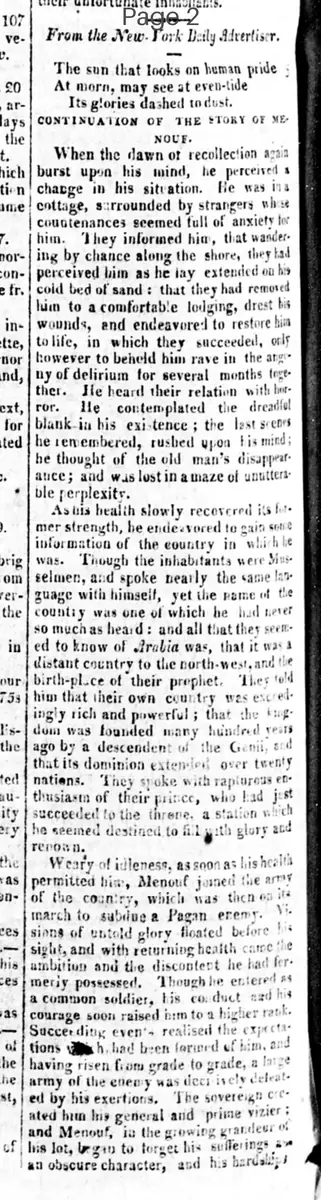
From the New-York Daily Advertiser.
The sun that looks on human pride
At morn, may see at even-tide
Its glories dashed to dust.
CONTINUATION OF THE STORY OF MENOUF.
When the dawn of recollection again burst upon his mind, he perceived a change in his situation. He was in a cottage, surrounded by strangers whose countenances seemed full of anxiety for him. They informed him, that wandering by chance along the shore, they had perceived him as he lay extended on his cold bed of sand: that they had removed him to a comfortable lodging, dressed his wounds, and endeavored to restore him to life, in which they succeeded, only however to behold him rave in the agony of delirium for several months together. He heard their relation with horror. He contemplated the dreadful blank in his existence: the last scenes he remembered, rushed upon his mind; he thought of the old man's disappearance; and was lost in a maze of unutterable perplexity.
As his health slowly recovered its former strength, he endeavored to gain some information of the country in which he was. Though the inhabitants were Musselmen, and spoke nearly the same language with himself, yet the name of the country was one of which he had never so much as heard: and all that they seemed to know of Arabia was, that it was a distant country to the north-west, and the birth-place of their prophet. They told him that their own country was exceedingly rich and powerful; that the kingdom was founded many hundred years ago by a descendant of the Genii, and that its dominion extended over twenty nations. They spoke with rapturous enthusiasm of their prince, who had just succeeded to the throne, a station which he seemed destined to fill with glory and repose.
Weary of idleness, as soon as his health permitted him, Menouf joined the army of the country, which was then on its march to subdue a Pagan enemy. Visions of untold glory floated before his sight, and with returning health came the ambition and the discontent he had formerly possessed. Though he entered as a common soldier, his conduct and his courage soon raised him to a higher rank. Succeeding events realised the expectations which had been formed of him, and having risen from grade to grade, a large army of the enemy was decisively defeated by his exertions. The sovereign created him his general and prime vizier; and Menouf, in the growing grandeur of his lot, began to forget his sufferings as an obscure character, and his hardships.
Seated in his speculations on the probable end of his advancing career.
Peace was soon re-established, and the glory and reputation of Menouf continued untainted. High in the confidence of his sovereign, he endeavored to promote the welfare of the empire which was called to assist by his counsels.
Wherever he appeared respect was paid to his presence and to his words; and the people congratulated themselves on possessing such a vizier with such endowments. As he returned from the Divan, he suddenly observed the old man who had been his guide awaiting him on the steps of his palace. The latter saluted him; but he, filled with resentment at the past, reproached him with his desertion, and boasted to him that he had succeeded in his undertakings far better since he had been alone. The old man bore his taunts without a murmur, till he had concluded. He then exclaimed:
"Providence, O Menouf! is dark and mysterious in its dealings. Thy weak and mortal eye cannot fathom its designs. Thou mayest despise my counsels, but time will prove their truth. Beware—the footsteps thou now treadest will lead thee to ruin. Take however, this talisman, which in the earthquake which separated us, I seized from its dwelling place of fire. As long as thou perseverest in the path of duty, this amethyst will exert such an influence over thy mind as to lead thee in the right way; but remember, too, O Menouf, that if thou fosterest for a moment the seeds of crime, and goest in the paths of unwarrantable ambition, it will warp thine intellect and pervert thy judgment. Use it with circumspection. From the future's dark prospect we may not strip the veil; but once again I warn thee—beware!"
—Menouf turned to reply, but the old man had disappeared.
It was in vain he endeavored to trace the fugitive. He now regretted that he had offended him, and wished to recall every thing he had said. Under the influence of these virtuous feelings, he felt himself strongly instigated to acts of high and exemplary virtue. The love and admiration he had excited were daily increased and he felt the value of the old man's gift.
Thus far all went well: till once when he had happened to have laid his talisman aside for a moment, he was immediately called to an audience of a person who was extremely anxious to speak to him. The gem was forgotten. He found one of the nobles of the court waiting for him, who by degrees, and with caution, implied several complaints against the conduct of the king. He said he had been induced to apply to the vizier, by the conversation of an old man who appeared intimately acquainted with his character.
Menouf started from his seat;—and Bardissi, the nobleman, remarking his confusion, described his informant in such a manner as to leave no doubt upon Menouf's mind who he was, adding, that he had departed from the country. He then dropt hints of a rebellion—of deposing the king. The blood of Menouf's heart throbbed as Bardissi spoke. He remembered the talisman, and abruptly quitting the room, regained its possession. But its effect was now widely different. He had listened with pleasure to the plans of the courtier, and the talisman fostered his dark conceptions.
A few days saw Menouf the blackest of traitors. Bardissi engaged to destroy the king by poison; and the unsuspecting monarch fell a victim to their treachery. In the actors in this dreadful tragedy kept out of sight, the popular voice proclaimed Menouf king, and he was crowned amid the acclamations of deluded thousands, who fondly imagined that they had placed upon the throne, one whose wisdom would surpass that of any former sovereign.
He acted the hypocrite for several months, till his power was fully established. He then found that the power for which he had ever so anxiously longed, was immense; that his treasures and resources were almost inexhaustible.
The tyrant then came out. The hand of oppression laid its iron rod on all. The people groaned beneath their burdens, and the nobles felt the weight of the tyranny he imposed upon them. The principles of virtue he once possessed were entirely forgotten: and instead of receiving the old appellation of Menouf the magnificent, which the enthusiasm of his people had at first bestowed, he received the odious appellation of Menouf the oppressor. The standard of rebellion was raised, and he vainly strove to cope with the rising energies of a nation. His general, Bardissi, was defeated and slain, and a few days beheld the glorious, exulting, powerful Menouf, begone in the solitude of a dungeon. A bowl of poison had been left for him to drink.
As he lay there, he remembered once more the talisman, and filled with compunction, he threw it from him. The beams of supernatural lustre that always played around it now brightened into a blaze of intolerable glory, on a sudden he beheld the bowl of poison, in the gloom of the moment, when a voice then became from the burning amethyst, and the form of the genius Zedosta stood again revealed. "Desist," said he sternly, "from crowning thy guilt with suicide. Thou askest for power, and thou hast received it in the form the old man I led thee through many designing hoping to wean thee from endless ambition. I brought thee to the summit of sorrow, and yet thou wast not humbled. The talisman I gave thee only hastened the desires and the conduct which would certainly have taken place at a more distant period. I instigated Bardissi to his enterprise, but he would have done it himself on a future occasion. The king, whom you imagined dead, was only stupified by the effect of an opiate of long duration, which I substituted for the poison. The attendants of the sepulchres of the king have discovered him awake. Dost thou not hear the shouts of the populace?—They are coming to tear thy body to pieces, and to scatter thy ashes to the winds of heaven!"
The sound of an enraged populace now drew near. Menouf shrieked in terror.
"I will save thee." said the genius; "I will substitute another form bloated with poison, for thine; whilst thou shalt be removed to the abode of thy father, (to whom I have revealed thy history.) to pass the remainder of thy days in peace, and to profit by the dreadful lesson which thou hast received. Go; and learn to repine no more, and to sigh no longer after that power which thou art unable to use with discretion, and which thou wast not born to wield!"
The roar approached nearer to the dungeon. The genius struck him with his wand.—A pang of intense agony shot through his frame; but when that was past, he looked around him, and beheld the rocks and the valleys of his father's abode.
The story of Menouf is recorded by his own desire on the annals of his kingdom. Hear, and be wise. (Ye who sigh like him after the grandeur Allah has forbidden to your lot, lest, also, like the infatuated Menouf, ye be plunged into the excesses of crime, and be doomed to feel the agonies of remorse!—ALLAHU AKBAR! Lail! To Allah be the praise!)
The sun that looks on human pride
At morn, may see at even-tide
Its glories dashed to dust.
CONTINUATION OF THE STORY OF MENOUF.
When the dawn of recollection again burst upon his mind, he perceived a change in his situation. He was in a cottage, surrounded by strangers whose countenances seemed full of anxiety for him. They informed him, that wandering by chance along the shore, they had perceived him as he lay extended on his cold bed of sand: that they had removed him to a comfortable lodging, dressed his wounds, and endeavored to restore him to life, in which they succeeded, only however to behold him rave in the agony of delirium for several months together. He heard their relation with horror. He contemplated the dreadful blank in his existence: the last scenes he remembered, rushed upon his mind; he thought of the old man's disappearance; and was lost in a maze of unutterable perplexity.
As his health slowly recovered its former strength, he endeavored to gain some information of the country in which he was. Though the inhabitants were Musselmen, and spoke nearly the same language with himself, yet the name of the country was one of which he had never so much as heard: and all that they seemed to know of Arabia was, that it was a distant country to the north-west, and the birth-place of their prophet. They told him that their own country was exceedingly rich and powerful; that the kingdom was founded many hundred years ago by a descendant of the Genii, and that its dominion extended over twenty nations. They spoke with rapturous enthusiasm of their prince, who had just succeeded to the throne, a station which he seemed destined to fill with glory and repose.
Weary of idleness, as soon as his health permitted him, Menouf joined the army of the country, which was then on its march to subdue a Pagan enemy. Visions of untold glory floated before his sight, and with returning health came the ambition and the discontent he had formerly possessed. Though he entered as a common soldier, his conduct and his courage soon raised him to a higher rank. Succeeding events realised the expectations which had been formed of him, and having risen from grade to grade, a large army of the enemy was decisively defeated by his exertions. The sovereign created him his general and prime vizier; and Menouf, in the growing grandeur of his lot, began to forget his sufferings as an obscure character, and his hardships.
Seated in his speculations on the probable end of his advancing career.
Peace was soon re-established, and the glory and reputation of Menouf continued untainted. High in the confidence of his sovereign, he endeavored to promote the welfare of the empire which was called to assist by his counsels.
Wherever he appeared respect was paid to his presence and to his words; and the people congratulated themselves on possessing such a vizier with such endowments. As he returned from the Divan, he suddenly observed the old man who had been his guide awaiting him on the steps of his palace. The latter saluted him; but he, filled with resentment at the past, reproached him with his desertion, and boasted to him that he had succeeded in his undertakings far better since he had been alone. The old man bore his taunts without a murmur, till he had concluded. He then exclaimed:
"Providence, O Menouf! is dark and mysterious in its dealings. Thy weak and mortal eye cannot fathom its designs. Thou mayest despise my counsels, but time will prove their truth. Beware—the footsteps thou now treadest will lead thee to ruin. Take however, this talisman, which in the earthquake which separated us, I seized from its dwelling place of fire. As long as thou perseverest in the path of duty, this amethyst will exert such an influence over thy mind as to lead thee in the right way; but remember, too, O Menouf, that if thou fosterest for a moment the seeds of crime, and goest in the paths of unwarrantable ambition, it will warp thine intellect and pervert thy judgment. Use it with circumspection. From the future's dark prospect we may not strip the veil; but once again I warn thee—beware!"
—Menouf turned to reply, but the old man had disappeared.
It was in vain he endeavored to trace the fugitive. He now regretted that he had offended him, and wished to recall every thing he had said. Under the influence of these virtuous feelings, he felt himself strongly instigated to acts of high and exemplary virtue. The love and admiration he had excited were daily increased and he felt the value of the old man's gift.
Thus far all went well: till once when he had happened to have laid his talisman aside for a moment, he was immediately called to an audience of a person who was extremely anxious to speak to him. The gem was forgotten. He found one of the nobles of the court waiting for him, who by degrees, and with caution, implied several complaints against the conduct of the king. He said he had been induced to apply to the vizier, by the conversation of an old man who appeared intimately acquainted with his character.
Menouf started from his seat;—and Bardissi, the nobleman, remarking his confusion, described his informant in such a manner as to leave no doubt upon Menouf's mind who he was, adding, that he had departed from the country. He then dropt hints of a rebellion—of deposing the king. The blood of Menouf's heart throbbed as Bardissi spoke. He remembered the talisman, and abruptly quitting the room, regained its possession. But its effect was now widely different. He had listened with pleasure to the plans of the courtier, and the talisman fostered his dark conceptions.
A few days saw Menouf the blackest of traitors. Bardissi engaged to destroy the king by poison; and the unsuspecting monarch fell a victim to their treachery. In the actors in this dreadful tragedy kept out of sight, the popular voice proclaimed Menouf king, and he was crowned amid the acclamations of deluded thousands, who fondly imagined that they had placed upon the throne, one whose wisdom would surpass that of any former sovereign.
He acted the hypocrite for several months, till his power was fully established. He then found that the power for which he had ever so anxiously longed, was immense; that his treasures and resources were almost inexhaustible.
The tyrant then came out. The hand of oppression laid its iron rod on all. The people groaned beneath their burdens, and the nobles felt the weight of the tyranny he imposed upon them. The principles of virtue he once possessed were entirely forgotten: and instead of receiving the old appellation of Menouf the magnificent, which the enthusiasm of his people had at first bestowed, he received the odious appellation of Menouf the oppressor. The standard of rebellion was raised, and he vainly strove to cope with the rising energies of a nation. His general, Bardissi, was defeated and slain, and a few days beheld the glorious, exulting, powerful Menouf, begone in the solitude of a dungeon. A bowl of poison had been left for him to drink.
As he lay there, he remembered once more the talisman, and filled with compunction, he threw it from him. The beams of supernatural lustre that always played around it now brightened into a blaze of intolerable glory, on a sudden he beheld the bowl of poison, in the gloom of the moment, when a voice then became from the burning amethyst, and the form of the genius Zedosta stood again revealed. "Desist," said he sternly, "from crowning thy guilt with suicide. Thou askest for power, and thou hast received it in the form the old man I led thee through many designing hoping to wean thee from endless ambition. I brought thee to the summit of sorrow, and yet thou wast not humbled. The talisman I gave thee only hastened the desires and the conduct which would certainly have taken place at a more distant period. I instigated Bardissi to his enterprise, but he would have done it himself on a future occasion. The king, whom you imagined dead, was only stupified by the effect of an opiate of long duration, which I substituted for the poison. The attendants of the sepulchres of the king have discovered him awake. Dost thou not hear the shouts of the populace?—They are coming to tear thy body to pieces, and to scatter thy ashes to the winds of heaven!"
The sound of an enraged populace now drew near. Menouf shrieked in terror.
"I will save thee." said the genius; "I will substitute another form bloated with poison, for thine; whilst thou shalt be removed to the abode of thy father, (to whom I have revealed thy history.) to pass the remainder of thy days in peace, and to profit by the dreadful lesson which thou hast received. Go; and learn to repine no more, and to sigh no longer after that power which thou art unable to use with discretion, and which thou wast not born to wield!"
The roar approached nearer to the dungeon. The genius struck him with his wand.—A pang of intense agony shot through his frame; but when that was past, he looked around him, and beheld the rocks and the valleys of his father's abode.
The story of Menouf is recorded by his own desire on the annals of his kingdom. Hear, and be wise. (Ye who sigh like him after the grandeur Allah has forbidden to your lot, lest, also, like the infatuated Menouf, ye be plunged into the excesses of crime, and be doomed to feel the agonies of remorse!—ALLAHU AKBAR! Lail! To Allah be the praise!)
What sub-type of article is it?
Prose Fiction
Allegory
Fable
What themes does it cover?
Moral Virtue
Political
Temperance
What keywords are associated?
Moral Tale
Ambition
Talisman
Tyranny
Remorse
Genius Guide
Power Corruption
What entities or persons were involved?
From The New York Daily Advertiser
Literary Details
Title
Continuation Of The Story Of Menouf
Author
From The New York Daily Advertiser
Key Lines
The Sun That Looks On Human Pride
At Morn, May See At Even Tide
Its Glories Dashed To Dust.
"Providence, O Menouf! Is Dark And Mysterious In Its Dealings. Thy Weak And Mortal Eye Cannot Fathom Its Designs."
"Desist," Said He Sternly, "From Crowning Thy Guilt With Suicide."
Hear, And Be Wise. (Ye Who Sigh Like Him After The Grandeur Allah Has Forbidden To Your Lot, Lest, Also, Like The Infatuated Menouf, Ye Be Plunged Into The Excesses Of Crime, And Be Doomed To Feel The Agonies Of Remorse!—Allahu Akbar! Lail! To Allah Be The Praise!)