Thank you for visiting SNEWPapers!
Sign up free
Alexandria Gazette
Alexandria, Alexandria County, District Of Columbia
What is this article about?
In the U.S. House of Representatives on Wednesday, debate occurred on a bill to extend the time for the commission adjudicating American claims against France under the 1831 treaty. Concerns arose over France's Chamber of Deputies refusing appropriation, but the bill passed after motions to postpone or recommit were defeated.
Merged-components note: Continuation of the article on the U.S. House of Representatives debate regarding the extension of the commission for claims against France following the French rejection.
Clipping
OCR Quality
Full Text
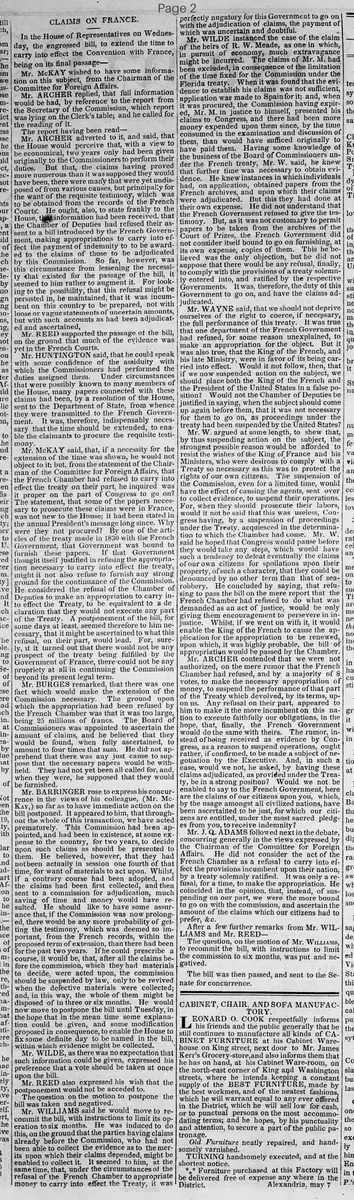
In the House of Representatives on Wednesday, the engrossed bill, to extend the time to carry into effect the Convention with France, being on its final passage—
Mr. McKAY wished to have some information on this subject, from the Chairman of the Committee for Foreign Affairs.
Mr. ARCHER replied, that full information would be had, by reference to the report from the Secretary of the Commission, which report was lying on the Clerk's table; and he called for the reading of it.
The report having been read—
Mr. ARCHER adverted to it, and said, that the House would perceive that, with a view to be economical, two years only had been given originally to the Commissioners to perform their duties. But that, the claims having proved more numerous than it was supposed they would have been, there were many that were yet undisposed of from various causes, but principally for the want of the requisite testimony, which was to be obtained from the records of the French Courts: He ought, also, to state frankly to the House, that information had been received, that the Chamber of Deputies had refused their assent to a bill introduced by the French Government, making appropriations to carry into effect the payment of indemnity to to be awarded to the claims of those to be adjudicated by this Commission. So far, however, was this circumstance from lessening the necessity that existed for the passage of the bill, it seemed to him rather to augment it. For looking to the possibility, that this refusal might be persisted in, he maintained, that it was incumbent on this country to be prepared, not with loose or vague statements of uncertain amounts. but with such accounts as had been adjudicated and ascertained.
Mr. REED supported the passage of the bill, on the ground that much of the evidence was yet in the French Courts.
Mr. HUNTINGTON said, that he could speak with some confidence of the assiduity with which the Commissioners had performed the duties assigned them. Under circumstances that were possibly known to many members of the House, many papers connected with these claims had been, by a resolution of the House, sent to the Department of State, from whence they were transmitted to the French Government. It was, therefore, indispensably necessary that the time should be extended, to enable the claimants to procure the requisite testimony.
Mr. McKAY said, that, if a necessity for the extension of the time was shown, he would not object to it; but, from the statement of the Chairman of the Committee for Foreign Affairs, that the French Chamber had refused to carry into effect the treaty on their part, he inquired was it proper on the part of Congress to go on? The statement, that some of the papers necessary to prosecute these claims were in France, was not new to the House; it had been stated in the annual President's message long since. Why were they not procured? By one of the articles of the treaty made in 1830 with the French Government, that Government was bound to furnish these papers. If that Government thought itself justified in refusing the appropriation necessary to carry into effect the treaty, might it not also refuse to furnish any strong ground for the continuance of the Commission. He considered the refusal of the Chamber of Deputies to make an appropriation to carry into effect the Treaty, to be equivalent to a declaration that they would not execute any part of the Treaty. A postponement of the bill, for some days at least, seemed therefore to him necessary, that it might be ascertained to what this refusal, on their part, would lead. For, surely, if it turned out that there would not be any prospect of the treaty being fulfilled by the Government of France, there could not be any propriety at all in continuing the Commission beyond its present legal term.
Mr. BURGES remarked. that there was one fact which would make the extension of the Commission necessary. The ground upon which the appropriation had been refused by the French Chamber was that it was too large, being 25 millions of francs. The Board of Commissioners was appointed to ascertain the amount of claims, and he believed that they would be found, when fully ascertained, to amount to four times that sum. He did not apprehend that there was any just cause to suppose that the necessary papers would be withheld. They had not yet been all called for, and when they were, he supposed that they would be furnished.
Mr. BARRINGER rose to express his concurrence in the views of his colleague, (Mr. McKay.) so far as to have immediate action on the bill postponed. It appeared to him, that throughout the whole of this transaction, we have acted prematurely. This Commission had been appointed, and had been in existence, at some expense to the country, for two years, to decide upon such claims as should be presented to them. He believed, however, that they had not been actually in session one fourth of that time. for want of materials to act upon. Whilst. if a contrary course had been adopted, and the claims had been first collected, and then sent to a commission for adjudication, much saving of time and money would have resulted. He should like to have some assurance that, if the Commission was now prolonged, there would be any more probability of getting the testimony, which was deemed so important, from the French records, within the proposed term of extension, than there had been for the past two years. If he could prescribe a course. it would be, that, after all the claims before the commission, which they had materials to decide, were acted upon, the commission should be suspended by law, only to be revived when the defective materials were collected: and, in this way. the whole of them might be disposed of in three or six months. He would now move to postpone the bill until Tuesday, in the hope that in the mean time some explanation could be given, and some modification proposed in consequence, to enable the House to fix some definite day to be named in the bill, within which evidence might be collected.
Mr. WILDE, as there was no expectation that such information could be given, expressed his preference that a vote should be taken at once upon the bill.
Mr. REED also expressed his wish that the postponement would not be acceded to.
The question on the motion to postpone the bill was taken and negatived.
Mr. WILLIAMS said he would move to recommit the bill, with instructions to limit its operation to six months. He was induced to do this, on the ground that the parties having claims already before the Commission, who had not been able to collect the evidence as to the merits upon which their claims depended, might be enabled to collect it. It seemed to him. at the same time. that. under the circumstances of the refusal of the French Chamber to appropriate money to carry into effect the Treaty, it was
perfectly nugatory for this Government to go on with the adjudication of claims, the payment of which was uncertain and doubtful.
Mr. WILDE instanced the case of the claim of the heirs of R. W. Meade, as one in which. in pursuit of economy, much extravagance might be incurred. The claims of Mr. M. had been excluded, in consequence of the limitation of the time fixed for the Commission under the Florida treaty. When it was found that the evidence to establish his claims was not sufficient, application was made to Spain for it; and, when it was procured, the Commission having expired, Mr. M. in justice to himself, presented his claims to Congress, and there had been more money expended upon them since, by the time consumed in the examination and discussion of them, than would have sufficed originally to have paid them. Having some knowledge of the business of the Board of Commissioners under the French treaty, Mr. W. said, he knew that further time was necessary to obtain evidence. He knew instances in which individuals had, on application, obtained papers from the French archives, and upon which their claims were adjudicated. But this they had done at their own expense. He did not understand that the French Government refused to give the testimony. But, as it was not customary to permit papers to be taken from the archives of the Court of Prizes, the French Government did not consider itself bound to go on furnishing, at its own expense, copies of them. This he believed was the only objection, but he did not suppose that there would be any refusal, finally, to comply with the provisions of a treaty solemnly entered into, and ratified by the respective Governments. It was, therefore, the duty of this Government to go on, and have the claims adjudicated.
Mr. WAYNE said, that we should not deprive ourselves of the right to coerce, if necessary, the full performance of this treaty. It was true that one department of the French Government had refused, for some reason unexplained, to make an appropriation for the object. But it was also true, that the King of the French, and his late Ministry, were in favor of its being carried into effect. Would it not follow, then, that if we now suspended action on the subject, we should place both the King of the French and the President of the United States in a false position? Would not the Chamber of Deputies be justified in saying, when the subject should come up again before them, that it was not necessary for them to go on, as proceedings under the treaty had been suspended by the United States? Mr. W. argued at some length, to shew that. by thus suspending action on the subject, the strongest possible reason would be afforded to resist the wishes of the King of France and his Ministers. who were desirous to comply with a Treaty so necessary as this was to protect the rights of our own citizens. The suspension of the Commission, even for a limited time, would have the effect of causing the agents, sent over to collect evidence, to suspend their operations. For, when they should prosecute their labors, would it not be said that this was useless, Congress having, by a suspension of proceedings under the Treaty, acquiesced in the determination to which the Chamber had come. Mr. W. said he hoped that Congress would pause before they would take any steps, which would have such a tendency to defeat eventually the claims of our own citizens for spoliations upon their property, of such a character, that they could be denounced by no other term than that of sea-robbery. He concluded by saying, that refusing to pass the bill on the mere report that the French Chamber had refused to do what was demanded as an act of justice. would be only giving them encouragement to persevere in injustice. Whilst. if we went on with it, it would enable the King of the French to cause the application for the appropriation to be renewed. upon which, it was highly probable, the bill of appropriation would be passed by the Chamber.
Mr. ARCHER contended that we were not authorized. on the mere rumor that the French Chamber had refused, and by a majority of 8 votes, to make the necessary appropriation of money, to suspend the performance of that part of the Treaty which devolved. by its terms, upon us. Any refusal on their part, appeared to him to make it the more incumbent on this nation to execute faithfully our obligations, in the hope, that, finally, the French Government would do the same with theirs. The rumor, instead of being received as evidence by Congress, as a reason to suspend operations, ought rather, if confirmed, to be made a subject of negotiation by the Executive. And, in such a case, would we not, he asked, by having these claims adjudicated, as provided under the Treaty, be in a strong position? Would we not be enabled to say to the French Government, here are the claims of our citizens upon you, which. by the usage amongst all civilized nations, have been ascertained to be just, for which our citizens are entitled, under the most sacred pledges from you, to receive indemnity?
Mr. J. Q. ADAMS followed next in the debate, concurring generally in the views expressed by the Chairman of the Committee for Foreign Affairs. He did not consider the act of the French Chamber as a refusal to carry into effect the provisions incumbent upon their nation, by a treaty solemnly ratified. It was only a refusal, for a time, to make the appropriation. He coincided in the opinion, that, instead, of suspending on our part, we were the more bound to go on with the commission, and ascertain the amount of the claims which our citizens had to prefer, &c.
After a few further remarks from Mr. WILLIAMS and Mr. REED
The question, on the motion of Mr. Williams, to recommit the bill, with instructions to limit the commission to six months, was put and negatived.
The bill was then passed, and sent to the Senate for concurrence.
What sub-type of article is it?
What keywords are associated?
What entities or persons were involved?
Where did it happen?
Domestic News Details
Primary Location
House Of Representatives
Event Date
On Wednesday
Key Persons
Outcome
the bill to extend the time for the commission was passed and sent to the senate for concurrence. motions to postpone and to recommit with a six-month limit were negatived.
Event Details
Debate in the House on extending the commission for adjudicating U.S. claims against France under the 1831 treaty, amid reports of French Chamber refusing appropriation. Speakers argued for continuation to prepare adjudicated claims, despite uncertainties, to strengthen U.S. position.