Thank you for visiting SNEWPapers!
Sign up free
Letter to Editor
September 7, 1816
Richmond Enquirer
Richmond, Richmond County, Virginia
What is this article about?
Letter from Richmond advises Virginia Legislature against directly calling a constitutional convention per Staunton Convention's request, urging instead to poll the people on the need for one to fix representation flaws, with comparisons to other states' amendment processes.
Clipping
OCR Quality
95%
Excellent
Full Text
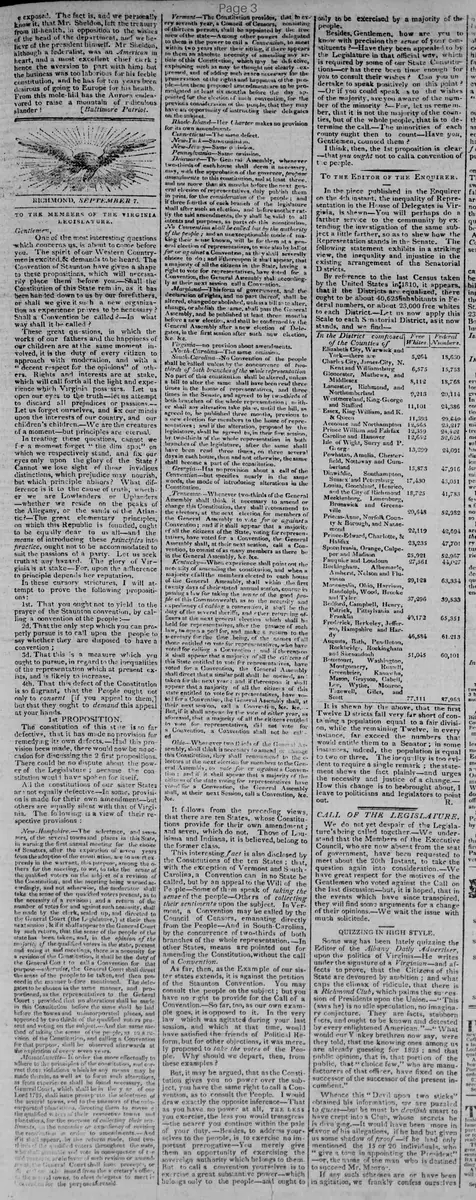
RICHMOND, SEPTEMBER 7.
TO THE MEMBERS OF THE VIRGINIA LEGISLATURE.
Gentlemen,
One of the most interesting questions which concerns us, is about to come before you. The spirit of our Western Countrymen is excited, & demands to be heard. The Convention of Staunton have given a shape to these propositions, which will necessarily place them before you.--Shall the Constitution of this State remain, as it has been handed down to us by our forefathers, or shall we give it such a new organization as experience proves to be necessary? Shall a Convention be called?--In what way shall it be called?
These great questions, in which the works of our fathers and the happiness of our children are at the same moment involved, it is the duty of every citizen to approach with moderation, and with a "decent respect for the opinions" of others. Rights and interests are at stake, which will call forth all the light and experience which Virginia possesses. Let us open our eyes to the truth-let us attempt to discard all prejudices or passions.--Let us forget ourselves, and fix our minds upon the interests of our country, and our children's children.--We are the creatures of a moment-but principles are eternal.
In treating these questions, cannot we for a moment forget "the dim spot" on which we respectively stand, and fix our eyes only upon the glory of the State? Cannot we lose sight of those invidious distinctions, which prejudice may nourish, but which principle abhors? What difference is it to the cause of truth, whether we are Lowlanders or Uplanders -whether we reside on the peaks of the Allegany, or the sands of the Atlantic?--The great elementary principles, on which this Republic is founded, ought to be equally dear to us all--and the means of introducing these principles into practice, ought not to be accommodated to suit the passions of a party. Let us seek truth at any hazard. The glory of Virginia is at stake--For, upon the adherence to principle depends her reputation,
In these cursory strictures, I will attempt to prove the following propositions:
1st. That you ought not to yield to the prayer of the Staunton convention, by calling a convention of the people:-
2d. That the only step which you can properly pursue is to call upon the people to say whether they are disposed to have a convention;
3d. That this is a measure which you ought to pursue, in regard to the inequalities of the representation which at present exists, and is likely to increase.
4th. That this defect of the Constitution is so flagrant, that the People ought not only to consent [if you appeal to them,] but that they ought to demand this appeal at your hands.
1st PROPOSITION.
The constitution of this state is so far defective, that it has made no provision for remedying its own defects.--Had this provision been made, there would now be no occasion for discussing the 2 first propositions. There could be no dispute about the power of the Legislature; because the constitution would have spoken for itself.
All the constitutions of our sister States are not equally defective--In some, provision is made for their own amendment-but others are equally silent with that of Virginia. The following is a view of their respective provisions :
New-Hampshire.--The Selectmen, and assessors, of the several towns and places in this State, in warning the first annual meeting for the choice of Senators, after the expiration of seven years from the adoption of the constitution, are to insert expressly in the warrant, this purpose, among the others for the meeting, to wit, to take the sense of the qualified voters on the subject of a revision of the Constitution, and the meeting being warned accordingly, and not otherwise, the moderator shall take the sense of the qualified voters present, as to the necessity of a revision; and a return of the number of votes for and against such necessity, shall be made by the clerk, sealed up, and directed to the General Court (the Legislature,) at their then next session ; & if it shall appear to the General Court by such return, that the sense of the people of the state has been taken, and, in the opinion of the majority of the qualified voters in the state, present and voting at said meetings, there is a necessity for a revision of the Constitution, it shall be the duty of the General Court to call a Convention for that purpose-otherwise, the General Court shall direct the sense of the people to be taken, and then proceed in the manner before mentioned. The delegates to be chosen in the same manner, and proportioned, as the representatives to the General Court : provided (that no alterations shall be made in this Constitution before the same shall be laid before the towns and unincorporated places, and approved by two thirds of the qualified voters present and voting on the subject.--And the same method of taking the sense of the people, as to a revision of the Constitution, and calling a Convention for that purpose, shall be observed afterwards at the expiration of every seven years.
Massachusetts--In order the more effectually to adhere to the principles of the constitution, and correct those violations which by any means may be made therein, as well as to form such alterations, as from experience shall be found necessary, the General Court, which shall be in the year of our Lord 1795, shall issue precepts to the selectmen of the several towns, and to the assessors of the unincorporated plantations, directing them to convene the qualified voters of their respective towns and plantations. for the purpose of collecting their sentiments, on the necessity or expediency of revising the constitution in order to amendments.--And if it shall appear, by the returns made, that two-thirds of the qualified voters throughout the state, who shall assemble and vote in consequence of the said precepts, are in favor of such revision or amendment, the General Court shall issue precepts, or warrants to the several towns, to elect delegates to meet in convention for the purpose aforesaid
Vermont--The Constitution provides." (that every seventh year, a Council of Censors, consisting of thirteen persons, shall be appointed by the freemen of the state--Among other powers delegated to them is the power to call a Convention, to meet within two years after their sitting, if there appears to them an absolute necessity of amending any article of this Constitution, which may be defective, explaining such as may be thought not clearly expressed, and of adding such as are necessary for the preservation of the rights and happiness of the people--but these proposed amendments are to be promulgated at least six months before the day appointed for the election of such convention, for the previous consideration of the people, that they may have an opportunity of instructing their delegates on the subject.
Rhode-Island--Her charter makes no provision for its own amendment.
Connecticut--The same defect
New-York--Same omission.
New-Jersey--Same omission.
Pennsylvania--Same omission.
Delaware--The General Assembly, whenever two-thirds of each house shall deem it necessary, may, with the approbation of the governor, propose amendments to this constitution, and at least three, and not more than six months before the next general election of representatives, duly publish them in print. for the consideration of the people ; and if three fourths of each branch of the legislature shall after such an election, and before another ratify the said amendments, they shall be valid to all intents and purposes, as parts of this constitution. No Convention shall be called but by the authority of the people ; and an unexceptionable mode of making their sense known, will be for them at a general election of representatives, to vote also by ballot for or against a Convention, as they shall severally choose to do; and if thereupon it shall appear, that a majority of all the citizens in the State, having a right to vote for representatives, have voted for a Convention, the General Assembly shall accordingly at their next session call a Convention.
Maryland--This form of government, and the declaration of rights, and no part thereof, shall be altered, changed or abolished, unless a bill so to alter, change, or abolish the same, shall pass the General Assembly, and be published at least three months before a new election, and shall be confirmed by the General Assembly after a new election of Delegates, in the first session after such new election, &c. &c.
Virginia--no provision about amendments.
North-Carolina--The same omission.
South-Carolina.--No Convention of the people shall be called unless by the concurrence of two-thirds of both branches of the whole representation No part of this constitution shall be altered, unless a bill to alter the same shall have been read three times in the house of representatives, and three times in the Senate, and agreed to by two-thirds of both branches of the whole representation; neither shall any alteration take place, until the bill, so agreed to, be published three months, previous to a new election for members to the house of representatives; and if the alteration, proposed by the legislature, shall be agreed to, in their first session. by two-thirds of the whole representation in both branches of the legislature, after the same shall have been read three times, on three several days in each house, then and not otherwise, the same shall become a part of the constitution.
Georgia--Has no provision about a call of the Convention--but specifies nearly in the same words, the mode of introducing alterations in the Constitution.
Tennessee-- Whenever two-thirds of the General Assembly shall think it necessary to amend or change this Constitution, they shall recommend to the electors, at the next election for members of the General Assembly to vote for or against a Convention; and if it shall appear that a majority of all the citizens of the State, voting for representatives, have voted for a Convention, the General Assembly shall, at their next session, call a Convention, to consist of as many members as there be in the General Assembly, &c. &c.
Kentucky--When experience shall point out the necessity of amending the constitution, and when a majority of all the members elected to each house of the General Assembly, shall within the first twenty days of their stated annual session, concur in passing a law for taking the sense of the good people of this Commonwealth as to the necessity and expediency of calling a convention, it shall be the duty of the several sheriffs, and other returning officers at the next general election which shall be held for representatives, after the passage of such law, to open a poll for, and make a return to the secretary for the time being, of the names of all those entitled to vote for representatives, who have voted for calling a Convention : and if thereupon it shall appear that a majority of all the citizens of this State entitled to vote for representatives, have voted for a Convention, the General Assembly shall direct that a similar poll shall be opened, and taken for the next year : and if thereupon it shall appear that a majority of all the citizens of this state entitled to vote for representatives, have voted for a Convention, the General Assembly shall, at their next session, call a Convention, &c. &c... But, if it shall appear by the vote of either year, as aforesaid, that a majority of all the citizens entitled to vote for representatives, did not vote for a Convention, a Convention shall not be called.
Ohio--Whenever two thirds of the General Assembly, shall think it necessary to amend or change this Constitution, they shall recommend to the electors at the next election for members to the General Assembly, to vote for or against a Convention ; and if it shall appear that a majority of the citizens of the state voting for representatives have voted for a Convention, the General Assembly shall, at their next Session, call a Convention, &c. &c.
It follows from the preceding views, that there are ten States, whose Constitutions provide for their own amendment; and seven, which do not. Those of Louisiana and Indiana, it is believed, belong to the former class.
This interesting fact is also disclosed by the Constitutions of the ten States ; that, with the exception of Vermont and South-Carolina, a Convention can in no State be called, but by an appeal to the Will of the People--Some of them speak of taking the sense of the people--Others of collecting their sentiments upon the subject. In Vermont, a Convention may be called by the Council of Censors, emanating directly from the People--And in South-Carolina, by the concurrence of two-thirds of both branches of the whole representation.--In other States, means are pointed out for amending the Constitution, without the call of a Convention.
As far, then, as the Example of our sister states extends, it is against the petition of the Staunton Convention. You may consult the people on the subject; but you have no right to provide for the Call of a Convention. So far, too, as our own example goes, it is opposed to it. In the very law which was agitated during your last session, and which at that time, would have satisfied the friends of Political Reform, but for other objections, it was merely proposed to take the votes of the People. Why should we depart, then, from these examples?
But, it may be argued, that as the Constitution gives you no power over the subject, you have the same right to call a Convention, as to consult the People. I would draw exactly the opposite inference--That as you have no power at all, The LESS you exercise, the less you would transgress -the nearer you continue within the pale of your duty.--Besides, to address yourselves to the people, is to exercise no important prerogative--You merely give them an opportunity of exercising the sovereign authority which belongs to them. But to call a convention yourselves is to exercise a great substantive power--which belongs only to the people--and ought to
only to be exercised by a majority of the people.
Besides, Gentlemen, how are you to know with precision the sense of your constituents ?--Have they been appealed to by the Legislature in that official way, which is required by some of our State Constitutions--or has there been time enough for you to consult their wishes ? Can you undertake to speak positively on this point? -Or if you could speak as to the wishes of the majority, are you aware of the number of the minority ? For, let us remember, that it is not the majority of the counties, but of the whole people, that is to determine the call.--The minorities of each county ought then to count--Have you, Gentlemen, counted them ?
I think, then, the 1st proposition is clear --that you ought not to call a convention of the people.
TO THE MEMBERS OF THE VIRGINIA LEGISLATURE.
Gentlemen,
One of the most interesting questions which concerns us, is about to come before you. The spirit of our Western Countrymen is excited, & demands to be heard. The Convention of Staunton have given a shape to these propositions, which will necessarily place them before you.--Shall the Constitution of this State remain, as it has been handed down to us by our forefathers, or shall we give it such a new organization as experience proves to be necessary? Shall a Convention be called?--In what way shall it be called?
These great questions, in which the works of our fathers and the happiness of our children are at the same moment involved, it is the duty of every citizen to approach with moderation, and with a "decent respect for the opinions" of others. Rights and interests are at stake, which will call forth all the light and experience which Virginia possesses. Let us open our eyes to the truth-let us attempt to discard all prejudices or passions.--Let us forget ourselves, and fix our minds upon the interests of our country, and our children's children.--We are the creatures of a moment-but principles are eternal.
In treating these questions, cannot we for a moment forget "the dim spot" on which we respectively stand, and fix our eyes only upon the glory of the State? Cannot we lose sight of those invidious distinctions, which prejudice may nourish, but which principle abhors? What difference is it to the cause of truth, whether we are Lowlanders or Uplanders -whether we reside on the peaks of the Allegany, or the sands of the Atlantic?--The great elementary principles, on which this Republic is founded, ought to be equally dear to us all--and the means of introducing these principles into practice, ought not to be accommodated to suit the passions of a party. Let us seek truth at any hazard. The glory of Virginia is at stake--For, upon the adherence to principle depends her reputation,
In these cursory strictures, I will attempt to prove the following propositions:
1st. That you ought not to yield to the prayer of the Staunton convention, by calling a convention of the people:-
2d. That the only step which you can properly pursue is to call upon the people to say whether they are disposed to have a convention;
3d. That this is a measure which you ought to pursue, in regard to the inequalities of the representation which at present exists, and is likely to increase.
4th. That this defect of the Constitution is so flagrant, that the People ought not only to consent [if you appeal to them,] but that they ought to demand this appeal at your hands.
1st PROPOSITION.
The constitution of this state is so far defective, that it has made no provision for remedying its own defects.--Had this provision been made, there would now be no occasion for discussing the 2 first propositions. There could be no dispute about the power of the Legislature; because the constitution would have spoken for itself.
All the constitutions of our sister States are not equally defective--In some, provision is made for their own amendment-but others are equally silent with that of Virginia. The following is a view of their respective provisions :
New-Hampshire.--The Selectmen, and assessors, of the several towns and places in this State, in warning the first annual meeting for the choice of Senators, after the expiration of seven years from the adoption of the constitution, are to insert expressly in the warrant, this purpose, among the others for the meeting, to wit, to take the sense of the qualified voters on the subject of a revision of the Constitution, and the meeting being warned accordingly, and not otherwise, the moderator shall take the sense of the qualified voters present, as to the necessity of a revision; and a return of the number of votes for and against such necessity, shall be made by the clerk, sealed up, and directed to the General Court (the Legislature,) at their then next session ; & if it shall appear to the General Court by such return, that the sense of the people of the state has been taken, and, in the opinion of the majority of the qualified voters in the state, present and voting at said meetings, there is a necessity for a revision of the Constitution, it shall be the duty of the General Court to call a Convention for that purpose-otherwise, the General Court shall direct the sense of the people to be taken, and then proceed in the manner before mentioned. The delegates to be chosen in the same manner, and proportioned, as the representatives to the General Court : provided (that no alterations shall be made in this Constitution before the same shall be laid before the towns and unincorporated places, and approved by two thirds of the qualified voters present and voting on the subject.--And the same method of taking the sense of the people, as to a revision of the Constitution, and calling a Convention for that purpose, shall be observed afterwards at the expiration of every seven years.
Massachusetts--In order the more effectually to adhere to the principles of the constitution, and correct those violations which by any means may be made therein, as well as to form such alterations, as from experience shall be found necessary, the General Court, which shall be in the year of our Lord 1795, shall issue precepts to the selectmen of the several towns, and to the assessors of the unincorporated plantations, directing them to convene the qualified voters of their respective towns and plantations. for the purpose of collecting their sentiments, on the necessity or expediency of revising the constitution in order to amendments.--And if it shall appear, by the returns made, that two-thirds of the qualified voters throughout the state, who shall assemble and vote in consequence of the said precepts, are in favor of such revision or amendment, the General Court shall issue precepts, or warrants to the several towns, to elect delegates to meet in convention for the purpose aforesaid
Vermont--The Constitution provides." (that every seventh year, a Council of Censors, consisting of thirteen persons, shall be appointed by the freemen of the state--Among other powers delegated to them is the power to call a Convention, to meet within two years after their sitting, if there appears to them an absolute necessity of amending any article of this Constitution, which may be defective, explaining such as may be thought not clearly expressed, and of adding such as are necessary for the preservation of the rights and happiness of the people--but these proposed amendments are to be promulgated at least six months before the day appointed for the election of such convention, for the previous consideration of the people, that they may have an opportunity of instructing their delegates on the subject.
Rhode-Island--Her charter makes no provision for its own amendment.
Connecticut--The same defect
New-York--Same omission.
New-Jersey--Same omission.
Pennsylvania--Same omission.
Delaware--The General Assembly, whenever two-thirds of each house shall deem it necessary, may, with the approbation of the governor, propose amendments to this constitution, and at least three, and not more than six months before the next general election of representatives, duly publish them in print. for the consideration of the people ; and if three fourths of each branch of the legislature shall after such an election, and before another ratify the said amendments, they shall be valid to all intents and purposes, as parts of this constitution. No Convention shall be called but by the authority of the people ; and an unexceptionable mode of making their sense known, will be for them at a general election of representatives, to vote also by ballot for or against a Convention, as they shall severally choose to do; and if thereupon it shall appear, that a majority of all the citizens in the State, having a right to vote for representatives, have voted for a Convention, the General Assembly shall accordingly at their next session call a Convention.
Maryland--This form of government, and the declaration of rights, and no part thereof, shall be altered, changed or abolished, unless a bill so to alter, change, or abolish the same, shall pass the General Assembly, and be published at least three months before a new election, and shall be confirmed by the General Assembly after a new election of Delegates, in the first session after such new election, &c. &c.
Virginia--no provision about amendments.
North-Carolina--The same omission.
South-Carolina.--No Convention of the people shall be called unless by the concurrence of two-thirds of both branches of the whole representation No part of this constitution shall be altered, unless a bill to alter the same shall have been read three times in the house of representatives, and three times in the Senate, and agreed to by two-thirds of both branches of the whole representation; neither shall any alteration take place, until the bill, so agreed to, be published three months, previous to a new election for members to the house of representatives; and if the alteration, proposed by the legislature, shall be agreed to, in their first session. by two-thirds of the whole representation in both branches of the legislature, after the same shall have been read three times, on three several days in each house, then and not otherwise, the same shall become a part of the constitution.
Georgia--Has no provision about a call of the Convention--but specifies nearly in the same words, the mode of introducing alterations in the Constitution.
Tennessee-- Whenever two-thirds of the General Assembly shall think it necessary to amend or change this Constitution, they shall recommend to the electors, at the next election for members of the General Assembly to vote for or against a Convention; and if it shall appear that a majority of all the citizens of the State, voting for representatives, have voted for a Convention, the General Assembly shall, at their next session, call a Convention, to consist of as many members as there be in the General Assembly, &c. &c.
Kentucky--When experience shall point out the necessity of amending the constitution, and when a majority of all the members elected to each house of the General Assembly, shall within the first twenty days of their stated annual session, concur in passing a law for taking the sense of the good people of this Commonwealth as to the necessity and expediency of calling a convention, it shall be the duty of the several sheriffs, and other returning officers at the next general election which shall be held for representatives, after the passage of such law, to open a poll for, and make a return to the secretary for the time being, of the names of all those entitled to vote for representatives, who have voted for calling a Convention : and if thereupon it shall appear that a majority of all the citizens of this State entitled to vote for representatives, have voted for a Convention, the General Assembly shall direct that a similar poll shall be opened, and taken for the next year : and if thereupon it shall appear that a majority of all the citizens of this state entitled to vote for representatives, have voted for a Convention, the General Assembly shall, at their next session, call a Convention, &c. &c... But, if it shall appear by the vote of either year, as aforesaid, that a majority of all the citizens entitled to vote for representatives, did not vote for a Convention, a Convention shall not be called.
Ohio--Whenever two thirds of the General Assembly, shall think it necessary to amend or change this Constitution, they shall recommend to the electors at the next election for members to the General Assembly, to vote for or against a Convention ; and if it shall appear that a majority of the citizens of the state voting for representatives have voted for a Convention, the General Assembly shall, at their next Session, call a Convention, &c. &c.
It follows from the preceding views, that there are ten States, whose Constitutions provide for their own amendment; and seven, which do not. Those of Louisiana and Indiana, it is believed, belong to the former class.
This interesting fact is also disclosed by the Constitutions of the ten States ; that, with the exception of Vermont and South-Carolina, a Convention can in no State be called, but by an appeal to the Will of the People--Some of them speak of taking the sense of the people--Others of collecting their sentiments upon the subject. In Vermont, a Convention may be called by the Council of Censors, emanating directly from the People--And in South-Carolina, by the concurrence of two-thirds of both branches of the whole representation.--In other States, means are pointed out for amending the Constitution, without the call of a Convention.
As far, then, as the Example of our sister states extends, it is against the petition of the Staunton Convention. You may consult the people on the subject; but you have no right to provide for the Call of a Convention. So far, too, as our own example goes, it is opposed to it. In the very law which was agitated during your last session, and which at that time, would have satisfied the friends of Political Reform, but for other objections, it was merely proposed to take the votes of the People. Why should we depart, then, from these examples?
But, it may be argued, that as the Constitution gives you no power over the subject, you have the same right to call a Convention, as to consult the People. I would draw exactly the opposite inference--That as you have no power at all, The LESS you exercise, the less you would transgress -the nearer you continue within the pale of your duty.--Besides, to address yourselves to the people, is to exercise no important prerogative--You merely give them an opportunity of exercising the sovereign authority which belongs to them. But to call a convention yourselves is to exercise a great substantive power--which belongs only to the people--and ought to
only to be exercised by a majority of the people.
Besides, Gentlemen, how are you to know with precision the sense of your constituents ?--Have they been appealed to by the Legislature in that official way, which is required by some of our State Constitutions--or has there been time enough for you to consult their wishes ? Can you undertake to speak positively on this point? -Or if you could speak as to the wishes of the majority, are you aware of the number of the minority ? For, let us remember, that it is not the majority of the counties, but of the whole people, that is to determine the call.--The minorities of each county ought then to count--Have you, Gentlemen, counted them ?
I think, then, the 1st proposition is clear --that you ought not to call a convention of the people.
What sub-type of article is it?
Persuasive
Political
Informative
What themes does it cover?
Constitutional Rights
Politics
What keywords are associated?
Virginia Constitution
Constitutional Convention
Representation Inequality
Staunton Convention
State Constitutions
Amendment Provisions
What entities or persons were involved?
Members Of The Virginia Legislature
Letter to Editor Details
Recipient
Members Of The Virginia Legislature
Main Argument
the virginia legislature should not directly call a constitutional convention as requested by the staunton convention but instead appeal to the people to determine if they desire one, particularly to address inequalities in representation, following examples from other states.
Notable Details
Cites Provisions For Constitutional Amendments In Constitutions Of New Hampshire, Massachusetts, Vermont, Delaware, Maryland, South Carolina, Tennessee, Kentucky, Ohio
Discusses Lack Of Amendment Provisions In Virginia, Rhode Island, Connecticut, New York, New Jersey, Pennsylvania, North Carolina, Georgia
Emphasizes That Conventions Should Only Be Called By The Will Of The People