Thank you for visiting SNEWPapers!
Sign up free
Story
April 15, 1870
Morning Republican
Little Rock, Pulaski County, Arkansas
What is this article about?
Historical article encouraging home grape growing with minimal effort and cost, offering practical advice on selecting vines, planting, and pruning to yield abundant fruit.
Clipping
OCR Quality
98%
Excellent
Full Text
Growing Grapes.
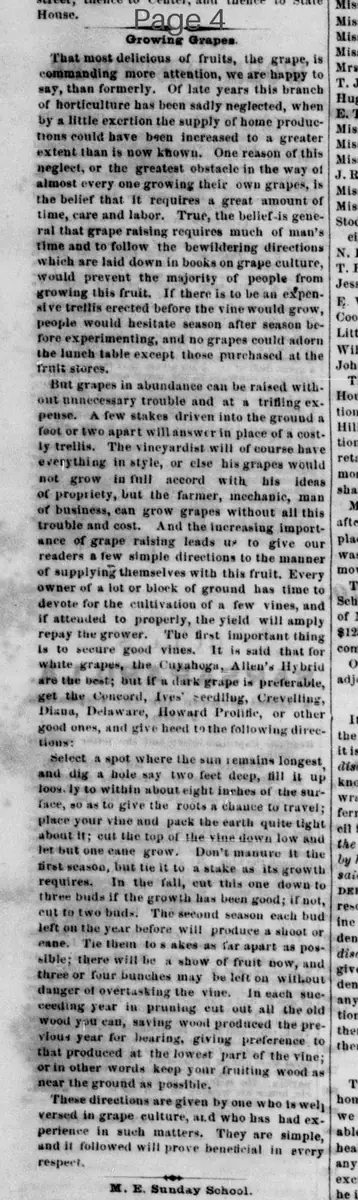
That most delicious of fruits, the grape, is commanding more attention, we are happy to say, than formerly. Of late years this branch of horticulture has been sadly neglected, when by a little exertion the supply of home productions could have been increased to a greater extent than is now known. One reason of this neglect, or the greatest obstacle in the way of almost every one growing their own grapes, is the belief that it requires a great amount of time, care and labor. True, the belief is general that grape raising requires much of man's time and to follow the bewildering directions which are laid down in books on grape culture, would prevent the majority of people from growing this fruit. If there is to be an expensive trellis erected before the vine would grow, people would hesitate season after season before experimenting, and no grapes could adorn the lunch table except those purchased at the fruit stores.
But grapes in abundance can be raised without unnecessary trouble and at a trifling expense. A few stakes driven into the ground a foot or two apart will answer in place of a costly trellis. The vineyardist will of course have everything in style, or else his grapes would not grow in full accord with his ideas of propriety, but the farmer, mechanic, man of business, can grow grapes without all this trouble and cost. And the increasing importance of grape raising leads us to give our readers a few simple directions to the manner of supplying themselves with this fruit. Every owner of a lot or block of ground has time to devote for the cultivation of a few vines, and if attended to properly, the yield will amply repay the grower. The first important thing is to secure good vines. It is said that for white grapes, the Cuyahoga, Allen's Hybrid are the best; but if a dark grape is preferable, get the Concord, Ives' seedling, Creveling, Diana, Delaware, Howard Prolific, or other good ones, and give heed to the following directions:
Select a spot where the sun remains longest and dig a hole say two feet deep, fill it up loosely to within about eight inches of the surface, so as to give the roots a chance to travel; place your vine and pack the earth quite tight about it; cut the top of the vine down low and let but one cane grow. Don't manure it the first season, but tie it to a stake as its growth requires. In the fall, cut this one down to three buds if the growth has been good; if not, cut to two buds. The second season each bud left on the year before will produce a shoot or cane. Tie them to stakes as far apart as possible; there will be a show of fruit now, and three or four bunches may be left on without danger of overtasking the vine. In each succeeding year in pruning cut out all the old wood you can, saving wood produced the previous year for bearing, giving preference to that produced at the lowest part of the vine; or in other words keep your fruiting wood as near the ground as possible.
These directions are given by one who is well versed in grape culture, and who has had experience in such matters. They are simple, and if followed will prove beneficial in every respect.
That most delicious of fruits, the grape, is commanding more attention, we are happy to say, than formerly. Of late years this branch of horticulture has been sadly neglected, when by a little exertion the supply of home productions could have been increased to a greater extent than is now known. One reason of this neglect, or the greatest obstacle in the way of almost every one growing their own grapes, is the belief that it requires a great amount of time, care and labor. True, the belief is general that grape raising requires much of man's time and to follow the bewildering directions which are laid down in books on grape culture, would prevent the majority of people from growing this fruit. If there is to be an expensive trellis erected before the vine would grow, people would hesitate season after season before experimenting, and no grapes could adorn the lunch table except those purchased at the fruit stores.
But grapes in abundance can be raised without unnecessary trouble and at a trifling expense. A few stakes driven into the ground a foot or two apart will answer in place of a costly trellis. The vineyardist will of course have everything in style, or else his grapes would not grow in full accord with his ideas of propriety, but the farmer, mechanic, man of business, can grow grapes without all this trouble and cost. And the increasing importance of grape raising leads us to give our readers a few simple directions to the manner of supplying themselves with this fruit. Every owner of a lot or block of ground has time to devote for the cultivation of a few vines, and if attended to properly, the yield will amply repay the grower. The first important thing is to secure good vines. It is said that for white grapes, the Cuyahoga, Allen's Hybrid are the best; but if a dark grape is preferable, get the Concord, Ives' seedling, Creveling, Diana, Delaware, Howard Prolific, or other good ones, and give heed to the following directions:
Select a spot where the sun remains longest and dig a hole say two feet deep, fill it up loosely to within about eight inches of the surface, so as to give the roots a chance to travel; place your vine and pack the earth quite tight about it; cut the top of the vine down low and let but one cane grow. Don't manure it the first season, but tie it to a stake as its growth requires. In the fall, cut this one down to three buds if the growth has been good; if not, cut to two buds. The second season each bud left on the year before will produce a shoot or cane. Tie them to stakes as far apart as possible; there will be a show of fruit now, and three or four bunches may be left on without danger of overtasking the vine. In each succeeding year in pruning cut out all the old wood you can, saving wood produced the previous year for bearing, giving preference to that produced at the lowest part of the vine; or in other words keep your fruiting wood as near the ground as possible.
These directions are given by one who is well versed in grape culture, and who has had experience in such matters. They are simple, and if followed will prove beneficial in every respect.
What sub-type of article is it?
Horticultural Guide
What keywords are associated?
Grape Cultivation
Home Vines
Pruning Advice
Grape Varieties
Simple Gardening
Story Details
Story Details
Provides simple directions for growing grapes at home using basic stakes instead of trellises, recommends varieties like Cuyahoga, Concord, and others, and outlines planting, pruning, and cultivation steps over seasons.