Thank you for visiting SNEWPapers!
Sign up free
Rutland Herald
Rutland, Rutland County, Vermont
What is this article about?
Reflective essay on recent deaths of prominent U.S. public figures including naval officers, politicians, lawyers, judges, and clergy, emphasizing death's impartiality among the high and mighty, with references to events around 1841-1842.
Clipping
OCR Quality
Full Text
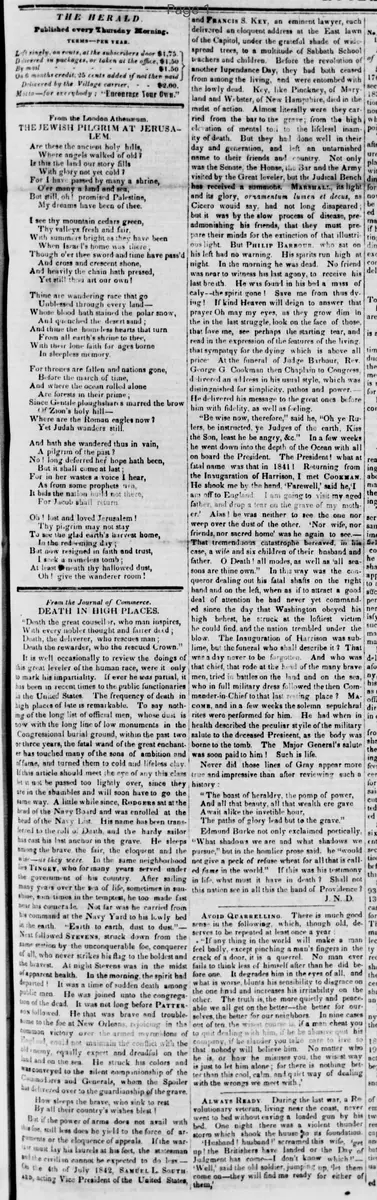
DEATH IN HIGH PLACES.
"Death the great counsellor, who man inspires,
With every nobler thought and fairer deed;
Death, the deliverer, who rescues man;
Death the rewarder, who the rescued Crown."
It is well occasionally to review the doings of
this great leveler of the human race, were it only
to mark his impartiality. If ever he was partial, it
has been in recent times to the public functionaries
in the United States. The frequency of death in
high places of late is remarkable. To say noth-
ing of the long list of official men, whose dust is
now with the long line of low monuments in the
Congressional burial ground, within the past two
or three years, the fatal wand of the great enchanter
has touched many of the sons of ambition and
of fame, and turned them to cold and lifeless clay.
If this article should meet the eye of any this class
let it not be passed too lightly over, since they
are in the shambles and will soon have to go the
same way. A little while since, Rogers sat at the
head of the Navy Board and was enrolled at the
head of the Navy List. His name has been trans-
ferred to the roll of Death, and the hardy sailor
has cast his last anchor in the grave. He sleeps
among the brave, the fair, the eloquent and the
wise—as they were. In the same neighborhood
was Taney, who for many years served under
the government of his country. After sailing
many years over the Sea of life, sometimes in sun-
shine, sometimes in the tempest, he too made fast
near his comrade. Not far was he carried from
his command at the Navy Yard to his lowly bed
in the earth. "Earth to earth, dust to dust."
—Next followed Stevens, struck down from the
same station by the unconquerable foe, conqueror
of all, who never strikes his flag to the boldest and
the bravest. At night Stevens was in the midst
of apparent health. In the morning, the spirit had
departed! It was a time of sudden death among
public men He was joined unto the congrega-
tion of the dead. It was not long before Porter-
son followed. He that was brave and trouble-
some to the foe at New Orleans, rejoicing in the
common victory over the armed millions of
Poglool, could not maintain the conflict with the
old enemy, equally
expert and dreadful on the
land and on the sea.
He struck his colors and
was conveyed to the silent companionship of the
Commodores and Generals, whom the Spoiler
has delivered over to the guardianship of the grave.
How sleeps the brave, who sink to rest
By all their country's wishes blest!
But if the power of arms do not avail with
these foe, still has does he yield to the force of ar-
guments or the eloquence of appeals. If the war-
nar must lay his laurels at his feet, the statesman
and the civilian cannot be expected to do less—
On the 4th of July 1842, Samuel L. South
and, acting Vice President of the United States,
and Francis S. Key, an eminent lawyer, each
delivered an eloquent address at the East lawn
of the Capitol, under the grateful shade of wide
spread trees, to a multitude of Sabbath School
teachers and children. Before the revolution of
another Independence Day, they had both ceased
from among the living, and were entombed with
the lowly dead. Key, like Pinckney, of Mary-
land and Webster, of New Hampshire, died in the
midst of action. Almost literally were they car.
ried from the bar to the grave: from the high
elevation of mental toil to the lifeless inan-
ity of death. But they had done well in their
day and generation, and left an untarnished
name to their friends and country. Not only
was the Senate, the House, the Bar and the Army
visited by the Great leveler, but the Judicial Bench
has received a summons. Marshall, its light
and its glory, ornamentum lumen et decus, as
Cicero would say, had not long disappeared;
but it was by the slow process of disease, pre-
admonishing his friends, that they must pre.
pare their minds for the extinction of that illustrious
light. But Philip Barbour, who sat on
his left had no warning. His spirits ran high at
night. In the morning he was dead. No friend
was near to witness his last agony, to receive his
last breath. He was found in his bed a mass of
clay—the spirit gone! Save me from thus dy.
ing! If kind Heaven will deign to answer that
prayer Oh may my eyes, as they grow dim in
the in the last struggle, look on the face of those.
that love me, see perhaps the starting tear, and
read in the expression of the features of the living.
that sympathy for the dying which is above all
price: At the funeral of Judge Barbour, Rev.
George G Cookman then Chaplain to Congress,
delivered an address in his usual style, which was
distinguished for simplicity, pathos and power.—
He delivered his message to the great ones before
him with fidelity, as well as feeling.
"Be wise now, therefore," said he, "Oh ye Ru-
lers, be instructed, ye Judges of the earth, Kiss
the Son, lest he be angry, &c." In a few weeks
he went down into the depth of the Ocean with all
on board the President. The President! what a
fatal name was that in 1841! Returning from
the Inauguration of Harrison, I met Cookman.
He shook me by the hand, 'Farewell,' said he, 'I
am off to England I am going to visit my aged
father, and drop a tear on the grave of my moth-
er.' Alas! he was neither to see the one nor
weep over the dust of the other. Nor wife, nor
friends, nor sacred home' was he again to see.—
That tremendous catastrophe bereaved, in his
case, a wife and six children of their husband and
father. O Death! all modes, as well as 'all sea-
seasons are thine own." In this way was the con-
queror dealing out his fatal shafts on the right
hand and on the left, when as if to attract a good
deal of attention he had never yet command.
ed since the day that Washington obeyed his
high behest, he struck at the loftiest victim
he could find, and the nation trembled under the
blow. The Inauguration of Harrison was sub-
lime, but the funeral who shall describe it? That
was a day never to be forgotten. And who was
that chief, that rode at the head of the many brave
men, tried in battles on the land and on the sea,
who in full military dress followed the then Com-
mander-in-Chief to that last resting place? Ma-
comn, and in a few weeks the solemn sepulchral
rites were performed for him. He had when in
health described the peculiar style of the military
salute to the deceased President, as the body was
borne to the tomb. The Major General's salute
was soon paid to him! Such is life.
Never did those lines of Gray appear more
true and impressive than after reviewing such a
history:
"The boast of heraldry, the pomp of power,
And all that beauty, all that wealth e'er gave
Await alike the inevitable hour.
The paths of glory lead but to the grave."
Edmund Burke not only exclaimed poetically.
"What shadows we are and what shadows we
pursue," but in the homlier prose said, he "would
not give a peck of refuse wheat for all that is call.
ed fame in the world." If this was his testimony
in life, what must it have in death? Shall not
this nation see in all this the hand of Providence?
J.N. D.
What sub-type of article is it?
What themes does it cover?
What keywords are associated?
What entities or persons were involved?
Where did it happen?
Story Details
Key Persons
Location
United States, Washington Dc, Congressional Burial Ground, Navy Yard, Capitol, Ocean
Event Date
Past Two Or Three Years, 4th Of July 1842, 1841
Story Details
Essay reflects on sudden deaths of prominent U.S. figures including naval officers Rogers, Taney, Stevens, Portarson; politicians Southard and Key; judge Barbour; chaplain Cookman lost at sea; President Harrison; and General Macom, underscoring death's impartiality and divine providence.