Thank you for visiting SNEWPapers!
Sign up free
Literary
November 7, 1818
Daily National Intelligencer
Washington, District Of Columbia
What is this article about?
Extract of a letter from C. S. Rafinesque in Lexington, Ky., dated Oct. 5, 1818, to J. G. Bogert in New York, detailing his explorations in Pennsylvania, Ohio River valley, and states of Ohio, Indiana, Illinois, and Kentucky. He reports a new physical map, herbal collection of 700 species, 28 new genera of plants, fishes, etc., and 86 new species. Lists ten new genera of fossils with descriptions.
Clipping
OCR Quality
98%
Excellent
Full Text
BOTANICAL
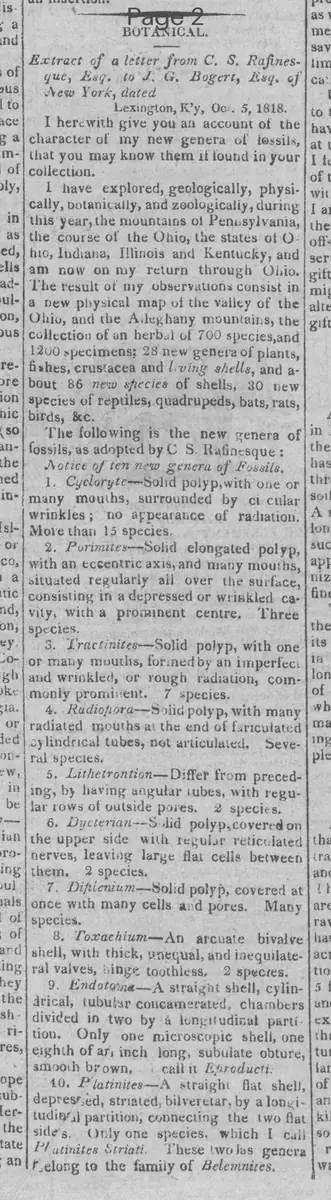
Extract of a letter from C. S. Rafinesque, Esq. to J. G. Bogert, Esq. of New York, dated Lexington, Ky., Oct. 5, 1818.
I herewith give you an account of the character of my new genera of fossils, that you may know them if found in your collection.
I have explored, geologically, physically, botanically, and zoologically, during this year, the mountains of Pennsylvania, the course of the Ohio, the states of Ohio, Indiana, Illinois and Kentucky, and am now on my return through Ohio.
The result of my observations consist in a new physical map of the valley of the Ohio, and the Alleghany mountains, the collection of an herbal of 700 species, and 1200 specimens; 28 new genera of plants, fishes, crustacea and living shells, and about 86 new species of shells, 30 new species of reptiles, quadrupeds, bats, rats, birds, &c.
The following is the new genera of fossils, as adopted by C. S. Rafinesque:
Notice of ten new genera of Fossils.
1. Cycloryte—Solid polyp, with one or many mouths, surrounded by circular wrinkles; no appearance of radiation. More than 15 species.
2. Porimites—Solid elongated polyp, with an eccentric axis, and many mouths, situated regularly all over the surface, consisting in a depressed or wrinkled cavity, with a prominent centre. Three species.
3. Practinites—Solid polyp, with one or many mouths, formed by an imperfect and wrinkled, or rough radiation, commonly prominent. 7 species.
4. Radionora—Solid polyp, with many radiated mouths at the end of fasciculated cylindrical tubes, not articulated. Several species.
5. Lithentron—Differ from preceding, by having angular tubes, with regular rows of outside pores. 2 species.
6. Dycterian—Solid polyp, covered on the upper side with regular reticulated nerves, leaving large flat cells between them. 2 species.
7. Diffenlum—Solid polyp, covered at once with many cells and pores. Many species.
8. Toxachium—An arcuate bivalve shell, with thick, unequal, and inequilateral valves, hinge toothless. 2 species.
9. Endotoma—A straight shell, cylindrical, tubular concamerated, chambers divided in two by a longitudinal partition. Only one microscopic shell, one eighth of an inch long, subulate obtuse, smooth brown. Call it E. producti.
10. Platinites—A straight flat shell, depressed, striated, bilocular, by a longitudinal partition, connecting the two flat sides. (Only one species, which I call Platinites Striati. These two genera belong to the family of Belemnites.
Extract of a letter from C. S. Rafinesque, Esq. to J. G. Bogert, Esq. of New York, dated Lexington, Ky., Oct. 5, 1818.
I herewith give you an account of the character of my new genera of fossils, that you may know them if found in your collection.
I have explored, geologically, physically, botanically, and zoologically, during this year, the mountains of Pennsylvania, the course of the Ohio, the states of Ohio, Indiana, Illinois and Kentucky, and am now on my return through Ohio.
The result of my observations consist in a new physical map of the valley of the Ohio, and the Alleghany mountains, the collection of an herbal of 700 species, and 1200 specimens; 28 new genera of plants, fishes, crustacea and living shells, and about 86 new species of shells, 30 new species of reptiles, quadrupeds, bats, rats, birds, &c.
The following is the new genera of fossils, as adopted by C. S. Rafinesque:
Notice of ten new genera of Fossils.
1. Cycloryte—Solid polyp, with one or many mouths, surrounded by circular wrinkles; no appearance of radiation. More than 15 species.
2. Porimites—Solid elongated polyp, with an eccentric axis, and many mouths, situated regularly all over the surface, consisting in a depressed or wrinkled cavity, with a prominent centre. Three species.
3. Practinites—Solid polyp, with one or many mouths, formed by an imperfect and wrinkled, or rough radiation, commonly prominent. 7 species.
4. Radionora—Solid polyp, with many radiated mouths at the end of fasciculated cylindrical tubes, not articulated. Several species.
5. Lithentron—Differ from preceding, by having angular tubes, with regular rows of outside pores. 2 species.
6. Dycterian—Solid polyp, covered on the upper side with regular reticulated nerves, leaving large flat cells between them. 2 species.
7. Diffenlum—Solid polyp, covered at once with many cells and pores. Many species.
8. Toxachium—An arcuate bivalve shell, with thick, unequal, and inequilateral valves, hinge toothless. 2 species.
9. Endotoma—A straight shell, cylindrical, tubular concamerated, chambers divided in two by a longitudinal partition. Only one microscopic shell, one eighth of an inch long, subulate obtuse, smooth brown. Call it E. producti.
10. Platinites—A straight flat shell, depressed, striated, bilocular, by a longitudinal partition, connecting the two flat sides. (Only one species, which I call Platinites Striati. These two genera belong to the family of Belemnites.
What sub-type of article is it?
Epistolary
What keywords are associated?
Fossils
New Genera
Rafinesque
Exploration
Botany
Zoology
Shells
Polyp
What entities or persons were involved?
C. S. Rafinesque, Esq.
Literary Details
Title
Notice Of Ten New Genera Of Fossils
Author
C. S. Rafinesque, Esq.
Subject
Account Of New Genera Of Fossils From Explorations