Thank you for visiting SNEWPapers!
Sign up free
Literary
March 8, 1885
Springfield Globe Republic
Springfield, Clark County, Ohio
What is this article about?
Excerpt from J. M. Cross's description of George Eliot's intellectual character, highlighting her enduring mental stamina, vast memory for literature, multilingual proficiency, interests in mathematics, astronomy, botany, and her humble view of her own knowledge.
Clipping
OCR Quality
98%
Excellent
Full Text
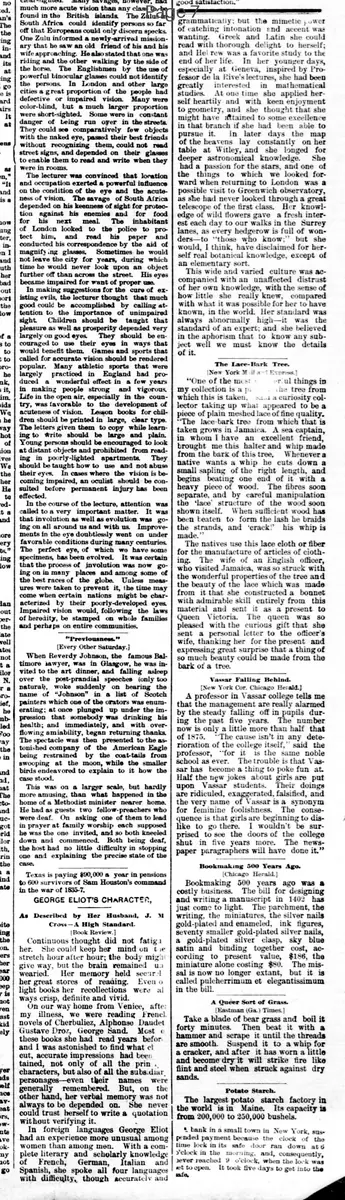
GEORGE ELIOT'S CHARACTER
As Described by Her Husband, J. M. Cross—A High Standard.
[Book Review.]
Continuous thought did not fatigue her. She could keep her mind on the stretch hour after hour; the body might give way, but the brain remained unwearied. Her memory held securely her great stores of reading. Even of light books her recollections were always crisp, definite and vivid.
On our way home from Venice, after my illness, we were reading French novels of Cherbuliez, Alphonse Daudet, Gustave Droz, George Sand. Most of these books she had read years before and I was astonished to find what clear, accurate impressions had been retained, not only of all the principal characters, but also of all the subsidiary personages—even their names were generally remembered. But, on the other hand, her verbal memory was not always to be depended on. She never could trust herself to write a quotation without verifying it.
In foreign languages George Eliot had an experience more unusual among women than among men. With a complete literary and scholarly knowledge of French, German, Italian and Spanish, she spoke all four languages with difficulty, though accurately and without foreign accent. Greek and Latin she could read with thorough delight to herself; and Hebrew was a favorite study to the end of her life. In her younger days, especially at Geneva, inspired by Professor de la Rive's lectures, she had been greatly interested in mathematical studies. At one time she applied herself heartily and with keen enjoyment to geometry, and she thought that she might have attained to some excellence in that branch if she had been able to pursue it. In later days the map of the heavens lay constantly on her table at Witley, and she longed for deeper astronomical knowledge. She had a passion for the stars, and one of the things to which we looked forward when returning to London was a possible visit to Greenwich observatory, as she had never looked through a great telescope of the first class. Her knowledge of wild flowers gave a fresh interest each day to our walks in the Surrey lanes, as every hedgerow is full of wonders—to "those who know;" but she would, I think, have disclaimed for herself real botanical knowledge, except of an elementary sort.
This wide and varied culture was accompanied with an unaffected distrust of her own knowledge, with the sense of how little she really knew, compared with what it was possible for her to have known, in the world. Her standard was always abnormally high—it was the standard of an expert: and she believed in the aphorism that to know any subject well we must know the details of it.
As Described by Her Husband, J. M. Cross—A High Standard.
[Book Review.]
Continuous thought did not fatigue her. She could keep her mind on the stretch hour after hour; the body might give way, but the brain remained unwearied. Her memory held securely her great stores of reading. Even of light books her recollections were always crisp, definite and vivid.
On our way home from Venice, after my illness, we were reading French novels of Cherbuliez, Alphonse Daudet, Gustave Droz, George Sand. Most of these books she had read years before and I was astonished to find what clear, accurate impressions had been retained, not only of all the principal characters, but also of all the subsidiary personages—even their names were generally remembered. But, on the other hand, her verbal memory was not always to be depended on. She never could trust herself to write a quotation without verifying it.
In foreign languages George Eliot had an experience more unusual among women than among men. With a complete literary and scholarly knowledge of French, German, Italian and Spanish, she spoke all four languages with difficulty, though accurately and without foreign accent. Greek and Latin she could read with thorough delight to herself; and Hebrew was a favorite study to the end of her life. In her younger days, especially at Geneva, inspired by Professor de la Rive's lectures, she had been greatly interested in mathematical studies. At one time she applied herself heartily and with keen enjoyment to geometry, and she thought that she might have attained to some excellence in that branch if she had been able to pursue it. In later days the map of the heavens lay constantly on her table at Witley, and she longed for deeper astronomical knowledge. She had a passion for the stars, and one of the things to which we looked forward when returning to London was a possible visit to Greenwich observatory, as she had never looked through a great telescope of the first class. Her knowledge of wild flowers gave a fresh interest each day to our walks in the Surrey lanes, as every hedgerow is full of wonders—to "those who know;" but she would, I think, have disclaimed for herself real botanical knowledge, except of an elementary sort.
This wide and varied culture was accompanied with an unaffected distrust of her own knowledge, with the sense of how little she really knew, compared with what it was possible for her to have known, in the world. Her standard was always abnormally high—it was the standard of an expert: and she believed in the aphorism that to know any subject well we must know the details of it.
What sub-type of article is it?
Essay
What themes does it cover?
Moral Virtue
What keywords are associated?
George Eliot
Intellectual Character
Memory
Languages
Astronomy
Botany
High Standards
What entities or persons were involved?
As Described By Her Husband, J. M. Cross
Literary Details
Title
George Eliot's Character
Author
As Described By Her Husband, J. M. Cross
Subject
A High Standard.
Key Lines
Continuous Thought Did Not Fatigue Her. She Could Keep Her Mind On The Stretch Hour After Hour; The Body Might Give Way, But The Brain Remained Unwearied.
Her Standard Was Always Abnormally High—It Was The Standard Of An Expert: And She Believed In The Aphorism That To Know Any Subject Well We Must Know The Details Of It.