Thank you for visiting SNEWPapers!
Sign up free
Editorial
March 5, 1828
Literary Cadet And Rhode Island Statesman
Providence, Providence County, Rhode Island
What is this article about?
Report on the defeat of a bill in the New York House of Assembly to pay De Witt Clinton's family the sum due him as Canal Commissioner, despite majority support. Speaker Root ruled it needed a two-thirds majority. Excerpts from debate, including Mr. Butler's defense urging passage on grounds of justice, public expectation, and transcending party prejudice against Clinton.
Clipping
OCR Quality
95%
Excellent
Full Text
De Witt Clinton's Heirs.
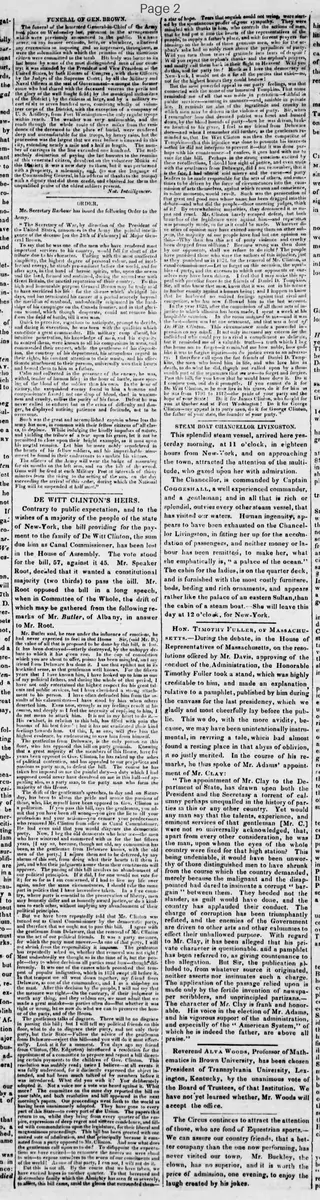
Contrary to public expectation, and to the wishes of a majority of the people of the state of New York, the bill providing for the payment to the family of De Witt Clinton the sum due him as Canal Commissioner, has been lost in the House of Assembly. The vote stood for the bill 57, against it 45. Mr. Speaker Root declared that it wanted a constitutional majority (two thirds) to pass the bill. Mr. Root opposed the bill in a long speech when in Committee of the Whole, the drift of which may be gathered from the following remarks of Mr. Butler of Albany, in answer to Mr. Root.
Mr. Butler said, he rose under the influence of emotions he had never expected to feel in that House. 'Sir,' said Mr. B., 'the value of all that is proposed to be done by this bill is lost. It has been destroyed—utterly destroyed by the unhappy debate to which it has given rise. In the cup of consolation which you are about to offer, poison has been mingled, and my friend from Delaware has done it. I use that epithet not in its hackneyed sense, as that gentleman well knows. For the fifteen years that I have known him, I have looked up to him as one of my political fathers, and during the whole of that period I have not only entertained the highest respect for his great talents and public services, but I have cherished a strong attachment to his person. I have often defended him from the assaults of his calumniators—I have stood by him when others deserted him. Even now, strongly as my feelings revolt at his course, and deeply as I feel the necessity of replying to him, I do not mean to attack him. It is not in my heart to do it.—His conduct in relation to this bill has filled with pain the bosoms of his best friends; but it has not eradicated their kind feelings towards him. Of this I, as one, will give him the highest evidence, by endeavoring to save him from himself.
The gentleman from Delaware is the only person on this floor who has opposed this bill on party grounds. Knowing that a great majority of the members of this House have for years been opposed to Gov. Clinton, he has raked up the ashes of political contention, and has appealed to our prejudices and passions as party men to defeat the bill. The course he has taken has imposed on me the painful duty—a duty which I had supposed could never have devolved on me in this hall—of appealing also, as a party man, to the party men who form the majority of this House.
The drift of the gentleman's speeches today and on Saturday has been to alarm the pride and arouse the passions of those who, like myself, have been opposed to Gov. Clinton as a politician. If you pass this bill, says the gentleman, you admit that you have been all wrong—you give the lie to all your professions and your actions—you censure your predecessors who removed Mr. Clinton from office as Canal Commissioner. He had even said that you would disgrace the democratic party. Now I beg the old democrats who hear me—the men who have wintered and summered with us for the last fifteen years [I say us, because, though not old, my communion has been, as the gentleman from Delaware knows, with the old men of the party] I adjure them not to be deterred by any alarms of this sort from doing what their hearts tell them is just, and what their judgments assure them their constituents will approve. The passing of this bill involves no abandonment of our political principles. If it did, I for one would not vote for it; for so far as I am concerned, if I had to live my life over again under the same circumstances, I should take the same part in politics that I have heretofore taken. In a free country where party is essential to the preservation of liberty, men may honestly differ and as honestly award justice, or do a kindness to each other, without implying any abandonment of their political principles.
But we have been repeatedly told that Mr. Clinton was turned out as Canal Commissioner by the democratic party, and therefore that we ought not to pass this bill. I agree with the gentleman from Delaware that the removal of Mr. Clinton was the act of our political friends. It was a party measure for which the party must answer. As one of that party, I will not shrink from the responsibility it imposes. The gentleman has repeatedly asked us whether that removal was not right? Most undoubtedly we thought so at the time of it, but the people—they to whose decisions all parties must bow—thought differently. It was one of the causes which provoked that tempest of popular indignation which in 1824 swept all before it. In that tempest we all went down together, my friend from Delaware as one of the commanders, and I as a ship-boy on the mast. After this decision by the people, I will not say that the measure was right. On the contrary, if their judgment is worth anything, and they seldom err, we must admit that we made a great mistake—as parties often do. But whether it was right or wrong, let us now do what we can to preserve the honor of the party and of the House.
The gentleman talks of disgrace. There will be no disgrace in passing this bill; but I will tell my political friends on this floor what to do to disgrace their party, and not only their party but their State—Follow the advice of the gentleman from Delaware—reject this bill—and you will do it most effectually. Look at it for a moment. Ten days ago my friend from Clinton (Mr. Edgarton) introduced a resolution for the appointment of a committee to prepare and report a bill directing certain payments to the children of Gov. Clinton. This resolution was audibly read—twice I believe—at all events it was fully understood, for it distinctly expressed the object intended, and had been much talked of by members before it was introduced. What did you with it? You deliberately adopted it. Not a voice nor vote was heard against it. What more? The committee on the same day reported the bill on your table, and both resolution and bill appeared in the next morning's papers. Our proceedings went forth to the world as having been unanimously adopted. They have gone to every part of this State—to every part of the Union. The papers that return to us, whilst they bring from every quarter of the empire expressions of deep regret and sincere condolence, are filled with commendations upon the legislature for their liberal and magnanimous proceeding. This bill has been greeted with one united voice of admiration—and that principally because it emanated from a party opposed to Mr. Clinton. And now what does the gentleman call upon us to do? To disappoint the expectations we have excited—to renounce the honors we were about to win—to expose ourselves to the scorn of our constituents and of the world! As one of that party, I cannot, I will not do it.
But this is not all. By the course that we have taken, we have excited hopes in another quarter. To that bereaved and disconsolate family which the Almighty has seen fit so severely to afflict, this bill came amid the gloom that surrounded them, a star of hope. Tears that anguish could not wring were started by the spontaneous proof of your sympathy. They were mingled with thanks to Him who had put it into the hearts of the representatives of the people to supply a father's place, and with fervent prayers for blessings on the heads of those generous men who for the orphan's sake had so nobly risen above the prejudices of party. Will you reject the orphan's thanks and the orphan's prayers? Will you turn those tears of gratitude into tears of despair? And madly call them back in their flight to Heaven? Will you do this, and for party too? Much as I love the democracy of New York, I would not do it for all the parties that exist—no, not for the highest honors they could bestow!
But the most powerful appeal to our party feelings was that public services—winning in manners—and amiable in private life. It reminds me of all that was noble in patriotism—faithful in connection with the name of our lamented Tompkins. That name reminds me also of the ingratitude and cruelty to which men may be driven in the violence of party. Sir, when I remember how that devoted patriot was beset and hunted down by the blood hounds of party—how he was driven, broken hearted to his grave, I feel as my friend from Delaware does—and when I remember still further, as the gentleman reminded us, that De Witt Clinton was then the competitor of Tompkins—that this injustice was done to promote his interests—that he did not interpose to prevent it—that it was done perhaps with his countenance—I confess it goes hard with me to vote for this bill. Perhaps in the strong emotions excited by these recollections, I should lose sight of justice, and even unite with the gentleman from Delaware, did I not remember that it is the same—I had almost said misery and the curse—of party leaders to be made responsible for the acts of others, and sometimes to be driven by the force of circumstances into the commission of acts themselves against which reason and conscience in sober moments would revolt. Such was the persecution of that great and good man whose name has been dragged into this debate—and what did the people—those unerring judges think of it? By overwhelming majorities they denounced it as unjust and cruel. Mr. Clinton barely escaped defeat, but both branches of the legislature were against him—and reparation was promptly made, so far as it could be made. Whatever diversities of opinion may have existed among them on other subjects, the majority of our people have had but one opinion on this. Why then has this act of party violence and cruelty been dragged from oblivion? Because wrong was then done by our opponents, shall we refuse to do right? The people have punished those who were the authors of this injustice, just as they punished us in 1824 for the removal of Mr. Clinton as canal commissioner. Let us forget on this occasion the squabbles of party, and the excesses to which our opponents or ourselves may have been driven. I feel that I may make this appeal with peculiar force to the friends of Daniel D. Tompkins. Sir, all who knew that man know that it was not in his nature to harbor enmity against a human being; and I happen to know that he harbored no unkind feelings against that rival and competitor who has now followed him to the last account.
In the year 1825, after the commission of all those acts of injustice to which allusion has been made, I spent a week at his hospitable mansion. In the room assigned to me—and it was the best—there was but one ornament, and that was a bust of De Witt Clinton. This circumstance made a powerful impression on my mind. It not only increased my esteem for the individual who could pay to a rival a compliment so delicate, but it reminded me of a valuable truth—a truth which I beg this house not to forget—it reminded me how noble, how god-like it was to forgive injuries—to do justice even to an adversary. I therefore call upon the fast friends of Daniel D. Tompkins, the men who loved him in life, and who love him in death, to do what he did, though not called upon by a thousandth part of the arguments that we are—to forget and forgive. Pass this bill, for you know that he would have done it. Do it, I conjure you, and do it promptly. If you cannot do it for De Witt Clinton as he now lies in his grave, do it for him as he was from 1798 to 1812—the pride of your party and the hope of your State! Do it for James Clinton, who fought for you at Quebec and at Fort Washington! Do it for George Clinton—my appeal is to party men, do it for George Clinton, the father of your state, the founder of your party.
Contrary to public expectation, and to the wishes of a majority of the people of the state of New York, the bill providing for the payment to the family of De Witt Clinton the sum due him as Canal Commissioner, has been lost in the House of Assembly. The vote stood for the bill 57, against it 45. Mr. Speaker Root declared that it wanted a constitutional majority (two thirds) to pass the bill. Mr. Root opposed the bill in a long speech when in Committee of the Whole, the drift of which may be gathered from the following remarks of Mr. Butler of Albany, in answer to Mr. Root.
Mr. Butler said, he rose under the influence of emotions he had never expected to feel in that House. 'Sir,' said Mr. B., 'the value of all that is proposed to be done by this bill is lost. It has been destroyed—utterly destroyed by the unhappy debate to which it has given rise. In the cup of consolation which you are about to offer, poison has been mingled, and my friend from Delaware has done it. I use that epithet not in its hackneyed sense, as that gentleman well knows. For the fifteen years that I have known him, I have looked up to him as one of my political fathers, and during the whole of that period I have not only entertained the highest respect for his great talents and public services, but I have cherished a strong attachment to his person. I have often defended him from the assaults of his calumniators—I have stood by him when others deserted him. Even now, strongly as my feelings revolt at his course, and deeply as I feel the necessity of replying to him, I do not mean to attack him. It is not in my heart to do it.—His conduct in relation to this bill has filled with pain the bosoms of his best friends; but it has not eradicated their kind feelings towards him. Of this I, as one, will give him the highest evidence, by endeavoring to save him from himself.
The gentleman from Delaware is the only person on this floor who has opposed this bill on party grounds. Knowing that a great majority of the members of this House have for years been opposed to Gov. Clinton, he has raked up the ashes of political contention, and has appealed to our prejudices and passions as party men to defeat the bill. The course he has taken has imposed on me the painful duty—a duty which I had supposed could never have devolved on me in this hall—of appealing also, as a party man, to the party men who form the majority of this House.
The drift of the gentleman's speeches today and on Saturday has been to alarm the pride and arouse the passions of those who, like myself, have been opposed to Gov. Clinton as a politician. If you pass this bill, says the gentleman, you admit that you have been all wrong—you give the lie to all your professions and your actions—you censure your predecessors who removed Mr. Clinton from office as Canal Commissioner. He had even said that you would disgrace the democratic party. Now I beg the old democrats who hear me—the men who have wintered and summered with us for the last fifteen years [I say us, because, though not old, my communion has been, as the gentleman from Delaware knows, with the old men of the party] I adjure them not to be deterred by any alarms of this sort from doing what their hearts tell them is just, and what their judgments assure them their constituents will approve. The passing of this bill involves no abandonment of our political principles. If it did, I for one would not vote for it; for so far as I am concerned, if I had to live my life over again under the same circumstances, I should take the same part in politics that I have heretofore taken. In a free country where party is essential to the preservation of liberty, men may honestly differ and as honestly award justice, or do a kindness to each other, without implying any abandonment of their political principles.
But we have been repeatedly told that Mr. Clinton was turned out as Canal Commissioner by the democratic party, and therefore that we ought not to pass this bill. I agree with the gentleman from Delaware that the removal of Mr. Clinton was the act of our political friends. It was a party measure for which the party must answer. As one of that party, I will not shrink from the responsibility it imposes. The gentleman has repeatedly asked us whether that removal was not right? Most undoubtedly we thought so at the time of it, but the people—they to whose decisions all parties must bow—thought differently. It was one of the causes which provoked that tempest of popular indignation which in 1824 swept all before it. In that tempest we all went down together, my friend from Delaware as one of the commanders, and I as a ship-boy on the mast. After this decision by the people, I will not say that the measure was right. On the contrary, if their judgment is worth anything, and they seldom err, we must admit that we made a great mistake—as parties often do. But whether it was right or wrong, let us now do what we can to preserve the honor of the party and of the House.
The gentleman talks of disgrace. There will be no disgrace in passing this bill; but I will tell my political friends on this floor what to do to disgrace their party, and not only their party but their State—Follow the advice of the gentleman from Delaware—reject this bill—and you will do it most effectually. Look at it for a moment. Ten days ago my friend from Clinton (Mr. Edgarton) introduced a resolution for the appointment of a committee to prepare and report a bill directing certain payments to the children of Gov. Clinton. This resolution was audibly read—twice I believe—at all events it was fully understood, for it distinctly expressed the object intended, and had been much talked of by members before it was introduced. What did you with it? You deliberately adopted it. Not a voice nor vote was heard against it. What more? The committee on the same day reported the bill on your table, and both resolution and bill appeared in the next morning's papers. Our proceedings went forth to the world as having been unanimously adopted. They have gone to every part of this State—to every part of the Union. The papers that return to us, whilst they bring from every quarter of the empire expressions of deep regret and sincere condolence, are filled with commendations upon the legislature for their liberal and magnanimous proceeding. This bill has been greeted with one united voice of admiration—and that principally because it emanated from a party opposed to Mr. Clinton. And now what does the gentleman call upon us to do? To disappoint the expectations we have excited—to renounce the honors we were about to win—to expose ourselves to the scorn of our constituents and of the world! As one of that party, I cannot, I will not do it.
But this is not all. By the course that we have taken, we have excited hopes in another quarter. To that bereaved and disconsolate family which the Almighty has seen fit so severely to afflict, this bill came amid the gloom that surrounded them, a star of hope. Tears that anguish could not wring were started by the spontaneous proof of your sympathy. They were mingled with thanks to Him who had put it into the hearts of the representatives of the people to supply a father's place, and with fervent prayers for blessings on the heads of those generous men who for the orphan's sake had so nobly risen above the prejudices of party. Will you reject the orphan's thanks and the orphan's prayers? Will you turn those tears of gratitude into tears of despair? And madly call them back in their flight to Heaven? Will you do this, and for party too? Much as I love the democracy of New York, I would not do it for all the parties that exist—no, not for the highest honors they could bestow!
But the most powerful appeal to our party feelings was that public services—winning in manners—and amiable in private life. It reminds me of all that was noble in patriotism—faithful in connection with the name of our lamented Tompkins. That name reminds me also of the ingratitude and cruelty to which men may be driven in the violence of party. Sir, when I remember how that devoted patriot was beset and hunted down by the blood hounds of party—how he was driven, broken hearted to his grave, I feel as my friend from Delaware does—and when I remember still further, as the gentleman reminded us, that De Witt Clinton was then the competitor of Tompkins—that this injustice was done to promote his interests—that he did not interpose to prevent it—that it was done perhaps with his countenance—I confess it goes hard with me to vote for this bill. Perhaps in the strong emotions excited by these recollections, I should lose sight of justice, and even unite with the gentleman from Delaware, did I not remember that it is the same—I had almost said misery and the curse—of party leaders to be made responsible for the acts of others, and sometimes to be driven by the force of circumstances into the commission of acts themselves against which reason and conscience in sober moments would revolt. Such was the persecution of that great and good man whose name has been dragged into this debate—and what did the people—those unerring judges think of it? By overwhelming majorities they denounced it as unjust and cruel. Mr. Clinton barely escaped defeat, but both branches of the legislature were against him—and reparation was promptly made, so far as it could be made. Whatever diversities of opinion may have existed among them on other subjects, the majority of our people have had but one opinion on this. Why then has this act of party violence and cruelty been dragged from oblivion? Because wrong was then done by our opponents, shall we refuse to do right? The people have punished those who were the authors of this injustice, just as they punished us in 1824 for the removal of Mr. Clinton as canal commissioner. Let us forget on this occasion the squabbles of party, and the excesses to which our opponents or ourselves may have been driven. I feel that I may make this appeal with peculiar force to the friends of Daniel D. Tompkins. Sir, all who knew that man know that it was not in his nature to harbor enmity against a human being; and I happen to know that he harbored no unkind feelings against that rival and competitor who has now followed him to the last account.
In the year 1825, after the commission of all those acts of injustice to which allusion has been made, I spent a week at his hospitable mansion. In the room assigned to me—and it was the best—there was but one ornament, and that was a bust of De Witt Clinton. This circumstance made a powerful impression on my mind. It not only increased my esteem for the individual who could pay to a rival a compliment so delicate, but it reminded me of a valuable truth—a truth which I beg this house not to forget—it reminded me how noble, how god-like it was to forgive injuries—to do justice even to an adversary. I therefore call upon the fast friends of Daniel D. Tompkins, the men who loved him in life, and who love him in death, to do what he did, though not called upon by a thousandth part of the arguments that we are—to forget and forgive. Pass this bill, for you know that he would have done it. Do it, I conjure you, and do it promptly. If you cannot do it for De Witt Clinton as he now lies in his grave, do it for him as he was from 1798 to 1812—the pride of your party and the hope of your State! Do it for James Clinton, who fought for you at Quebec and at Fort Washington! Do it for George Clinton—my appeal is to party men, do it for George Clinton, the father of your state, the founder of your party.
What sub-type of article is it?
Partisan Politics
What keywords are associated?
De Witt Clinton
Canal Commissioner
New York Assembly
Party Politics
Bill Defeat
Political Debate
Justice To Family
Democratic Party
What entities or persons were involved?
De Witt Clinton
Mr. Speaker Root
Mr. Butler Of Albany
Daniel D. Tompkins
George Clinton
James Clinton
Democratic Party
New York House Of Assembly
Editorial Details
Primary Topic
Debate Over Bill Paying De Witt Clinton's Family As Canal Commissioner
Stance / Tone
Supportive Of Bill Passage, Urging Transcendence Of Party Prejudice For Justice
Key Figures
De Witt Clinton
Mr. Speaker Root
Mr. Butler Of Albany
Daniel D. Tompkins
George Clinton
James Clinton
Democratic Party
New York House Of Assembly
Key Arguments
Bill Requires Constitutional Two Thirds Majority, Defeated 57 45
Opposition By Root Revives Old Party Animosities Against Clinton
Passing Bill Does Not Abandon Political Principles
Public And Press Expect Passage, Rejection Would Disgrace Party
Justice To Clinton's Bereaved Family Transcends Party Lines
Historical Injustices To Tompkins Should Not Prevent Reparation
Clinton's Public Services And Family Legacy Warrant Payment