Thank you for visiting SNEWPapers!
Sign up free
Story
June 29, 1804
Alexandria Daily Advertiser
Alexandria, Virginia
What is this article about?
Anecdote from Mr. Carr's book: Before his 1802 execution, Governor Wall attempts to surrender in Calais, reveals himself to messenger Brooks, but panics and flees unable to write his name; Brooks dies in a subsequent storm.
Clipping
OCR Quality
98%
Excellent
Full Text
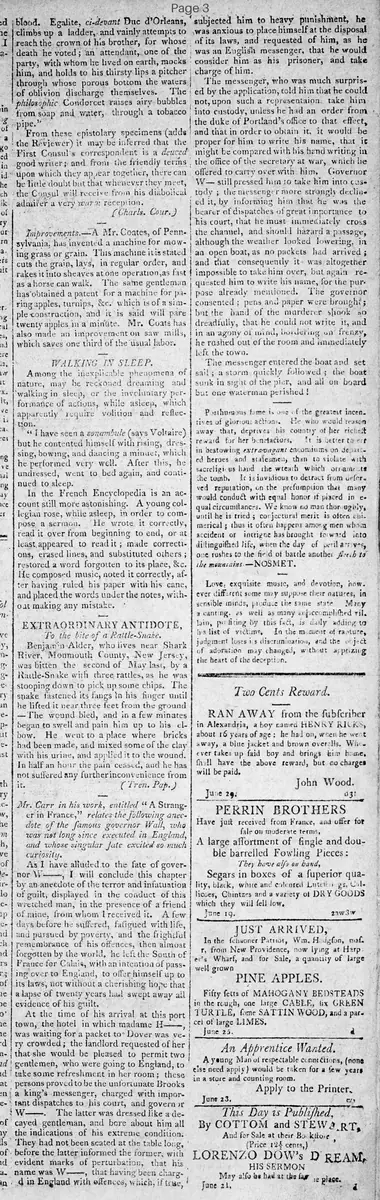
Mr. Carr in his work, entitled "A Stranger in France," relates the following anecdote of the famous governor Wall, who was not long since executed in England, and whose singular fate excited so much curiosity.
As I have alluded to the fate of governor W-, I will conclude this chapter by an anecdote of the terror and infatuation of guilt, displayed in the conduct of this wretched man, in the presence of a friend of mine, from whom I received it. A few days before he suffered, fatigued with life, and pursued by poverty, and the frightful remembrance of his offences, then almost forgotten by the world, he left the South of France for Calais, with an intention of passing over to England, to offer himself up to its laws, not without a cherishing hope that a lapse of twenty years had swept away all evidence of his guilt.
At the time of his arrival at this port town, the hotel in which madame H- was waiting for a packet to Dover was very crowded; the landlord requested of her that she would be pleased to permit two gentlemen, who were going to England, to take some refreshment in her room; these persons proved to be the unfortunate Brooks a king's messenger, charged with important dispatches to his court, and governor Wane. The latter was dressed like a decayed gentleman, and bore about him all the indications of his extreme condition. They had not been seated at the table long, before the latter informed the former, with evident marks of perturbation, that his name was W-a--, that having been charged in England with offences, which, if true, subjected him to heavy punishment, he was anxious to place himself at the disposal of its laws, and requested of him, as he was an English messenger, that he would consider him as his prisoner, and take charge of him.
The messenger, who was much surprised by the application, told him that he could not, upon such a representation, take him into custody, unless he had an order from the duke of Portland's office to that effect, and that in order to obtain it, it would be proper for him to write his name, that it might be compared with his hand writing in the office of the secretary at war, which he offered to carry over with him. Governor W- still pressed him to take him into custody; the messenger more strongly declined it, by informing him that he was the bearer of dispatches of great importance to his court, that he must immediately cross the channel, and should hazard a passage, although the weather looked lowering, in an open boat, as no packets had arrived; and that consequently it was altogether impossible to take him over, but again requested him to write his name, for the purpose already mentioned. The governor consented; pens and paper were brought; but the hand of the murderer shook so dreadfully, that he could not write it, and in an agony of mind, bordering on frenzy, he rushed out of the room and immediately left the town.
The messenger entered the boat and set sail; a storm quickly followed; the boat sunk in sight of the pier, and all on board but one waterman perished!
As I have alluded to the fate of governor W-, I will conclude this chapter by an anecdote of the terror and infatuation of guilt, displayed in the conduct of this wretched man, in the presence of a friend of mine, from whom I received it. A few days before he suffered, fatigued with life, and pursued by poverty, and the frightful remembrance of his offences, then almost forgotten by the world, he left the South of France for Calais, with an intention of passing over to England, to offer himself up to its laws, not without a cherishing hope that a lapse of twenty years had swept away all evidence of his guilt.
At the time of his arrival at this port town, the hotel in which madame H- was waiting for a packet to Dover was very crowded; the landlord requested of her that she would be pleased to permit two gentlemen, who were going to England, to take some refreshment in her room; these persons proved to be the unfortunate Brooks a king's messenger, charged with important dispatches to his court, and governor Wane. The latter was dressed like a decayed gentleman, and bore about him all the indications of his extreme condition. They had not been seated at the table long, before the latter informed the former, with evident marks of perturbation, that his name was W-a--, that having been charged in England with offences, which, if true, subjected him to heavy punishment, he was anxious to place himself at the disposal of its laws, and requested of him, as he was an English messenger, that he would consider him as his prisoner, and take charge of him.
The messenger, who was much surprised by the application, told him that he could not, upon such a representation, take him into custody, unless he had an order from the duke of Portland's office to that effect, and that in order to obtain it, it would be proper for him to write his name, that it might be compared with his hand writing in the office of the secretary at war, which he offered to carry over with him. Governor W- still pressed him to take him into custody; the messenger more strongly declined it, by informing him that he was the bearer of dispatches of great importance to his court, that he must immediately cross the channel, and should hazard a passage, although the weather looked lowering, in an open boat, as no packets had arrived; and that consequently it was altogether impossible to take him over, but again requested him to write his name, for the purpose already mentioned. The governor consented; pens and paper were brought; but the hand of the murderer shook so dreadfully, that he could not write it, and in an agony of mind, bordering on frenzy, he rushed out of the room and immediately left the town.
The messenger entered the boat and set sail; a storm quickly followed; the boat sunk in sight of the pier, and all on board but one waterman perished!
What sub-type of article is it?
Biography
Crime Story
Tragedy
What themes does it cover?
Crime Punishment
Misfortune
Tragedy
What keywords are associated?
Governor Wall
Guilt Terror
Surrender Attempt
Calais
Storm Disaster
Execution
What entities or persons were involved?
Governor Wall
Brooks
Madame H
Where did it happen?
Calais
Story Details
Key Persons
Governor Wall
Brooks
Madame H
Location
Calais
Event Date
A Few Days Before His Execution, Lapse Of Twenty Years
Story Details
Governor Wall, pursued by guilt, travels to Calais to surrender to English laws after twenty years. He approaches King's messenger Brooks in madame H-'s room, reveals his identity, and begs to be taken into custody but fails to write his name due to trembling hands, then flees in frenzy. Brooks perishes in a storm while crossing the channel.