Thank you for visiting SNEWPapers!
Sign up free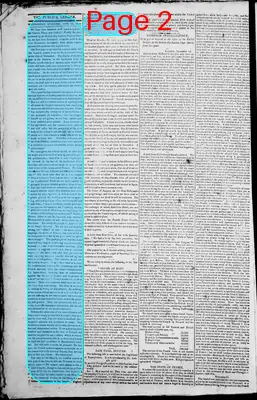
Editorial
January 18, 1809
Norfolk Gazette And Publick Ledger
Norfolk, Virginia
What is this article about?
The 1809 Publick Ledger editorial analyzes a French expose on commercial warfare against Britain, highlighting claims of US cooperation via embargo. It criticizes Jefferson and Madison for deceiving Americans about the policy's neutrality, portraying it as alignment with French interests rather than protection of maritime rights.
Clipping
OCR Quality
95%
Excellent
Full Text
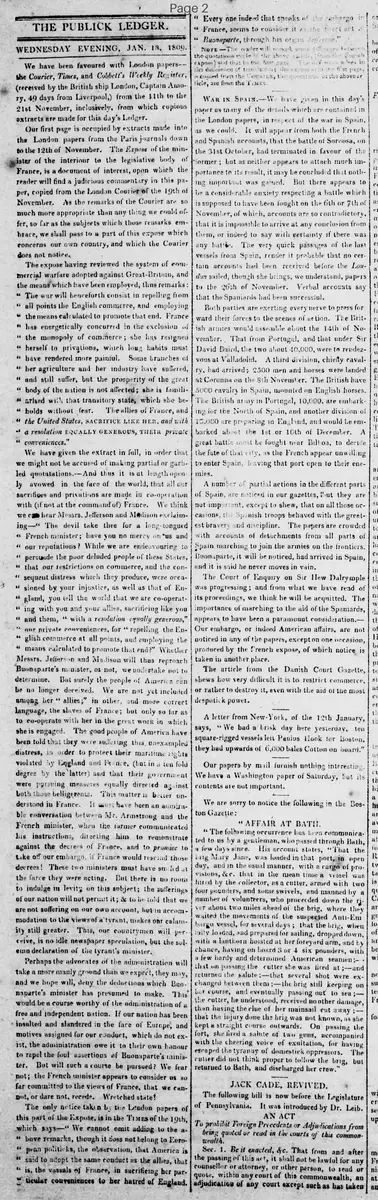
THE PUBLICK LEDGER.
WEDNESDAY EVENING, JAN. 18, 1809.
We have been favoured with London papers--
the Courier, Times, and Cobbett's Weekly Register,
(received by the British ship London, Captain Amory, 49 days from Liverpool,) from the 11th to the
21st November, inclusively, from which copious
extracts are made for this day's Ledger.
Our first page is occupied by extracts made into
the London papers from the Paris journals down
to the 12th of November. The Expose of the min-
ister of the interior to the legislative body of
France, is a document of interest, upon which the
reader will find a judicious commentary in this pa-
per, copied from the London Courier of the 19th of
November. As the remarks of the Courier are so
much more appropriate than any thing we could of-
fer, so far as the subjects which those remarks em-
brace, we shall pass to a part of this expose which
concerns our own country, and which the Courier
does not notice.
The expose having reviewed the system of com-
mercial warfare adopted against Great-Britain, and
the means which have been employed, thus remarks:
"The war will henceforth consist in repelling from
"all points the English commerce, and employing
"the means calculated to promote that end. France
"has energetically concurred in the exclusion of
"the monopoly of commerce; she has resigned
"herself to privations, which long habits must
"have rendered more painful. Some branches of
"her agriculture and her industry have suffered,
"and still suffer, but the prosperity of the great
"body of the nation is not affected; she is famili-
"arized with that transitory state, which she be-
"holds without fear. The allies of France, and
"the United States, SACRIFICE LIKE HER, and with
"a RESOLUTION EQUALLY GENEROUS, THEIR private
"conveniences."
We have given the extract in full, in order that
we might not be accused of making partial or garbled
quotations.--And thus it is at length openly
avowed in the face of the world, that all our
sacrifices and privations are made in co-operation
with (if not at the command of) France. We think
we can hear Messrs. Jefferson and Madison exclaim-
ing-"The devil take thee for a long-tongued
"French minister; have you no mercy on us and
"our reputations? While we are endeavouring to
"persuade the poor deluded people of these States,
"that our restrictions on commerce, and the con-
"sequent distress which they produce, were occa-
"sioned by your injustice, as well as that of En-
"gland, you tell the world that we are co-operat-
"ing with you and your allies, sacrificing like you
"and them, "with a resolution equally generous,"
"our private conveniences, for "repelling the En-
"glish commerce at all points, and employing the
"means calculated to promote that end?" Whether
Messrs. Jefferson and Madison will thus reproach
Buonaparte's minister, or not, we undertake not to
determine. But surely the people of America can
be no longer deceived. We are not yet included
among her "allies;" in other, and more correct
language, the slaves of France; but only so far as
to co-operate with her in the great work in which
she is engaged. The good people of America have
been told that they were suffering this unexampled
distress, in order to protect their maritime rights
violated by England and France, (but in a ten fold
degree by the latter) and that their government
were pursuing measures equally directed against
both those belligerents. This matter is better un-
derstood in France. It must have been an admi-
rable conversation between Mr. Armstrong and the
French minister, when the former communicated
his instructions, directing him to remonstrate
against the decrees of France, and to promise to
take off our embargo, if France would rescind those
decrees! These two ministers must have smiled at
the farce they were acting. But there is no room
to indulge in levity on this subject; the sufferings
of our nation will not permit it; & to be told that we
are not suffering on our own account, but in accom-
modation to the views of a tyrant, makes our calam-
ity still greater. This, our countrymen will per-
ceive, is no idle newspaper speculation, but the sol-
emn declaration of the tyrant's minister.
Perhaps the advocates of the administration will
take a more manly ground than we expect, they may,
and we hope will, deny the deductions which Buo-
aparte's minister has presumed to make. This
would be a course worthy of the administration of a
free and independent nation. If our nation has been
insulted and slandered in the face of Europe, and
motives assigned for our conduct, which do not ex-
ist, the administration owe it to their own honour
to repel the foul assertions of Buonaparte's minis-
ter. But will such a course be pursued? We fear
not; the French minister appears to consider us so
far committed to the views of France, that we can-
not, or dare not, recede. Wretched state!
The only notice taken by the London papers of
this part of the Expose, is in the Times of the 19th,
which says--"We cannot omit adding to the a-
"bove remarks, though it does not belong to Euro-
"pean politicks, the observation, that America is
"said to adopt the same conduct as the allies, that
"is, the vassals of France, in sacrificing her par-
"ticular conveniences to her hatred of England.
"Every one indeed that speaks of the embargo in
"France, seems to consider it a the work of that art.
"Buonaparte, through his organ himself."
Note--The reader will remark some difference be-
tween the quotations made from the above French
expose and that in the first page. The difference arises in
the difference of translation; the expose as the first page,
is copied from the Courier. the quotations on the above ar-
ticle, are from the TIMES.
WEDNESDAY EVENING, JAN. 18, 1809.
We have been favoured with London papers--
the Courier, Times, and Cobbett's Weekly Register,
(received by the British ship London, Captain Amory, 49 days from Liverpool,) from the 11th to the
21st November, inclusively, from which copious
extracts are made for this day's Ledger.
Our first page is occupied by extracts made into
the London papers from the Paris journals down
to the 12th of November. The Expose of the min-
ister of the interior to the legislative body of
France, is a document of interest, upon which the
reader will find a judicious commentary in this pa-
per, copied from the London Courier of the 19th of
November. As the remarks of the Courier are so
much more appropriate than any thing we could of-
fer, so far as the subjects which those remarks em-
brace, we shall pass to a part of this expose which
concerns our own country, and which the Courier
does not notice.
The expose having reviewed the system of com-
mercial warfare adopted against Great-Britain, and
the means which have been employed, thus remarks:
"The war will henceforth consist in repelling from
"all points the English commerce, and employing
"the means calculated to promote that end. France
"has energetically concurred in the exclusion of
"the monopoly of commerce; she has resigned
"herself to privations, which long habits must
"have rendered more painful. Some branches of
"her agriculture and her industry have suffered,
"and still suffer, but the prosperity of the great
"body of the nation is not affected; she is famili-
"arized with that transitory state, which she be-
"holds without fear. The allies of France, and
"the United States, SACRIFICE LIKE HER, and with
"a RESOLUTION EQUALLY GENEROUS, THEIR private
"conveniences."
We have given the extract in full, in order that
we might not be accused of making partial or garbled
quotations.--And thus it is at length openly
avowed in the face of the world, that all our
sacrifices and privations are made in co-operation
with (if not at the command of) France. We think
we can hear Messrs. Jefferson and Madison exclaim-
ing-"The devil take thee for a long-tongued
"French minister; have you no mercy on us and
"our reputations? While we are endeavouring to
"persuade the poor deluded people of these States,
"that our restrictions on commerce, and the con-
"sequent distress which they produce, were occa-
"sioned by your injustice, as well as that of En-
"gland, you tell the world that we are co-operat-
"ing with you and your allies, sacrificing like you
"and them, "with a resolution equally generous,"
"our private conveniences, for "repelling the En-
"glish commerce at all points, and employing the
"means calculated to promote that end?" Whether
Messrs. Jefferson and Madison will thus reproach
Buonaparte's minister, or not, we undertake not to
determine. But surely the people of America can
be no longer deceived. We are not yet included
among her "allies;" in other, and more correct
language, the slaves of France; but only so far as
to co-operate with her in the great work in which
she is engaged. The good people of America have
been told that they were suffering this unexampled
distress, in order to protect their maritime rights
violated by England and France, (but in a ten fold
degree by the latter) and that their government
were pursuing measures equally directed against
both those belligerents. This matter is better un-
derstood in France. It must have been an admi-
rable conversation between Mr. Armstrong and the
French minister, when the former communicated
his instructions, directing him to remonstrate
against the decrees of France, and to promise to
take off our embargo, if France would rescind those
decrees! These two ministers must have smiled at
the farce they were acting. But there is no room
to indulge in levity on this subject; the sufferings
of our nation will not permit it; & to be told that we
are not suffering on our own account, but in accom-
modation to the views of a tyrant, makes our calam-
ity still greater. This, our countrymen will per-
ceive, is no idle newspaper speculation, but the sol-
emn declaration of the tyrant's minister.
Perhaps the advocates of the administration will
take a more manly ground than we expect, they may,
and we hope will, deny the deductions which Buo-
aparte's minister has presumed to make. This
would be a course worthy of the administration of a
free and independent nation. If our nation has been
insulted and slandered in the face of Europe, and
motives assigned for our conduct, which do not ex-
ist, the administration owe it to their own honour
to repel the foul assertions of Buonaparte's minis-
ter. But will such a course be pursued? We fear
not; the French minister appears to consider us so
far committed to the views of France, that we can-
not, or dare not, recede. Wretched state!
The only notice taken by the London papers of
this part of the Expose, is in the Times of the 19th,
which says--"We cannot omit adding to the a-
"bove remarks, though it does not belong to Euro-
"pean politicks, the observation, that America is
"said to adopt the same conduct as the allies, that
"is, the vassals of France, in sacrificing her par-
"ticular conveniences to her hatred of England.
"Every one indeed that speaks of the embargo in
"France, seems to consider it a the work of that art.
"Buonaparte, through his organ himself."
Note--The reader will remark some difference be-
tween the quotations made from the above French
expose and that in the first page. The difference arises in
the difference of translation; the expose as the first page,
is copied from the Courier. the quotations on the above ar-
ticle, are from the TIMES.
What sub-type of article is it?
Foreign Affairs
Economic Policy
Partisan Politics
What keywords are associated?
Us Embargo
French Expose
British Commerce
Commercial Warfare
Jefferson Madison
Napoleon Minister
Maritime Rights
What entities or persons were involved?
Jefferson
Madison
Buonaparte
French Minister
Mr. Armstrong
London Courier
Times
Cobbett's Weekly Register
Editorial Details
Primary Topic
Us Embargo As Cooperation With France Against British Commerce
Stance / Tone
Strongly Critical Of Us Administration And French Alignment
Key Figures
Jefferson
Madison
Buonaparte
French Minister
Mr. Armstrong
London Courier
Times
Cobbett's Weekly Register
Key Arguments
Us Sacrifices And Privations Are Made In Cooperation With France To Repel English Commerce
Administration Deceives People By Claiming Embargo Protects Maritime Rights Against Both England And France
French Expose Reveals Us Policy Aligns With French Allies, Not Neutral
Government Should Deny French Claims To Preserve Honor And Independence
Embargo Causes Unexampled Distress For Americans, Accommodating French Tyrant's Views