Thank you for visiting SNEWPapers!
Sign up free
South Omaha Stockman
South Omaha, Douglas County, Nebraska
What is this article about?
A report contrasts inefficient Mexican plantation cultivation with U.S. methods and discusses barriers to American investment in Mexico's Laguna region, including language issues, concentrated land ownership by conservative hacendados, and peons' debt bondage preventing labor mobility.
Clipping
OCR Quality
Full Text
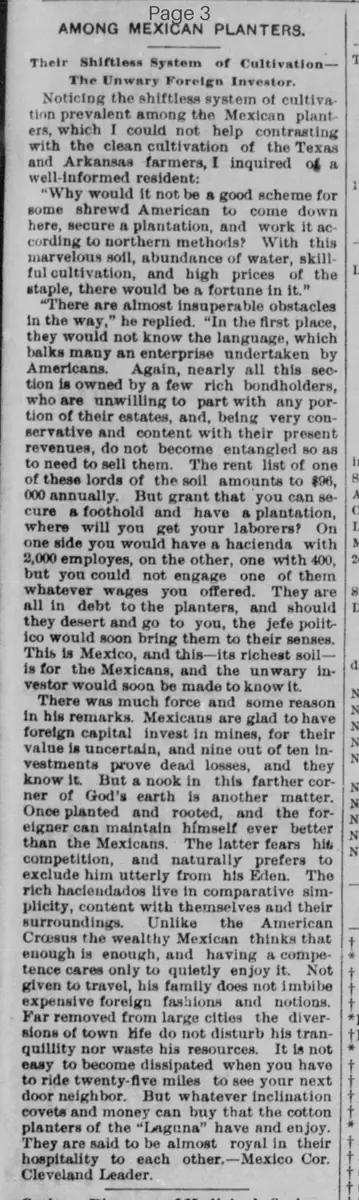
Their Shiftless System of Cultivation-
The Unwary Foreign Investor.
Noticing the shiftless system of cultivation prevalent among the Mexican planters, which I could not help contrasting with the clean cultivation of the Texas and Arkansas farmers, I inquired of a well-informed resident:
"Why would it not be a good scheme for some shrewd American to come down here, secure a plantation, and work it according to northern methods? With this marvelous soil, abundance of water, skillful cultivation, and high prices of the staple, there would be a fortune in it."
"There are almost insuperable obstacles in the way," he replied. "In the first place, they would not know the language, which balks many an enterprise undertaken by Americans. Again, nearly all this section is owned by a few rich bondholders, who are unwilling to part with any portion of their estates, and, being very conservative and content with their present revenues, do not become entangled so as to need to sell them. The rent list of one of these lords of the soil amounts to $96,000 annually. But grant that you can secure a foothold and have a plantation, where will you get your laborers? On one side you would have a hacienda with 2,000 employees, on the other, one with 400, but you could not engage one of them whatever wages you offered. They are all in debt to the planters, and should they desert and go to you, the jefe politico would soon bring them to their senses. This is Mexico, and this—its richest soil—is for the Mexicans, and the unwary investor would soon be made to know it."
There was much force and some reason in his remarks. Mexicans are glad to have foreign capital invest in mines, for their value is uncertain, and nine out of ten investments prove dead losses, and they know it. But a nook in this farther corner of God's earth is another matter. Once planted and rooted, and the foreigner can maintain himself ever better than the Mexicans. The latter fears his competition, and naturally prefers to exclude him utterly from his Eden. The rich hacendados live in comparative simplicity, content with themselves and their surroundings. Unlike the American Crœsus the wealthy Mexican thinks that enough is enough, and having a competence cares only to quietly enjoy it. Not given to travel, his family does not imbibe expensive foreign fashions and notions. Far removed from large cities the diversions of town life do not disturb his tranquillity nor waste his resources. It is not easy to become dissipated when you have to ride twenty-five miles to see your next door neighbor. But whatever inclination covets and money can buy that the cotton planters of the "Laguna" have and enjoy. They are said to be almost royal in their hospitality to each other.—Mexico Cor. Cleveland Leader.
What sub-type of article is it?
What keywords are associated?
Where did it happen?
Foreign News Details
Primary Location
Laguna, Mexico
Outcome
insurmountable obstacles to foreign investment including language barriers, land ownership concentration, and peon debt systems preventing labor acquisition
Event Details
The text describes inefficient cultivation among Mexican planters contrasted with U.S. methods, a conversation highlighting barriers to American investment in plantations due to language issues, conservative hacendado ownership, and indebted laborers bound to estates enforced by authorities, noting Mexican preference for foreign mining investments over agricultural ones.