Thank you for visiting SNEWPapers!
Sign up free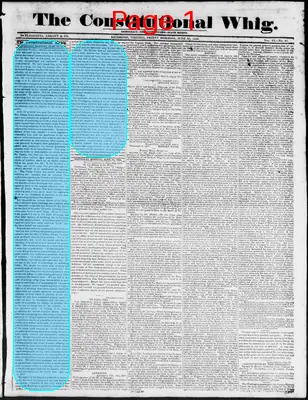
Constitutional Whig
Richmond, Virginia
What is this article about?
Editorial in The Constitutional Whig defends its assertions against the Richmond Enquirer's editor (T.R.), arguing the public printer role is more lucrative than the collectorship, refuting claims of insinuation, and accusing Ritchie of political inconsistency and remonstrating against Maj. Gibbon's removal. It asserts ongoing scrutiny of Ritchie's actions amid partisan rivalry in 1829 Richmond.
Merged-components note: These two components form a single continuous editorial piece on the Public Printer and related political commentary, as the text flows directly from one to the other.
Clipping
OCR Quality
Full Text
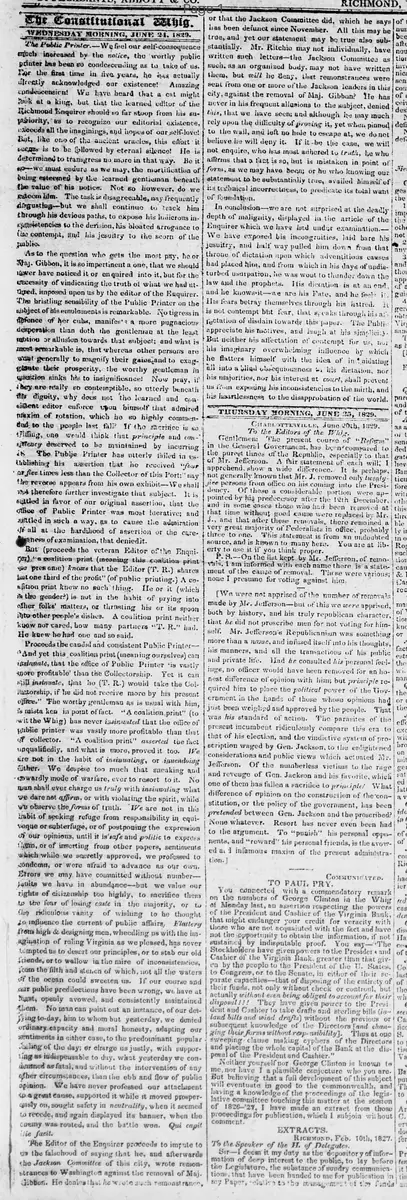
WEDNESDAY MORNING, JUNE 24, 1829.
The Public Printer.--We feel our self-consequence much increased by the notice, the worthy public printer has been so condescending as to take of us. For the first time in five years, he has actually directly acknowledged our existence! Amazing condescension! We have heard that a cat might look at a king, but that the learned editor of the Richmond Enquirer should so far stoop from his superiority, as to recognize our editorial existence, exceeds all the imaginings, and hopes of our self-love! But, like one of the ancient oracles, this effort it beggars is to be followed by eternal silence! He is determined to transgress no more in that way. Be it so--we must endure as we may, the mortification of being esteemed by the learned gentleman beneath the value of his notice. Not so however, do we esteem him. The task is disagreeable, nay frequently disgusting--but we shall continue to track him through his devious paths, to expose his ludicrous inconsistencies to the derision, his bloated arrogance to the contempt, and his jesuitry to the scorn of the public.
As to the question who gets the most pay, he or Maj. Gibbon, it is so impertinent a one, that we should never have noticed it or enquired into it, but for the necessity of vindicating the truth of what we had uttered, imposed upon us by the editor of the Enquirer. The bristling sensibility of the Public Printer on the subject of his emoluments is remarkable. No tigress in defence of her cubs, manifests a more pugnacious desperation than doth the gentleman at the least allusion or allusion towards that subject; and what is most remarkable is, that whereas other persons are wont generally to magnify their gains, and to exaggerate their prosperity, the worthy gentleman in question sinks his to insignificance! Now pray, if they are really so contemptible, so utterly beneath his dignity, why does not the learned and consistent editor enforce upon himself that admired maxim of rotation, which he so highly commended to the people last fall? If the sacrifice is so trifling one would think that principle and consistency deserved to be maintained by incurring it. The Public Printer has often failed in establishing his assertion that he received "four or five times less than the Collector of this Port;" nay the reverse appears from his own exhibit--We shall therefore further investigate that subject. It is settled in favor of our original assertion, that the office of Public Printer was most lucrative; and settled in such a way, as to cause the admiration of all at the hardihood of assertion or the carelessness of examination, that denied it.
But (proceeds the veteran Editor of the Enquirer) a coalition print (meaning this coalition print we presume) knows that the Editor (T. R.) shares but one third of the profit" (of public printing.) A coalition print knew no such thing. He or it (which the gender?) is not in the habit of prying into other folks' matters, or thrusting his or its spoon into other people's dishes. A coalition print neither knew nor cared, how many partners "T. R." had. He knew he had one and so said.
Proceeds the candid and consistent Public Printer-- "And yet this coalition print (meaning ourselves) can insinuate, that the office of Public Printer 'is vastly more profitable' than the Collectorship. Yet it can still insinuate, that he (T. R.) would take the Collectorship, if he did not receive more by his present office." The worthy gentleman as is usual with him, is mistaken in point of fact. "A coalition print" (to wit the Whig) has never insinuated that the office of public printer was vastly more profitable than that of collector. A coalition print" asserted the fact unqualifiedly, and what is more, proved it too. We are not in the habit of insinuating, or innuendoing either. We despise too much that sneaking and cowardly mode of warfare, ever to resort to it. No man shall ever charge us truly with insinuating what we dare not affirm, or with violating the spirit, while we observe the forms of truth. We are not in the habit of seeking refuge from responsibility in equivogue or subterfuge, or of postponing the expression of our opinions, until it is 'safe and politic to express them, or of inserting from other papers, sentiments which while we secretly approved, we professed to condemn, or were afraid to advance as our own.
Errors we may have committed without number--- faults we have in abundance--but we value our rights of citizenship too highly, to sacrifice them to the fear of losing caste in the majority, or to the ridiculous vanity of wishing to be thought to influence the current of public affairs. Flattery from high & designing men, wheedling us with the imagination of ruling Virginia as we pleased, has never tempted us to desert our principles, or to stab our old friends, or to wallow in the mire of inconsistencies, from the filth and stench of which, not all the waters of the ocean could sweeten us. If our course and our public predilections have been wrong, we have at least, openly avowed, and consistently maintained them. No man can point out an instance, of our denying to-day, him to whom but yesterday, we denied ordinary capacity and moral honesty, adapting our sentiments in either case, to the predominant popular feeling of the day; or charge us justly, with supporting as indispensable to day, what yesterday we condemned as fatal, and without the intervention of any other circumstances, than the ebb and flow of public opinion. We have never professed our attachment to a great cause, supported it while it moved prosperously on, sought safety in neutrality, when it seemed to recede, and again displayed its banner, when the enemy was routed, and the battle won. Quicquid delirant reges, plectuntur Achivi.
The Editor of the Enquirer proceeds to impute to us the falsehood of saying that he, and afterwards the Jackson Committee of this city, wrote remonstrances to Washington against the removal of Maj. Gibbon. He denies that he wrote such remonstrance,
or that the Jackson Committee did, which he says has been defunct since November. All this may be true, and yet our statement may be true also substantially. Mr. Ritchie may not individually, have written such letters-the Jackson Committee as such, as an organized body, may not have written them, but till he deny, that remonstrances were sent from one or more of the Jackson leaders in this city, against the removal of Maj. Gibbon? He has never in his frequent allusions to the subject, denied this, that we have seen; and although he may much rely upon the difficulty of proving it, yet when pinned to the wall, and left no hole to escape at, we do not believe he will deny it. If it be the case, we will not enquire, who has most adhered to truth, he who affirms that a fact is so, but is mistaken in point of form, as we may have been; or he who knowing our statement to be substantially true, availed himself of its technical incorrectness, to predicate its total want of foundation.
In conclusion-we are not surprised at the deadly depth of malignity, displayed in the article of the Enquirer which we have had under examination.-- We have exposed his incongruities, laid bare his jesuitry, and half way pulled him down from that throne of dictation upon which adventitious causes had placed him, and from which in his days of undisturbed usurpation, he was wont to thunder down the law and the prophets. His dictation is at an end, and he knows it--we are his Fate. and he feels it. His fears betray themselves through his hatred. It is not contempt but fear, that speaks through his affectation of disdain towards this paper. The Public appreciate his motives, and laugh at his simplicity. But neither his affectation of contempt for us, nor his imaginary overwhelming influence by which he flatters himself with the idea of intimidating all into a blind obsequiousness - his dictation, nor his majorities, nor his interest at court, shall prevent us from exposing his inconsistencies to the mirth, and his heartlessness to the disapprobation of the world.
What sub-type of article is it?
What keywords are associated?
What entities or persons were involved?
Editorial Details
Primary Topic
Defense Against Richmond Enquirer Criticisms On Public Printer Profitability And Political Consistency
Stance / Tone
Aggressively Defensive And Accusatory Towards The Enquirer Editor
Key Figures
Key Arguments