Thank you for visiting SNEWPapers!
Sign up free
New Hampshire Statesman And Concord Register
Concord, Merrimack County, New Hampshire
What is this article about?
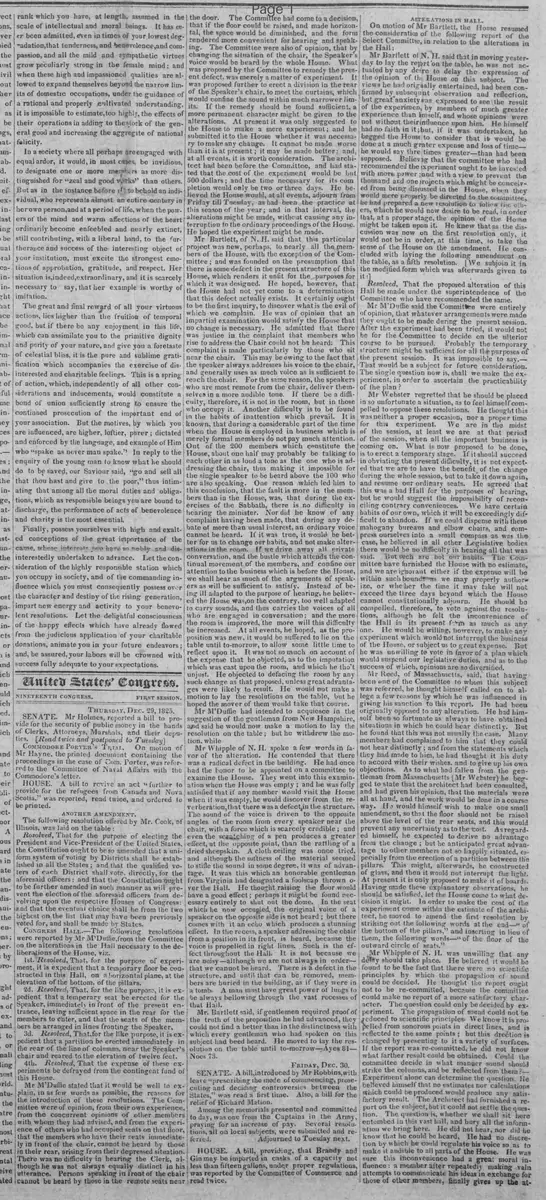
Detailed report of U.S. Congress proceedings from December 29, 1825, to January 4, 1826, including Senate and House sessions on bills for public money security, Commodore Porter's trial, Canadian refugees, presidential election amendments, extensive debate on altering Congress Hall for better acoustics, import regulations, bankruptcy system, Massachusetts war claims, judicial reforms, and Treasury estimates.
Merged-components note: These components form a single continuous report on United States Congress proceedings, including the table of appropriations as integral data within the news item.
Clippings
1 of 2
OCR Quality
Full Text
NINETEENTH CONGRESS.
FIRST SESSION.
Thursday, Dec. 29, 1825.
SENATE. Mr. Holmes, reported a bill to provide for the security of public money in the hands of Clerks, Attorneys, Marshals, and their deputies. [Read twice and postponed to Tuesday]
Commodore Porter's Trial. On motion of Mr. Hayne, the printed document containing the proceedings in the case of Com. Porter, was referred to the Committee of Naval Affairs with the Commodore's letter.
HOUSE. A bill to revive an act "further to provide for the refugees from Canada and Nova Scotia," was reported, read twice, and ordered to be printed.
ANOTHER AMENDMENT.
The following resolution offered by Mr. Cook, of Illinois, was laid on the table:
Resolved, That for the purpose of electing the President and Vice-President of the United States, the Constitution ought to be so amended that a uniform system of voting by Districts shall be established in all the States; and that the qualified voters of each District shall vote, directly, for the aforesaid officers: and that the Constitution ought to be further amended in such manner as will prevent the election of the aforesaid officers from devolving upon the respective Houses of Congress: and that the eventual choice shall be from the two highest on the list that may have been previously voted for, and shall be made by States.
Congress Hall.—The following resolutions were reported by Mr. M'Duffie, from the Committee on the alterations in the Hall necessary to the deliberations of the House, viz.
1st. Resolved, That, for the purpose of experiment, it is expedient that a temporary floor be constructed in this Hall, on a horizontal plane, at the elevation of the bottom of the pillars.
2d. Resolved, That, for the like purpose, it is expedient that a temporary seat be erected for the Speaker, immediately in front of the present entrance, leaving sufficient space in the rear for the members to enter, and that the seats of the members be arranged in lines fronting the Speaker.
3d. Resolved, That, for the like purpose, it is expedient that a partition be erected immediately in the rear of the line of columns, near the Speaker's chair and raised to the elevation of twelve feet.
4th. Resolved, That the expense of these experiments be defrayed from the contingent fund of this House.
Mr. M'Duffie stated that it would be well to explain, in as few words as possible, the reasons for the introduction of these resolutions. The Committee were of opinion, from their own experience, from the concurrent opinions of other members with whom they had advised, and from the experience of others who had occupied seats on that floor, that the members who have their seats immediately in front of the chair, cannot be heard by those in their rear, arising from their depressed situation. There was no difficulty in hearing the Clerk, although he was not always equally distinct in his utterance. Persons speaking in front of the chair cannot be heard by those in the remote seats near the door. The Committee had come to a decision that if the floor could be raised, and made horizontal, the space would be diminished, and the form rendered more convenient for hearing and speaking. The Committee were also of opinion, that by changing the situation of the chair, the Speaker's voice would be heard by the whole House. What was proposed by the Committee to remedy the present defect, was merely a matter of experiment. It was proposed further to erect a division in the rear of the Speaker's chair, to meet the curtains, which would confine the sound within much narrower limits. If the remedy should be found sufficient, a more permanent character might be given to the alterations. At present it was only suggested to the House to make a mere experiment; and he submitted it to the House whether it was necessary to make any change. It cannot be made worse than it is at present; it may be made better; and, at all events, it is worth consideration. The architect had been before the Committee, and had stated that the cost of the experiment would be but 500 dollars; and the time necessary for its completion would only be two or three days. He believed the House would, at all events, adjourn from Friday till Tuesday, as had been the practice at this season of the year; and in that interval, the alterations might be made, without causing any interruption to the ordinary proceedings of the House. He hoped the experiment might be made.
Mr. Bartlett, of N. H. said that this particular project was new, perhaps, to nearly all the members of the House, with the exception of the Committee: and was founded on the presumption that there is some defect in the present structure of this House, which renders it unfit for the purposes for which it was designed. He hoped, however, that the House had not yet come to a determination that this defect actually exists. It certainly ought to be the first inquiry, to discover what is the evil of which we complain. He was of opinion that an impartial examination would satisfy the House that no change is necessary. He admitted that there was justice in the complaint that members who rise to address the Chair could not be heard: This complaint is made particularly by those who sit near the chair. This may be owing to the fact that the speaker always addresses his voice to the chair, and generally uses as much voice as is sufficient to reach the chair. For the same reason, the speakers who are most remote from the chair, deliver themselves in a more audible tone. If there be a difficulty, therefore, it is not in the room, but in those who occupy it. Another difficulty is to be found in the habits of inattention which prevail. It is known, that during a considerable part of the time when the House is employed in business which is merely formal members do not pay much attention. Out of the 200 members which constitute the House, about one half may probably be talking to each other in as loud a tone as the one who is addressing the chair, thus making it impossible for the single speaker to be heard above the 100 who are also speaking. One reason which led him to this conclusion, that the fault is more in the members than in the House, was, that during the exercises of the Sabbath, there is no difficulty in hearing the minister. Nor did he know of any complaint having been made, that during any debate of more than usual interest, an ordinary voice cannot be heard. If it was true, it would be better for us to change our habits, and not make alterations in the room. If we drive away all private conversation, and the bustle which attends the continual movement of the members, and confine our attention to the business which is before the House, we shall hear as much of the arguments of speakers as will be sufficient to satisfy. Instead of being ill adapted to the purpose of hearing, he believed the House was, on the contrary, too well adapted to carry sounds, and thus carries the voices of all who are engaged in conversation; and the more the room is improved, the more will this difficulty be increased. At all events, he hoped, as the proposition was new, it would be suffered to lie on the table until to-morrow, to allow some little time to reflect upon it. It was not so much on account of the expense that he objected, as to the imputation which was cast upon the room, and which he tho't unjust. He objected to defacing the room by any such change as that proposed, unless great advantages were likely to result. He would not make a motion to lay the resolutions on the table, but he hoped the mover of them would take that course.
Mr. M'Duffie had intended to acquiesce in the suggestion of the gentleman from New Hampshire, and said he would now make a motion to lay the resolution on the table; but he withdrew the motion, while Mr. Whipple of N. H. spoke a few words in favor of the alteration. He contended that there was a radical defect in the building. He had once had the honor to be appointed on a committee to examine the House. They went into this examination when the House was empty; and he was fully satisfied that if any member would visit the House when it was empty, he would discover from the reverberation, that there was a defect in the structure. The sound of the voice is driven to the opposite angles of the room from every speaker near the chair, with a force which is scarcely credible; and even the scratching of a pen produces a greater effect, at the opposite point, than the rattling of a dried sheepskin. A cloth ceiling was once tried, and although the softness of the material seemed to stifle the sound in some degree, it was of advantage. It was this which an honorable gentleman from Virginia had designated a foolscap thrown over the Hall. He thought raising the floor would have a good effect; perhaps it might be found necessary entirely to shut out the dome. In the seat which he now occupied, the original voice of a speaker on the opposite side is not heard; but there comes with it an echo which produces a stunning effect. In the recess, a speaker addressing the chair from a position in its front, is heard, because the voice is propelled in right lines. Such is the effect throughout the Hall. It is not because we are noisy—although we are not always in order—that we cannot be heard. There is a defect in the structure, and until that can be removed, members are buried in the building, as if they were in a tomb. A man must have great power of lungs to be always bellowing through the vast recesses of that Hall.
Mr. Bartlett said, if gentlemen required proof of the truth of the proposition he had advanced, they could not find a better than in the distinctness with which every gentleman who had spoken on this subject had been heard. He moved to lay the resolution on the table until to-morrow—Ayes 81—Noes 73.
Friday, Dec. 30.
SENATE. A bill, introduced by Mr. Robbins, with leave "prescribing the mode of commencing, prosecuting and deciding controversies between the States," was read a first time. Also, a bill for the relief of Richard Matson.
Among the memorials presented and committed to day, was one from the Captains in the Army, praying for an increase of pay. Several resolutions, all on local subjects, were submitted and referred.
Adjourned to Tuesday next.
HOUSE. A bill, providing, that Brandy and Gin may be imported in casks of a capacity not less than fifteen gallons, under proper regulations, was reported by the Committee of Commerce and read twice.
ALTERATIONS IN HALL.
On motion of Mr. Bartlett, the House resumed the consideration of the following report of the Select Committee, in relation to the alterations in the Hall:
Mr. Bartlett of N. H. said that in moving yesterday to lay the report on the table, he was not actuated by any desire to delay the expression of the opinion of the House on this subject. The views he had originally entertained, had been confirmed by subsequent observation and reflection, but great anxiety was expressed to see the result of the experiment, by members of much greater experience than himself, and whose opinions were not without their influence upon him. He himself had no faith in it; but, if it was undertaken, he begged the House to consider that it would be done at a much greater expense and loss of time—he would say three times greater—than had been supposed. Believing that the committee who had recommended the experiment ought to be invested with more power; and with a view to prevent the thousand and one projects which might be conceived from being discussed in the House, when they would more properly be directed to the committee, he had prepared a new resolution to follow the others, which he would now desire to be read, in order that, at a proper stage, the opinion of the House might be taken upon it. He knew that as the discussion was now on the first resolution only, it would not be in order, at this time, to take the sense of the House on the amendment. He concluded with laying the following amendment on the table, as a fifth resolution. [We subjoin it in the modified form which was afterwards given to it:]
Resolved, That the proposed alteration of this Hall be made under the superintendence of the Committee who have recommended the same.
Mr. M'Duffie said the Committee were entirely of opinion, that whatever arrangements were made they ought to be made during the present session. After the experiment had been tried, it would not be for the Committee to decide on the ulterior course to be pursued. Probably the temporary structure might be sufficient for all the purposes of the present session. It was impossible to say.—That would be a subject for future consideration. The single question now is, shall we make the experiment, in order to ascertain the practicability of the plan?
Mr. Webster regretted that he should be placed in so unfortunate a situation, as to feel himself compelled to oppose these resolutions. He thought this was neither a proper occasion, nor a proper time for this experiment. We are in the midst of the session, at least we are at that period of the session, when all the important business is coming on. What is now proposed to be done, is to erect a temporary stage. If it should succeed in obviating the present difficulty, it is not expected that we are to have the benefit of the change during the whole session, but to take it down again, and resume our ordinary seats. He agreed that this was a bad Hall for the purposes of hearing, but he would suggest the impossibility of reconciling contrary conveniences. We have certain habits of our own, which it will be exceedingly difficult to abandon. If we could dispense with these mahogany bureaus and elbow chairs, and compress ourselves into a small compass as was the case, he believed in all other Legislative bodies there would be no difficulty in hearing all that was said. But such are not our habits. The Committee have furnished the House with no estimate, and we are ignorant either if the expense will be within such bounds as we may properly authorize, or whether the time it may take will not exceed the three days beyond which the House cannot constitutionally adjourn. He should be compelled, therefore, to vote against the resolutions, although he felt the inconvenience of the Hall in its present form as much as any one. He would be willing, however, to make any experiment which would not interrupt the business of the House, or subject us to great expense. But he was unwilling to vote in favor of a plan which would suspend our legislative duties, and as to the success of which, opinions are so diversified.
Mr. Reed, of Massachusetts, said, that having been one of the Committee to whom this subject was referred, he thought himself called on to allege a few reasons by which he was influenced in giving his sanction to this report. He had been originally opposed to any alteration. He had himself been so fortunate as always to have obtained situations in which he could hear distinctly. But he found that this was not usually the case. Many members had complained to him that they could not hear distinctly; and from the statements which they had made to him, he had thought it his duty to accord with their wishes, and to give up his own objections. As to what had fallen from the gentleman from Massachusetts (Mr. Webster) he begged to state that the architect had been consulted, and had given his opinion, that the materials were all at hand, and the work would be done in a coarse way. He would himself wish to make one small amendment, so that the floor should not be raised above the level of the rear seats, and this would prevent any uncertainty as to the cost. As regarded himself, he expected to derive no advantage from the change; but he anticipated great advantage to other members not so happily situated, especially from the erection of a partition between the pillars. This might, afterwards, be constructed of glass, and then it would not interrupt the light. At present it is only proposed to make it of boards. Having made these explanatory observations, he should be satisfied, let the House come to what decision it might. In order to make the cost of the experiment come within the estimate of the architect, he moved to amend the first resolution by striking out the following words at the end "of the bottom of the pillars," and inserting in lieu of them, the following words—"of the back of the outward circle of seats."
Mr. Whipple of N. H. was unwilling that any delay should take place. He believed it would be found to be the fact that there were no scientific principles by which the propagation of sound could be decided. He thought the report ought not to be re-committed, because the committee could make no report of a more satisfactory character. The question could only be decided by experiment. The propagation of sound could not be reduced to scientific principles. We know it is propelled from sonorous points in direct lines, and is reflected to the same points; but this direction is changed by presenting to it a variety of surfaces. If the report was re-committed, he did not know what farther result could be obtained. Could the committee decide in what manner sound should strike the columns, and be reflected from them?—Experiment alone can determine the question. He believed himself that no estimates nor calculations which could be produced would produce any satisfactory result. The Architect had furnished a report on the subject, but it could not settle the question. The question is, whether we shall sit here entombed in this vast hall, and bury all the information we bring here. He did not hear, nor did he know that he could be heard. He had no discretion by which he could regulate his voice so as to make it audible to all parts of the House. He was sure this inconvenience had a great moral influence: a member after repeatedly making vain attempts to communicate his ideas in exchange for those of other members, finally gives up the attemp in despair, and sinks into negligence of his duties. Nothing could be done to remedy this evil but by experiment; and if we are to give up all hope of improving this hall, let us look about for another room. A great mass of mind was collected here from all parts, and it was only concentrated here to be lost.
The question to re-commit was then put, and negatived without a division.
The amendment moved by Mr. Reed was then agreed to; after which, the question was taken on the first resolution, which was negatived.
Mr. Bartlett then moved to strike out the last sentence of the second resolution, consisting of the words, "and that the seats of the members be arranged in lines fronting the Speaker."
Mr. McDuffie merely rose to say, that the first resolution having been rejected, the second ought not to pass. No good effect was to be expected from the passing of this resolution, except in connexion with the first, moving the chair could avail nothing towards remedying the evil complained of.
He was of opinion that the two resolutions should stand or fall together.
Mr. Powell (of Virginia) could not concur with the gentleman from South Carolina in this view.
The second resolution contemplated an experiment easily made, involving very inconsiderable expense of time. The trial would at least be made; and the question would be easily settled by the removal of the chair. If it was found to promote the convenience of the House, the seats might easily be changed. If not, the Speaker's chair can be restored to its present situation, and no inconvenience will have been experienced.
The question was then taken on the amendment, and subsequently on the second resolution itself, and both were successively negatived.
Mr. Forsyth moved so to amend the 3d resolution as to provide only for the lowering of the curtain behind the Speaker's chair, and covering the walls of the House with cloth. He was induced to make this amendment by the following facts. When the Senate Chamber was originally built, it was much complained of as being ill-adapted to hearing. It was then recommended to cover the walls with cloth, which had produced a great improvement. The Hall of the Legislative Assembly in Paris very much resembles this Hall in shape, but is neither so large nor so magnificent. When it was first occupied, nobody could hear. The walls have since been covered with cloth, and the evil is to a certain extent remedied. He thought that by doing the same, the present inconvenience would be much lessened. The Hall is too large. All its ornaments are useless. They only serve to break the voice, and create a thousand echoes.
Mr. Wood, of New York, said his only objection to the amendment was, that it did not contemplate a fair experiment. The curtains would not obstruct the voice, while a proper partition would be a sufficient test. Should it prove effectual, a glass partition could be constructed. Again, curtains would preclude the light, which would, of itself, be an inconvenience. The experiment contemplated by this resolution would take no time, and create no expense. He hoped the gentleman from Georgia would make his second proposition a distinct one. Covering with cloth had been suggested before, but as the walls were not considered sufficiently dry, it had been postponed till some future period.
He hoped the question would be divided.
Mr. Forsyth replied that he did not profess to be well acquainted with the doctrine of sounds, but he had always thought that cloth deadens the sound. As to the exclusion of the light, so far from deeming that an objection, he should regard it as a positive advantage. The light from the windows in the recess was to him most unpleasant.
The amendment was then negatived.
The third resolution was agreed to.
Mr. Stephenson, of Penn. moved to amend the 4th resolution by striking out the words "for the like purpose." He did not wish to regard this as an experiment, which these words imported. Negatived.
Mr. Bartlett, then moved to amend the report, by adding his resolution (which we have before given as a 5th resolution). Ayes 98.
The amendment was therefore adopted.
On motion of Mr. Van Rensselaer, it was ordered that when the House adjourn, it adjourn to meet on Tuesday next.
Adj.
TUESDAY, JAN. 3.
In the Senate, the Vice President communicated a letter from Thomas Randall, enclosing a copy of the printed publication alluded to in Com. Porter's communication of the 27th ult. and commenting upon the character and objects of that communication, which was referred to the Naval Committee.
The Vice President also communicated a report showing the aggregate quantity of Wines imported into the U. S. since the year 1800 and the rates of duty paid on them.
BANKRUPT SYSTEM PROPOSED.
In the House, Mr. Webster from the committee on the Judiciary reported the following resolution :
"Resolved, That it is expedient to establish by law a uniform system of bankruptcy throughout the U. States."
Mr. Webster said, the committee on the Judiciary had directed him to report the resolution which had been read. He moved that the resolution be referred to a committee of the whole. Before the time at which it would be called up, he hoped some further resolutions would be presented from the same committee, describing the outline which it was the intention of that committee to recommend to the adoption of the House.
The resolve was committed, as moved, and a day not far distant assigned for its consideration.
On motion of Mr. Webster, of Massachusetts, it was
Resolved, That the Committee on Ways and Means be instructed to inquire into the expediency of repealing the 37th section of the act of March 3d, 1823, entitled "An act supplementary, &c. to the act for regulating the collection of duties on imports and tonnage:" being so much of said first mentioned act as applies to goods and merchandise transported coastwise.
Mr. Hamilton gave notice that he should, to-morrow, call up the resolution offered by him some days since calling for information from the President of the United States respecting the appointment of Delegates to the Congress of Panama.
MASSACHUSETTS CLAIMS.
Mr. Hamilton, from the Committee on Military Affairs, reported the following bill.
M
"A bill to authorize the settlement of the claims of the State of Massachusetts for certain services rendered during the late war.
"Be it enacted, &c. That the proper accounting officers of the Treasury, under the direction of the Department of War, be, and are hereby, authorized and directed to audit and settle, under the usual rules in such cases the claims of the State of Massachusetts, for militia services rendered during the late war, 1st. In all cases where the militia of the said State were called out in conformity with a desire or requisition of an officer of the General Government. 2dly. In all cases where they were called out to repel actual invasion, or under a well founded apprehension of invasion: Provided, the number of troops so called out were not in undue proportion to the exigency: And provided, further, That the services of the said militia, for which compensation may be asked, were not at variance with the views of the General Government, or in cases where the troops employed in the same were not withheld specifically from the command of an officer or officers of the General Government applying for the same."
The bill was twice read and committed.
On motion of Mr. Everett, of Massachusetts, it was
Resolved: That the committee on foreign Affairs be instructed to take into consideration the claim of Israel Thorndike, of Boston, on the Russian Government, for indemnity for the loss of the brigantine Hector, and her cargo, the property of the said Thorndike, which vessel was captured and carried into the island of Tenedos, by the Russian frigate Venus, and there, together with her cargo, unjustly condemned, in the month of June, 1807.
WEDNESDAY, JAN. 4.
Mr. Robbins, of R. I. moved, that the Naval Committee be instructed to inquire into the expediency of establishing a Navy Yard, &c. within the waters of Narragansett Bay, in Rhode Island.
Laid on the table.
THE JUDICIAL SYSTEM.
The House, In Committee, resumed the consideration of the bill, "further to amend the Judicial System of the United States."
[This bill proposes, That the Supreme Court of the United States shall hereafter consist of a Chief Justice and nine Associate Justices, and provides for the appointment of three Additional Associate Justices of said Court.
That the seventh Judicial Circuit of the United States shall, hereafter, consist of the Districts of Ohio, Indiana, and Illinois; the eighth Circuit, of the Districts of Kentucky and Missouri; the ninth Circuit, of the Districts of Tennessee and Alabama: and the tenth circuit, of the Districts of Louisiana and Mississippi.
It repeals so much of any act or acts of Congress, as vests in the District Courts of the United States in the Districts of Indiana, Illinois, Missouri, Mississippi, Alabama, and Louisiana, the powers and jurisdiction of Circuit Courts, and provides that there shall be hereafter Circuit Courts for said Districts, to be composed of the Justice of the Supreme Court, assigned or allotted to the Circuit to which such Districts, may respectively belong, and of the District Judge of such District.
Mr. Webster, Chairman of the Judiciary Committee, said, that the bill was so simple in its provisions, and so unembarrassed with detail, that little or nothing, in the way of explanation, merely, was probably expected from the committee. But the general importance of the subject, and the material change which the proposed measure embraces, demanded some exposition of the reasons which had led the Committee to submit it to the consideration of the House.
[Mr. Webster then went into an explanation of those reasons, at much length. His speech on the occasion occupies over three close columns of the Washington papers.]
On motion of Mr. Eastman (of N. H.) it was
Resolved, that the Committee on the Judiciary be instructed to inquire into the expediency of reporting a bill which shall make provision that, for the purpose of decisions in all actions involving constitutional principles, which may hereafter be carried into the Supreme Court, there shall be a concurrence in opinion of a majority of all the Judges in commission as members of said Court, at the time such decisions are respectively to be made.
The estimate of appropriations proposed by the Secretary of the Treasury, for the service of the year 1826, amount to $9,157,725 02. viz:-
Civil List, $879,787 65
Miscellaneous, 339,937 01
Intercourse with Foreign Nations, 224,500 00
Army and Military Academy, 1,974,879 55
Fortifications, Armories, Arsenals and Corps, - 2,526,612 81
$9,157,725 02
To the Estimate are annexed two statements:
1st. Of appropriations for the year 1826, which have been made by former acts, viz: for arming and equipping the Militia; Gradual Increase of the Navy; Public Debt; Civilization of the Indians, and treaties with the Indian tribes; amounting to 10,898,775.00
2d The balances of unsatisfied appropriations, made previous to the year 1826, and which will be required for the objects for which they were severally made, amounting to 4,181,236 79
$15,080,011 79
| and Ordnance, | - | - | 1,356,700 | 00 |
| Pensions, | - | - | 1,432,290 | 00 |
| Indian Agencies and Presents, | - | - | 153,000 | 00 |
| Arrearages, | - | - | 18,000 | 00 |
| Internal Improvements, | - | - | 192,000 | 00 |
| Naval Establishment and Marine |
What sub-type of article is it?
What keywords are associated?
What entities or persons were involved?
Where did it happen?
Domestic News Details
Primary Location
Congress Hall, Washington
Event Date
Dec. 29, 1825 Jan. 4, 1826
Key Persons
Event Details
Proceedings of the Nineteenth Congress, First Session, including Senate reports on bills for public money security and state controversies, referral of Commodore Porter's trial documents; House bills reviving aid for Canadian and Nova Scotia refugees, proposing constitutional amendments for presidential elections by districts, extensive debate and partial adoption of resolutions to experimentally alter Congress Hall for improved acoustics by raising floor, repositioning Speaker's seat, erecting partition, and funding from contingent fund; further sessions on import regulations for brandy and gin, bankruptcy system resolution, repeal of coastwise transport duties, Massachusetts militia claims from the late war, Rhode Island navy yard inquiry, judicial system amendments increasing Supreme Court justices and reorganizing circuits, and Treasury appropriation estimates for 1826 totaling over $9 million plus prior commitments.