Thank you for visiting SNEWPapers!
Sign up free
The Virginia Gazette
Williamsburg, Virginia
What is this article about?
In December 1769, a Middlesex resident writes to Mr. Rind defending a disregarded paper urging prohibition of dealings with servants and slaves to curb thefts. He describes widespread complaints of thefts, supports a petition to the Virginia Assembly for laws banning such dealings, licensing small sales of tobacco and grain, and requiring storekeepers' security, while refuting objections of partiality favoring the rich.
Merged-components note: Continuation of the same letter to the editor across pages 1 and 2, as the text flows seamlessly from the end of the first component to the start of the second.
Clippings
1 of 2
OCR Quality
Full Text
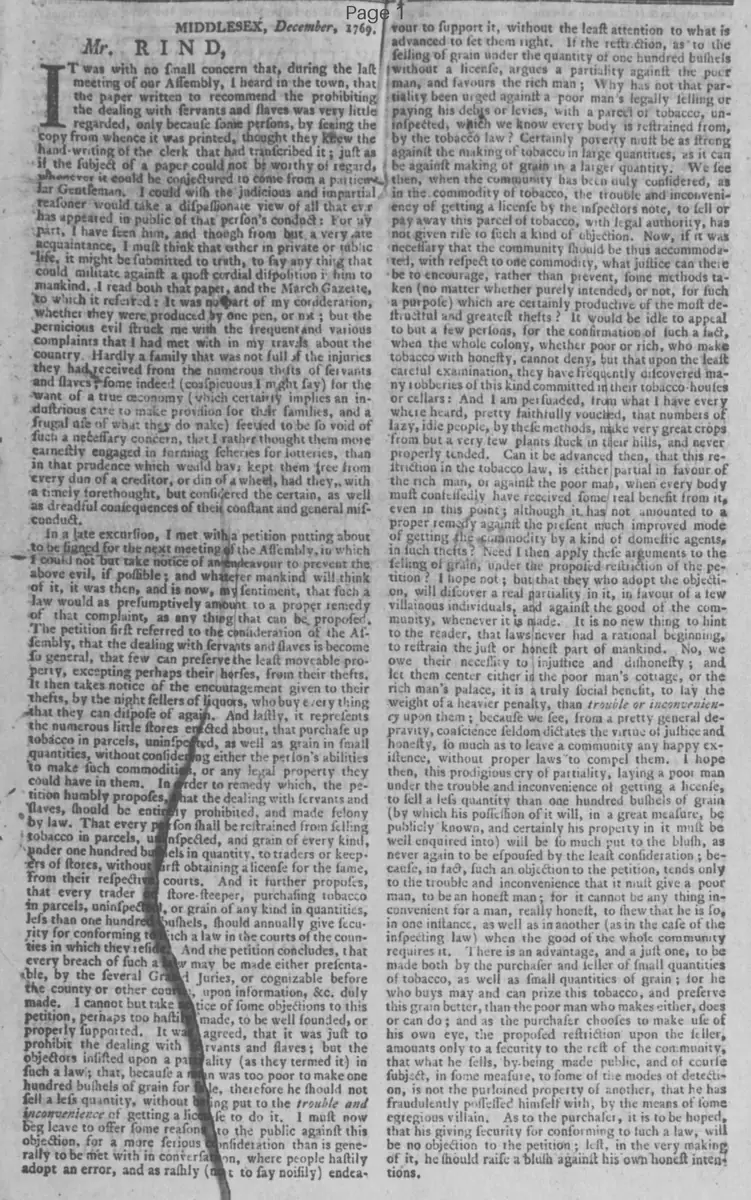
Mr. RIND,
'Twas with no small concern that, during the last meeting of our Assembly, I heard in the town, that the paper written to recommend the prohibiting the dealing with servants and slaves was very little regarded, only because some persons, by seeing the copy from whence it was printed, thought they knew the hand-writing of the clerk that had transcribed it; just as if the subject of a paper could not be worthy of regard, whenever it could be conjectured to come from a particular Gentleman. I could wish the judicious and impartial reasoner would take a dispassionate view of all that ever has appeared in public of that person's conduct: For my part, I have seen him, and though from but a very late acquaintance, I must think that either in private or public life, it might be submitted to truth, to say anything that could militate against a most cordial disposition in him to mankind. I read both that paper, and the March Gazette, to which it referred: It was no part of my consideration, whether they were produced by one pen, or not; but the pernicious evil struck me with the frequent and various complaints that I had met with in my travels about the country. Hardly a family that was not full of the injuries they had received from the numerous thefts of servants and slaves: some indeed (conspicuous I might say) for the want of a true economy (which certainly implies an industrious care to make provision for their families, and a frugal use of what they do make) seemed to be so void of such a necessary concern, that I rather thought them more earnestly engaged in farming chimeras for lotteries, than in that prudence which would have kept them free from every dun of a creditor, or din of a wheel, had they, with a timely forethought, but considered the certain, as well as dreadful consequences of the constant and general misconduct.
In a late excursion, I met with a petition putting about to be signed for the next meeting of the Assembly, in which I could not but take notice of an endeavour to prevent the above evil, if possible; and whatever mankind will think of it, it was then, and is now, my sentiment, that such a law would as presumptively amount to a proper remedy of that complaint, as anything that can be proposed. The petition first referred to the consideration of the Assembly, that the dealing with servants and slaves is become so general, that few can preserve the least moveable property, excepting perhaps their horses, from their thefts. It then takes notice of the encouragement given to their thefts, by the night sellers of liquors, who buy every thing that they can dispose of again. And lastly, it represents the numerous little stores erected about, that purchase up tobacco in parcels, uninspected, as well as grain in small quantities, without considering either the person's abilities to make such commodities, or any legal property they could have in them. In order to remedy which, the petition humbly proposes, that the dealing with servants and slaves, should be entirely prohibited, and made felony by law. That every person shall be restrained from selling tobacco in parcels, uninspected, and grain of every kind, under one hundred bushels in quantity, to traders or keepers of stores, without first obtaining a license for the same, from their respective courts. And it further proposes, that every trader or store-keeper, purchasing tobacco in parcels, uninspected, or grain of any kind in quantities, less than one hundred bushels, should annually give security for conforming to such a law in the courts of the counties in which they reside. And the petition concludes, that every breach of such a law may be made either presentable, by the several Grand Juries, or cognizable before the county or other courts upon information, &c. duly made, I cannot but take notice of some objections to this petition, perhaps too hasty made, to be well founded, or properly supported. It was agreed, that it was just to prohibit the dealing with servants and slaves: but the objectors insisted upon a partiality (as they termed it) in such a law: that, because a man was too poor to make one hundred bushels of grain for sale, therefore he should not sell a less quantity, without being put to the trouble and inconvenience of getting a license to do it. I must now beg leave to offer some reason to the public against this objection, for a more serious consideration than is generally to be met with in conversation, where people hastily adopt an error, and as rashly (not to say noisily) endeavour to support it, without the least attention to what is advanced to set them right. If the restriction, as to the selling of grain under the quantity of one hundred bushels without a license, argues a partiality against the poor man, and favours the rich man; Why has not that partiality been urged against a poor man's legally selling or paying his debts or levies, with a parcel of tobacco, uninspected, which we know every body is restrained from, by the tobacco law? Certainly poverty must be as strong against the making of tobacco in large quantities, as it can be against making of grain in a larger quantity. We see then, when the community has been duly considered, as in the commodity of tobacco, the trouble and inconvenience of getting a license by the inspectors note, to sell or pay away this parcel of tobacco, with legal authority, has not given rise to such a kind of objection. Now, if it was necessary that the community should be thus accommodated, with respect to one commodity, what justice can there be to encourage, rather than prevent, some methods taken (no matter whether purely intended, or not, for such a purpose) which are certainly productive of the most destructful and greatest thefts? It would be idle to appeal to but a few persons, for the confirmation of such a fact, when the whole colony, whether poor or rich, who make tobacco with honesty, cannot deny, but that upon the least careful examination, they have frequently discovered many robberies of this kind committed in their tobacco-houses or cellars: And I am persuaded, from what I have everywhere heard, pretty faithfully vouched, that numbers of lazy, idle people, by these methods, make very great crops from but a very few plants stuck in their hills, and never properly tended. Can it be advanced then, that this restriction in the tobacco law, is either partial in favour of the rich man, or against the poor man, when every body must confessedly have received some real benefit from it, even in this point; although it has not amounted to a proper remedy against the present much improved mode of getting the commodity by a kind of domestic agents, in such thefts? Need I then apply these arguments to the selling of grain, under the proposed restriction of the petition? I hope not: but that they who adopt the objection, will discover a real partiality in it, in favour of a few villainous individuals, and against the good of the community, whenever it is made. It is no new thing to hint to the reader, that laws never had a rational beginning, to restrain the just or honest part of mankind. No, we owe their necessity to injustice and dishonesty; and let them center either in the poor man's cottage, or the rich man's palace, it is a truly social benefit, to lay the weight of a heavier penalty, than trouble or inconvenience upon them; because we see, from a pretty general depravity, conscience seldom dictates the virtue of justice and honesty, so much as to leave a community any happy existence, without proper laws to compel them. I hope then, this prodigious cry of partiality, laying a poor man under the trouble and inconvenience of getting a license, to sell a less quantity than one hundred bushels of grain (by which his possession of it will, in a great measure, be publicly known, and certainly his property in it must be well enquired into) will be so much put to the blush, as never again to be espoused by the least consideration; because, in fact, such an objection to the petition, tends only to the trouble and inconvenience that it must give a poor man, to be an honest man; for it cannot be anything inconvenient for a man, really honest, to shew that he is so, in one instance, as well as in another (as in the case of the inspecting law) when the good of the whole community requires it. There is an advantage, and a just one, to be made both by the purchaser and seller of small quantities of tobacco, as well as small quantities of grain; for he who buys may and can prize this tobacco, and preserve this grain better, than the poor man who makes either, does or can do; and as the purchaser chooses to make use of his own eye, the proposed restriction upon the seller, amounts only to a security to the rest of the community, that what he sells, by being made public, and of course subject, in some measure, to some of the modes of detection, is not the purloined property of another, that he has fraudulently possessed himself with, by the means of some egregious villain. As to the purchaser, it is to be hoped, that his giving security for conforming to such a law, will be no objection to the petition: lest, in the very making of it, he should raise a blush against his own honest intentions.
Having thus, I am persuaded, proved this argument of partiality, &c. against a poor man, out of countenance, I must slide in a word, that the expence of obtaining such a license (should a law of such a kind think it improper to require the clerks of the county courts to do their work, either for some addition to their standing salary, as it is a public service, or make it an ex officio business on the present common salaries allowed them; or should it oblige the seller to pay a fee for such a license) I must say the advantages to be gained by the poor man's thus selling with great reputation, either his tobacco or grain, in small quantities, will, in the price that he may then insist upon, be more than a sufficient compensation for the trifling fee that such a service of a license can deserve; for, besides the great saving in the care of his tobacco, which he is at present obliged to take, before he can get it inspected, to pay away (a case by the by, though very necessary, but seldom endeavoured at, in many cases of poverty, in either tobacco or grain) yet whilst a rogue, fraudulently possessed of a thing, generally thinks himself under the necessity of parting with it very cheap, the honest man, with his license in his hand, can no way be obliged to take less than the market price. I must now imitate a late publisher in the Gazettes, and say, could I imagine that this piece would be thought the product of the same pen, with the above disregarded paper, I would put my name to it; but I have rather too much modesty to say from whence so much just reasoning has proceeded; and I find myself too cleanly to pick up any dirt to return, should any one bespatter me for it.
What sub-type of article is it?
What themes does it cover?
What keywords are associated?
What entities or persons were involved?
Letter to Editor Details
Recipient
Mr. Rind
Main Argument
the letter defends a prior paper recommending prohibition of dealings with servants and slaves to prevent thefts, supports a petition to the assembly for laws making such dealings felony, requiring licenses for small sales of tobacco and grain, and mandating storekeepers' security, while refuting claims of partiality against the poor by comparing to existing tobacco laws.
Notable Details