Thank you for visiting SNEWPapers!
Sign up free
The Laramie Republican
Laramie, Albany County, Wyoming
What is this article about?
Expert J. E. Barlow's 1921 report to Laramie Mayor Coolican analyzes city finances showing deficits and rising costs, reviews water supply from springs and railroad pipes, recommends metering and charges; evaluates sewer design needs, suggests delays for study; proposes engineering enhancements, platting controls, street surfacing, and fire dept improvements. (278 chars)
Merged-components note: This is a continued municipal expert's report across pages; merging into a single coherent story component.
Clippings
1 of 2
OCR Quality
Full Text
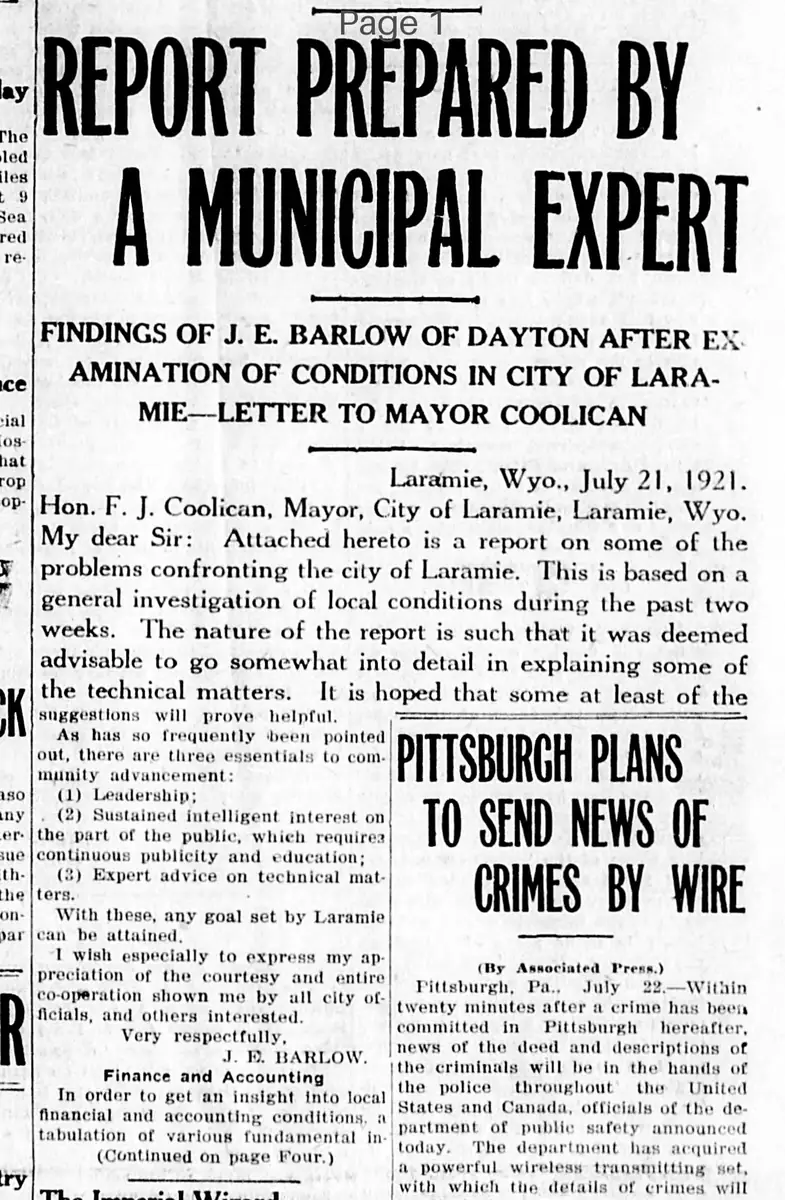
FINDINGS OF J. E. BARLOW OF DAYTON AFTER EXAMINATION OF CONDITIONS IN CITY OF LARAMIE--LETTER TO MAYOR COOLICAN
Laramie, Wyo., July 21, 1921.
Hon. F. J. Coolican, Mayor, City of Laramie, Laramie, Wyo.
My dear Sir: Attached hereto is a report on some of the problems confronting the city of Laramie. This is based on a general investigation of local conditions during the past two weeks. The nature of the report is such that it was deemed advisable to go somewhat into detail in explaining some of the technical matters. It is hoped that some at least of the proposals will be helpful.
As has so frequently been pointed out, there are three essentials to community advancement: (1) Leadership: (2) Sustained intelligent interest on the part of the public, which requires continuous publicity and education; (3) Expert advice on technical matters. With these, any goal set by Laramie can be attained. I wish especially to express my appreciation of the courtesy and entire co-operation shown me by all city officials, and others interested.
Very respectfully,
J. E. BARLOW.
Finance and Accounting
In order to get an insight into local financial and accounting conditions, a tabulation of various fundamental in (Continued on page Four.)
EXPERT'S REPORT
(Continued from page One.)
Information was made and is included herewith. These charts show the tax rate for the past seven years, distribution of the taxes, tabulation of revenues, expenditures and bonded indebtedness. The chart on tax data shows that the valuation in the last seven years has been tripled and that the city in a general way has gotten a fair proportion of the increased taxes. For last year (note that the 1919 tax levy constitutes the city's tax revenue for 1920) the general fund levy was eight mills, the maximum allowable by law and for this year 6.20 although the actual cash received this year was considerably higher than last year, due to increased valuation of property. In common with other cities throughout the country, the cost of running the city government has increased due to increased prices of materials and labor; at the same time prohibition has eliminated the revenue from liquor licenses, which in Laramie amounted to $20,000 per year. An occupational tax was passed this year to raise revenue, and will produce possibly $10,000.00.
For the past several years the city has been going behind, a deficit being passed along from one administration to another. The accounts are not kept in such shape that the treasurer's or clerk's statements show these deficits clearly, but nevertheless they exist and should be shown. A detailed statement of the general fund at least should be made each year as of December 31st showing amount of cash on hand, the amount of bills and other obligations outstanding, the amount of outstanding loans either to banks or other city funds, so that an intelligent idea can be readily obtained as to whether or not the city has lived within its revenues for the year. In examining the records, no attempt has been made to audit the accounts.
In spite of the occupational tax there is a real problem to finance the operating expenses of the city government to the end of the present year. The officials state that between twenty and thirty thousand dollars has been spent from the general fund for work properly chargeable to bond funds, and that when this money is transferred from the proceeds of recent sale of water and sewer bonds to the general operating fund they will, by adopting a stringent economical policy for the rest of the year, be able to get through the balance of the year without increasing the deficit.
The city's books show a record of each financial transaction, but there is lack of continuous financial information needed to give an executive intelligent administrative control over all municipal activities. Different officials are spending money from the same fund for different purposes, without proper regard to the gross amount of money available for the year. To remedy this condition the installation of a budget system is recommended. Under such a system, the revenues would be estimated for the succeeding year, and the activities of the government planned in accordance therewith. The council at the beginning of the year, by ordinance, would appropriate to each activity of the city government its allotment of money for its year's work, and then the head of that activity would have to see that they lived within that appropriation, being checked from time to time by the chief executive. During the year, the appropriations could, by council action, be adjusted to meet changed conditions of income and expenditures, but such changes in general would be minor.
Such a scheme of operation forces an administration to consider and plan ahead a program of activities as well as making possible a public hearing where the program can be explained. Such a hearing will give city officials not only an opportunity to hear public sentiment, but also interested citizens may have valuable suggestions to offer from which the city may profit greatly.
Bond Issues
The city of Laramie, at the close of 1920, as shown on one of the attached charts, had outstanding only $164,000 of bonds. This shows an unusually favorable financial condition as regards indebtedness. A proper sinking fund policy, however, has not been adopted. A sound policy on bonds requires that (a) no bond should run for a longer period than the life of the improvement or article purchased, (b) a sinking fund should be established and proper annual payments started immediately, so that there is a fair distribution of the capital cost rather than unfairly leaving the burden of raising the money to pay the bond when due, to some future administration to worry about; (c) In lieu of sinking fund bonds, serials may be issued; these would have a proportionate amount of the bond issue falling due every year, thus reducing annually the outstanding indebtedness of that particular issue.
Another matter to which attention should be particularly called is the practise of not keeping strictly separate accounts of the proceeds of the sale of bonds, and the general fund. In general, money should not be spent on capital improvements until the actual proceeds of the sale of bonds are available—the practise of using up the general fund on the water works, causing large deficits in operating funds, and then selling bonds and reimbursing the general fund, should be discontinued. Likewise a strictly separate account should be set up in the books for the proceeds of every bond sale and no money spent from this fund for any purpose other than the purpose for which the bonds were sold, discontinuing the expenditure when the fund is exhausted.
As stated, the bonded indebtedness of the city at the close of 1920 was $164,000, of which $115,000 was for water and $49,000 for sewer. This year there has been authorized bonds to the extent of $119,500 for water works, and $162,000 for sanitary sewers, both to be paid from the general tax levy. These two issues, amounting to $281,500, will more than double the outstanding indebtedness of the city. At 6 per cent interest, and say 3 per cent sinking fund, the amount to be raised from taxation to pay this should be approximately $25,000 per year, a very considerable sum. With local valuations high (except in case of some large industries within city limits which are entirely untaxed) and with wide objection to high general taxation, federal and local, it would seem wise to make a charge for water so as to put the water works on a self-sustaining basis and to adopt as a policy the assessment of all special benefits such as sanitary sewer, pavements, etc., against the property benefited and thus relieve the general taxes.
The charge for water is discussed under water works.
The assessment of all or part of the cost of improvements, such as sewers, street pavements, sidewalks, etc., against the property benefited, is a common practice throughout the country. For example, the laying of sanitary sewers (and water mains likewise) in a plat increases the value of the lots enormously, which increment of value the owner reaps, and there is no reason why the city in general should pay the bill. In fact there is much less objection to special taxation of this kind than a high general tax as the owner sees and feels immediately the special benefit for which he is paying. It may be interesting to note that in some cities, in addition to a charge for water used, the cost of water mains is assessed in this same way, a condition not unlike the dual ownership obtaining in Laramie, where the property owners have paid for some of the laterals.
Water Works.
On Sept. 14, 1874, a contract was entered into between the Union Pacific Railroad company and Albany county by which the former laid an 11½ inch cement lined pipe line from the City Springs, 2½ miles east of the city to the railroad. The county paid $18,000 towards same, in return for which the citizens of the county were to get the surplus water free.
Supplementary contract of May 7, 1907. Under this, the Union Pacific railroad replaced the old cement-lined pipe with a cast iron pipe line, consisting of approximately 9090 feet of 14 inch pipe from the reservoir to the intersection of Grand avenue and Ninth street, and from there 2520 feet of 12 inch pipe to Second street and Grand avenue. At each street crossing Grand avenue as far East as Sixteenth street, the railroad installed or agreed to install, when necessary, a cross to allow for the connection of either six inch or eight inch lateral mains. All taps supplying citizens were to be taken from these laterals no taps being allowed on the Grand Avenue main.
The Union Pacific railroad was to own and maintain this line and have the right to draw such quantities of water from it as might be necessary for the uses of the railroad company without interference from city officials or other persons and any excess water supplied was to be free to the citizens of Albany county under such regulations as might be prescribed by competent authority. The railroad, the city, and all parties using the water were to do so economically and without waste. In case the city later issued bonds for improvements to the water works to be paid for from taxation, the portion of such taxes assessed against the Union Pacific railroad was to be offset by, and up to the amount the Railroad had spent in laying the main. Supplementary Contract of Dec. 7, 1915. This contract allowed the city to connect the new line from Soldier Springs with the distribution system, and protected the railroad from any curtailment of its rights to water from the City Springs.
The Railroad company has built a reservoir at City Springs holding approximately 1,400,000 gallons. The available supply at the City Springs is estimated at 1,600,000 gallons per day, of which the Union Pacific Railroad is stated to use a maximum of 650,000 gallons.
The city in 1915 developed the Soldier Springs, estimated to furnish a supply of 1,600,000 gallons per day, and laid a 14 inch and 16 inch cast iron main, 22,857 feet long joining the city main at Steele and Fifteenth Streets. The city in 1915 acquired the Pope Springs which have not been tied in to the system, but which are estimated capable of furnishing a supply of 900,000 gallons per day.
The citizens in the past have laid at their own expense laterals of various sizes from the Grand avenue main. These in many cases have been totally inadequate, resulting in poor pressure for the residences built more and more remote from Grand Avenue. The natural result has been not only inadequate pressure but inadequate valving, lack of records of which exists under-ground, poor service connections, lack of uniformity of curb cocks, etc. The City has spent considerable money in relieving the poor pressure conditions on these laterals.
The foregoing facts have been related so that the water situation will be clear.
There is no other service supplied to the citizens of a city so essential to their health, welfare, comfort, preservation of vegetation, and protection of property as a bountiful supply of pure water. For best results, the absolute control of and responsibility for, the system should be under one authority from the source of supply to at least the curb cocks; in Laramie, it is under three ownerships, railroad, city and individuals. It is perhaps not feasible to acquire the Railroad rights, but the balance of the system should certainly be under one ownership and control.
In Laramie there are over 1,500 house connections. With a gravity supply, free water to all, and hence no accounting system to maintain, and no single regular water works employees, it is safe to say that it has the lowest operating cost of any city water works in the country. Nevertheless, there is some time of city employees devoted to the water works and property chargeable thereto; also the carrying charges on water works bonds of which there is $115,000 outstanding is met from the general tax fund. In view of the financial condition of the city, there is no reason why the water works should not be an entirely self-supporting utility relieving the general fund to that extent, and providing money for its own future improvements. A fair charge for water service is recommended, to be inaugurated preferably on a meter basis, as this is the only effective way to eliminate waste in leaky plumbing, and otherwise, which in the aggregate is enormous in every city. This, in time, causes an overtaxing of the sewers and hence additional outlays of money. A bond issue of $119,000, has been authorized for water works improvements which will require additional money from general taxes unless a charge is made for water.
It is realized that irrigating or sprinkling of lawns, etc., is essential to the attractive appearance of a city located where the rainfall per year is only ten inches. Hence, there should not be any desire to reduce use of water for such purposes. A flat rate possibly based on size of connection with rigid house to house inspection to eliminate leaks might produce results, but not so effectively as meters. In any event the large services should be metered.
The statement is made that the water pressure during sprinkling period is poor. The reservoir at the City Springs is only 104 feet above the down-town street levels. This gives a static pressure of less than 45 pounds, which itself would be considered a low pressure but owing to frictional losses, it is of course considerably less than this. The pressure at the fire station fluctuates between 20 and 30 pounds, but the information available is not sufficient to base any definite recommendations on to provide relief. There are, however, certain things that should be done at once: At Soldier Springs the Fish Hatchery should be moved; the springs, basins, and whole tributary area cleaned up, fenced off and allow no trespassing, as the protection of the sanitary condition of the drinking water supply of 8,000 people is far more important than the convenience of pleasure seekers. The reservoirs should be inspected frequently and attention given to maintenance of surroundings, cleaning of screens, basins, etc. To prevent growth of algae all stored water should be covered.
At the City Springs likewise a large area should be effectively fenced off so that there would be no picnicking on the slopes draining into the springs. Some development work which will cost a comparatively small amount of money should be carried on to see if the supply at all three springs can be increased. More fire hydrants should be installed and larger laterals laid to supply the hydrants. Furthermore, there is a large amount of data still to be secured in the way of maps, showing size and location of all the underground mains, valves, etc.: a large number of new valves should be installed: Venturi meters should be installed on the main supply from both springs, the amount furnished the Union Pacific should be metered, the amount going to waste at each spring in the summer season and fluctuation in reservoir heights, if any, should be determined, recording pressure gauges should be purchased and records taken especially in the summer season at various locations in the system, so that the real pressure conditions can be known. Investigation conducted this week shows that portions of the supply main from Soldier Springs is laid with the hydraulic gradient below the pipe line during the sprinkling period,—in other words, both air valves at the summit have been letting air into the main and reducing its carrying capacity rather than letting air out. It may prove advisable to lower the line if the storage at the Soldier Springs or development work at Pope Springs or Soldier Springs warrants same. Shutting off the air valves will help some but at intervals inspections should be made to let any air out of pipe line, while latter is under positive pressure.
Definite reliable information must first be secured on all these matters before a decision can be made as to what should be done to improve the service pressure condition; i.e. whether it is best to increase the supply, provide larger storage at the springs, increase the capacity of mains from springs: build standpipe down town, etc.
Sewers.
A large amount of fundamental data is needed to intelligently design a sanitary sewer system. The city engineer started with little real information and has gotten together in the field and otherwise much valuable data among which may be mentioned: Topographic map with five inch contour interval on tracing cloth of the built-up portion of the city, including some outlying territory. To intelligently design for a population say three or four times as large as the present, a larger amount of territory should be included. Some of this has been done privately, but is not city property.
Map on tracing cloth showing all existing sewers with sizes, with location of manholes and directions of flow indicated. On this map should also be placed elevation of inverts and top of manholes. Some of these data have been secured in the field but not yet put on the map.
Profiles have been run on about one-third of the streets and alleys of the city.
Preliminary layout and estimate of cost of a trunk sewer with several laterals has been made basing design on estimated density of population and estimated quantity of sewage per inhabitant.
The design above mentioned, however, is only in a preliminary stage and by further study can be made more economical—also by carefully designing, so that invert elevation of new layout will correspond at certain points with the existing system, thus allowing use of present system for outlets, the construction of portions of the new system can be delayed for several years without detriment to the city, and thus save many thousand dollars in interest. Also there are no real data on which to base the estimate of quantity of sewage per capita; some confirming data should be secured by gauging the flow at sewer outlet under different conditions. Elevations of basements at critical points should be determined so that the depth of sewers can be sufficient to drain them readily.
In further studying the problem more careful estimates can be made of the population, say 25 years hence, and its probable distribution and thus a consistent design worked out.
An inspection of the sewers and the outlet several times fails to show conditions requiring haste in the construction of this new system. After repeated inquiries have learned of one house at Second and Park, which has sewage backing up in cellar. This, of course, is a bad condition. The occupant stated that it has occurred twice, once last winter, and during the recent cloudburst ten days ago. The latter, of course, was very unusual, the whole south end of the city being flooded—the former may be due to the creek water being turned into the Park street sewer and thus over-taxing it. An investigation of local sewer facilities should be made, as it may need special treatment quite apart from the new sewerage system.
Funds for proper maintenance, are needed badly and standard sewer clearing equipment should be provided at once. This may relieve some of this surcharging of sewers which occurs in winter. A little work also in cleaning up at the outlet and providing a smooth channel from outfall to the river so as to prevent sewage standing stagnant would help the odor conditions materially. A personal inspection has been made of every bad sewer condition of which information could be learned. Some backing-up of sewage occurred in 1918 during a heavy rain at some of the business houses near Second and Garfield. These merchants stated that continuous precautions are taken by them to prevent a repetition. This is, due to the roof water being connected to the sanitary sewers, which is very bad practice as they are not designed to accommodate it. As business houses downtown increase in number and area covered, more and more trouble will be experienced from this source unless storm sewers in downtown district are provided in meantime to care for this surface drainage. The proposed sanitary system would probably not relieve this condition at Second and Garfield as it is doubtless a local trouble and can be remedied by local relief.
In winter it is stated that the Park street sewer is surcharged but this again is likely due to turning the water from the creek in the southern part of the city into the sanitary system. Again some of the surcharging may be due to residents allowing water in faucets, etc., to remain turned on to prevent freezing, and also generally to lack of attention to repair of leaks, both of which conditions are surely aggravated on account of all water being furnished free. For reasons given, the flow in the sewers is a maximum in the winter, and should be gauged in order to determine rather closely the amount of sewage per capita. This would of course delay the construction of the main part at least of the proposed system until next year, but there are no indications that this would cause any particular inconvenience and it will give ample time for careful study of the whole proposition. If necessary the portion of First street to provide relief to Park avenue could be laid this year, and even extended south to give sewage facilities to that portion of the city; provided, of course, this invert is so designed that it will drain into the existing sewer outlet. At the same time if water meters are installed or even a rigid house to house inspection to eliminate waste, the flow in sewers can be reduced materially.
Under these circumstances, it is recommended that the construction of the system as a whole be not undertaken at once, but that ample time be given to work out a careful design, consistent throughout. When all data are secured and the City Engineer has worked out the plan in detail, he should be allowed to call in a consulting engineer of established reputation to get the benefit of his final advice.
It is a wise move in the right direction to make a general layout of a system amply large to provide for the future so that each little piece as constructed can be made to fit into a comprehensive scheme, but unless the real necessity exists, it is not necessary to construct the complete layout at once. Any portion of it that can be delayed without detriment will result in the saving of the interest on its construction cost and depreciation which may amount to a considerable sum in dollars and cents, the fluctuation up or down in the prices of labor or material not being taken into consideration.
A similar study of a general layout of a storm sewer system should be undertaken not necessarily with the idea of constructing it immediately but sooner or later an attempt will be made to relieve some particularly aggravated condition, and it may prevent the waste of considerable money to have such a comprehensive plan at hand.
It is realized that in most cities, the officials have more work to be done than there is money to do it with, and in consequence, the funds for such investigations are rarely forthcoming—nevertheless, such expenditures in the long run pay big dividends.
City Engineer's Office.
The City of Laramie is not large enough to warrant the employment of a number of technical municipal employees, and the city engineer should have the responsibility for a large part of such work. He should have more authority. He should be a regularly salaried man, devoting his full time to the city's services, without conducting private practice on the side. In this way a reliable comprehensive system of records can be built up and a continuous policy carried through. The engineer could have responsible charge of the water works, have general supervision and charge of all street and sewer maintenance. Reliable maps should be prepared of the sewer system, of all water mains—in fact of all underground structures, in addition to a general topographic map of the city and suburbs. This latter map will furnish the fundamental data for all platting, the layout of streets and roads, all storm and sanitary sewerage studies, etc., and is invaluable. Numerous bench and survey points should be established throughout the city. All this information should be placed in convenient form readily accessible to the public and be without question the permanent property of the city. Negatives of all maps or other valuable tracings should be taken and stored in a vault in another building so as to prevent entire loss in case of fire.
The city engineer should proceed with comprehensive studies for future lay out of sewers, water main extensions, etc., so that any small section laid will conform to the final plans and not be a short-lived, temporary expedient.
The grades of all streets, preferably as of the top of the curb, should be established by ordinance before any house is built. The foundation walls and cellar floors of all houses can then be placed at such level that they will conform to the final street improvements. This will prevent future irregularity of sidewalk levels, the construction of houses and yards below sidewalk levels, the construction of cellars floors so low that they are unable to get drainage to sanitary sewers, etc.
Standard drawings should be made of manholes, of typical cross sections of streets, of sidewalks showing thickness and depth of curbs for various heights, etc. Proper office equipment, filing system, etc., should be purchased for the keeping of all records.
Attention should be called to the fact that the city engineer is already doing some of the work outlined above, but a great deal more should be done. Unfortunately the engineer's office is so situated, there being no full-time city clerk, that he has been called upon to devote a large amount of time to dealing with the public on general matters. The secretary of the Council of Industry now, however, does a great deal of this. Some of the activities of the city engineer's office have been outlined in detail above to show what an active city engineer's office may accomplish for a city, and which unfortunately is not always done, due often to lack of funds. The position of city engineer will easily consume a man's full time —in fact he can not carry out the above program unless given ample financial support of the council.
Platting.
The city should take legal steps to control all platting at least within the city limits. In Ohio such control is exercised for three miles outside the city limits as no plat can be placed on record at the court house until approved by the city.
One of the new subdivisions in the eastern part of the city is a good illustration of what should be allowed. In order to get more lots out of the same area, the length of lots, and hence blocks, has been decreased so that the continuity of the east and west streets has been broken. This, of course, is now on the outskirts of the city but as the built-up area expands this abortion will become more and more noticeable. It is not only an eye-sore interfering with traffic for all future time, but complicates the drainage problem, increases the cost of sewers, makes more intersections increasing cost of street lighting, necessitates entire change of names of east and west streets, etc.
Standard rules should be made up as a guide to platters of subdivisions, fixing minimum width of streets, which will be acceptable to the city, minimum width and depth of lots, etc. Also studies should be made of expected development of the city so that main arteries of traffic can be made of greater width as it is much cheaper to insist on adequate dedication now than have to condemn property in later years to widen out thoroughfares. Also as the city expands, the need for diagonal arteries will become more and more apparent, and these should be located to be included in future plat dedications.
Checkerboard plats are the rule here but attention should be called to the fact that much more charming residence districts usually result when the residential roads are adapted to the contour of the ground keeping the continuity of the thoroughfares only.
Street Repair.
There are no paved streets in Laramie. The natural soil by legging after a rain, dries out and becomes hard. However, such treatment is only temporary and hardly gives good streets. Some of the streets in the downtown district have been graveled in the past, but this year a rather extensive program of surfacing the residence streets with river gravel has been carried out, a caterpillar tractor and grading scarifier having been purchased last year. The purchase of this equipment was a good move, it being unfortunate that such a large investment must lie idle so much of the year due to lack of funds.
The river gravel used on the streets would ordinarily be classed as too fine and to contain not enough bonding material. However, it is the material which is locally available and the street department tried out some of it last year to see how it would hold up during the winter. The results secured were very satisfactory. It is unfortunate that the lack of funds prevents the graveling of more of the residential streets.
There seems to be little local objection to dust although in the aggregate the extra work caused to merchants and housewives must be considerable. In many eastern cities oiling is resorted to, to lay the dust; it is realized that such treatment is sticky, often being tracked into the houses, but nevertheless, the majority of the householders living on these streets continue to petition to have such work done, the entire cost being assessed against themselves. The local refineries have such oil available, in fact are shipping large quantities of this special road oil to Denver for use on the streets, and it is suggested that an experimental stretch be oiled to ascertain the local results. The refinery has offered to donate enough oil to treat a trial block.
It is exceedingly difficult to keep the gutters and especially culverts at intersections clean, particularly from ice in the winter season. Some of these, especially the wooden ones rot and break down, causing also a dangerous condition. Storm sewers with inlets or catch basins in down town district would eliminate these culverts, and thus indirectly improve street conditions by getting rid of standing water.
City governments are often looked upon as institutions to spend, or perhaps waste, the citizens' money. However, they are really a co-operative enterprise to perform service for the whole city much cheaper than the individual could do it for himself. For example, the city could inaugurate a continuous service, collecting ashes and rubbish from each household periodically much cheaper than the individual can do it for himself. In Dayton, for example, this service cost the city for monthly collection about $1.50 per house per year. The individual cost of private collection to each householder must greatly exceed this. If such service could be rendered here it would also have a material bearing upon the general appearance of the streets and alleys, and hence the city as the householder could be urged more reasonably to keep the grass and weeds cut, especially in the gutters and sidewalk space.
Fire Protection.
The City of Laramie has good fire fighting equipment but the department is under-manned. There are two American La France combination pumpers but for nine hours per day during meals there are often only two men on duty, which is insufficient to properly man one pumper. Moreover the hydrants are too far apart, necessitating too much time in getting hose laid and too much loss of pressure in forcing water through it. Some hydrants have no shut-off valves, so are very difficult to repair. Also the laterals supplying the hydrants in some instances are too small, being unable to furnish enough water to supply th.
(Continued on page Eight.)
What sub-type of article is it?
What themes does it cover?
What keywords are associated?
What entities or persons were involved?
Where did it happen?
Story Details
Key Persons
Location
Laramie, Wyo.
Event Date
1921 07 21
Story Details
J. E. Barlow's report details Laramie's financial deficits, recommends budget system and water charges; reviews water works history with railroad contracts and springs; suggests improvements for pressure and metering; assesses sewer needs, recommends studies and delays; advises on city engineering, platting, street repair, and fire protection.