Thank you for visiting SNEWPapers!
Sign up free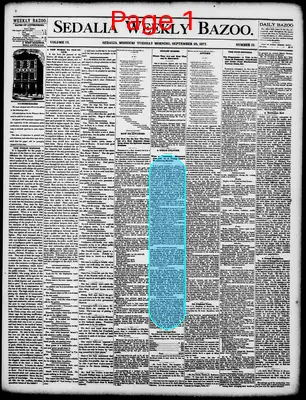
Story
September 25, 1877
The Sedalia Weekly Bazoo
Sedalia, Pettis County, Missouri
What is this article about?
A young lady at Sweet Springs mistakes Samuel Johnson's 'Rasselas' for a prize-fighting book during a conversation, highlighting the superficial education of fashionable women and its potential to ruin marriages.
Clipping
OCR Quality
95%
Excellent
Full Text
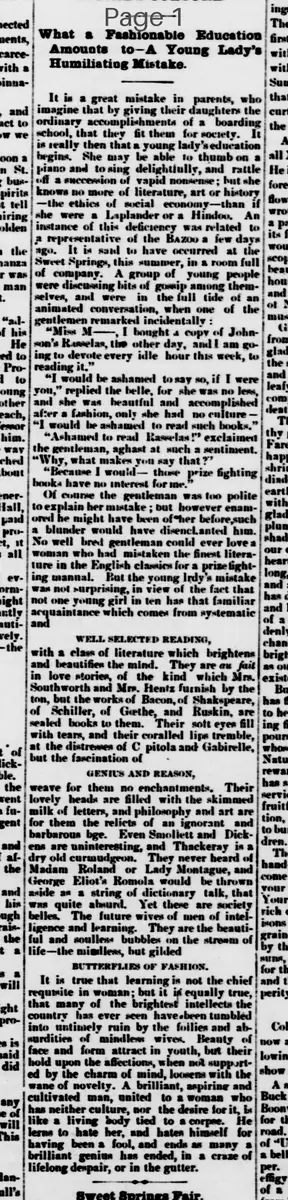
What a Fashionable Education Amounts to—A Young Lady's Humiliating Mistake.
It is a great mistake in parents, who imagine that by giving their daughters the ordinary accomplishments of a boarding school, that they fit them for society. It is really then that a young lady's education begins. She may be able to thumb on a piano and to sing delightfully, and rattle off a succession of vapid nonsense; but she knows no more of literature, art or history—the ethics of social economy—than if she were a Laplander or a Hindoo. An instance of this deficiency was related to a representative of the Bazoo a few days ago. It is said to have occurred at the Sweet Springs, this summer, in a room full of company. A group of young people were discussing bits of gossip among themselves, and were in the full tide of an animated conversation, when one of the gentlemen remarked incidentally:
"Miss M— . I bought a copy of Johnson's Rasselas, the other day, and I am going to devote every idle hour this week, to reading it."
"I would be ashamed to say so, if I were you," replied the belle, for she was no less, and she was beautiful and accomplished after a fashion, only she had no culture— "I would be ashamed to read such books."
"Ashamed to read Rasselas!" exclaimed the gentleman, aghast at such a sentiment. "Why, what makes you say that?"
"Because I would— those prize fighting books have no interest for me."
Of course the gentleman was too polite to explain her mistake: but however enamored he might have been of her before such a blunder would have disenchanted him. No well bred gentleman could ever love a woman who had mistaken the finest literature in the English classics for a prize-fighting annual. But the young lady's mistake was not surprising, in view of the fact that not one young girl in ten has that familiar acquaintance which comes from systematic
WELL SELECTED READING,
with a class of literature which brightens and beautifies the mind. They are au fait in love stories, of the kind which Mrs. Southworth and Mrs. Hentz furnish by the ton, but the works of Bacon, of Shakespeare, of Schiller, of Goethe, and Ruskin, are sealed books to them. Their soft eyes fill with tears, and their coralled lips tremble at the distresses of Capicola and Gabrielle
but the fascination of
GENIUS AND REASON,
weave for them no enchantments. Their lovely heads are filled with the skimmed milk of letters, and philosophy and art are for them the relicts of an ignorant and barbarous age. Even Smollett and Dickens are uninteresting, and Thackeray is a dry old curmudgeon. They never heard of Madam Roland or Lady Montague, and George Eliot's Romola would be thrown aside as a string of dictionary talk, that was quite absurd. Yet these are society belles. The future wives of men of intelligence and learning. They are the beautiful and soulless bubbles on the stream of life—the mindless, but gilded
BUTTERFLIES OF FASHION.
It is true that learning is not the chief requisite in woman; but it is equally true, that many of the brightest intellects the country has ever seen have been tumbled into untimely ruin by the follies and absurdities of mindless wives. Beauty of face and form attract in youth, but their hold upon the affections, when not supported by the charm of mind, loosens with the wane of novelty. A brilliant, aspiring and cultivated man, united to a woman who
has neither culture, nor the desire for it, is
like a living body tied to a corpse.
He learns to hate her, and hates himself for having been a fool, and ends as many brilliant genius has ended, in a craze of lifelong despair, or in the gutter.
It is a great mistake in parents, who imagine that by giving their daughters the ordinary accomplishments of a boarding school, that they fit them for society. It is really then that a young lady's education begins. She may be able to thumb on a piano and to sing delightfully, and rattle off a succession of vapid nonsense; but she knows no more of literature, art or history—the ethics of social economy—than if she were a Laplander or a Hindoo. An instance of this deficiency was related to a representative of the Bazoo a few days ago. It is said to have occurred at the Sweet Springs, this summer, in a room full of company. A group of young people were discussing bits of gossip among themselves, and were in the full tide of an animated conversation, when one of the gentlemen remarked incidentally:
"Miss M— . I bought a copy of Johnson's Rasselas, the other day, and I am going to devote every idle hour this week, to reading it."
"I would be ashamed to say so, if I were you," replied the belle, for she was no less, and she was beautiful and accomplished after a fashion, only she had no culture— "I would be ashamed to read such books."
"Ashamed to read Rasselas!" exclaimed the gentleman, aghast at such a sentiment. "Why, what makes you say that?"
"Because I would— those prize fighting books have no interest for me."
Of course the gentleman was too polite to explain her mistake: but however enamored he might have been of her before such a blunder would have disenchanted him. No well bred gentleman could ever love a woman who had mistaken the finest literature in the English classics for a prize-fighting annual. But the young lady's mistake was not surprising, in view of the fact that not one young girl in ten has that familiar acquaintance which comes from systematic
WELL SELECTED READING,
with a class of literature which brightens and beautifies the mind. They are au fait in love stories, of the kind which Mrs. Southworth and Mrs. Hentz furnish by the ton, but the works of Bacon, of Shakespeare, of Schiller, of Goethe, and Ruskin, are sealed books to them. Their soft eyes fill with tears, and their coralled lips tremble at the distresses of Capicola and Gabrielle
but the fascination of
GENIUS AND REASON,
weave for them no enchantments. Their lovely heads are filled with the skimmed milk of letters, and philosophy and art are for them the relicts of an ignorant and barbarous age. Even Smollett and Dickens are uninteresting, and Thackeray is a dry old curmudgeon. They never heard of Madam Roland or Lady Montague, and George Eliot's Romola would be thrown aside as a string of dictionary talk, that was quite absurd. Yet these are society belles. The future wives of men of intelligence and learning. They are the beautiful and soulless bubbles on the stream of life—the mindless, but gilded
BUTTERFLIES OF FASHION.
It is true that learning is not the chief requisite in woman; but it is equally true, that many of the brightest intellects the country has ever seen have been tumbled into untimely ruin by the follies and absurdities of mindless wives. Beauty of face and form attract in youth, but their hold upon the affections, when not supported by the charm of mind, loosens with the wane of novelty. A brilliant, aspiring and cultivated man, united to a woman who
has neither culture, nor the desire for it, is
like a living body tied to a corpse.
He learns to hate her, and hates himself for having been a fool, and ends as many brilliant genius has ended, in a craze of lifelong despair, or in the gutter.
What sub-type of article is it?
Curiosity
What themes does it cover?
Social Manners
Moral Virtue
What keywords are associated?
Fashionable Education
Humiliating Mistake
Rasselas
Prize Fighting
Cultural Deficiency
Social Blunder
What entities or persons were involved?
Miss M—
The Gentleman
The Young Lady
Where did it happen?
Sweet Springs
Story Details
Key Persons
Miss M—
The Gentleman
The Young Lady
Location
Sweet Springs
Event Date
This Summer
Story Details
A young lady mistakes Johnson's Rasselas for a prize-fighting book in conversation, revealing her lack of cultural education; the article critiques superficial accomplishments in women and warns of marital ruin.