Thank you for visiting SNEWPapers!
Sign up free
The Rhode Island American, And General Advertiser
Providence, Providence County, Rhode Island
What is this article about?
Historical account of a 1816 court-martial on USS Java in Messina harbor, where Commodore Oliver H. Perry was charged by Marine Captain John Heath with abusive language and striking him. Perry claimed provocation from Heath's insolence. Court found Perry partially guilty, issuing a private reprimand after his reconciliation offer. (248 characters)
Clipping
OCR Quality
Full Text
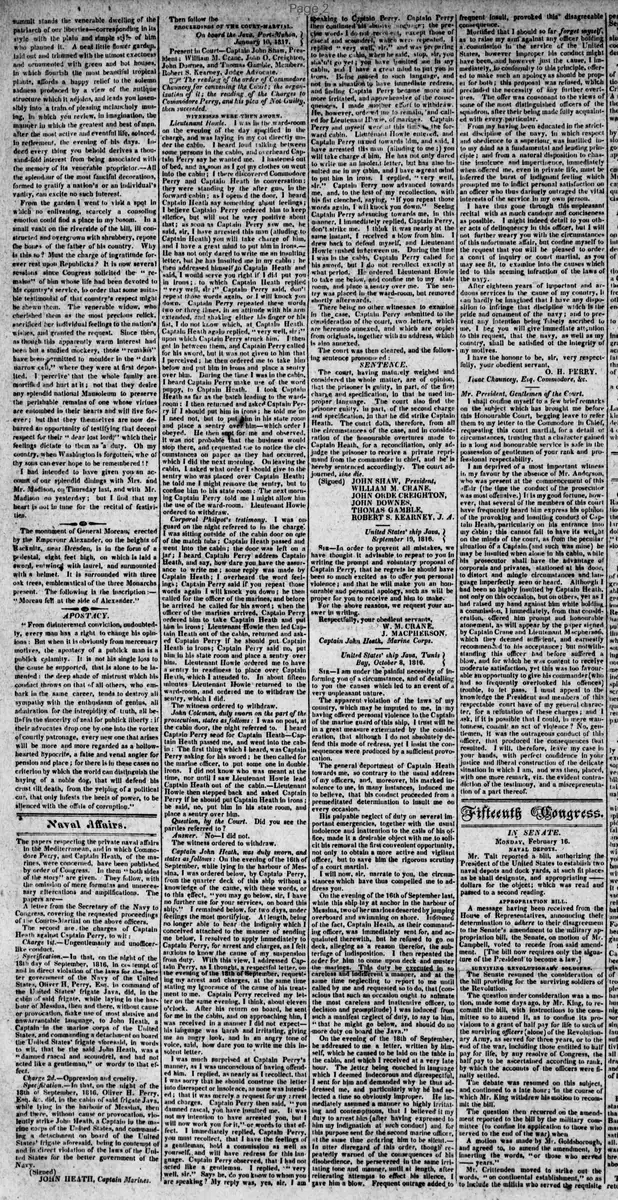
The papers respecting the private naval affairs in the Mediterranean, and in which Commodore Perry, and Captain Heath, of the marines, were concerned, have been published by order of Congress. In them "both sides of the story" are given. They follow, with the omission of mere formulas and unnecessary alterations and amplifications. The papers are—
A letter from the Secretary of the Navy to Congress, covering the requested proceedings of the Courts-Martial on the above officers.
The second are, the charges of Captain Heath against Captain Perry, to wit:
Charge 1st.—Ungentlemanly and un-officer-like conduct.
Specification.—In that, on the night of the 18th day of September, 1816, in contempt of and in direct violation of the laws for the better government of the Navy of the United States, Oliver H. Perry, Esq. in command of the United States' frigate Java, did, in the cabin of said frigate, while laying in the harbour of Messina, then and there, without cause or provocation, make use of most abusive and unwarrantable language, to John Heath, a Captain in the marine corps of the United States, and commanding a detachment on board the United States' frigate aforesaid, in words to wit, that he the said John Heath, was a "damned rascal and scoundrel, and had not acted like a gentleman," or words to that effect.
Charge 2d.—Oppression and cruelty.
Specification.—In that, on the night of the 18th of September, 1816, Oliver H. Perry, Esq. &c. did, in the cabin of said frigate Java, while lying in the harbour of Messina, then and there, without cause or provocation, violently strike John Heath, a Captain in the marine corps of the United States, and commanding a detachment on board of the United States' frigate aforesaid, being in contempt of and in direct violation of the laws of the United States for the better government of the Navy.
(Signed) JOHN HEATH, Captain Marines.
The proceedings of the Court-martial:
On board the Java, Port-Mahon, January 10, 1817.
Present in Court—Captain John Shaw, President; William M. Crane, John O. Creighton, John Downes, and Thomas Gamble, Members.
Robert S. Kearney, Judge Advocate.
The reading of the order of Commodore Chauncey for convening the Court; the organization of it; the reading of the Charges to Commodore Perry, and his plea of Not Guilty, then succeeded.
WITNESSES WERE THEN SWORN.
Lieutenant Howle, I was in the ward-room on the evening of the day specified in the charge, and was lying in my cot directly under the cabin. I heard loud talking between some persons in the cabin, and overheard Captain Perry say he wanted me. I hastened out of bed, and as soon as I got my clothes on went into the cabin; I there discovered Commodore Perry and Captain Heath in conversation; they were standing by the after gun, in the forward cabin; as I opened the door, I heard Captain Heath say something about feelings; I believe Captain Perry ordered him to keep silence, but will not be very positive about that; as soon as Captain Perry saw me, he said, sir, I have arrested this man (alluding to Captain Heath) you will take charge of him, and I have a great mind to put him in irons.—He has not only dared to write me an insulting letter, but he has insulted me in my cabin: he then addressed himself to Captain Heath and said, I would serve you right if I did put you in irons; to which Captain Heath replied "very well, sir;" Captain Perry said, don't repeat those words again, or I will knock you down. Captain Perry repeated these words two or three times, in an attitude with his arm extended, and shaking either his finger or his fist, I do not know which, at Captain Heath. Captain Heath again replied, "very well, sir;" upon which Captain Perry struck him. I then got in between them, and Captain Perry called for his sword, but it was not given to him that I perceived; he then ordered me to take him below and put him in irons and place a sentry over him. During the time I was in the cabin, I heard Captain Perry make use of the word puppy, to Captain Heath. I took Captain Heath as far as the hatch leading to the ward-room: I then returned and asked Captain Perry if I should put him in irons: he told me no, I need not, but to put him in his state room and place a sentry over him—which order I obeyed. He then sent for me and observed, it was not probable that the business would stop there, and requested me to notice the circumstances on paper as they had occurred, which I did the next morning. On leaving the cabin, I asked what order I should give to the sentry who was placed over Captain Heath; he told me I might remove the sentry, but to confine him to his state room: The next morning Captain Perry told me I might allow him the use of the ward-room. Lieutenant Howle ordered to withdraw.
Corporal Philpot's testimony. I was on guard on the night referred to in the charge. I was sitting outside of the cabin door on one of the match tubs; Captain Heath passed and went into the cabin; the door was left on a jar; I heard Captain Perry address Captain Heath, and say, how dare you have the assurance to write me; some reply was made by Captain Heath; I overheard the word feelings; Captain Perry said if you repeat those words again I will knock you down; he then called for the officer of the marines, and before he arrived he called for his sword; when the officer of the marines arrived, Captain Perry ordered him to take Captain Heath and put him in irons; Lieutenant Howle then led Captain Heath out of the cabin, returned and asked Captain Perry if he should put Captain Heath in irons; Captain Perry said no, put him in his state room and place a sentry over him. Lieutenant Howle ordered me to have a sentry in readiness to place over Captain Heath, which I attended to. In about fifteen minutes Lieutenant Howle returned to the ward-room, and ordered me to withdraw the sentry, which I did. The witness ordered to withdraw.
John Coleman, duly sworn on the part of the prosecution, states as follows: I was on post, at the cabin door, the night referred to. I heard Captain Perry send for Captain Heath—Captain Heath passed me, and went into the cabin: The first thing which I heard, was Captain Perry asking for his sword; he then called for the marine officer, to put some one in double irons. I did not know who was meant at the time, nor until I saw Lieutenant Howle lead Captain Heath out of the cabin.—Lieutenant Howle then stepped back and asked Captain Perry if he should put Captain Heath in irons; he said, no, put him in his state room, and place a sentry over him.
Question, by the Court. Did you see the parties referred to?
Answer. No—I did not.
The witness ordered to withdraw.
Captain John Heath, was duly sworn, and states as follows: On the evening of the 16th of September, while lying in the harbour of Messina, I was ordered below, by Captain Perry, from the quarter deck of this ship without a knowledge of the cause, with these words, or to this effect, "you may go below, sir, I have no further use for your services, on board this ship." I remained below, for two days, under feelings the most mortifying. At length, being no longer able to bear the indignity which I conceived attached to the manner of sending me below, I resolved to apply immediately to Captain Perry, for arrest and charges, as I felt anxious to know the cause of my suspension from duty. With this view, I addressed Captain Perry, as I thought, a respectful letter, on the evening of the 18th of September, requesting my arrest and charges, at the same time stating my ignorance of the cause of his treatment to me. Captain Perry received my letter on the same evening, I think, about eleven o'clock. After his return on board, he sent for me in the cabin, and on approaching him, I was received in a manner I did not expect—his language was harsh and irritating, giving me an angry look, and in an angry tone of voice, said, how dare you to write me this insolent letter.
I was much surprised at Captain Perry's manner, as I was unconscious of having offended him. I replied, as nearly as I recollect, that I was sorry that he should construe the letter into disrespect or insolence, as none was intended; that it was merely a request for my arrest and charges. Captain Perry then said, "you damned rascal, you have insulted me. It was not my intention to have arrested you, but I will now work you for it,"—or words to that effect. I immediately replied, Captain Perry, you must recollect, that I have the feelings of a gentleman, hold a commission as well as yourself, and will have redress for this language. Captain Perry observed, that I had not acted like a gentleman. I replied, "very well, sir." Says he, do you know to whom you are speaking? My reply was, yes, sir, I am speaking to Captain Perry. Captain Perry then continued his abusive language; the precise words I do not recollect, except those of rascal and scoundrel, which were repeated. I replied "very well, sir." and was preparing to leave the cabin, when he said, stop, sir, you sha'n't go yet; you have insulted me in my cabin, and I have a great mind to put you in irons. Being pummelled to such language, and not in a situation to have immediate redress, and finding Captain Perry became more and more irritated, and apprehensive of the consequences, I made another effort to withdraw. He, however, ordered me to remain, and called for Lieutenant Howle, of marines. Captain Perry and myself were at this time in the forward cabin. Lieutenant Howle entered, and Captain Perry turned towards him, and said, I have arrested this man (alluding to me;) you will take charge of him. He has not only dared to write me an insolent letter, but has also insulted me in my cabin, and I have a great mind to put you in irons. I replied, "very well, sir." Captain Perry now advanced towards me, and, to the best of my recollection, with his fist clenched, saying, "if you repeat those words again, I'll knock you down." Seeing Captain Perry advancing towards me, in this manner, I immediately replied, Captain Perry, don't strike me. I think it was nearly at the same instant, I received a blow from him. I drew back to defend myself, and Lieutenant Howle rushed in between us. During the time I was in the cabin, Captain Perry called for his sword, but I do not recollect exactly at what period. He ordered Lieutenant Howle to take me below, and confine me to my state room, and place a sentry over me. The sentry was placed in the ward-room, but removed shortly afterwards.
There being no other witnesses to examine in the case, Captain Perry submitted to the consideration of the court, two letters, which are hereunto annexed, and which are copies from originals, together with an address, which is also annexed.
The court was then cleared, and the following sentence pronounced:
SENTENCE.
The court, having maturely weighed and considered the whole matter, are of opinion, that the prisoner is guilty, in part, of the first charge and specification, in that he used improper language. The court also find the prisoner guilty, in part, of the second charge and specification, in that he did strike Captain Heath. The court doth, therefore, from all the circumstances of the case, and in consideration of the honourable overtures made to Captain Heath, for a reconciliation, only adjudge the prisoner to receive a private reprimand from the commander in chief, and he is hereby sentenced accordingly.
The court adjourned, sine die.
(Signed) JOHN SHAW, President,
WILLIAM M. CRANE.
JOHN ORDE CREIGHTON,
JOHN DOWNES,
THOMAS GAMBLE,
ROBERT S. KEARNEY, J. A.
United States' ship Java,
September 19, 1816.
Sir—In order to prevent all mistakes, we have thought it advisable to repeat to you in writing the prompt and voluntary proposal of Captain Perry, that he regrets he should have been so much excited as to offer you personal violence; and that he will make you an honourable and personal apology, such as will be proper for you to receive and him to make.
For the above reasons, we request your answer in writing.
Respectfully, your obedient servants,
W M. CRANE.
J. MACPHERSON.
Captain John Heath, Marine Corps.
United States' ship Java, Tunis
Bay, October 8, 1816.
Sir—I am under the painful necessity of informing you of a circumstance, and of detailing to you the causes which led to an event of a very unpleasant nature.
The apparent violation of the laws of my country, which may be imputed to me, in my having offered personal violence to the Captain of the marine guard of this ship, I trust will be in a great measure extenuated by the consideration, that although I do not absolutely defend this mode of redress, yet I insist the consequences were produced by a sufficient provocation.
The general deportment of Captain Heath towards me, so contrary to the usual address of my officers, and, moreover, his marked insolence to me, in many instances, induced me to believe, that his conduct proceeded from a premeditated determination to insult me on every occasion.
His palpable neglect of duty on several important emergencies, together with the usual indolence and inattention to the calls of his office, made it a desirable object with me to solicit his removal the first convenient opportunity, not only to obtain a more active and vigilant officer, but to save him the rigorous scrutiny of a court martial.
I will now, sir, narrate to you, the circumstances which have thus compelled me to address you.
On the evening of the 16th of September last, while this ship lay at anchor in the harbour of Messina, two of her marines deserted by jumping overboard and swimming on shore. Informed of the act, Captain Heath, as their commanding officer, was immediately sent for, and acquainted therewith, but he refused to go on deck, alleging as a reason therefor, the subterfuge of indisposition. I then repeated the order for him to come upon deck and muster the marines. This duty he executed in so careless and indifferent a manner, and at the same time neglecting to report to me until called by me and requested so to do, that (conscious that such an occasion ought to animate the most careless and inattentive officer, to decision and promptitude) I was induced from such a manifest neglect of duty, to say to him, "that he might go below, and should do no more duty on board the Java."
On the evening of the 18th of September, he addressed to me a letter, written by himself, which he caused to be laid on the table in the cabin, and which I received at a very late hour. The letter being couched in language which I deemed indecorous and disrespectful, I sent for him and demanded why he thus addressed me, and particularly why he had selected a time so obviously improper. He immediately assumed a manner so highly irritating and contemptuous, that I believed it my duty to arrest him (after having expressed to him my indignation at such conduct) and for this purpose sent for the second marine officer, at the same time ordering him to be silent.—In utter disregard of this order, though repeatedly warned of the consequences of his disobedience, he persevered in the same irritating tone and manner, until at length, after reiterating attempts to effect his silence, I gave him a blow. Frequent outrage added to frequent insult, provoked this disagreeable consequence.
Mortified that I should so far forget myself as to raise my arm against any officer holding a commission in the service of the United States, however improper his conduct might have been, and however just the cause, I immediately, in conformity to this principle, offered to make such an apology as should be proper for both; this proposal was refused, which precluded the necessity of any further overtures. The offer was consonant to the views of some of the most distinguished officers of the squadron, after their being made fully acquainted with every particular.
From my having been educated in the strictest discipline of the navy, in which respect and obedience to a superior, was instilled into my mind as a fundamental and leading principle; and from a natural disposition to chastise insolence and impertinence, immediately when offered me, even in private life, must be inferred the burst of indignant feeling which prompted me to inflict personal satisfaction on an officer who thus daringly outraged the vital interests of the service in my own person.
I have thus gone through this unpleasant recital with as much candour and conciseness as possible. I might indeed detail to you other acts of delinquency in this officer, but I will not further weary you with the circumstances of this unfortunate affair, but confine myself to the request that you will be pleased to order a court of inquiry or court martial, as you may see fit, to examine into the causes which led to this seeming infraction of the laws of the navy.
After eighteen years of important and arduous services in the cause of my country, I can hardly be imagined that I have any disposition to infringe that discipline which is the pride and ornament of the navy; and to prevent any intention being falsely ascribed to me, I beg you will give immediate attention to this request, that the navy, as well as my country, shall be satisfied of the integrity of my motives.
I have the honour to be, sir, very respectfully, your obedient servant,
O. H. PERRY.
Isaac Chauncey, Esq. Commodore, &c.
Mr. President, Gentlemen of the Court.
I shall confine myself to a few brief remarks on the subject which has brought me before this Honourable Court, begging leave to refer them to my letter to the Commodore in Chief, requesting this court martial, or a detail of circumstances, trusting that a character gained in a long and honourable service is safe in the possession of gentlemen of your rank and professional respectability.
I am deprived of a most important witness in my favour by the absence of Mr. Anderson, who was present at the commencement of this affair (the time the conduct of the prosecutor was most offensive.) It is my good fortune, however, that several of the members of this court have frequently heard him express his opinion of the provoking and insulting conduct of Captain Heath, particularly on his entrance into my cabin; this cannot fail to have its weight on the minds of the court, as from the peculiar situation of a Captain (and such was mine) he may be insulted when alone in his cabin, while his prosecutor shall have the advantage of corporals and privates, stationed at his door, to distort and mingle circumstances and language imperfectly seen or heard. Although I had been so highly insulted by Captain Heath, not only on this occasion, but on others, yet as I had raised my hand against him while holding a commission, I immediately, from that consideration, offered him prompt and honourable atonement, as will appear by the paper signed by Captain Crane and Lieutenant Macpherson which they deemed sufficient, and earnestly recommended to his acceptance; but notwithstanding this officer had before suffered a blow, and for which he was content to receive moderate satisfaction, yet this was too favourable an opportunity to give his commander (who had so frequently overlooked his offences) trouble, to let pass, I must appeal to the knowledge the President and members of this respectable court have of my general character, for a refutation of these charges; and ask, if it is possible that I could, in mere wantonness, commit an act of violence? No, gentlemen, it was the outrageous conduct of this officer, that produced the consequences that resulted. I will, therefore, leave my case in your hands, with perfect confidence in your justice and liberal construction of the delicate situation in which I am, and was then, placed, with one more remark, viz. the evident contradiction of the testimony, and a misrepresentation of a part thereof.
What sub-type of article is it?
What themes does it cover?
What keywords are associated?
What entities or persons were involved?
Where did it happen?
Story Details
Key Persons
Location
Harbour Of Messina, On Board The United States' Frigate Java
Event Date
September 18, 1816
Story Details
Captain Heath charges Commodore Perry with ungentlemanly conduct and striking him without provocation in the cabin of the USS Java. Testimony from witnesses describes the altercation escalating from a letter dispute to physical violence. Perry defends his actions as provoked by Heath's insolence and neglect of duty. The court-martial finds Perry guilty in part and sentences him to a private reprimand, considering his offer of reconciliation.