Thank you for visiting SNEWPapers!
Sign up free
Story
October 19, 1870
Public Ledger
Memphis, Shelby County, Tennessee
What is this article about?
A writer in London Society praises unmarried heiresses as clever, cultured, and generous women who avoid fortune hunters, often remaining single by choice. They possess wide sympathies and contribute bountifully without selfish motives, sometimes marrying late in life.
Clipping
OCR Quality
95%
Excellent
Full Text
Heiresses and Heiress-Hunters,
A writer in the London Society says:
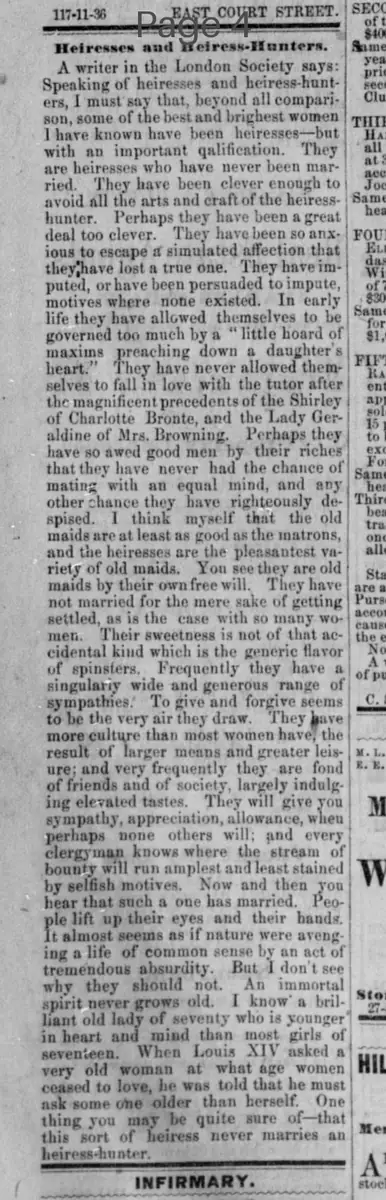
Speaking of heiresses and heiress-hunters, I must say that, beyond all comparison, some of the best and brightest women I have known have been heiresses—but with an important qualification. They are heiresses who have never been married. They have been clever enough to avoid all the arts and craft of the heiress-hunter. Perhaps they have been a great deal too clever. They have been so anxious to escape a simulated affection that they have lost a true one. They have imputed, or have been persuaded to impute, motives where none existed. In early life they have allowed themselves to be governed too much by a "little hoard of maxims preaching down a daughter's heart." They have never allowed themselves to fall in love with the tutor after the magnificent precedents of the Shirley of Charlotte Bronte, and the Lady Geraldine of Mrs. Browning. Perhaps they have so awed good men by their riches that they have never had the chance of mating with an equal mind, and any other chance they have righteously despised. I think myself that the old maids are at least as good as the matrons, and the heiresses the pleasantest variety of old maids. You see they are old maids by their own free will. They have not married for the mere sake of getting married, as in the case with so many women. Their sweetness is not of that accidental kind which is the generic favor of spinsters. Frequently they have a singularly wide and generous range of sympathies. To give and forgive seems to be the very air they draw. They have more culture than most women have, the result of larger means and greater leisure; and very frequently they are fond of friends and of society, largely indulging elevated tastes. They will give you sympathy, appreciation, allowance, when perhaps none others will; and every clergyman knows where the stream of bounty will run amplest and least stained by selfish motives. Now and then you hear that such a one has married. People lift up their eyes and their hands. It almost seems as if nature were avenging a life of common sense by an act of tremendous absurdity. But I don't see why they should not. An immortal spirit never grows old. I know a brilliant old lady of seventy who is younger in heart and mind than most girls of seventeen. When Louis XIV asked a very old woman at what age women ceased to love, he was told that he must ask some one older than herself. One thing you may be quite sure of—that this sort of heiress never marries an heiress-hunter.
A writer in the London Society says:
Speaking of heiresses and heiress-hunters, I must say that, beyond all comparison, some of the best and brightest women I have known have been heiresses—but with an important qualification. They are heiresses who have never been married. They have been clever enough to avoid all the arts and craft of the heiress-hunter. Perhaps they have been a great deal too clever. They have been so anxious to escape a simulated affection that they have lost a true one. They have imputed, or have been persuaded to impute, motives where none existed. In early life they have allowed themselves to be governed too much by a "little hoard of maxims preaching down a daughter's heart." They have never allowed themselves to fall in love with the tutor after the magnificent precedents of the Shirley of Charlotte Bronte, and the Lady Geraldine of Mrs. Browning. Perhaps they have so awed good men by their riches that they have never had the chance of mating with an equal mind, and any other chance they have righteously despised. I think myself that the old maids are at least as good as the matrons, and the heiresses the pleasantest variety of old maids. You see they are old maids by their own free will. They have not married for the mere sake of getting married, as in the case with so many women. Their sweetness is not of that accidental kind which is the generic favor of spinsters. Frequently they have a singularly wide and generous range of sympathies. To give and forgive seems to be the very air they draw. They have more culture than most women have, the result of larger means and greater leisure; and very frequently they are fond of friends and of society, largely indulging elevated tastes. They will give you sympathy, appreciation, allowance, when perhaps none others will; and every clergyman knows where the stream of bounty will run amplest and least stained by selfish motives. Now and then you hear that such a one has married. People lift up their eyes and their hands. It almost seems as if nature were avenging a life of common sense by an act of tremendous absurdity. But I don't see why they should not. An immortal spirit never grows old. I know a brilliant old lady of seventy who is younger in heart and mind than most girls of seventeen. When Louis XIV asked a very old woman at what age women ceased to love, he was told that he must ask some one older than herself. One thing you may be quite sure of—that this sort of heiress never marries an heiress-hunter.
What sub-type of article is it?
Biography
Curiosity
What themes does it cover?
Social Manners
Moral Virtue
What keywords are associated?
Unmarried Heiresses
Fortune Hunters
Social Commentary
Women's Independence
Cultural Leisure
Story Details
Story Details
The writer extols unmarried heiresses for evading fortune hunters through cleverness, leading to fulfilling single lives marked by culture, generosity, and broad sympathies, superior to many married women.