Thank you for visiting SNEWPapers!
Sign up free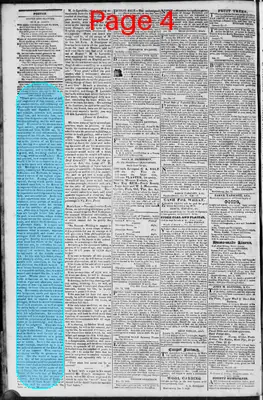
Story
February 14, 1828
Martinsburg Gazette And Public Advertiser
Martinsburg, Berkeley County, West Virginia
What is this article about?
Biographical sketch of Chief Justice John Marshall from an essay by Treasury Secretary Rush, praising his intellectual depth, independence, and enduring contributions to American law as a national treasure.
Clipping

OCR Quality
100%
Excellent
Full Text
The following portrait of Chief Justice Marshall, is taken from the concluding pages of an essay on the jurisprudence of the United States, written ten or twelve years ago by Mr. Rush, the present Secretary of the Treasury.
THE CHIEF JUSTICE,
There graces the first seat of judicial magistracy of this country, a man of another stamp, and exhibiting different aspects of intellectual excellence. Venerable and dignified, laborious and intuitive, common law, constitutional law, and admiralty law, each make their demands upon his profound, his discriminating, and his well stored mind. Universal in his attainments in legal science, prompt and patient, courteous and firm, he fills up, by a combination of rare endowments, the measure of his difficult, his extensive, and his responsible duties, responsible, not to the dictates of an Executive, but, moving in a sphere of true independence, responsible to his conscience, to his country, and to his God. What a grand, and, to a mind exalted and virtuous, what an awful sphere! How independent, how responsible! Vain would it be for us to expect to do justice to the merit with which he moves in it. Bred up in a State rich in great names, counting her Washingtons, her Jeffersons, her Madisons, he long sustained a career of the highest reputation at the bar. Passing, after a short interval, during which public honors thickened upon him, to the Bench of the supreme Court of the United States, he carried to its duties a mind matured by experience and invigorated by long daily, and successful toil. In the mixed and voluminous state of our jurisprudence, every portion of which occasionally comes under his review, and in the novelties of our political state, often does it happen that questions are brought before him where the path is untrodden, where neither the bookcase nor the record exists to guide, and where the elementary water glimmers dimly. It is upon such occasions that he pierces what is dark, examines what is remote, separates what is entangled, and draws down analogies from the fountain of first principles. Seizing with a large grasp what none but minds of the highest order can see, he embodies his comprehensive and distinct conceptions in language not sarcastic, but suited to the solemnity of the temple around him. In this way he is found, always with masterly ability, and most frequently with conviction, to lay open and elucidate the difficult subject. If there be any learning applicable to it, it is reasonable to think, that, to a mind formed and trained like his, it will be at hand. Where there is none, the fertile deductions of his own independent vigor and clearness stand in the place of learning, and will become learning, to those who are to live after him. His country alternately a neutral and belligerent, again and again he is called upon to expound the volume of national law, to explore its intricate passages, to mark its nicest limitations. Upon such occasions, as well as upon the entire body of commercial law, so copiously in the last resort intermingled with his adjudications, his recorded opinions will best make known to the world the penetration of his views, the extent of his knowledge, and the solidity of his judgment. They are a national treasure. They will be a stream of light to after times. Posterity will read in them as well the rule of conduct, as the monuments of a genius that would have done honor to any age or nation. Such is the sketch we would attempt, imperfect as it is, of the judicial character of the Chief Justice of our country. That country is advancing swiftly to greatness and glory. To the world at large, the early day of her jurisprudence may remain unknown until the period of her mature fame shall arrive, but then it will break into light, and the name of this great Judge, like the Fortescues and Cokes, of the early day of England, acquire, by time, its just increase of renown. Let the Courts of England boast of Sir William Scott. Those of America will be content with the name of John Marshall.
THE CHIEF JUSTICE,
There graces the first seat of judicial magistracy of this country, a man of another stamp, and exhibiting different aspects of intellectual excellence. Venerable and dignified, laborious and intuitive, common law, constitutional law, and admiralty law, each make their demands upon his profound, his discriminating, and his well stored mind. Universal in his attainments in legal science, prompt and patient, courteous and firm, he fills up, by a combination of rare endowments, the measure of his difficult, his extensive, and his responsible duties, responsible, not to the dictates of an Executive, but, moving in a sphere of true independence, responsible to his conscience, to his country, and to his God. What a grand, and, to a mind exalted and virtuous, what an awful sphere! How independent, how responsible! Vain would it be for us to expect to do justice to the merit with which he moves in it. Bred up in a State rich in great names, counting her Washingtons, her Jeffersons, her Madisons, he long sustained a career of the highest reputation at the bar. Passing, after a short interval, during which public honors thickened upon him, to the Bench of the supreme Court of the United States, he carried to its duties a mind matured by experience and invigorated by long daily, and successful toil. In the mixed and voluminous state of our jurisprudence, every portion of which occasionally comes under his review, and in the novelties of our political state, often does it happen that questions are brought before him where the path is untrodden, where neither the bookcase nor the record exists to guide, and where the elementary water glimmers dimly. It is upon such occasions that he pierces what is dark, examines what is remote, separates what is entangled, and draws down analogies from the fountain of first principles. Seizing with a large grasp what none but minds of the highest order can see, he embodies his comprehensive and distinct conceptions in language not sarcastic, but suited to the solemnity of the temple around him. In this way he is found, always with masterly ability, and most frequently with conviction, to lay open and elucidate the difficult subject. If there be any learning applicable to it, it is reasonable to think, that, to a mind formed and trained like his, it will be at hand. Where there is none, the fertile deductions of his own independent vigor and clearness stand in the place of learning, and will become learning, to those who are to live after him. His country alternately a neutral and belligerent, again and again he is called upon to expound the volume of national law, to explore its intricate passages, to mark its nicest limitations. Upon such occasions, as well as upon the entire body of commercial law, so copiously in the last resort intermingled with his adjudications, his recorded opinions will best make known to the world the penetration of his views, the extent of his knowledge, and the solidity of his judgment. They are a national treasure. They will be a stream of light to after times. Posterity will read in them as well the rule of conduct, as the monuments of a genius that would have done honor to any age or nation. Such is the sketch we would attempt, imperfect as it is, of the judicial character of the Chief Justice of our country. That country is advancing swiftly to greatness and glory. To the world at large, the early day of her jurisprudence may remain unknown until the period of her mature fame shall arrive, but then it will break into light, and the name of this great Judge, like the Fortescues and Cokes, of the early day of England, acquire, by time, its just increase of renown. Let the Courts of England boast of Sir William Scott. Those of America will be content with the name of John Marshall.
What sub-type of article is it?
Biography
What themes does it cover?
Triumph
Justice
Moral Virtue
What keywords are associated?
Chief Justice Marshall
Judicial Excellence
Us Jurisprudence
Supreme Court
Legal Genius
What entities or persons were involved?
Chief Justice Marshall
John Marshall
Mr. Rush
Where did it happen?
United States
Story Details
Key Persons
Chief Justice Marshall
John Marshall
Mr. Rush
Location
United States
Event Date
Ten Or Twelve Years Ago
Story Details
Portrait of Chief Justice John Marshall as a venerable, dignified jurist excelling in various legal fields, independent and responsible to conscience, country, and God; his career from bar to Supreme Court, handling novel questions with profound insight; his opinions as national treasure for posterity.