Thank you for visiting SNEWPapers!
Sign up free
Editorial
February 6, 1793
National Gazette
Philadelphia, Philadelphia County, Pennsylvania
What is this article about?
David Jones critiques current U.S. strategies in the Indian War, opposing standing armies in peacetime and ineffective frontier forts. He advocates stationing a regular army near Detroit for strategic excursions to force peace, dismissing fears of war with England amid European upheavals. Signed from Philadelphia County, Jan. 31.
Clipping
OCR Quality
95%
Excellent
Full Text
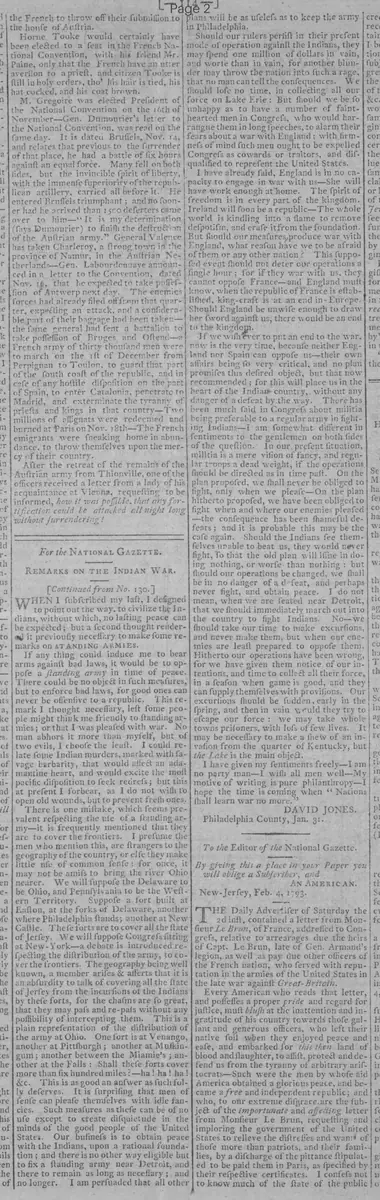
For the NATIONAL GAZETTE.
REMARKS ON THE INDIAN WAR.
[Continued from No. 130.]
WHEN I subscribed my last, I designed to point out the way, to civilize the Indians, without which, no lasting peace can be expected; but a second thought rendered it previously necessary to make some remarks on STANDING ARMIES.
If any thing could induce me to bear arms against bad laws, it would be to oppose a standing army in time of peace. There could be no object in such measures, but to enforce bad laws, for good ones can never be offensive to a republic. This remark I thought necessary, lest some people might think me friendly to standing armies; or that I was pleased with war. No man abhors it more than myself, but of two evils, I choose the least. I could relate some Indian murders, marked with savage barbarity, that would affect an adamant heart, and would excite the most pacific disposition to seek redress; but this at present I forbear, as I do not wish to open old wounds, but to prevent fresh ones.
There is one mistake, which seems prevalent respecting the use of a standing army—it is frequently mentioned that they are to cover the frontiers. I presume the men who mention this, are strangers to the geography of the country, or else they make little use of common sense: or once, it may not be amiss to bring the river Ohio nearer. We will suppose the Delaware to be Ohio, and Pennsylvania to be the Western Territory. Suppose a fort built at Easton, at the forks of Delaware, another where Philadelphia stands; another at New Castle. These forts are to cover all the state of Jersey. We will suppose Congress sitting at New-York—a debate is introduced respecting the distribution of the army, to cover the frontiers. The geography being well known, a member arises & asserts that it is an absurdity to talk of covering all the state of Jersey from the incursions of the Indians by these forts, for the chains are so great, that they may pass and re-pass without any possibility of intercepting them. This is a plain representation of the distribution of the army at Ohio. One fort is at Venango, another at Pittsburgh; another at Muskingum; another between the Miamis; another at the Falls: Shall these forts cover more than six hundred miles?—ha! ha! ha! &c. This is as good an answer as such folly deserves. It is surprising that men of sense can please themselves with idle fancies. Such measures as these can be of no use except to create disquietude in the minds of the good people of the United States. Our business is to obtain peace with the Indians, upon a rational foundation; and there is no other way eligible but to fix a standing army near Detroit, and there to remain as long as necessary; and no longer. I am persuaded that all other plans will be as useless as to keep the army in Philadelphia.
Should our rulers persist in their present mode of operation against the Indians, they may spend one million of dollars in vain, and worse than in vain, for another blunder may throw the nation into such a rage, that no man can tell the consequences. We should lose no time, in collecting all our force on Lake Erie: But should we be so unhappy as to have a number of faint-hearted men in Congress, who would harangue them in long speeches, to alarm their fears about a war with England; with firmness of mind such men ought to be expelled Congress as cowards or traitors, and disqualified to represent the United States.
I have already said, England is in no capacity to engage in war with us—She will have work enough at home. The spirit of freedom is in every part of the kingdom. Ireland will soon be a republic—The whole world is kindling into a flame to remove despotism, and erase it from the foundation. But should our measures produce war with England, what reason have we to be afraid of them or any other nation? This supposed event should not deter our operations a single hour; for if they war with us, they cannot oppose France—and England must know, when the republic of France is established, king-craft is at an end in Europe. Should England be unwise enough to draw her sword against us, there would be an end to the kingdom.
If we wish ever to put an end to the war, now is the very time, because neither England nor Spain can oppose us—their own affairs being so very critical, and no plan promises this desired object, but that now recommended; for this will place us in the heart of the Indian country, without any danger of a defeat by the way. There has been much said in Congress about militia being preferable to a regular army in fighting Indians—I am somewhat different in sentiments to the gentlemen on both sides of the question. In our present situation, militia is a mere vision of fancy, and regular troops a dead weight, if the operations should be directed as in time past. On the plan proposed, we shall never be obliged to fight, only when we please—On the plan hitherto proposed, we have been obliged to fight when and where our enemies pleased—the consequence has been shameful defeats; and it is probable this may be the case again. Should the Indians see themselves unable to beat us, they would never fight, so that the old plan will issue in doing nothing, or worse than nothing: but should our operations be changed, we shall be in no danger of a defeat, and perhaps never fight, and obtain peace. I do not mean, when we are seated near Detroit, that we should immediately march out into the country to fight Indians. No—we should take our time to make excursions, and never make them, but when our enemies are least prepared to oppose them.
Hitherto our operations have been wrong, for we have given them notice of our intentions, and time to collect all their force, in a season when game is good, and they can supply themselves with provisions. Our excursions should be sudden, early in the spring, and then in vain would they try to escape our force: we may take whole towns prisoners, with loss of few lives. It may be necessary to make a show of an invasion from the quarter of Kentucky, but the Lake is the main object.
I have given my sentiments freely—I am no party man—I wish all men well—My motive of writing is pure philanthropy—I hope the time is coming when
Nations shall learn war no more.
DAVID JONES.
Philadelphia County, Jan. 31.
REMARKS ON THE INDIAN WAR.
[Continued from No. 130.]
WHEN I subscribed my last, I designed to point out the way, to civilize the Indians, without which, no lasting peace can be expected; but a second thought rendered it previously necessary to make some remarks on STANDING ARMIES.
If any thing could induce me to bear arms against bad laws, it would be to oppose a standing army in time of peace. There could be no object in such measures, but to enforce bad laws, for good ones can never be offensive to a republic. This remark I thought necessary, lest some people might think me friendly to standing armies; or that I was pleased with war. No man abhors it more than myself, but of two evils, I choose the least. I could relate some Indian murders, marked with savage barbarity, that would affect an adamant heart, and would excite the most pacific disposition to seek redress; but this at present I forbear, as I do not wish to open old wounds, but to prevent fresh ones.
There is one mistake, which seems prevalent respecting the use of a standing army—it is frequently mentioned that they are to cover the frontiers. I presume the men who mention this, are strangers to the geography of the country, or else they make little use of common sense: or once, it may not be amiss to bring the river Ohio nearer. We will suppose the Delaware to be Ohio, and Pennsylvania to be the Western Territory. Suppose a fort built at Easton, at the forks of Delaware, another where Philadelphia stands; another at New Castle. These forts are to cover all the state of Jersey. We will suppose Congress sitting at New-York—a debate is introduced respecting the distribution of the army, to cover the frontiers. The geography being well known, a member arises & asserts that it is an absurdity to talk of covering all the state of Jersey from the incursions of the Indians by these forts, for the chains are so great, that they may pass and re-pass without any possibility of intercepting them. This is a plain representation of the distribution of the army at Ohio. One fort is at Venango, another at Pittsburgh; another at Muskingum; another between the Miamis; another at the Falls: Shall these forts cover more than six hundred miles?—ha! ha! ha! &c. This is as good an answer as such folly deserves. It is surprising that men of sense can please themselves with idle fancies. Such measures as these can be of no use except to create disquietude in the minds of the good people of the United States. Our business is to obtain peace with the Indians, upon a rational foundation; and there is no other way eligible but to fix a standing army near Detroit, and there to remain as long as necessary; and no longer. I am persuaded that all other plans will be as useless as to keep the army in Philadelphia.
Should our rulers persist in their present mode of operation against the Indians, they may spend one million of dollars in vain, and worse than in vain, for another blunder may throw the nation into such a rage, that no man can tell the consequences. We should lose no time, in collecting all our force on Lake Erie: But should we be so unhappy as to have a number of faint-hearted men in Congress, who would harangue them in long speeches, to alarm their fears about a war with England; with firmness of mind such men ought to be expelled Congress as cowards or traitors, and disqualified to represent the United States.
I have already said, England is in no capacity to engage in war with us—She will have work enough at home. The spirit of freedom is in every part of the kingdom. Ireland will soon be a republic—The whole world is kindling into a flame to remove despotism, and erase it from the foundation. But should our measures produce war with England, what reason have we to be afraid of them or any other nation? This supposed event should not deter our operations a single hour; for if they war with us, they cannot oppose France—and England must know, when the republic of France is established, king-craft is at an end in Europe. Should England be unwise enough to draw her sword against us, there would be an end to the kingdom.
If we wish ever to put an end to the war, now is the very time, because neither England nor Spain can oppose us—their own affairs being so very critical, and no plan promises this desired object, but that now recommended; for this will place us in the heart of the Indian country, without any danger of a defeat by the way. There has been much said in Congress about militia being preferable to a regular army in fighting Indians—I am somewhat different in sentiments to the gentlemen on both sides of the question. In our present situation, militia is a mere vision of fancy, and regular troops a dead weight, if the operations should be directed as in time past. On the plan proposed, we shall never be obliged to fight, only when we please—On the plan hitherto proposed, we have been obliged to fight when and where our enemies pleased—the consequence has been shameful defeats; and it is probable this may be the case again. Should the Indians see themselves unable to beat us, they would never fight, so that the old plan will issue in doing nothing, or worse than nothing: but should our operations be changed, we shall be in no danger of a defeat, and perhaps never fight, and obtain peace. I do not mean, when we are seated near Detroit, that we should immediately march out into the country to fight Indians. No—we should take our time to make excursions, and never make them, but when our enemies are least prepared to oppose them.
Hitherto our operations have been wrong, for we have given them notice of our intentions, and time to collect all their force, in a season when game is good, and they can supply themselves with provisions. Our excursions should be sudden, early in the spring, and then in vain would they try to escape our force: we may take whole towns prisoners, with loss of few lives. It may be necessary to make a show of an invasion from the quarter of Kentucky, but the Lake is the main object.
I have given my sentiments freely—I am no party man—I wish all men well—My motive of writing is pure philanthropy—I hope the time is coming when
Nations shall learn war no more.
DAVID JONES.
Philadelphia County, Jan. 31.
What sub-type of article is it?
Indian Affairs
Military Affairs
War Or Peace
What keywords are associated?
Indian War
Standing Army
Detroit Strategy
Frontier Forts
Peace Negotiations
European Revolutions
Military Operations
What entities or persons were involved?
Indians
Congress
England
France
David Jones
Editorial Details
Primary Topic
Strategic Placement Of Army Near Detroit To End Indian War
Stance / Tone
Critical Of Current Policies, Advocating Bold Military Strategy For Peace
Key Figures
Indians
Congress
England
France
David Jones
Key Arguments
Standing Armies In Peacetime Enforce Bad Laws And Should Be Opposed
Current Forts Cannot Effectively Cover Frontiers Against Indian Incursions
Station Army Near Detroit To Control Indian Country And Force Peace
No Fear Of War With England Due To Her Internal Troubles And European Changes
Regular Troops Preferable Over Militia For Strategic Operations
Sudden Spring Excursions To Capture Indian Towns Without Major Battles